

If you take melatonin every night and still wake up at 3 am, the pill is not broken. Your approach to it probably is.
Most adults over 50 who reach for melatonin are working with the wrong dose, the wrong timing, and a bottle label that nobody has independently verified. The supplement aisle sells confidence. What it doesn’t sell is a dose calibrated for how your body actually processes melatonin after 50.
This article is for adults over 50 who take melatonin regularly and still wake up tired. By the end, you’ll know exactly why the standard habit often backfires and what a corrected approach looks like.
| # | What’s Coming | Open Question |
|---|---|---|
| 1 | Your body’s quieter signal | Why does less production mean anything for your dose? |
| 2 | The pill that overshoots | What happens when your receptors get too much, too often? |
| 3 | Timing changes everything | What if you’re taking it too late for your body’s actual clock? |
| 4 | The label problem | How much melatonin is actually in your bottle tonight? |
| 5 | When it helps, when it doesn’t | Does melatonin fix the sleep problem you actually have? |
| 6 | The corrected protocol | What would a properly configured melatonin routine look like? |
Why Your Body No Longer Needs as Much Melatonin After 50
You take the pill because you can’t sleep, and you figure more is better than less. That logic works for a lot of things. It doesn’t work here.
Quieter signal, same purpose. As the pineal gland ages, it produces less melatonin at night. The nightly peak still happens. It just isn’t as high as it was in your twenties.
A systematic review of studies measuring melatonin levels in healthy older adults found that peak nocturnal melatonin concentration declines with increasing age.¹
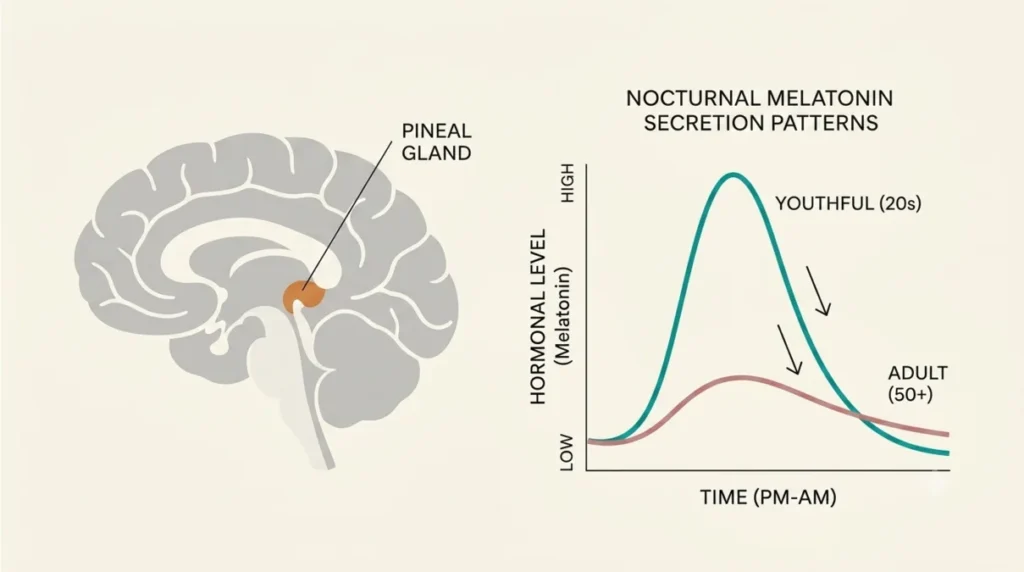
Older adults taking supplemental melatonin show higher blood level rises than younger adults on the same dose.² Their bodies are more sensitive to the supplement, not less.
Earlier clock, earlier signal. Your circadian clock also shifts with age. A study of middle-aged adults found a measurable advance in both sleep timing and temperature circadian rhythms, with habitual bedtime and wake time shifting earlier.³
This matters for when you take the pill, not just how much.
By the time you take your melatonin at 10 pm, your body may have already been sending its own sleep signal since 8 pm. You may be adding to something already underway, not filling a gap.
The Dose on Your Pill Is Not Designed for You
You probably picked up the smallest bottle the pharmacy had and assumed that was a reasonable starting point. It wasn’t. The smallest dose most stores sell is already too high.
What MIT found. MIT researcher Richard Wurtman and his team studied adults over 50 specifically. They found that a dose of 0.3 milligrams restores sleep in adults over 50.⁴ Not three milligrams. Not 10.
At that dose, blood melatonin levels rise to what the body produced naturally when younger.
At five or 10 milligrams, they rise far beyond what the pineal gland ever made.
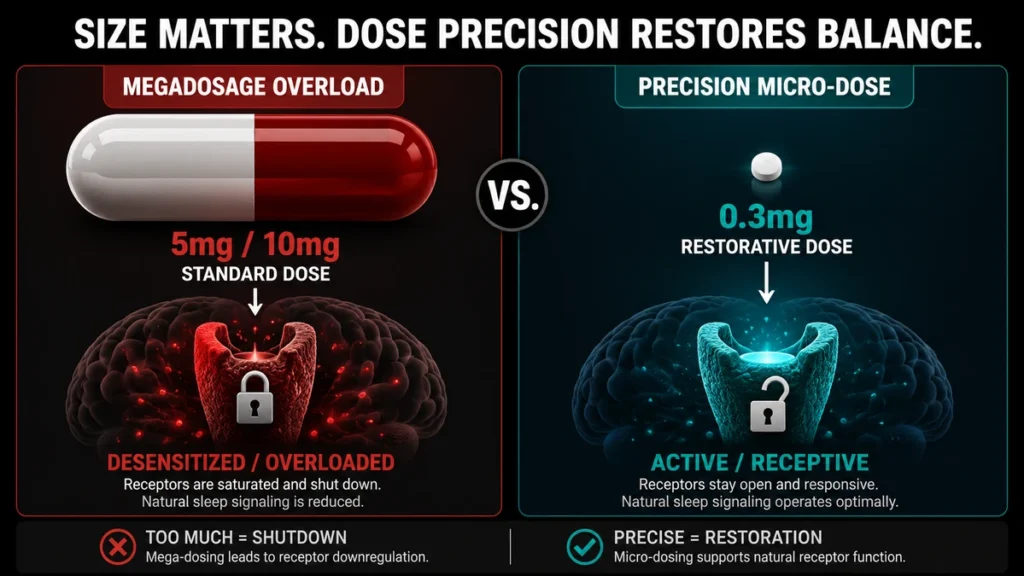
After 50, the standard 5 mg pill puts 10 times more melatonin in your bloodstream than your body used to make on its own, and your receptors respond by going quiet.⁴
Receptor desensitization [the process by which receptors in the brain stop responding when flooded with too much of a signal] is the mechanism behind this. When melatonin receptors are exposed to supra-physiological concentrations repeatedly, they become less responsive.⁵
A clinical review in the American Journal of Managed Care notes that desensitization is the likely explanation for why higher doses, taken nightly, stop working over time.⁵
A clinical update in touchNEUROLOGY states that too-high doses will desensitize both MT1 and MT2 melatonin receptors [cell surface proteins in the brain that receive the sleep signal] and may paralyze the melatonin system’s contribution to sleep entirely.⁶ Timing is the other half of the problem.
Timing Is Where Melatonin Either Works or Backfires
Melatonin is not a sedative. It tells the brain that darkness has arrived and the sleep cycle should begin.
Direction matters. A review on melatonin and circadian rhythms states that melatonin given in the evening can advance the phase of the circadian clock, while melatonin given in the morning can delay it.⁷ Taking it at the wrong time doesn’t just fail to help. It can push your sleep window in the wrong direction.
The aging clock shifts earlier. Many adults over 50 feel genuinely tired by 8:30 or 9 pm, push through it, and then take melatonin at 10:30 pm. The phase-advance study referenced in the previous section found this shift begins in the forties and fifties.³ By 10:30 pm, the body’s own melatonin peak may have already passed.
No single study has tested all of this together: declining production, dose overshoot, receptor desensitization, and timing mismatch. What exists are the separate research pieces. Together they point the same direction.
One detail a generalist would miss. The MT2 receptor [one of two main melatonin receptors in the brain, involved in the timing of the sleep signal] transiently desensitizes even at normal nighttime melatonin concentrations.⁶
This is a built-in feedback mechanism limiting how long the sleep signal stays active. In older adults, that feedback may already be altered by age, independent of any supplement.
High-dose supplementation adds stress to a system already managing a weaker signal with a less reliable feedback loop.
Knowing when the pill was taken isn’t enough. You also need to know what’s actually in it.
What the Label on Your Melatonin Bottle Is Not Telling You
Here’s the direct challenge: when you assume your five milligram melatonin pill contains five milligrams, you’re trusting a label the FDA has no obligation to verify.
Melatonin is a dietary supplement. It is not subject to the pre-market testing required of prescription medications. Manufacturers are not required to prove dose accuracy before a product reaches the shelf. ⁹
A 2017 study in the Journal of Clinical Sleep Medicine tested 31 supplements from 16 brands. Researchers found that actual melatonin content ranged from 83% below to 478% above the labeled amount.⁸
Lot-to-lot variation within the same brand reached as high as 465%. A bottle that says five milligrams might contain one milligram or nearly 24 milligrams.
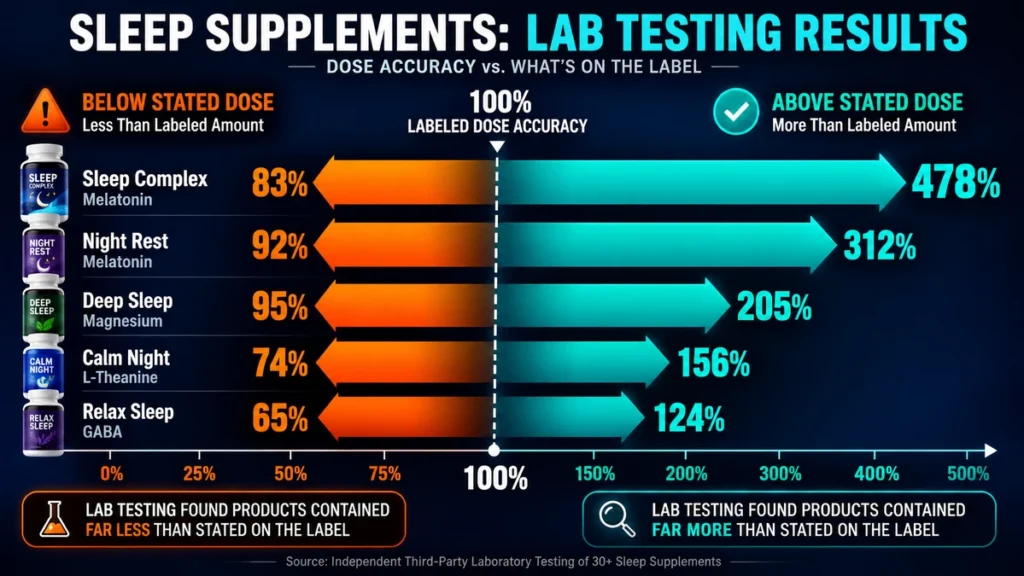
The same study found serotonin in 26% of the supplements tested, unlabeled, unregulated and introduced as a completely hidden contaminant.⁸
A 2023 review by the National Center for Complementary and Integrative Health found that 22 out of 25 OTC melatonin gummy products were inaccurately labeled, with most containing more melatonin than stated.⁹
“Natural” does not mean accurately dosed. That’s not a scare tactic. It means that when the pill stops working, you cannot tell from the label whether you were taking three milligrams or 12.
Whether any dose of melatonin addresses your specific sleep problem is a separate question entirely.
When Melatonin Genuinely Helps After 50 and When It Does Not
The research on melatonin in older adults is not all negative. But it is specific about what melatonin does well.
Where the evidence is strongest. Melatonin has demonstrated consistent effectiveness for circadian rhythm disruptions: jet lag, shift work, and delayed sleep phase disorders.
A review published in Experimental Gerontology found that exogenous melatonin was more effective at promoting sleep when the person had genuinely diminished endogenous melatonin production.¹⁰
If your body is making very little on its own, a small dose can make a measurable difference.

Where the evidence is thinner. When it comes to general chronic insomnia in otherwise healthy older adults; here, the massive scale of public use significantly outpaces the science. Most clinical studies on melatonin after 50 are strictly short-term. As a result, the long-term impact of nightly, high-dose use over several years is a complete medical unknown.¹¹
Melatonin primarily affects sleep timing, not total sleep duration, in most older adult populations studied. Chronic pain, sleep apnea, anxiety, and certain medications all drive sleep disruption in adults over 50. Melatonin does not address any of them.
If the problem is genuine circadian disruption, the research supports melatonin. If the problem is something else, the pill may be doing very little while you keep raising the dose.
The Dose and Timing Fix for Melatonin After 50
The melatonin system in your body after 50 is not broken. It’s just different. The research consistently points in the same direction: lowest possible dose, immediate release, taken at the right time.
Safety note: Talk to your doctor before changing your supplement routine if you’re on blood thinners, blood pressure medications, antidepressants, or managing diabetes or a chronic condition. Melatonin can interact with several common medications.
Your corrected melatonin protocol:
- Dose: 0.3 mg to 1 mg. Not three milligrams. Not five. A systematic review in adults aged 55 to 77 advises the lowest possible dose of immediate-release melatonin to best mimic the normal physiological circadian rhythm.² The European Food Safety Authority’s recommended maximum is 0.3 mg to 1 mg.⁵
- Formulation: Immediate-release only. Extended-release keeps melatonin elevated into morning hours and can cause grogginess and circadian confusion.⁵
- Timing: 30 to 60 minutes before your body’s natural sleepiness signal, not before your desired bedtime. For most adults over 50, that may be 8:30 pm to 9:30 pm. Pay attention to when you first feel tired in the evening. That’s the window.
- Frequency: Nightly use at high doses is where receptor desensitization builds fastest. If you’re using melatonin for situational disruption rather than chronic insomnia, intermittent use is preferable.
- Sourcing: Look for third-party tested products. A product with USP, NSF, or Informed Sport certification has been independently verified for dose accuracy.

Start Here Tonight
The pill on your nightstand is probably configured for someone else. The dose is too high. The timing may be off. The label may not reflect what you’re taking. None of that means melatonin can’t help you.
Check the dose on your melatonin bottle tonight. If it says five milligrams or 10 milligrams, consider switching to low dose melatonin of 0.3 mg to 1 mg and taking it 30 to 60 minutes before bed. The research on melatonin after 50 says less, earlier, and consistent. That’s where better sleep starts.
⚠️DISCLAIMER:
This article is for informational purposes only and does not constitute medical advice or a recommendation to use any supplement. The content addresses melatonin dosage and timing for adults over 50 and is intended for general educational purposes only. Supplements can interact with medications and may not be appropriate for everyone, always consult a licensed healthcare provider before starting, changing, or stopping any supplement regimen.
References
- Blume C, et al. Physiological melatonin levels in healthy older people: a systematic review. Sleep Medicine. 2016. https://www.sciencedirect.com/science/article/abs/pii/S0022399916302100
- Riemersma-van der Lek RF, et al. Optimal dosages for melatonin supplementation therapy in older adults: a systematic review of current literature. PubMed/MEDLINE. 2014. https://pubmed.ncbi.nlm.nih.gov/24802882/
- Carrier J, et al. Phase advance of sleep and temperature circadian rhythms in the middle years of life in humans. PubMed. 2002. https://pubmed.ncbi.nlm.nih.gov/11849749/
- Zhdanova IV, Wurtman RJ, Regan MM, Taylor JA, Shi JP, Leclair OU. Melatonin Treatment for Age-Related Insomnia. Journal of Clinical Endocrinology and Metabolism. 2001;86(10):4727–4730. https://academic.oup.com/jcem/article/86/10/4727/2849013
- Furman A. Should lower doses of melatonin be used for older adults? American Journal of Managed Care. 2020. https://www.ajmc.com/view/should-lower-doses-of-melatonin-be-used-for-older-adults
- Zisapel N. Low doses of melatonin promote sleep onset and maintenance in older people: an update. touchNEUROLOGY. 2020. https://touchneurology.com/alzheimers-disease-dementia/journal-articles/low-doses-of-melatonin-promote-sleep-onset-and-maintenance-in-older-people-an-update/
- Arendt J, Skene DJ. Melatonin, circadian rhythms, and sleep. PubMed. 2003. https://pubmed.ncbi.nlm.nih.gov/12670411/
- Erland LA, Saxena PK. Melatonin natural health products and supplements: presence of serotonin and significant variability of melatonin content. Journal of Clinical Sleep Medicine. 2017. https://pubmed.ncbi.nlm.nih.gov/27855744/
- National Center for Complementary and Integrative Health. Melatonin: what you need to know. NIH/NCCIH. 2023. https://www.nccih.nih.gov/health/melatonin-what-you-need-to-know
- Brzezinski A, et al. Melatonin and sleep in aging population. Experimental Gerontology / PubMed. 2005. https://pubmed.ncbi.nlm.nih.gov/16183237/
- Foley HM, Steel AE. Adverse events associated with oral administration of melatonin: a critical systematic review. Clinical Interventions in Aging / Dove Medical Press. 2023. https://www.dovepress.com/current-insights-into-the-risks-of-using-melatonin-as-a-treatment-for–peer-reviewed-fulltext-article-CIA