

You stepped outside this morning and felt the sun on your face. That small act is doing more for your heart than you probably realize.
For adults over 60, disrupted body clocks are now recognized as a significant cardiovascular risk factor.¹ The fix costs nothing and takes five minutes.
Your body runs on a 24-hour rhythm that governs blood pressure, heart rate, and dozens of other cardiac processes. When that rhythm falls out of sync, your heart pays the price.
Heart health after 60 depends on more than diet and exercise. The body’s internal clock is part of the equation now.
This article explains what morning light does inside your body and how to make the habit stick.
| # | What’s Coming | Open Question |
|---|---|---|
| 1 | The clock your heart obeys | Why does the time of day affect your heart at all? |
| 2 | What changes after 60 | Why does this habit become more important with age? |
| 3 | The five-minute protocol | What exactly should you do, and when? |
| 4 | The quiet habit that stacks | Which one add-on multiplies the benefit most? |
| 5 | What you can expect | How long before you notice a difference? |
How Light Controls Your Heart’s Daily Rhythm
You probably know light affects sleep. What most people miss is that it also controls blood pressure, heart rate, and inflammation every hour of the day.
The American Heart Association’s 2025 scientific statement confirms that the body’s internal clock regulates 24-hour cardiovascular cycles, and disruptions are linked to heart disease, diabetes, and high blood pressure.¹
At the center of this system is the suprachiasmatic nucleus [the master clock in the brain that sets your body’s daily schedule using light signals from your eyes]. When morning light reaches your eyes, this clock signals a cascade: melatonin drops, cortisol rises, and your cardiovascular system shifts from nighttime recovery into daytime readiness.
A study in the Journal of Clinical Endocrinology and Metabolism found that the transition from dim to bright morning light produced an immediate cortisol rise of more than 50%.²
Blood pressure dipping [the natural 10-20% drop in blood pressure that a healthy body produces during sleep] is one of the most important things this rhythm protects. Researchers have documented that people without this nocturnal dip face elevated risk of stroke, coronary events, and heart failure.³
Morning light keeps this dip intact by properly timing melatonin production the following night.⁷
A 2025 study of nearly 89,000 adults over 40 found the highest nighttime light exposure was linked to significantly higher rates of coronary artery disease, heart failure, atrial fibrillation, and stroke.⁴
The morning light habit works in two directions: right light in the morning, and protected dark hours at night. For anyone focused on heart health after 60, that gap is where the problem starts.

Why the Stakes Go Up After 60
Your heart at 60 is not the same organ it was at 40.
Arterial stiffening [the gradual thickening and hardening of blood vessel walls that reduces their ability to expand and contract with each heartbeat] is one of the most consistent findings in cardiovascular aging research.
A National Heart, Lung, and Blood Institute study found that large arteries thicken due to collagen and calcium deposition and loss of elastic fibers. This causes systolic blood pressure to rise even in otherwise healthy older adults.⁵
Your heart muscle also remodels. The left ventricle thickens and relaxes more slowly, which affects how well it fills between beats.⁵ Your cardiovascular system carries less reserve when things go wrong.
Here is what almost no other article says plainly: your circadian rhythms begin to weaken precisely when your heart becomes most dependent on them.
Without consistent environmental cues, blood pressure regulation becomes less efficient and inflammatory processes quietly increase throughout the cardiovascular system.¹
Heart rate variability [the natural variation in time between heartbeats that reflects how well your nervous system is regulating cardiac function] is one measurable sign of this. It tends to decline with age and with circadian disruption. Lower variability is associated with higher cardiovascular risk.⁶
The AHA statement notes that circadian disruption is particularly relevant for people managing multiple conditions, since the same rhythm misalignment affects sleep, blood pressure, and blood glucose at once.¹
Consistent light-dark cycles are the behavioral trait that holds this together. Morning light is how you create them.
The Five-Minute Morning Light Protocol
Talk to your doctor before making significant changes to your routine if you are taking prescription medications, managing a chronic eye condition such as macular degeneration, cataracts, or retinal damage, or have been told to limit light exposure for any reason.
Doing this right takes less effort than making coffee. For adults working to maintain heart health after 60, getting the timing wrong removes most of the benefit.
When to go outside
The first 30 minutes after waking is the critical window. Your suprachiasmatic nucleus is most responsive to light signals at this time. Research on morning light confirms it stabilizes circadian phase and alters metabolic functions closely related to cardiovascular health, including the nocturnal blood pressure dip.⁷
Set your alarm five minutes earlier if needed. Do not check your phone first.
How long to stay out
Duration depends on conditions:
- Sunny day: five to ten minutes
- Overcast: 15-20 minutes
- Heavy cloud or winter: up to 30 minutes
What to do while outside
Face the general direction of the sun. Do not look directly at it. Remove sunglasses.
Regular glasses and contact lenses are fine. Use the time for gentle stretching, slow breathing, or standing still. The light is working regardless of what else you do.

If you cannot go outside
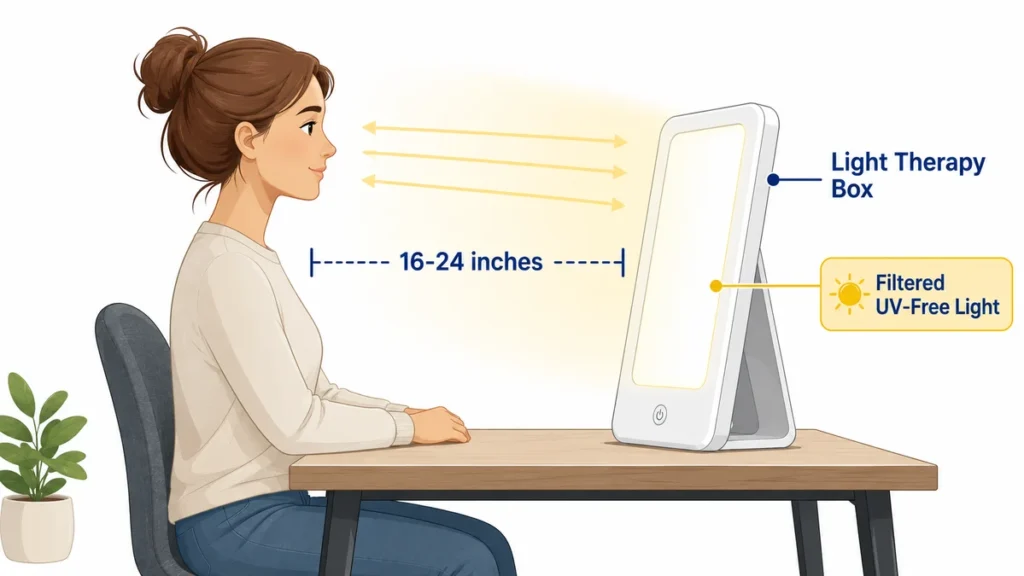
A light therapy box rated at 10,000 lux, positioned 16-24 inches from your face for 20-30 minutes, is a clinically accepted alternative. Harvard Health documents this as an effective substitute when natural light is unavailable.⁸ Choose a unit that filters UV radiation while delivering appropriate visible light.
Making it automatic
Attach this habit to something you already do every morning without thinking.
If you always make coffee first, take it outside. If you let a pet out, go with them. The trigger you never skip is the one that works.
One Habit Worth Stacking
The most useful addition to morning light is also the simplest. It requires no equipment and no extra time outside. For adults managing heart health after 60, sustainable habits are the ones that compound.
Meditation practiced for five minutes immediately after light exposure is associated with improved heart rate variability [the variation between heartbeats that signals healthy nervous system regulation of the heart].
A controlled study found that nondirective meditation increased HRV significantly in both low-frequency and high-frequency bands compared to rest.⁶
A 2025 systematic review concluded that slow-paced breathing and mindfulness practices are associated with significant reductions in heart rate, blood pressure, and perceived stress levels.⁹ These compound over months in the same direction as morning light.
The practical version
After your light exposure, remain where you are. Sit or stand comfortably. Count breaths from one to ten and repeat. Five minutes. No app required.

Consistent sleep timing
The second addition is not a morning habit at all.
Going to bed and waking at the same time every day, including weekends, is the structural support that morning light builds on.
A CDC analysis of nationally representative US adults found that very short sleep and very long sleep were both associated with decreased odds of ideal cardiovascular health.¹⁰ The AHA recommends seven to nine hours nightly for adults.¹¹
Your morning light exposure trains your circadian clock. Consistent sleep timing keeps it on schedule.
One addition at a time
Start with light. After two weeks, add five minutes of breathing. After two more weeks, evaluate your sleep timing. Small changes built in sequence hold better than several made together.
What to Expect and When
Most people want to know how long before morning light makes a difference for heart health after 60. The honest answer depends on how disrupted your current rhythm already is.
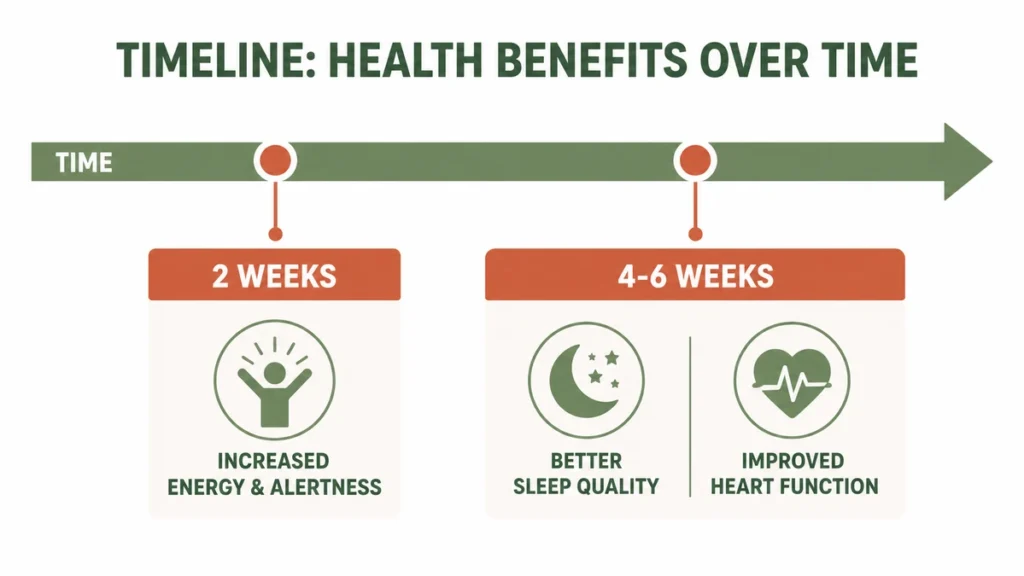
In the first two weeks, you will likely notice earlier morning alertness and more settled evenings. These are signs your circadian clock is responding. Consistent morning light is one of the most direct inputs for heart health after 60.
By four to six weeks of consistent practice, sleep quality tends to stabilize. This is when the cardiovascular benefits of improved nocturnal dipping and more consistent blood pressure patterns begin to accumulate.
The ScienceDirect review on morning light as a cardiovascular modifier suggests that morning light may affect blood pressure through pathways independent of vitamin D production.⁷
What the evidence does not yet confirm
The research linking morning light to cardiovascular outcomes in adults over 60 is built largely from observational studies and mechanistic research. No long-term randomized trials have tested morning light as a standalone intervention in this specific population.
The biological pathways are well documented. The precise clinical benefit for any individual has not been measured. The AHA statement calls for more research to establish causality.¹
That is not a reason to avoid the habit. It is a reason to hold reasonable expectations about what a single behavior can do for heart health after 60.
Morning light is one tool among several. It does not replace medication, exercise, or dietary care. It works alongside them to support heart health after 60.
Start Here
The AHA 2025 scientific statement is direct: light exposure timing is a meaningful behavioral tool for reducing cardiometabolic risk.¹
Supporting heart health after 60 does not require expensive equipment or a complicated protocol. It requires five minutes, an open door, and consistency. The circadian system responds to habit, not intensity.
Step outside within 30 minutes of waking tomorrow morning. Stay for five minutes. No sunglasses. Face the light. That is where it starts.
⚠️DISCLAIMER:
This article is for informational purposes only and does not constitute medical advice, diagnosis, or treatment. The content addresses morning light exposure and cardiovascular health after 60 and is intended for general educational purposes only. Health conditions vary significantly between individuals, always consult a licensed physician or qualified healthcare provider before making any decisions about your health or medical care.
References
- Knutson KL, et al. Role of Circadian Health in Cardiometabolic Health and Disease Risk: A Scientific Statement From the American Heart Association. Circulation. 2025. https://www.ahajournals.org/doi/10.1161/CIR.0000000000001388
- Leproult R, et al. Transition from Dim to Bright Light in the Morning Induces an Immediate Elevation of Cortisol Levels. Journal of Clinical Endocrinology and Metabolism. 2001. https://academic.oup.com/jcem/article/86/1/151/2841140
- Fagard RH, et al. Nocturnal Blood Pressure Dipping and Cardiovascular Risk. PMC / PubMed. 2003. https://pmc.ncbi.nlm.nih.gov/articles/PMC10001803/
- Heng LI, et al. Light Exposure at Night and Cardiovascular Disease Incidence. JAMA Network Open. 2025. https://pubmed.ncbi.nlm.nih.gov/41129148/
- Strait JB, Lakatta EG. Age-Associated Changes in Cardiovascular Structure and Function. National Heart, Lung, and Blood Institute / National Institute on Aging. PMC. 2012. https://pmc.ncbi.nlm.nih.gov/articles/PMC4677819/
- Nesvold A, et al. Increased Heart Rate Variability During Nondirective Meditation. European Journal of Cardiovascular Prevention and Rehabilitation. PubMed. 2012. https://pubmed.ncbi.nlm.nih.gov/21693507/
- Cardoso VM, et al. Morning Light Exposure: A Potential Modifier of Cardiovascular Risk Factor. ScienceDirect. 2025. https://www.sciencedirect.com/science/article/abs/pii/S0306987725000933
- Harvard Health Publishing. Try This: Light Therapy. Harvard Medical School. 2025. https://www.health.harvard.edu/mind-and-mood/try-this-light-therapy
- Effects of Meditation on Cardiovascular Parameters: Systematic Review. European Journal of Cardiovascular Medicine. 2025. https://healthcare-bulletin.co.uk/article/effects-of-meditation-on-cardiovascular-parameters-systematic-review-4282/
- Arem H, et al. Association Between Sleep Duration and Ideal Cardiovascular Health Among US Adults. CDC / Preventing Chronic Disease. 2020. https://www.cdc.gov/pcd/issues/2020/19_0424.htm
- Cappuccio FP, et al. Self-Reported Sleep Duration and Quality and Cardiovascular Disease and Mortality: A Dose-Response Meta-Analysis. Journal of the American Heart Association. 2019. https://www.ahajournals.org/doi/10.1161/JAHA.118.008552