
You finish a workout and expect to feel better. Instead you feel strung out, heart still racing, thoughts scattered, the familiar restlessness that makes it impossible to sit still. You did everything right. You moved your body. Yet something went wrong.
The problem is almost never the exercise itself. Exercise raises cortisol by design.
But whether that cortisol rise tips into a problem depends on a threshold most fitness advice never mentions: how you were breathing when you crossed it.
For adults who exercise regularly but still feel wired, anxious, or exhausted afterward, the answer often lives not in the workout plan but in the breath driving it.
Why exercise sometimes feels like stress: the cortisol connection
When a hard workout leaves you tense and wired instead of calm, that is not a coincidence, and it is not a sign that exercise is bad for you. It is cortisol doing its job.
Cortisol [a hormone released by the adrenal glands that helps the body manage energy, inflammation and the stress response] rises during exercise to mobilize fuel, sharpen focus and keep blood pressure steady.
That rise is normal. The problem comes when the rise is larger than your body can recover from.
Intensity shapes the cortisol spike almost entirely.
At low intensity, around 40% of maximum effort, circulating cortisol levels actually fell slightly over a 30-minute session in a controlled trial measuring this directly.¹
At 60% of maximum effort, cortisol climbed by nearly 40%. At 80%, it rose by more than 83%.¹
The relationship is not gradual. It accelerates steeply once a threshold is crossed.
Most people believe that more exercise always means more stress. It does not.
Low-intensity movement may actively pull cortisol down, while higher-intensity effort pushes it sharply up.
No other article on exercise and stress makes this point clearly, because the finding contradicts the assumption that all exercise stress is the same stress.
A measurable gap in the cortisol response between low and high intensity exists. What controls which side of it you land on is where the conversation in most articles stops.
The breathing threshold your body already knows
Every exerciser has crossed it without knowing its name.
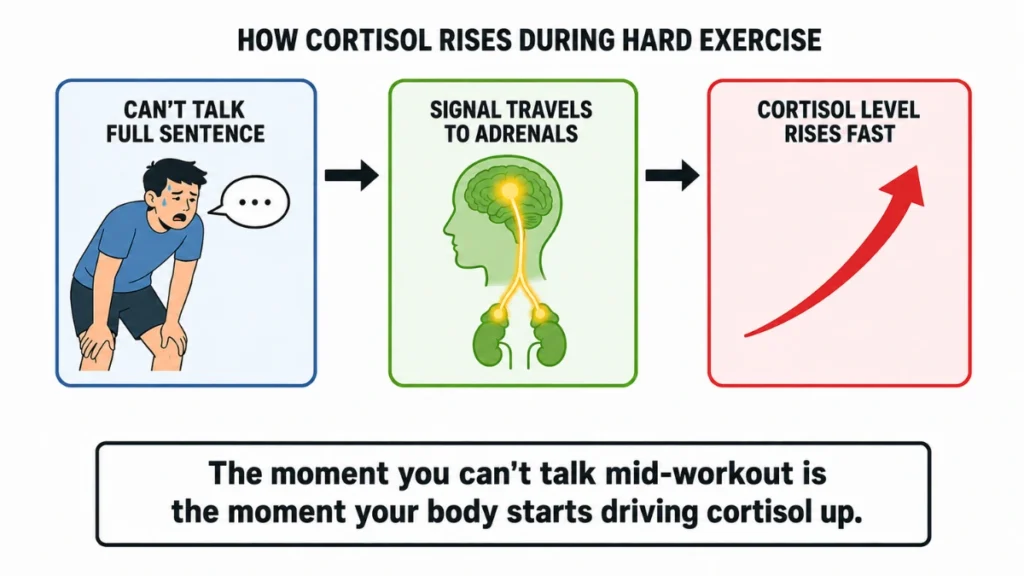
It is the moment in a workout when talking becomes work, when you stop mid-sentence to breathe, when conversation shifts from normal to effortful.
Physiologists call it the ventilatory threshold [the point at which your breathing rate rises steeply and your exhaled air shifts in composition, signaling that your body’s fuel and oxygen balance has changed].
Your breathing rate during exercise isn’t just background noise: it roughly tracks whether the workout raises or lowers your cortisol, since both climb together as intensity increases.
Pushing through breathlessness is commonly treated as a mark of fitness. That assumption gets the signal backwards. The breathlessness is not your body adapting.
It is your body crossing into a zone where cortisol is rising steeply, where the sympathetic nervous system [the network of nerves that coordinates the “fight or flight” response] appears to take a larger role in driving the session, and where the stress benefit of exercise may begin to reverse.
Exercise intensity itself changes the sympathetic and hormonal response you get.
In a controlled trial, men who exercised at vigorous intensity (60–84% of heart-rate reserve) showed a distinctly different, more stress-dampening cortisol pattern to a stressor 45 minutes later than those who exercised lightly or moderately.²
Whether the ventilatory threshold specifically is the dividing line is still an open question. The researchers behind this intensity-cortisol work note that connecting their intensity measure to the ventilatory threshold is something future research still needs to confirm.
One honest note belongs here. No single controlled trial has tested the full chain from breath pattern during exercise through to cortisol outcome in one session. The evidence is assembled from separate studies, each measuring a different piece.
The intensity-cortisol relationship is directly measured in human trials.¹
These findings fit together logically, but the assembled picture is not the same as a single study proving the whole claim.
The ventilatory threshold itself, as a breathing-rate marker, is not in dispute. What’s still being worked out is exactly how tightly it tracks the cortisol response. Almost no exercise plan tells you how to stay below it.
What your nose does that your mouth cannot
Switch to mouth breathing during a workout and you lose something your body cannot replace by going faster. Your nasal passages produce nitric oxide [a gas released by cells lining the nasal airway that dilates blood vessels and helps regulate oxygen uptake]. Your mouth does not.
Your body works just as hard through your nose, while producing far more of a gas your nasal passages generate right there in the sinuses.
Measured directly in healthy adults at two different exercise intensities, the nasal airway contributed at least 50% of the total nitric oxide output detected in exhaled air, a difference that held at both intensities and fell significantly once breathing shifted to the mouth.³
Heart rate and oxygen consumption did not differ significantly between nasal and oral breathing in that same trial.³
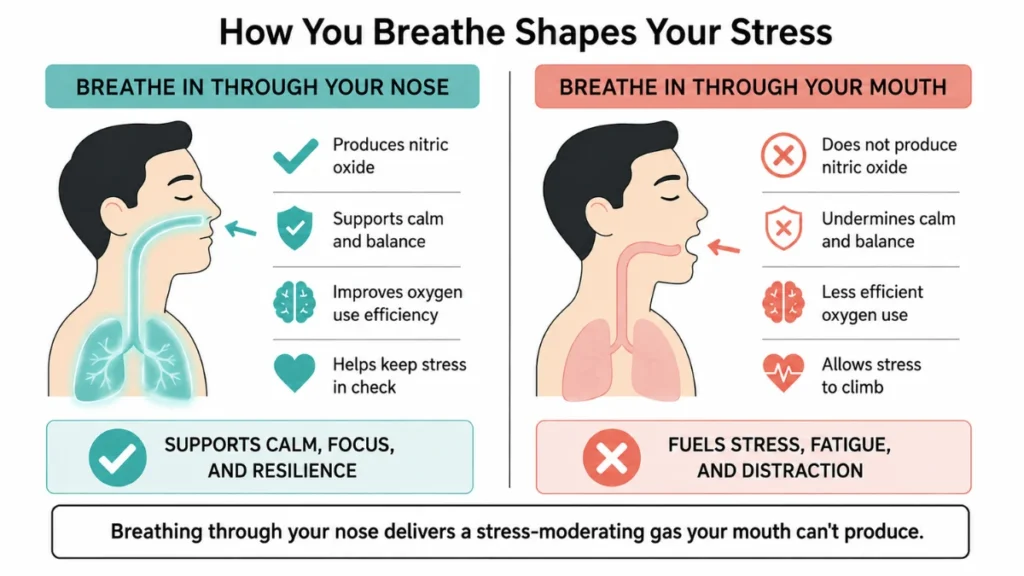
Nitric oxide is not a performance supplement. It is built into the architecture of nasal breathing, produced in the sinuses and released with every inhale. What this nitric oxide does once produced is still being worked out.
The same study that measured it found no clear effect on respiratory function during the exercise bout itself, so don’t expect it to change how hard the workout feels.
Switching to oral breathing removes that pathway from the equation, even though your pace and effort don’t measurably change.
Oral breathing does not just change the route of air into the lungs. It cuts off a source of nitric oxide your nasal passages were generating with every inhale, even if the evidence doesn’t yet show what that costs you during the workout itself.
Most exercise advice focuses on breathing rate and depth. Whether the breath enters through the nose or mouth rarely comes up. Yet the route changes what the breath delivers, even if the exact downstream effect on the workout itself is still an open question.
Workouts that regularly tip into a cortisol-raising zone often share one tell: check the mouth first. Mouth breathing during moderate exercise may be both a sign that intensity has crossed the ventilatory threshold and a factor that worsens the stress response once it has.
The five minutes after your workout that most people waste
A typical workout ends with a quick gear-shift: check the phone, grab water, move on.
The recovery window, roughly the five to ten minutes right after exercise, is when your body decides how quickly the sympathetic state of the workout gives way to rest. What you do with your breath during that window shapes the answer.

How you breathe during recovery isn’t neutral.
A randomized trial comparing three post-HIIT breathing protocols found that box breathing, with its four built-in breath-holds, pushed heart rate and perceived exertion significantly higher than slower, uninterrupted breathing.⁴
Six breaths per minute didn’t outperform simply breathing naturally, but it avoided the stress spike that box breathing caused.
In a randomized controlled trial comparing recovery breathing protocols after high-intensity interval sessions, participants using 6 bpm showed significantly lower heart rates (154.77 bpm) than those using box breathing (164.65 bpm), a large effect size between the two groups.⁴
The 6-bpm group also reported lower perceived exertion than those in the box-breathing condition.⁴
Conducted in physically active young adults, this trial means the exact response may differ for older adults or those new to structured breathing.
The direction of the finding, that slower deliberate breathing after exercise supports faster cardiovascular recovery, holds across the broader breathing and autonomic recovery literature.
If you have never tried a structured breathing cool-down, check with your doctor before starting if you have a heart condition, take medication that affects heart rate, or are managing a respiratory condition.
A 6-breath cool-down you can do anywhere
After your workout, sit or lie down comfortably. Breathe in through the nose for a count of five. Breathe out through the nose or mouth for a count of five.
Repeat for five full minutes without pausing between breaths. Six complete breaths per minute is the target. No app required. No equipment needed. The count itself is the anchor.
Starting with two minutes and building up works just as well.
Breathing this way is simple. Doing it consistently is the part most people skip.
The conversation test: a breathing anchor you already own
You have already used this method without knowing it had a name. Every time you slowed down because you could not catch enough breath to answer someone, you were applying it instinctively.
If you can hold a normal conversation during your workout, you are in a moderate-intensity zone. If speech becomes difficult or impossible, you have moved above it.
This approach to monitoring intensity using speech as the measure is described in clinical exercise guidance as a practical tool for everyday use.⁵ No device required. No formula.⁵

The breathing threshold connection is straightforward. The moment speech becomes effortful is roughly the moment the ventilatory threshold has been crossed.
Breathing has shifted from a rhythmic background process to something your body is actively managing. That is the same line that separates a cortisol-friendly intensity from one where cortisol rises steeply.
This tool applies differently depending on how fit you are and what medications you take. Beta-blockers and other heart-rate-modifying drugs can make standard intensity cues unreliable, so a doctor’s guidance is worth having if your medications affect heart rate or breathing.
The Talk Test is not a ceiling. It is a reference point. Some workouts belong above it. The point is to know where you are, so you can choose deliberately rather than drift past the threshold without noticing.
How to put breathing first and make every session count
Three points of control sit inside every workout: the intensity you choose, the route your breath takes, and what you do in the minutes after you finish.

Deliberately slowing your breathing between and after exercise is linked to a calmer physiological state.
A systematic review of 15 studies found that slow breathing techniques are associated with increased parasympathetic activity and reduced psychological stress markers in healthy adults.⁶
The review was conducted outside the exercise context, and the techniques varied across studies, so the finding does not apply to post-workout recovery directly. The direction it points is consistent with what the rest of the evidence here shows.
For most people, the practical application looks like this. Keep the majority of your weekly sessions at an intensity where conversation is still possible. Use nasal breathing where you can sustain it.
The evidence on its downstream benefit during exercise itself is still thin, but there’s no downside to breathing this way when you’re not gasping for air.
When a session pushes above the ventilatory threshold, treat the recovery window as part of the workout: five minutes of deliberate slow breathing before you move on.
These adjustments do not require a new exercise program. They fit around whatever you already do. A 45-minute run stays a 45-minute run. A gym session stays a gym session. The change is in how you enter the effort and how you leave it.
Cortisol responds to signals, and breathing is one of the clearest signals your body sends itself during and after exercise. That signal is available in every session. Most people just never use it deliberately.
The breath is the lever
Whether exercise reduces your stress or adds to it depends more on how you do it than how much. Intensity and what you do in the five minutes after you finish are the two levers most directly tied to your cortisol response.
Breathing route plays a role too, even though its direct link to cortisol hasn’t actually been tested.
Before your next workout, pick an effort level where you can still speak in full sentences. If you cannot, slow down until you can.
How much of your exercise-related stress comes from the workout is worth sitting with. The answer might change what you do next.
References
- Hill EE, Zack E, Battaglini C, Viru M, Viru A, Hackney AC. Exercise and circulating cortisol levels: the intensity threshold effect. J Endocrinol Invest. 2008. https://pubmed.ncbi.nlm.nih.gov/18787373/
- Caplin A, Chen FS, Beauchamp MR, Puterman E. The effects of exercise intensity on the cortisol response to a subsequent acute psychosocial stressor. Psychoneuroendocrinology. 2021. https://www.sciencedirect.com/science/article/pii/S0306453021002109
- Yasuda Y, Itoh T, Miyamura M, Nishino H. Comparison of exhaled nitric oxide and cardiorespiratory indices between nasal and oral breathing during submaximal exercise in humans. Jpn J Physiol. 1997. https://pubmed.ncbi.nlm.nih.gov/9504133/
- Kasap M, Aydin GR. Box breathing or six breaths per minute: Which strategy improves athletes post-HIIT cardiovascular recovery? PLoS One. 2025. https://pmc.ncbi.nlm.nih.gov/articles/PMC12622787
- Reed JL, Pipe AL. Practical Approaches to Prescribing Physical Activity and Monitoring Exercise Intensity. Can J Cardiol. 2016. https://pubmed.ncbi.nlm.nih.gov/26897182/
- Zaccaro A, Piarulli A, Laurino M, Garbella E, Menicucci D, Neri B, Gemignani A. How Breath-Control Can Change Your Life: A Systematic Review on Psycho-Physiological Correlates of Slow Breathing. Front. Hum. Neurosci. 2018. https://www.frontiersin.org/journals/human-neuroscience/articles/10.3389/fnhum.2018.00353/full