
That slow, heavy pull at your eyes by nine in the morning, even after a full night in bed, is not your imagination and it is not your mattress.
If you are one of the many adults over 50 who feel exhausted despite sleeping a full seven or eight hours, the problem is probably not how long you slept.
It is how many times your brain quietly woke up without you ever knowing it happened. Understanding why you wake up tired after 50 starts with letting go of the idea that hours are the whole story.
Most people over 50 spend years chasing longer sleep when the real issue is shorter, invisible breaks inside the sleep they already get.¹
Why Read This
- Discover why “I got eight hours” can still mean a night full of hidden wake-ups.
- Find out why the number of interruptions matters more than the number of hours.
- Learn the one habit backed by the strongest evidence for fixing this, and it has nothing to do with buying anything new.
Why “I Slept 8 Hours” Doesn’t Mean What You Think It Does
You wake up, check the clock, do the math, and it adds up. Eight hours, sometimes more.
So why do you still wake up tired anyway? The number on the clock only tells you how long you were in bed with your eyes closed.
It says nothing about how many times your brain surfaced toward wakefulness during that stretch, even for a few seconds too brief to remember by morning.¹ Sleep quality after 50 depends less on total hours and more on how unbroken those hours actually were.¹
Sleep researchers describe this as sleep continuity [how unbroken a stretch of sleep is, separate from its total length]. Two people can log the exact same eight hours and wake up in completely different shape, because one of them spent that time in long, connected stretches and the other spent it in fragments stitched together.
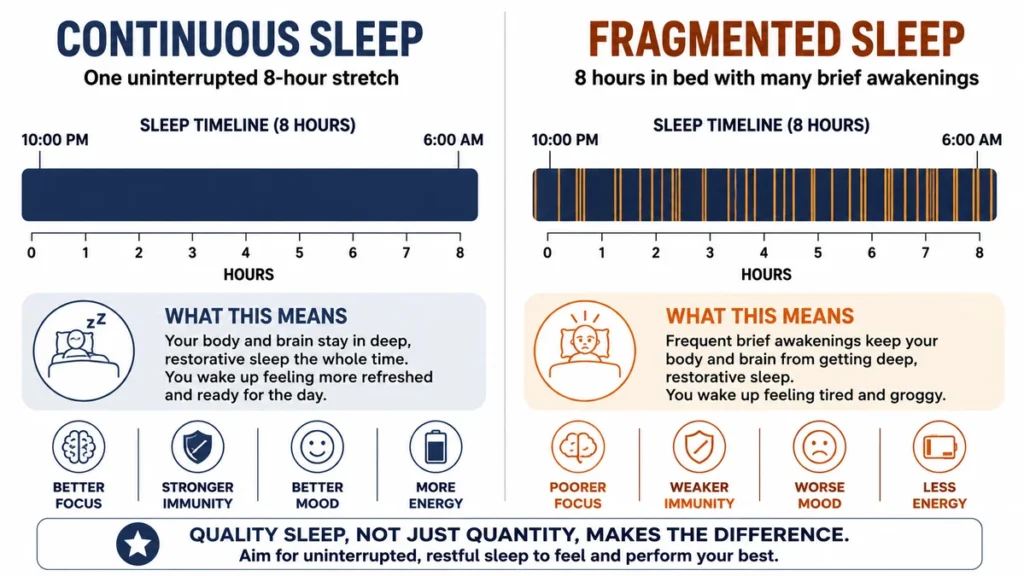
You have probably felt this without having a name for it. A night that felt off even though nothing obvious happened, no late night, no stress, no bad dinner. The clock said the same eight hours it always says.
That gap between the hours you log and how you actually feel the next day is the real starting point here, not your mattress, not your pillow, and not how many hours you managed to squeeze in.
The Interruptions You Never Remember Happening
You roll over at some point in the night, glance at the clock, and feel certain almost nothing woke you. In reality, your brain may have already surfaced and dropped back under several times before that glance, each one lasting less than fifteen seconds.
Your brain can wake you up more than a dozen times a night for less than fifteen seconds each time, and in the morning you will swear you slept straight through. ¹ Researchers call these transient arousals [brief moments of surfacing toward wakefulness, too short to remember], and they are short enough that most people never remember a single one.
A study of adults in their sixties to eighties measured sleep stages, breathing, and movement overnight, then tested how sleepy each person felt the next day.¹ The finding cuts against what most people assume: daytime sleepiness did not line up with total sleep time or with which sleep stage someone spent the night in.¹
It lined up with how many brief arousals interrupted the night, along with breathing disturbances during sleep.¹

Total hours slept is not what determines how tired you feel the next day. How many times your sleep breaks apart is.
The clock was never measuring the thing that was actually wearing you down.
No single study has followed this entire chain in adults over 50 from start to finish. This picture comes from several different pieces of research, each confirming one part of it.
This kind of fragmentation tends to increase with age, and healthy older adults typically maintain the ability to fall back asleep quickly after these brief awakenings, which is exactly why they go unnoticed.² You are not failing at sleep. Your brain is doing something normal for its age, just more often than it used to.
Fragmentation like this still needs a next question answered: if the hours were never the real problem, what has been the point of counting them at all.
Why Counting Hours Is Measuring the Wrong Thing
If you have spent years tracking hours slept as your main measure of a good night, that habit has been pointing you at the wrong number the whole time. Counting hours tells you how long you were in bed.
It does not tell you how many times your brain interrupted itself, which is the piece that actually predicts how you feel the next day.
This is not a small distinction. Two nights of identical length can produce two completely different mornings, and no amount of staring at your sleep tracker’s hour count will explain why. The count was never built to capture interruptions this brief.
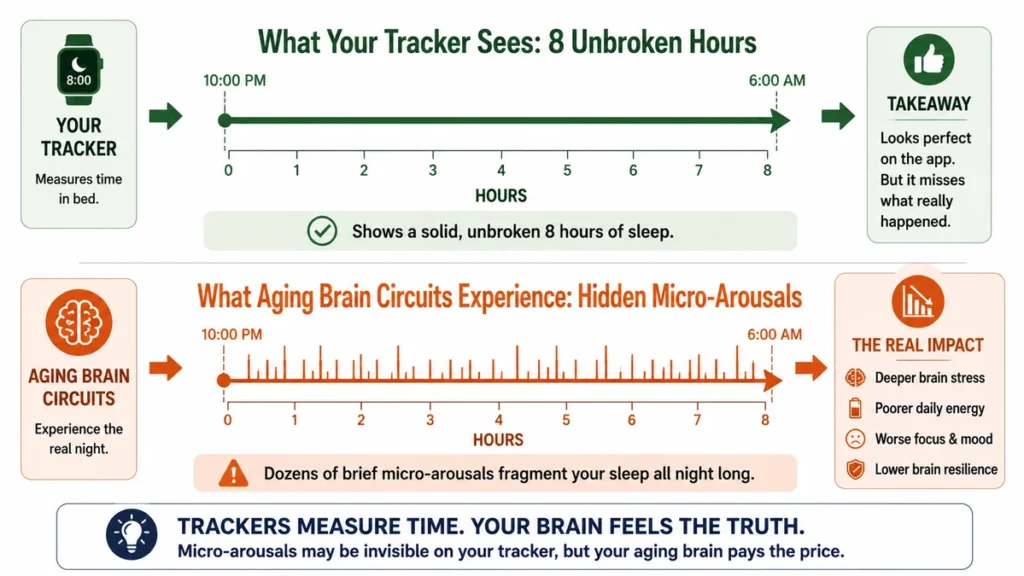
Scientists studying this in aging brains have found that the circuits controlling arousal become more excitable with age, making the brain more prone to these brief wake-ups in the first place.³
This research has so far been demonstrated in animal models, and whether the same circuit change applies the same way in humans has not been directly confirmed.³
Even without a full human confirmation of the exact mechanism, what shows up in people is consistent with more interruptions, not less total sleep, driving the exhaustion.
So the next time you wake up and do the math on your phone, remember what that number can and cannot tell you.
What’s Actually Driving Your Daytime Exhaustion
By afternoon, you are running on less than you think, even if the math on your nightstand says otherwise.
Sleep fragmentation after 50 is not one single cause with one single fix. It is usually several things happening together, including more nighttime awakenings, lighter overall sleep, and breathing changes that increase with age.⁴
Insomnia and obstructive sleep apnea [a condition where breathing repeatedly stops and starts during sleep] both become more common in adults 65 and older, affecting a substantial share of that age group, and both are linked to increased fragmentation on their own.⁴
Layered on top of normal age-related changes, these conditions can turn ordinary fragmentation into something heavier.

Fragmented sleep, not insufficient sleep, appears to be the more common driver of persistent daytime exhaustion in older adults who are otherwise healthy.⁴
The exact mix of what is fragmenting any one person’s sleep, normal aging, breathing changes, stress, or something else entirely, has not been fully mapped by a single study. Researchers are still working out how much each factor contributes on its own versus in combination with the others.⁴
That gap matters less than it sounds. You do not need a complete map of every contributing cause to start addressing the piece within your control.
The One Habit With the Strongest Evidence Behind It
You want something you can actually do tonight, not another study to read about. Out of everything researchers have tested for improving sleep quality after 50, exercise carries the most consistent evidence, and the amount required is smaller than most people assume.
A 2025 meta-analysis of randomized controlled trials in older adults found that even low frequency, short duration, low to moderate intensity exercise improved subjective sleep quality, with benefits leveling off around 527 MET-minutes per week(roughly 150 minutes of brisk walking, or 30 minutes of moderate activity, five days a week).⁵
That works out to roughly two hours of brisk walking spread across a week, not a daily workout.
Separately, a large study following adults over time found that people with the most consistent sleep and wake times had a 30 percent lower risk of dying from any cause compared to those with the least consistent patterns.⁶ This held even after accounting for how many hours they slept.
Sleep regularity, going to bed and waking at roughly the same time each day, was linked to long-term health outcomes independent of total sleep duration.⁶
Talk to your doctor before starting a new exercise routine if you have a heart condition, joint problems, or another chronic condition that affects how your body handles physical activity.
Two starting points, backed by the evidence above:
- Aim for roughly 30 minutes of brisk walking, five days a week, adjusting pace to what feels sustainable
- Pick a wake-up time you can hold seven days a week, weekends included, and protect it the same way you would a medical appointment
Neither of these requires new equipment or a new mattress, and both target the piece of the problem that total sleep time was never measuring in the first place.
When It’s More Than Normal Aging
You have just read that most of this is normal. It is, for most people, most of the time. But a few signs are worth a conversation with your doctor rather than something to manage on your own.
Loud snoring, gasping or choking sounds during sleep, or a bed partner who notices you stop breathing for a few seconds at a time are worth mentioning at your next appointment.⁴ These can point toward sleep apnea, which becomes more common with age and responds well to treatment once identified.

The same goes for exhaustion severe enough to interfere with driving, work, or basic daily tasks despite trying the habits above for several weeks.
Chronic sleep disturbances in older adults have been linked to higher risks of falls and cognitive decline over time, which is part of why they are worth addressing rather than accepting as unavoidable.⁴
You know your own baseline better than any article can. A pattern that feels genuinely different from your normal, not just an occasional rough night, is the signal worth acting on.
What Actually Counts on a Good Night
The number of hours on your clock was never the whole story. How unbroken those hours were is what actually decides how you feel by afternoon, and that piece has been invisible to you for years.
Track how many times you wake briefly during the night this week, even for a few seconds, instead of only tracking how many hours you slept. Feeling like you wake up tired after 50 is common, but it is not something you simply have to accept as the price of getting older.
⚠️DISCLAIMER:
This article is for informational purposes only and does not constitute medical advice, diagnosis, or treatment. The content addresses why adults over 50 wake up tired despite sleeping a full night, focusing on sleep fragmentation and continuity, and is intended for general educational purposes only. Health conditions vary significantly between individuals, always consult a licensed physician or qualified healthcare provider before making any decisions about your health or medical care.
References
- Carskadon M A, Brown E D, Dement W C. Sleep fragmentation in the elderly: relationship to daytime sleep tendency. Neurobiology of Aging. 1982. PubMed. https://pubmed.ncbi.nlm.nih.gov/7170049/
- Li J, Vitiello MV, Gooneratne N. Sleep in normal aging. Sleep Med Clin. 2018. PMCID: PMC5841578. https://pmc.ncbi.nlm.nih.gov/articles/PMC5841578/
- Li S-B, et al. Hyperexcitable arousal circuits drive sleep instability during aging. Science. 2022. PMCID: PMC10248856. https://pmc.ncbi.nlm.nih.gov/articles/PMC10248856/
- Alhajaji R, Jahrami H, Pandi-Perumal SR, BaHammam AS. Sleep health in the older adults: Architecture, circadian changes, and common sleep disorders. Ageing Res Rev. 2026. doi: 10.1016/j.arr.2026.103101. https://sciencedirect.com/science/article/abs/pii/S1568163726000930
- Li Y, Quan W, Gao Z, et al. Effects of exercise interventions on subjective sleep quality in older adults: a systematic review and meta-analysis of randomized controlled trials. Frontiers in Medicine. 2025. doi: 10.3389/fmed.2025.1664567. PMCID: PMC12528139. https://pmc.ncbi.nlm.nih.gov/articles/PMC12528139/
- Windred D, Burns A, Lane J, et al. Consistency is key: sleep regularity predicts all-cause mortality. Sleep. 2024. doi: 10.1093/sleep/zsad285. PMCID: PMC10782489. https://pmc.ncbi.nlm.nih.gov/articles/PMC10782489/