

You went to grab the glass before it tipped and your hand arrived just a little late. It was nothing. But you noticed it.
If you are an adult over 50 who wants to understand what your brain is actually doing right now, memory tests are the wrong place to look.
The speed at which your brain responds to the world around you is a more immediate and measurable signal of how well your brain is aging, and most of what shapes that speed has nothing to do with getting older.
Reaction time brain health after 50 is not what most people think it is. It comes down to what is happening inside your neural wiring, right now, today.
Why keep reading:
- What your response speed is actually measuring inside the brain, and why it is not the same thing as reflexes
- The one number that predicts cognitive decline better than how fast you respond
- What a single night of poor sleep does to your reaction speed in measurable terms
- Why memory tests can miss early cognitive changes that your response speed may already be showing
- How to take a free, two-minute test today that gives you a baseline worth tracking
What your reaction time is actually telling you right now
You probably assume your brain just works until it starts to forget things. Most people do. But reaction time is not about reflexes or finger speed.²
It is a direct measure of how efficiently your brain sends signals through its entire network, from the moment your eyes catch something to the moment your hand responds.
Processing speed [the rate at which your brain can take in and act on new information] is what your response speed actually measures. When that speed slows, it does not just mean your hand is late to the party.
It means the whole system, from perception to decision to movement, is running at a slower clock rate.
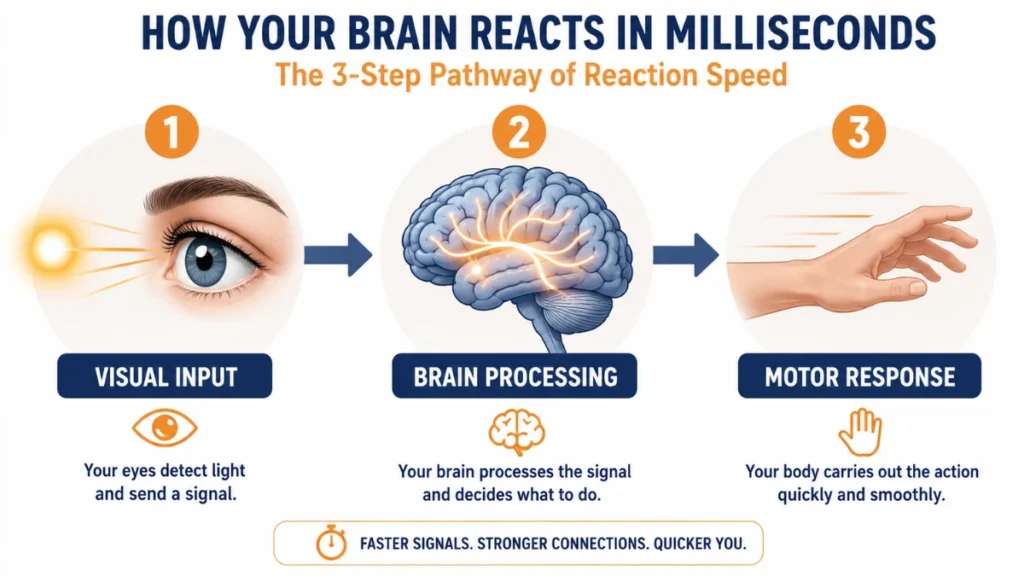
A large web-based study of 75,666 adults ages 18 to 85, conducted by researchers at TGen, found that simple visual response speed tracks closely with memory performance across the lifespan, and that both decline together as people age.¹
Age was the strongest single factor, but it was far from the only one. Education, smoking history, medication load, and even handedness all showed measurable effects on how quickly participants responded.¹
Here is what that tells you: your reaction time is not a pure readout of your age. It is a readout of your brain’s current operating state. That is the part most people miss.
Why your brain’s speed matters more than your memory score
Memory tests feel like the obvious check. You forget a name, lose your keys, blank on a word mid-sentence, and your mind goes straight to Alzheimer’s.
But memory is a complex product of many brain systems, and it can cover for itself in ways that hide early problems. Processing speed is harder to fake.
Your reaction time does not just measure how fast your hand moves. It measures how cleanly your brain’s wiring is still firing, which is something no word list or crossword puzzle can show you.
A 2012 study at the University of California, San Francisco examined 131 cognitively normal adults ages 55 to 87 using brain scans alongside timed response tasks.²
The researchers found that people with slower response speeds consistently showed reduced integrity in the white matter tracts connecting the frontal and parietal regions of the brain. This relationship held even after controlling for gray matter atrophy and white matter lesions.²
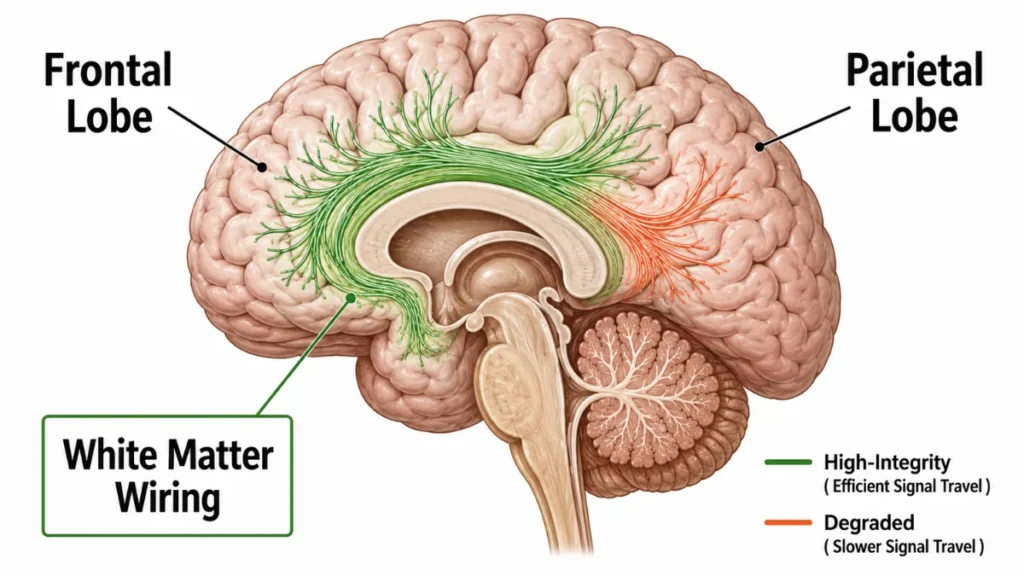
In plain terms: a slower response was linked to less efficient communication between the parts of the brain that make decisions and the parts that direct action.
White matter [the network of insulated nerve fibers that carry signals between different brain regions] degradation is associated with the kind of processing speed loss that appears in your response speed well before it shows up in a formal memory test.²
Memory scores reflect what you already know. Your response speed reflects how fast your brain is working right now.²
The inconsistency signal almost nobody talks about
Most people, when they think about how fast they respond, picture a single number. How fast am I? But researchers who study cognitive aging are increasingly interested in a different question: How much does your response time jump around?
Intraindividual variability [the degree to which your response swings from one trial to the next, even within the same short test] has emerged as a potentially more sensitive early signal than mean speed alone.

A 2017 systematic review covering 22 longitudinal studies of middle-aged and older adults found that greater baseline variability in response speed was consistently linked to increased risk of cognitive decline, impairment, and mortality in follow-up, results that held across multiple study populations.³
Then came research from the Harvard Aging Brain Study that sharpened that finding considerably.
Among 109 cognitively normal adults with an average age of 77, those whose responses swung more erratically from session to session showed worse performance on executive function tests and faster cognitive decline over follow-up.⁴
Their variability was independently associated with tau protein buildup in the brain.⁴
These were people who felt fine. They were passing standard tests. The variability in their response times was the signal that something was changing.
Average speed gives one number. Variability in that speed shows whether the brain’s wiring is firing consistently, and consistency may be the more sensitive early window into what is changing.
No single study has yet directly proven that measuring variability at home can predict dementia years out. The evidence is assembled from multiple sources, each testing a different piece of this picture, and that context shapes how any individual score should be read.⁴
What is quietly slowing your reaction time right now
Your daily habits change your response speed more than most people expect. Not gradually, over years. Right now, today.

Sleep loss is the most immediate factor. After 17 to 19 hours without sleep, response speed on timed tasks matched the impairment level of a blood alcohol concentration of 0.05 percent.⁵
After 24 hours without sleep, that impairment reached the equivalent of a 0.10 percent blood alcohol level.⁵
One poor night does not just make you tired. It measurably slows the signal between perceiving a stimulus and responding to it.
Sedentary behavior is the slower version of the same problem. A 12-week aerobic exercise program in inactive adults ages 60 to 75 produced a 20 percent improvement in whole-body response speed in the group that exercised.⁶
No significant change appeared in the control group. Moving regularly appears to keep the brain’s signal speed higher than sitting does.⁶
Chronic stress shapes it too. In a longitudinal study of 6,207 adults ages 65 and older, higher perceived stress was independently associated with accelerated cognitive decline over an average follow-up of nearly seven years.⁷ Stress adds to the same pathway that sleep loss and inactivity affect.
If three of the most significant factors affecting your response speed today are sleep, movement, and stress, what does that say about how much of this is within your control?
What the research can and cannot tell us yet
You deserve a straight answer about what the evidence actually proves, and what it does not.
The evidence falls into three distinct buckets.
Firmly established: slower average reaction time is linked to higher dementia risk.⁸
A prospective study of 861 community-dwelling older adults, followed over roughly four years, found that adults with slower simple reaction times were two to three times more likely to develop dementia over the following four years, compared to those with typical response speeds.⁸
That association held after accounting for age, sex, education, general cognitive function, mood, and genetic susceptibility.⁸
Emerging but unproven: reaction time variability may detect subtle brain changes before a clinical diagnosis is possible.⁴
The Harvard Aging Brain Study data supporting this involved 109 participants followed for less than two years, which limits what it can confirm about long-term trajectories.⁴
Not yet established: whether tracking your own response times at home, without a trained examiner and standardized equipment, produces results that translate directly to the laboratory findings above. Home tests introduce variables that clinical tests control for, including device latency, distractions, and irregular testing conditions.
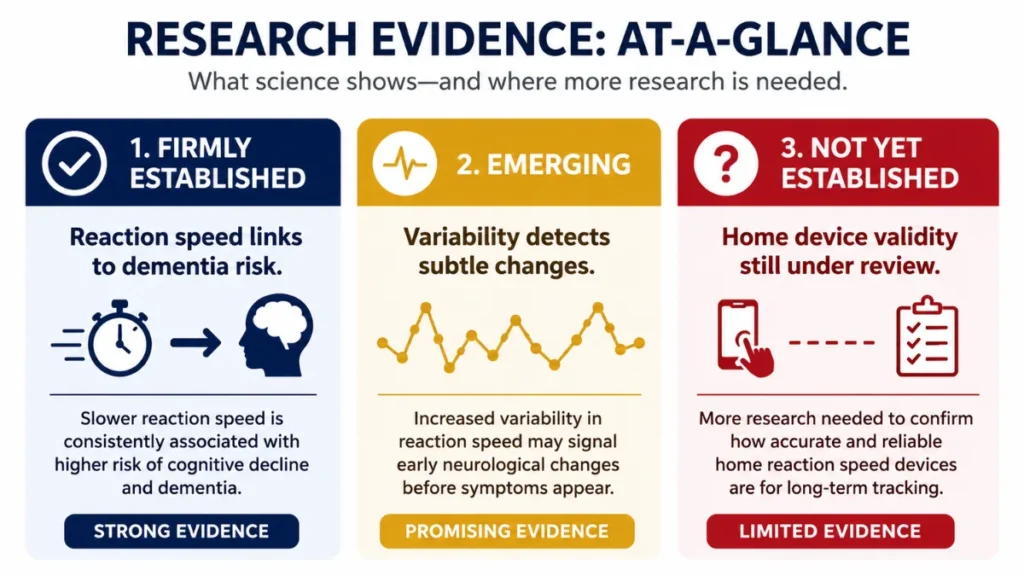
What is clear is that no single score from a home device is a diagnosis or a screening result in any clinical sense. It is a data point. The value is in the trend over time, not the single number.
How to test yourself today and what to do next
The test itself takes about two minutes and requires nothing more than a computer or smartphone with internet access.
Go to humanbenchmark.com and select the Reaction Time test. It is free, requires no account, and gives your result in milliseconds.
Most adults in their 20s average around 250 milliseconds on this test.¹ Scores tend to increase with age, and adults in their 60s and 70s typically average 280 to 320 milliseconds, though individual variation is wide.¹
Before you start, a few conditions affect your score immediately and have nothing to do with your brain health:
- Take the test when you are rested, not after a night of poor sleep
- Sit in a quiet room with no active distractions
- Use a mouse or trackpad rather than a touchscreen if possible, since touchscreen latency adds variability
- Complete at least five trials in one sitting and note the average, not just the best score
- Record your result with the date

The number you get on any single day matters less than the pattern over time. Take the test monthly under the same conditions. What you are tracking is consistency in your average, not whether you beat a benchmark, but whether your own baseline stays stable.
If your average worsens noticeably over three to four consecutive months under consistent conditions, bring that pattern to your doctor. Not as an alarm, but as a data point your health record should include.
Your brain speed is worth tracking
Your reaction time is not about catching a falling glass. It is about whether your brain’s wiring is moving information cleanly and consistently, and that is something you can now begin to measure.
Take a free online reaction time test this week, then bring the result to your next doctor’s visit as a baseline to track over time.
What variability predicts long-term, and how well home tests translate to clinical findings, are still open questions. The pattern of your own scores over months means more than any single number.⁴
⚠️DISCLAIMER
This article is for informational purposes only and is not a substitute for professional medical advice, diagnosis, or treatment. The self-administered test described here is not a clinical screening tool and cannot diagnose any cognitive condition. If you have concerns about your cognitive health, speak with a qualified healthcare provider.
References
- Talboom JS, De Both MD, Naymik MA, Schmidt AM, Lewis CR, Jepsen WM, Håberg AK, Rundek T, Levin BE, Hoscheidt S, Bolla Y, Brinton RD, Schork NJ, Hay M, Barnes CA, Glisky E, Ryan L, Huentelman MJ. Two separate, large cohorts reveal potential modifiers of age-associated variation in visual reaction time performance. npj Aging and Mechanisms of Disease. 2021. https://www.nature.com/articles/s41514-021-00067-6
- Kerchner GA, Racine CA, Hale S, et al. Cognitive processing speed in older adults: relationship with white matter integrity. PLOS ONE. 2012. https://pmc.ncbi.nlm.nih.gov/articles/PMC3503892
- Haynes BI, Bauermeister S, Bunce D. A Systematic Review of Longitudinal Associations Between Reaction Time Intraindividual Variability and Age-Related Cognitive Decline or Impairment, Dementia, and Mortality. Journal of the International Neuropsychological Society. 2017. https://pubmed.ncbi.nlm.nih.gov/28462758/
- Jutten RJ, Amariglio RE, Maruff P, Properzi MJ, Rentz DM, Johnson KA, Sperling RA, Papp KV. Increased intraindividual variability in reaction time performance is associated with emerging cognitive decline in cognitively unimpaired adults. Neuropsychology. 2023. https://pmc.ncbi.nlm.nih.gov/articles/PMC12184789/
- Williamson AM, Feyer AM. Moderate sleep deprivation produces impairments in cognitive and motor performance equivalent to legally prescribed levels of alcohol intoxication. Occupational and Environmental Medicine. 2000. https://pubmed.ncbi.nlm.nih.gov/10984335/
- Kalapotharakos VI, Michalopoulos M, Strimpakos N, Diamantopoulos K, Tokmakidis SP. Functional and neuromotor performance in older adults: effect of 12 weeks of aerobic exercise. Medicine and Science in Sports and Exercise. 2006. https://pubmed.ncbi.nlm.nih.gov/16357550/
- Aggarwal NT, Wilson RS, Beck TL, et al. Perceived stress and change in cognitive function among adults 65 years and older. Psychosomatic Medicine. 2014. https://pubmed.ncbi.nlm.nih.gov/24367123/
- Kochan NA, Bunce D, Pont S, Crawford JD, Brodaty H, Sachdev PS. Reaction time measures predict incident dementia in community-living older adults: the Sydney Memory and Ageing Study. American Journal of Geriatric Psychiatry. 2016. https://pubmed.ncbi.nlm.nih.gov/26905045/