

That slow, cloudy feeling that settles in around 1:00 or 2:00 in the afternoon isn’t a warning sign, and it isn’t your age. Adults over 50 who feel sharp in the morning but foggy and slow after lunch are experiencing something that neurologists and sleep researchers have studied for decades.
It’s a built-in biological event called midday brain fog, and it has nothing to do with cognitive decline.
The problem isn’t that your brain is getting worse. The problem is that a specific system in your body loses some of its push with age, and most people have no idea it exists.
By the end of this article, you’ll know exactly what that system is and how to work with it.
What You’ll Find Inside
- Why the post-lunch dip shows up even on days you skip lunch entirely
- The one thing about your meal that matters more than how much you eat
- What the room you’re sitting in after lunch is doing to your brain’s clock
- Why the timing of a short walk matters more than how long you walk
- The window before the fog arrives that most people waste
What the Post-Lunch Dip Actually Is and Why It Gets Worse After 50
You didn’t eat too much. You’re not sleep-deprived. And it’s not dementia. The midday brain fog you feel most afternoons is a real biological event called the post-lunch dip, and researchers have documented it for decades.
Here’s what makes this different from most afternoon tiredness: the dip shows up even when people skip lunch entirely and have no idea what time it is.¹ It isn’t a food response.

It is a feature of the human circadian clock [the internal 24-hour timing system that controls when you feel awake and when you feel foggy]. The post-lunch dip is linked to a secondary wave in that clock, a kind of 12-hour echo of the overnight sleep urge that lands in the early-to-mid afternoon for most people.¹
You may have blamed your age or your lunch for years. The research points somewhere else.
Why it lands harder after 50 is not a separate problem. It is the same clock signal with less biological support around it. Younger adults have a stronger circadian system that can push back against the afternoon dip. After 50, that pushback weakens for reasons the next section covers directly.
How the Aging Circadian Clock Loses Its Midday Grip on Alertness
The midday fog that feels like aging is actually the same biological signal that caused afternoon drowsiness when you were 30. It just has fewer counterweights now to hold it in check.
The counterweight in question has a name: circadian amplitude [the size of the difference between your most active, alert periods and your most sluggish ones].
Research using data from the Baltimore Longitudinal Study of Aging found that in cognitively healthy adults aged 50 and older, circadian amplitude is associated with cognitive performance, and weaker rhythm strength is linked to steeper declines over time.²
Evidence from rest-activity monitoring in older adults also shows that this amplitude measurably decreases with age.³
It isn’t that the clock breaks. It flattens.
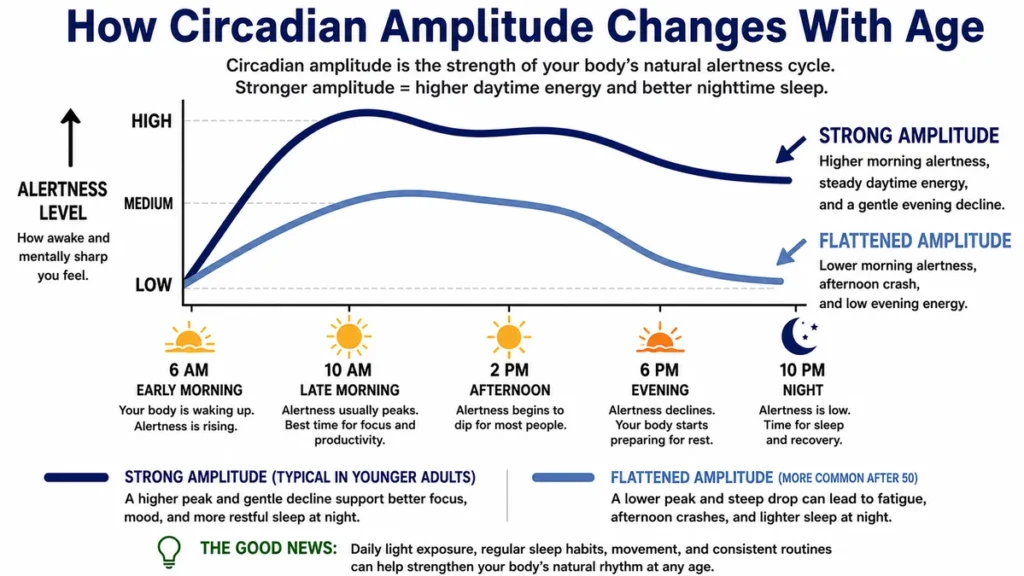
A younger adult’s circadian system rises sharply in the morning and holds a strong alertness signal through most of the day. The afternoon trough still arrives, it always does, but the morning peak was tall enough that the drop feels short.
After 50, the morning peak is lower and the curve is flatter, so the same afternoon trough feels like falling off a cliff.
No single study has directly tested this full chain in adults specifically over 50, from amplitude decline to worsened afternoon fog to recovery. What the research shows separately is this: the dip is biological, amplitude changes with age, and those amplitude changes are tied to cognitive outcomes.
That’s three pieces pointing the same direction. Not one proof.
Why Lunch Composition Changes the Severity of the Dip in Older Adults
Most people assume a lighter lunch means a lighter afternoon. That assumption is wrong, and understanding why actually gives you one of the most practical tools in this article.
The post-lunch dip is a circadian event, not a meal event. It can still happen on days when you eat very little or skip lunch entirely.¹ So the midday brain fog isn’t caused by your sandwich. But what’s in that sandwich can make the biological dip significantly worse.
High-carbohydrate meals [foods that break down quickly into sugar and spike blood glucose fast, such as white bread, rice, pasta, and sweetened drinks] amplify the dip.⁴
In a controlled trial, adults who ate a high-fat lunch had a 57.7% smaller decline in memory scores compared to adults who ate a high-carbohydrate lunch.⁴
The population in that study was overweight and obese adults, not specifically adults over 50, so the exact percentage may differ. But the direction of the effect is consistent with the underlying biology of glucose and alertness.
This is the direct challenge: if you’ve been eating a light pasta salad or a sandwich on white bread and wondering why you’re still foggy, the lightness of the meal isn’t the relevant variable. The composition is.
How Light Exposure at Midday Either Sharpens or Deepens the Fog
Where you sit after lunch is doing something to your brain, and most people have never thought about it.
Your eyes are one of the main inputs your circadian clock uses to know what time it is. Bright light tells the clock to boost alertness. Dim light, the kind found in most offices and living rooms, does not send that signal.
When your circadian system is already in its afternoon trough, dim light leaves the clock with nothing to push back against.
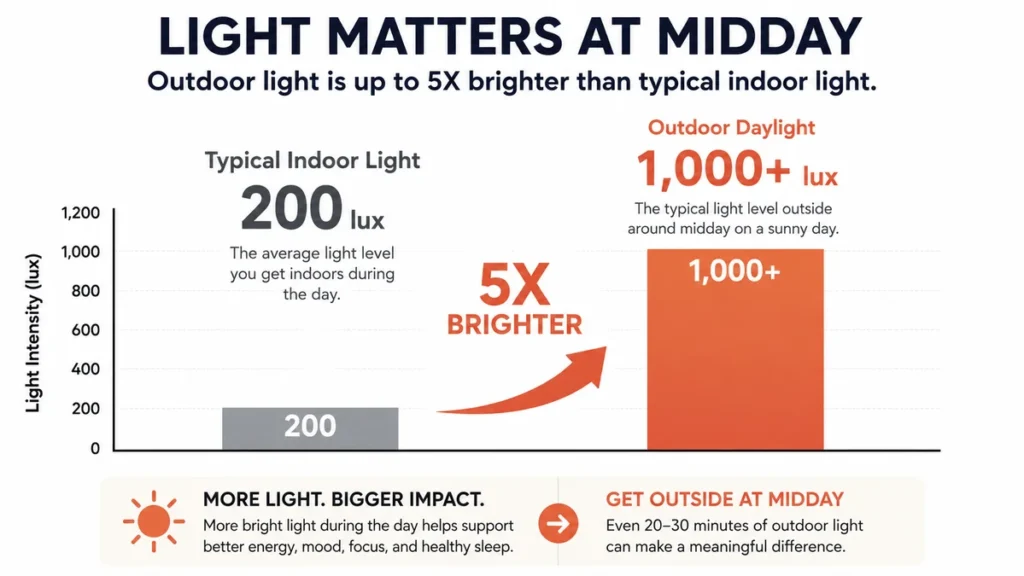
Bright light exposure [high-intensity light from a light therapy lamp or bright daylight] during the early afternoon can directly counter the dip. In a trial with adults, bright blue-enriched light during the post-lunch window significantly reduced sleepiness and improved working memory performance compared to normal indoor lighting.⁵
The study was conducted in young adults, so the response profile may differ somewhat for adults over 50. But the underlying clock mechanism that light acts on does not change with age.
Here is the save-worthy practical moment: you don’t need a special lamp to get this effect. Stepping outside within an hour of finishing lunch exposes your eyes to far more light than any indoor environment, typical indoor lighting measures around 200 lux, while outdoor daylight, even under cloud cover, regularly exceeds 1,000 lux.¹⁰
Bright light afternoon alertness doesn’t require a purchase.
The Movement Window: Why a Short Walk After Lunch Works Differently After 50
You’ve probably heard that a walk after lunch is good for you. What most articles don’t mention is why the timing matters far more than the duration.
When you eat, your blood glucose rises. That rise is normal, but a sharp spike makes the midday brain fog worse. The circadian dip and a blood glucose spike arriving at the same time are thought to compound each other, though the combined effect hasn’t been directly tested.
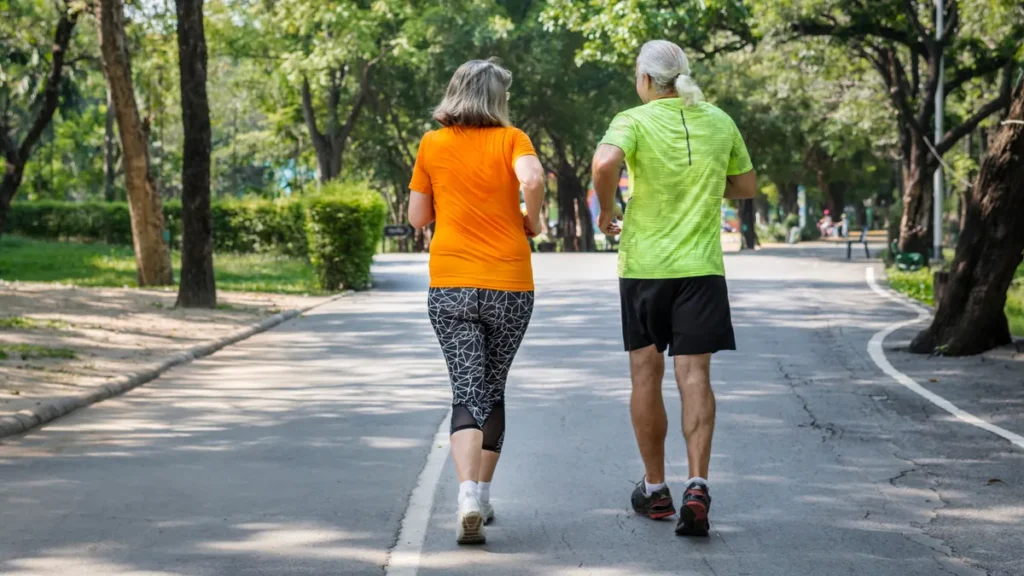
Postmeal walking [walking within 30 minutes of finishing a meal, before the glucose spike peaks] directly blunts that rise. In a study of inactive older adults aged 60 and over, three 15-minute bouts of walking after each main meal produced significantly better 24-hour glucose control compared to a single 45-minute session later in the day.⁶ The timing mattered more than the total duration.
Here is where the evidence gets thinner.
The link between post-meal walking, blunted glucose, and improved afternoon cognition specifically in adults over 50 hasn’t been tested in a single clean study. What has been tested separately is this: postmeal walking reduces glucose in older adults.⁶
And separately, sustained high glucose after meals has been associated with reduced cognitive performance in adults.⁷
Those are two pieces pointing the same direction, not one proof.
You don’t need to walk far. Fifteen minutes at a relaxed pace, starting within 30 minutes of eating, puts the timing in the right window.
What to Do in the Hour Before the Dip Arrives
The best time to do anything about midday brain fog is before it lands. Most people try to push through it after it’s already there. That’s the wrong window.
Adults over 50 tend to shift toward being morning people as they age, not by choice, but because of biological changes in the circadian clock.⁸ Cognitive performance in older adults peaks earlier in the day and falls off more sharply as the afternoon progresses compared to younger adults.⁹
That means the fog doesn’t just arrive. For many people over 50, it arrives earlier than it used to.
The hour before it arrives is the intervention window. Here is a practical protocol you can use today:

Talk to your doctor before changing your routine significantly if you’re managing a condition that affects light sensitivity or if you’re on photosensitizing medications.
Your Pre-Dip Protocol
- Finish demanding cognitive work by noon. If your fog typically lands around 1:00 or 2:00 pm, your sharpest thinking window likely closes 60 to 90 minutes before that, based on the timing patterns described above. Plan accordingly.
- Choose a lower-carbohydrate lunch. Protein and fat slow the glucose rise that amplifies the dip. Eggs, fish, legumes, and leafy greens are better choices than white bread, pasta, or sweetened drinks.
- Step outside within 30 minutes of eating. A 15-minute walk serves two functions at once: it delivers the bright light your circadian clock needs and blunts the postmeal glucose spike that deepens the fog.
The Fog Is a Clock Problem
The most important thing to remember from this article: midday brain fog after 50 is a circadian event. Your brain isn’t failing. Your clock’s amplitude has flattened, which means the afternoon trough hits harder and holds longer than it used to. That’s a system you can work with.
Restructure your three riskiest midday hours by making one change to your light exposure, meal timing, or movement pattern this week. The circadian rhythm over 50 responds to behavior. It always has.
⚠️DISCLAIMER:
This article is for informational purposes only and does not constitute medical advice, diagnosis, or treatment. The content addresses midday brain fog and circadian changes after 50 and is intended for general educational purposes only. Health conditions vary significantly between individuals, always consult a licensed physician or qualified healthcare provider before making any decisions about your health or medical care.
References
- Monk TH. Post-lunch dip in performance: circadian phenomenon occurring even without food or time awareness. Clinics in Sports Medicine. 2005. https://pubmed.ncbi.nlm.nih.gov/15892914/
- Rainer J et al. Circadian rest/activity rhythms associated with cognition in adults aged 50 and older; weaker amplitude linked to poorer memory and faster decline. Frontiers in Neuroscience / Baltimore Longitudinal Study of Aging. 2022. https://pmc.ncbi.nlm.nih.gov/articles/PMC9597505/
- Kim JH, Duffy JF. Rest-activity patterns in older adults show reduced amplitude and advanced acrophase with aging. Circadian Rhythm Sleep-Wake Disorders in Older Adults, Sleep Medicine Clinics. 2022. https://pmc.ncbi.nlm.nih.gov/articles/PMC9181175/
- Barbour JA et al. Almond-enriched high-fat lunch reduced memory score decline by 57.7% compared to high-carbohydrate lunch in overweight and obese adults. British Journal of Nutrition. 2017. https://pubmed.ncbi.nlm.nih.gov/28183366/
- Zhou Y et al. Bright blue-enriched white light during post-lunch dip window significantly reduced sleepiness and improved working memory performance vs. normal indoor light in young adults. Frontiers in Psychology. 2021. https://www.ncbi.nlm.nih.gov/pmc/articles/PMC8215386/
- Colberg SR et al. Three 15-minute postmeal walks produced better 24-hour glycemic control than a single 45-minute walk in inactive older adults aged 60 and over. Diabetes Care. 2009. https://pmc.ncbi.nlm.nih.gov/articles/PMC3781561/
- Nilsson A et al. Lower postprandial glycemic exposure associated with better selective attention performance in the late postprandial period in adults aged 49 to 71. European Journal of Clinical Nutrition. 2012. https://pubmed.ncbi.nlm.nih.gov/22781020/
- Mander BA et al. The aging clock: circadian rhythms and later life; older adults shift toward morningness as a biological developmental pattern. Frontiers in Aging Neuroscience. 2017. https://pmc.ncbi.nlm.nih.gov/articles/PMC5272178/
- Walters A, Lesk VE. Interactive role of sleep and circadian rhythms in older adults; cognitive processing speed peaked at 0800 and declined through the day, with stronger effect in older participants. Frontiers in Aging Neuroscience. 2023. https://pmc.ncbi.nlm.nih.gov/articles/PMC10562893/
- Wright KP Jr et al. Entrainment of the human circadian clock to the natural light-dark cycle; typical indoor lighting measures approximately 200 lux, while outdoor daylight regularly exceeds 1,000 lux. Current Biology. 2013. https://pmc.ncbi.nlm.nih.gov/articles/PMC4020279/