

You wake up fine. Nothing happened last night. Nothing is scheduled today that should put you on edge. But somewhere around mid-morning, your shoulders are up near your ears, your jaw is tight, and there is a low hum of readiness that has no target.
Adults over 50 who feel off but can’t explain why often assume they are anxious about something they have forgotten. The real explanation is different, and it starts inside the nervous system, not the calendar.
Your body may have stopped waiting for a reason. This is survival mode after 50, and it runs quietly whether or not anything is wrong.
In this article, you will discover:
- Why the nervous system shifts its baseline after 50, and what that shift actually feels like in the body
- The surprising statistic about your heart’s flexibility that no stress article mentions
- What your inflammation levels look like right now, even on a good day
- The one diurnal pattern researchers track that almost no consumer health content covers
- How a five-minute daily practice can signal your nervous system to stand down
Why Your Body Stopped Needing a Reason to Feel on Edge
You feel on edge, and you cannot point to why. That is not a character flaw or a sign that something in your life is falling apart.
After 50, the body’s stress system can shift so that low-level activation becomes its new normal, not a response to anything happening right now.
Researchers call this allostatic load [the total wear and tear on the body that builds when its stress systems are called on too often or for too long]. When allostatic load stays high, the nervous system stops treating calm as the default state. It treats alert as the default instead.

The consequences are measurable. A five-year longitudinal study following 3,614 community-dwelling older adults found that each one-point increase in allostatic load was linked to a 47% rise in the accumulation of new chronic conditions and a 33% increase in mortality risk over that period.¹
That number is not about feeling stressed. It is about what happens inside the body when the stress system never fully switches off.
Most articles about stress in later life treat it as a lifestyle problem. They recommend better sleep, less screen time, more walks.
Those things help. But they do not address a more fundamental shift: after 50, survival mode after 50 may not be a response to your circumstances at all.
The Clock Your Nervous System Reset Without Asking You
You have probably noticed that you recover more slowly than you used to. A tense conversation leaves a residue.
A poor night’s sleep takes two days to shake. What used to bounce back in an hour now lingers until evening.
This is not weakness. It is biology.
Your body does not wait for a crisis to run its stress system; after 50, the system runs on its own, like an engine left idling with no key in the ignition.
One reason recovery takes longer is that the heart’s flexibility has quietly declined. Researchers use a measure called heart rate variability [the variation in time between heartbeats, controlled by the autonomic nervous system] to assess how well the body shifts between alert and calm states.
In a sample of over eight million people, heart rate variability was estimated to be approximately 80% lower at age 60 than at age 20.²
Eighty percent. Not a gradual fade. A near-disappearance of the system that is supposed to buffer the chronic stress response aging creates.
The hypothalamic-pituitary-adrenal axis [the hormonal chain linking the brain, pituitary gland, and adrenal glands that controls cortisol release] also changes with age, and in ways that affect how cortisol is released and how well it shuts itself off.
Evidence from multiple studies suggests that diurnal cortisol may increase with age and that its daily pattern may become altered, for example, its normal decline across the day may flatten.³ Many of the studies in this area are cross-sectional, which limits the conclusions that can be drawn.
No single study tests all of these mechanisms together. The picture here is assembled from separate lines of research, each solid on its own, none completing the chain by itself.
What Your Body Looks Like on the Inside When Nothing Is Wrong
Here is the part most people find hard to accept: your body may already be running a low-grade stress response right now, on a Tuesday afternoon when nothing has gone wrong. The stress is not in your thoughts. It is in your chemistry.
The immune system of an older adult is associated with higher resting levels of inflammatory proteins, including interleukin-6 [a chemical messenger released by immune cells that promotes inflammation] and C-reactive protein [a protein the liver makes in response to inflammation, used as a general marker of internal stress].⁴
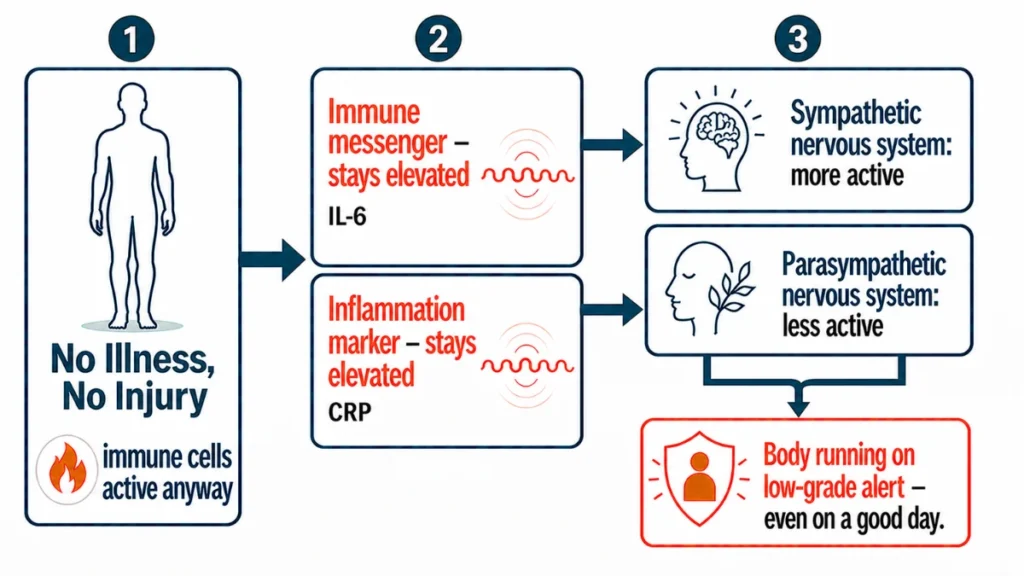
This chronic low-grade inflammation is called inflammaging [the persistent, low-level inflammation that comes with biological aging, separate from illness or injury].⁴
IL-6 is normally low or undetectable in healthy younger adults. In older adults, it rises steadily, even in people who report feeling well, and elevated levels are associated with frailty, cognitive decline, and increased mortality.⁴
At the same time, the sympathetic nervous system [the branch of the nervous system responsible for the fight-or-flight response] becomes more active with age, while the parasympathetic branch, the one that signals rest and repair, becomes less so.⁵
This is not a stress response to anything. It is a restructuring of the system itself.
This is the insight most articles skip: the stress response after 50 is not a louder version of what you had at 30. So what does it actually look like inside a body that appears fine?
The One Signal Almost Every Aging Article Leaves Out
Your cortisol level is not the whole story. What almost no article mentions is that researchers track it differently in aging adults: not just whether the level is high, but whether it follows the right shape across the day.
In a healthy younger adult, cortisol peaks in the morning and steadily drops toward evening. In older adults, this daily slope can flatten, meaning the level does not fall as much as it should.
A systematic review linking cortisol aging patterns to health outcomes found that flatter diurnal slopes were associated with depression, fatigue, and cardiovascular disease, separate from whether morning levels seemed elevated.⁶
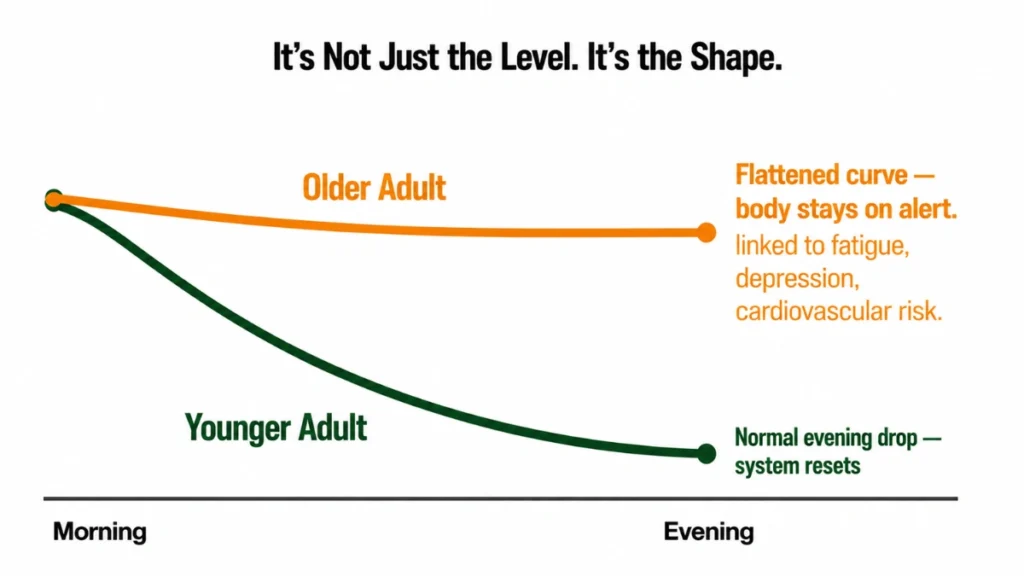
The shape of the curve matters as much as the number on the test.
There is a second signal most aging articles miss. Loneliness functions as a physiological stressor as much as a social one.
A 2025 narrative review drawing on studies in PubMed, PsycINFO, and Scopus found that loneliness is associated with dysregulated hypothalamic-pituitary-adrenal axis activity, elevated inflammatory markers, and cardiometabolic risk factors, with the strongest evidence in older adults.⁷
This matters because many adults over 50 experience a narrowing social world without labeling it as stress. Retirement, loss, and children leaving home can all reduce the daily contact that buffers the nervous system, even when the person does not feel lonely in an obvious way.⁷
A fair limit on this evidence: most loneliness-and-physiology research uses cross-sectional designs and heterogeneous measurement tools, which makes it harder to confirm the direction of effect. The association is consistent, but the mechanistic pathway in humans is not yet fully established.
How to Give Your Body Permission to Stand Down
The nervous system does not respond to reasoning. Telling yourself that you are safe has limited effect on a system that has drifted into low-level alert as its new resting state. The intervention has to be physical, and it has to be direct.
The most accessible entry point is breathing. A pilot randomized controlled trial testing a structured deep diaphragmatic breathing protocol found that participants who practiced the technique showed reduced allostatic load, increased parasympathetic activation measured by heart rate variability, and decreased cortisol and inflammatory markers compared to controls.⁸
The mechanism is direct. Slow, extended exhales stimulate the vagus nerve, which runs from the brainstem into the chest and abdomen and carries the primary signal for the body to shift from alert into rest.⁸
A separate study found that a single session of deep, slow breathing, with a longer exhale than inhale, significantly increased parasympathetic activity and reduced perceived anxiety in both younger and older adults within five minutes.⁹
Five minutes. Not an hour. Not a program.
That is the real finding here: the body still responds to a well-delivered signal even when the stress system has reset to a higher baseline. The hardware has changed. So what does using that input actually look like in practice?
Talk to your doctor before starting a new breathing or exercise practice if you are managing a cardiovascular condition, respiratory illness, or any condition affecting your breathing.
Three Daily Practices That Work With How Your Nervous System Actually Changes
These are not stress-management tips. They work because each one targets a specific mechanism in how the aging nervous system has changed. Use them in any order. Pick one to start.

Talk to your doctor before making changes to your daily routine if you are managing a heart condition, respiratory illness, or a chronic condition affecting your energy or mobility.
- Extended-exhale breathing, five minutes daily. Breathe in for four counts, out for six. The longer exhale activates the vagus nerve and raises heart rate variability. Morning or before bed works equally well. This does not require silence or stillness; it can be done sitting in a chair.
- One scheduled low-stakes social contact per day. Phone, in person, or a brief exchange in a shared space. Research on loneliness and physiological stress suggests that regular, predictable contact buffers the nervous system even when it is brief.⁷ The quality is less important than the consistency.
- Daily activity with a purpose you can name. In a study of older adults aged 55 to 90, a higher sense of purpose was associated with faster cortisol recovery after a stressor, without reducing the response.¹⁰ Name one thing you are doing today for a reason you can state out loud.
The National Institute on Aging offers freely accessible plain-language resources on stress, aging, and practical coping strategies at nia.nih.gov/health/stress-and-anxiety.
Your Nervous System Has Not Failed You
Survival mode after 50 is not a personal failure. It is a structural shift in how the nervous system ages, running whether or not you have anything to be stressed about.
Once per day, spend five minutes breathing out longer than you breathe in. This is one of the few things you can do right now that directly signals your nervous system to downshift out of survival mode.
What science has not settled is how much of this shift is reversible. The biology is real. The response to intervention appears to be real too.
⚠️DISCLAIMER
This article is for informational purposes only and does not constitute medical advice. Consult your doctor or a qualified healthcare provider before making changes to your health routine, especially if you have a diagnosed condition or are taking medication.
References
- Polick CS, Harris-Gersten ML, Dennis PA, Noonan D, Hastings SN, Calhoun PS, Rosemberg MA, Stoddard SA. Allostatic Load, Morbidity, and Mortality Among Older Adults: A Multi-Wave Analysis From the National Health and Aging Trends Study. 2024. https://pmc.ncbi.nlm.nih.gov/articles/PMC11291700/
- Nashiro K, Yoo HJ, Cho C, Kim AJ, Nasseri P, Min J, Dahl MJ, Mercer N, Choupan J, Choi P, Lee HRJ, Choi D, Alemu K, Herrera AY, Ng NF, Thayer JF, Mather M. Heart rate and breathing effects on attention and memory (HeartBEAM): study protocol for a randomized controlled trial in older adults. 2024. https://www.ncbi.nlm.nih.gov/pmc/articles/PMC10941428/
- Gaffey AE, Bergeman CS, Clark LA, Wirth MM. Aging and the HPA axis: Stress and resilience in older adults. Neuroscience & Biobehavioral Reviews. 2016. https://pubmed.ncbi.nlm.nih.gov/27377692/
- Puzianowska-Kuźnicka M, Owczarz M, Wieczorowska-Tobis K, Nadrowski P, Chudek J, Slusarczyk P, Skalska A, Jonas M, Franek E, Mossakowska M. Interleukin-6 and C-reactive protein, successful aging, and mortality: the PolSenior study. Immunity & Ageing. 2016. https://pmc.ncbi.nlm.nih.gov/articles/PMC4891873/
- de Lucia C, Piedepalumbo M, Paolisso G, Koch WJ. Sympathetic nervous system in age-related cardiovascular dysfunction: pathophysiology and therapeutic perspective. International Journal of Biochemistry & Cell Biology. 2019. https://pmc.ncbi.nlm.nih.gov/articles/PMC6383565/
- Adam EK, Quinn ME, Tavernier R, McQuillan MT, Dahlke KA, Gilbert KE. Diurnal cortisol slopes and mental and physical health outcomes: A systematic review and meta‑analysis. Psychoneuroendocrinology. 2017. https://www.sciencedirect.com/science/article/abs/pii/S0306453017302652
- Warren A. Loneliness as a driver of allostatic load: mechanisms linking social disconnection to physiological dysregulation and health disparities. Stress and Health. 2025. https://www.tandfonline.com/doi/full/10.1080/10253890.2025.2594067
- Maniaci G, Daino M, Iapichino M, Giammanco A, Taormina C, Bonura G, Sardella Z, Carolla G, Cammareri P, Sberna E, Clesi MF, Ferraro L, Gambino CM, Ciaccio M, Rispoli L, La Cascia C, La Barbera D, Quattrone D. Neurobiological and anti‑inflammatory effects of a deep diaphragmatic breathing technique based on neofunctional psychotherapy: a pilot RCT. 2024. https://pmc.ncbi.nlm.nih.gov/articles/PMC11636440/
- Magnon V, Dutheil F, Vallet GT. Benefits from one session of deep and slow breathing on vagal tone and anxiety in young and older adults. Scientific Reports. 2021. https://www.ncbi.nlm.nih.gov/pmc/articles/PMC8481564/
- Fogelman N, Canli T. ‘Purpose in Life’ as a psychosocial resource in healthy aging: an examination of cortisol baseline levels and response to the Trier Social Stress Test. npj Aging and Mechanisms of Disease. 2017. https://www.ncbi.nlm.nih.gov/pmc/articles/PMC5514985/