

You have probably blamed it on the shoes, or the floor, or simply not being in a rush. But if you are over 50 and you have noticed that you move a little more slowly than you used to, your walking speed may be doing something you did not sign up for: reporting on your brain.
Most people who notice changes in how they move or feel less sharp than they used to assume those two things are unrelated. They are not.
Research now shows that how fast you walk across a room is linked to what is happening inside your brain right now, and that the connection appears years before any memory test would catch it.
Why this article is worth your time:
- Learn why walking is actually a brain task, and what it costs when the brain starts to struggle
- Discover a simple behavior many people dismiss as distraction that clinicians use as an early warning sign
- Find out what brain scans show when gait speed slows, and whether it is reversible
- Understand one pre-dementia syndrome that requires no lab test and no specialist to screen for
- Get a practical protocol you can run in your own home today
Why Your Legs Are Not Actually Running the Show
You feel the slowness in your legs. That is the natural conclusion: something in the muscles or the joints must have changed. But the legs are only the last stop.
Every step involves your brain managing far more than most people realize: balance, spatial awareness, step timing, and constant adjustments for whatever is underfoot. Walking is a brain task wearing a physical disguise.
Researchers studying adults with average ages in the mid-70s found that executive function [the brain’s ability to plan, shift attention, and manage multiple demands at once] predicted how quickly gait speed declined year over year.¹
That means a person whose thinking was slower at the start of a study tended to walk slower as the years went on, not the other way around. The legs were following the brain’s lead.
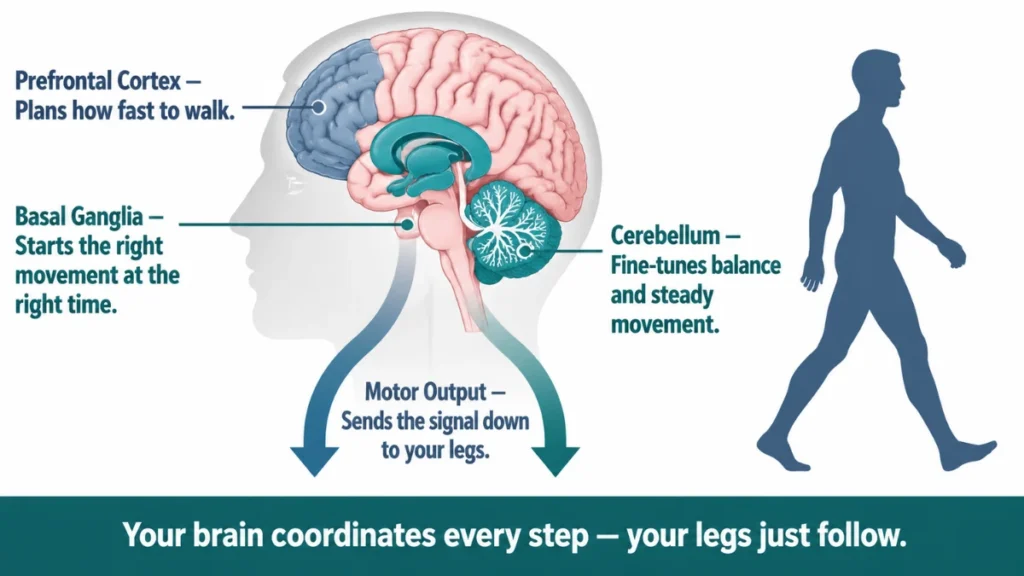
Most people know that the body slows with age. What gets left out is that the brain’s coordination of movement starts slipping first, and the walking speed you experience is often a delayed reflection of that earlier shift.
Brain health and gait speed are tracking the same thing, not two separate things running in parallel.
Your brain is not one system commanding your legs. It is dozens of regions: motor cortex, cerebellum, prefrontal cortex [the brain’s front section, responsible for decisions, focus, and movement coordination], and basal ganglia, all communicating in real time to keep you upright and moving.¹
When that communication starts to fray, walking is often the first observable place it shows.
What Happens in Your Brain the Second You Start Walking
Walking looks automatic. It is not. The moment you stand up and move, your brain begins running a continuous stream of micro-decisions: how to shift your weight, which foot lands next, how much force to use, and whether the path ahead has changed since the last step.
That stream runs through a part of the brain called the frontal lobe [a large region at the front of the brain involved in movement planning, attention, and decision-making].
Researchers at the Vanderbilt Memory and Aging Project studied 570 adults between ages 50 and 92 and found that slower usual walking pace was associated with reduced frontal lobe volume in both men and women.²
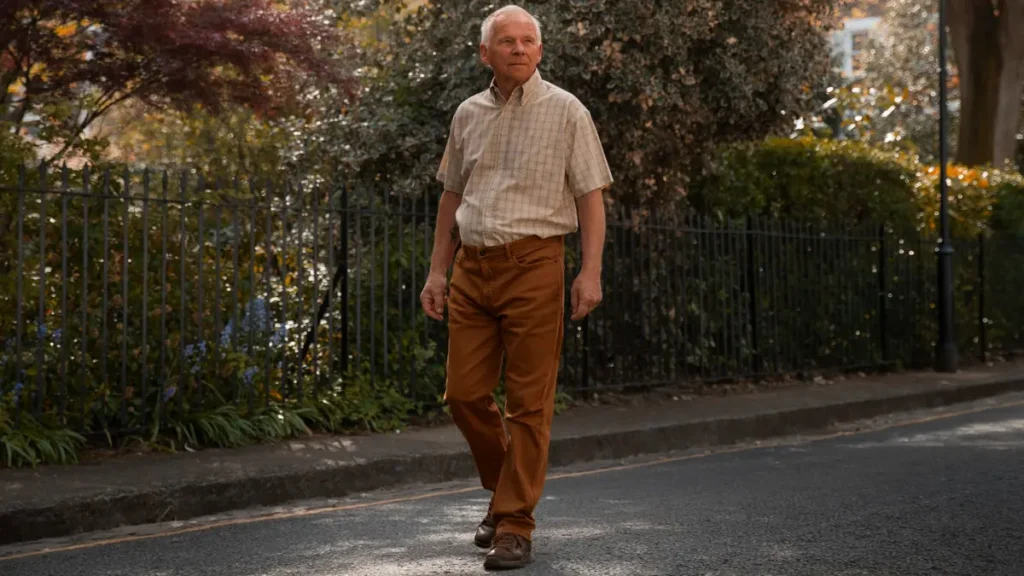
This is not a small note in an obscure paper. It means the tissue dedicated to planning and attention physically corresponds to how fast a person walks.
A separate study from the Rush Memory and Aging Project followed 438 adults with an average age of 81, using brain imaging to identify which regions were linked to slower gait.³
Smaller volumes in the frontal white matter and medial temporal lobe were consistently associated with slower walking speed.³
Those same regions predicted steeper drops in memory and executive function over the following five years.³
Here is what this research reveals: gait speed [how fast a person walks over a measured distance, used as a marker of overall brain-body function] is not a proxy for leg strength; it is a real-time measure of how well the brain’s planning and coordination systems are still working together.
Most gait assessments treat it as a physical output. The brain imaging data suggests it is closer to a cognitive one.
No single study directly proves that slower walking is responsible for the brain changes, or vice versa. What the evidence shows, assembled from neuroimaging studies, cohort data, and longitudinal observations, is a consistent association pointing in the same direction.
The moment you have to stop moving to keep up a conversation, your brain is telling you something worth paying attention to.

The Pause That Clinicians Notice First
You stop walking to answer a question. It happens in the kitchen, in a parking lot, on a phone call mid-stride. Most people assume this is just politeness or concentration. Clinicians have a different interpretation.
When older adults are forced to pause their walking to answer a question, clinicians take note—and a body of research confirms this pause signals a genuine risk.⁴
A 2009 systematic review of 15 studies concluded that changes in gait while talking were significantly associated with a higher risk of falling, even though some early reports showed mixed results.⁴
A later analysis pooling data from multiple studies calculated a combined odds ratio of 5.3 for falls among people who stopped moving during a cognitive task while walking.⁴
This means the risk of falling was more than five times higher for people who could not sustain walking while talking.
Why does this happen? Both tasks draw on the brain’s attention system. For a healthy young brain, the demand is manageable.
For a brain that is working harder to coordinate movement, because the networks supporting it have started to thin or slow, having a conversation at the same time is enough to tip the balance.
Dual-task walking [performing a physical and a cognitive task simultaneously, such as walking while answering a question] has become one of the most studied screening tools in clinical aging research, precisely because the pause is so observable and so meaningful.
Stopping is not politeness. It is your brain choosing which task to keep running.
When Slow Walking and Fuzzy Memory Appear Together
You may have noticed both things at once: walking feels like more effort than it used to, and your memory is not as quick as it once was. Researchers have noticed that combination too, and they have given it a name.
Motoric cognitive risk syndrome [a pre-dementia condition defined by slow walking speed plus self-reported memory complaints in people who do not yet have dementia or mobility disability] was formally proposed in 2013 by researcher Joe Verghese and colleagues at Albert Einstein College of Medicine.⁵
Its defining feature is that it requires no brain scan, no specialist visit, and no blood test. A slow walk and a complaint about memory are enough to identify someone at elevated risk.
In a meta-analysis combining data from five cohort studies and 4,936 older adults, people meeting the criteria for this syndrome were 70% more likely to develop cognitive impairment than those who did not.⁵
That is not a marginal signal. It is a meaningful one, found consistently across different populations.
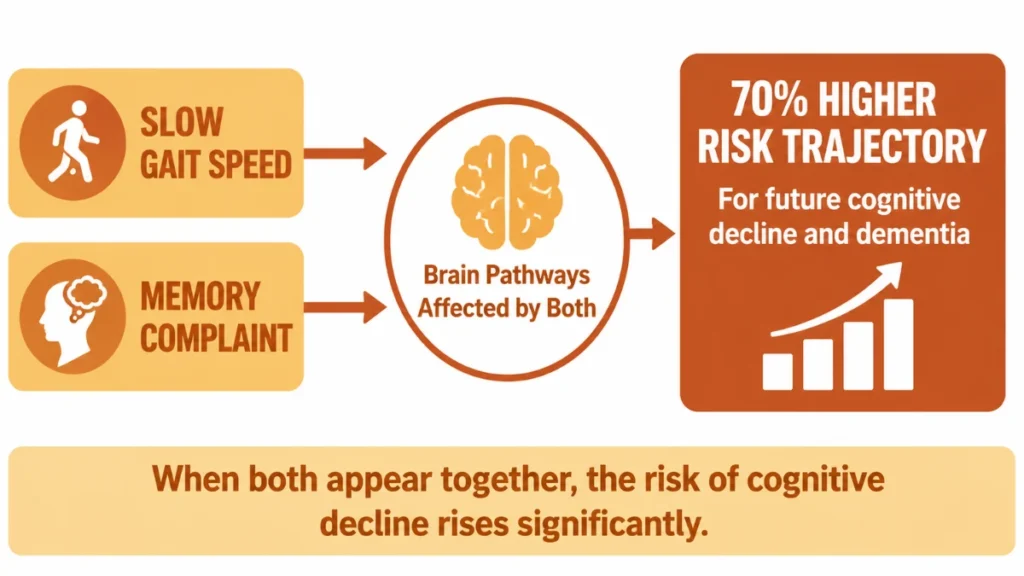
Why does the combination matter more than either sign alone? Both functions draw on overlapping brain circuits, specifically the frontal-subcortical pathways that coordinate attention, sequencing, and memory retrieval.
When both start to slip together, the research suggests a broader pattern of change is likely underway, not two separate problems happening to coincide.⁶
This does not mean that walking slowly and forgetting where you put your keys is a diagnosis. It means those two things together carry more information than either one would on its own.
Does your doctor time your walk at checkups? Most do not, and that is a gap in standard care worth knowing about.
What a Brain Scan Shows When Gait Speed Drops
You might assume the connection between walking and brain health is tracked by memory tests or brain scans. Researchers went further: they put people in MRI machines and looked at what is actually happening inside the brain when gait slows. What they found is specific and worth understanding.
In a study of 3,932 adults aged 60 and over, those with faster baseline walking speeds were 64% less likely to develop dementia over a follow-up period of up to 12 years.⁷
Slower walking speed was associated with greater dementia risk, and a steeper decline in walking speed over time predicted an even higher risk, independent of any changes in cognitive test scores.⁷
That finding sits with you for a moment. Walking speed alone, not a brain scan, not a neurologist, not a two-hour cognitive battery, tracked dementia risk across more than a decade. The body was signaling something the tests had not yet caught.
Gait speed is the earliest diagnostic signal most people are never told to track.
When both memory scores and gait speed declined together, the picture in brain imaging was distinct: greater volume loss in the frontal and parietal regions, the thalamus, and the cerebellum, compared to people who declined in only one domain or neither.⁸
Walking speed is a window into a process the brain cannot report on directly. That is what the imaging data keeps showing.

Try this at home: a simple self-assessment:
Talk to your doctor before changing any health routine if you are managing a chronic condition, take medications affecting balance or coordination, or have had a recent fall.
- Mark off approximately 13 feet (about 4 meters) on a flat surface; a hallway works well
- Walk the distance at your normal, comfortable pace two or three times
- Have someone time you, or use your phone’s stopwatch
- A typical healthy adult over 60 covers this distance in about 4 to 5 seconds at a comfortable pace ⁶
- Speeds consistently below 0.8 meters per second (roughly 10 seconds for 4 meters) are what clinical researchers classify as slow gait ⁶
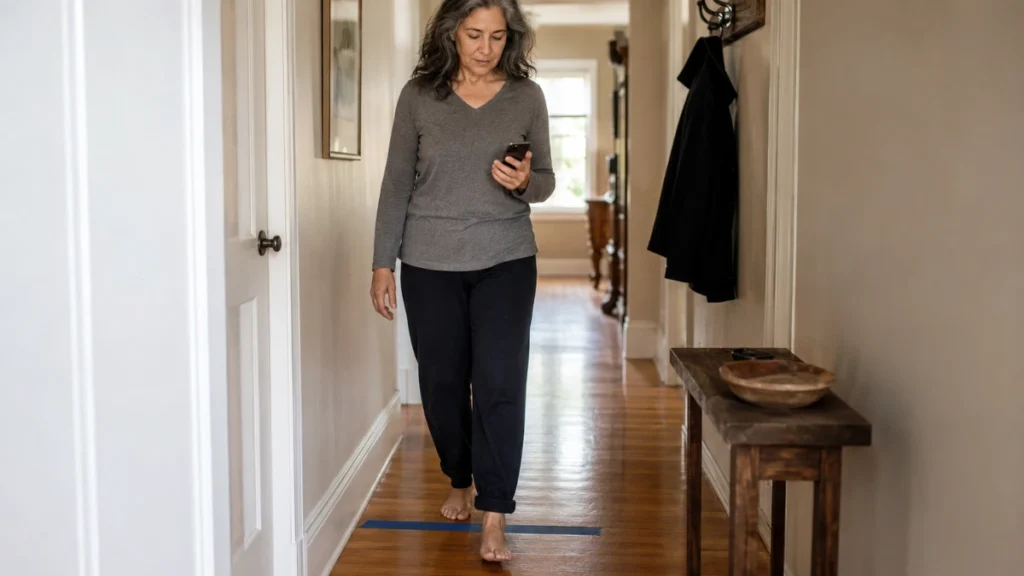
One number will not tell you everything. A trend across months is more informative than any single measurement, which is why writing the result down matters.
What You Can Do Today to Protect Both
If you have read this far, you probably want to know whether any of this is changeable. The research on reversibility is encouraging, with important limits.
Exercise programs that combine strength training with balance and coordination work have shown improvements in gait speed of 6% to 12% in older adults with cognitive impairment.⁹
These are not dramatic numbers, but they are consistent across multiple trials and appear in people who already showed signs of decline, not just healthy controls.
A 2025 systematic review of walking interventions in older adults found that regular walking improved executive function and memory, with executive function being one of the cognitive domains most tightly linked to gait speed.¹⁰
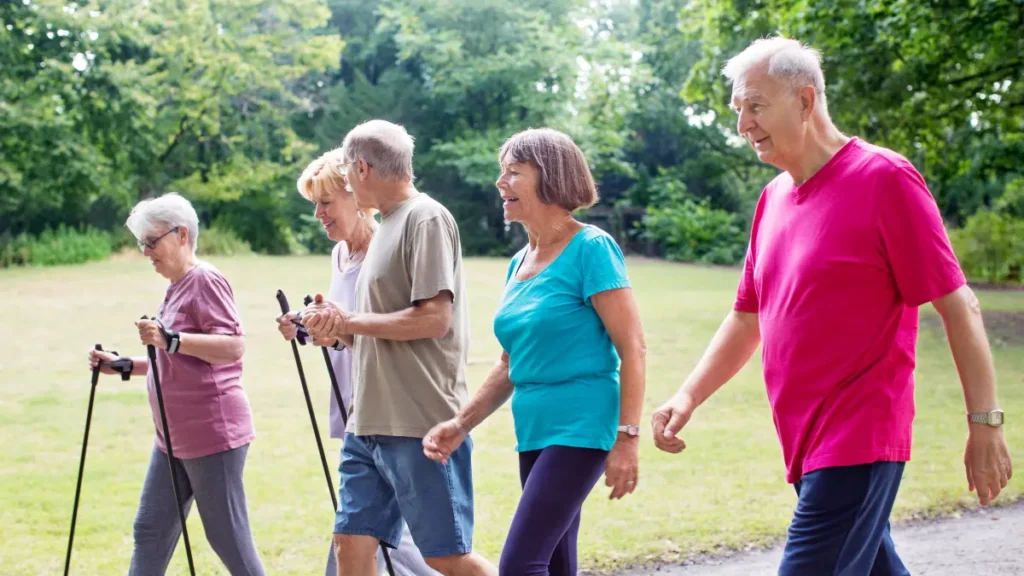
Group-based walking showed particular benefit for gait variability, which is the consistency of step timing and a separate marker researchers use to track cognitive risk.¹⁰
The evidence on whether exercise can slow or reverse the brain volume changes associated with gait decline is less settled. Most studies show functional improvements without confirming structural ones. That gap is worth holding onto rather than resolving prematurely.
What does appear well-supported: staying active, particularly with activities that require coordination and attention at the same time, keeps the brain-body communication system in use.
Cognitive-motor tasks, specifically dual-task training [exercise programs that deliberately combine physical movement with a mental challenge, such as walking while counting], appear to produce meaningful improvements in gait speed in older adults with cognitive impairment.⁹
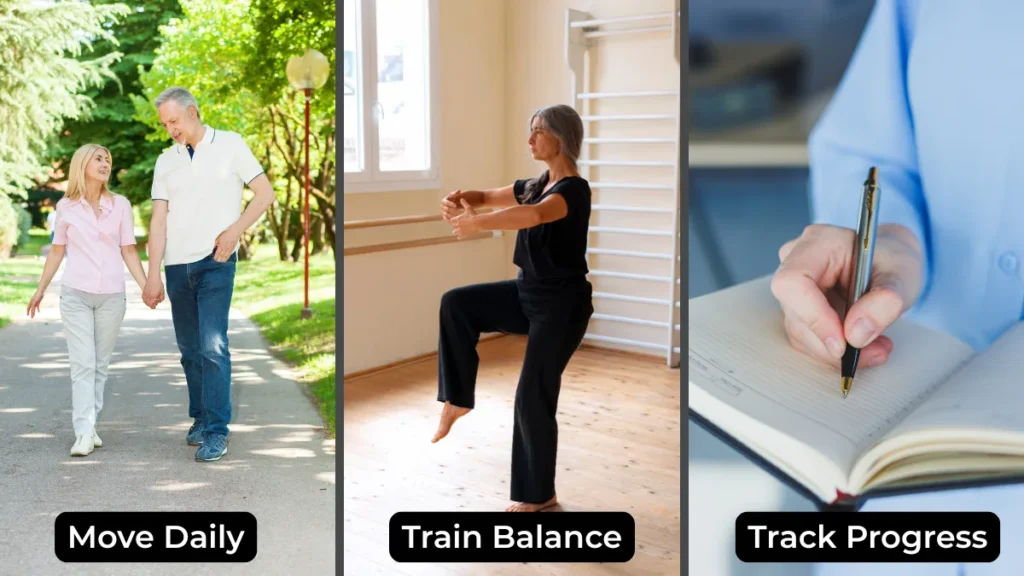
Three habits the research points toward consistently:
- Regular aerobic activity, particularly walking, at least 150 minutes per week ¹⁰
- Activities that combine movement with mental engagement: dancing, tennis, martial arts, tai chi
- Periodic self-monitoring of gait speed using the home protocol in the previous section
Your pace across a room is information. Use it.
Your Walk Is Already Telling You Something
The most important thing to take from this: walking speed and brain health are not separate concerns. They track each other, reflect the same underlying systems, and a change in one is worth paying attention to in the other.
Ask your doctor to time your walk across the room at your next checkup and use that number as a starting point for protecting your brain.
The research on whether exercise can restore what has already changed is still developing. Whether staying active keeps those systems working longer is not in dispute. Start there.
⚠️DISCLAIMER
This article is for informational purposes only and does not constitute medical advice. The research discussed involves associations, not proven causes. If you have concerns about changes in your walking speed, memory, or overall cognitive health, speak with a qualified healthcare provider before making any changes to your routine.
References
- Blumen HM, Brown LL, Habeck C, et al. Gray matter volume covariance patterns associated with gait speed in older adults: a multi-cohort MRI study. Brain Imaging and Behavior. 2019. https://pubmed.ncbi.nlm.nih.gov/29629501/
AND Demnitz N, Zsoldos E, Mahmood A, et al. Associations between Mobility, Cognition, and Brain Structure in Healthy Older Adults. Frontiers in Aging Neuroscience. 2017. https://www.frontiersin.org/journals/aging-neuroscience/articles/10.3389/fnagi.2017.00155/full#h6 - Cole KR, Full KM, Shi H, Pechman KR, Shashikumar N, Davis LT, Hohman TJ, Jefferson AL. Association of grip strength and gait speed with structural brain volume in older adults with and without cognitive impairment. Vanderbilt Memory and Aging Project. PMCID: PMC11710779. https://pmc.ncbi.nlm.nih.gov/articles/PMC11710779/
- Poole VN, Oveisgharan S, Yu L, Dawe RJ, Leurgans SE, Zhang S, Arfanakis K, Buchman AS, Bennett DA. Volumetric brain correlates of gait associated with cognitive decline in community-dwelling older adults. Frontiers in Aging Neuroscience. 2023. https://pmc.ncbi.nlm.nih.gov/articles/PMC10582745
- Beauchet O, Annweiler C, Dubost V, Allali G, Kressig RW, Bridenbaugh S, Berrut G, Assal F, Herrmann FR. Stops walking when talking: a predictor of falls in older adults? European Journal of Neurology. 2009. https://pubmed.ncbi.nlm.nih.gov/19473368/
- Semba RD, Tian Q, Carlson MC, Xue Q-L, Ferrucci L. Motoric cognitive risk syndrome: Integration of two early harbingers of dementia in older adults. Ageing Research Reviews. 2020;58:101022. doi:10.1016/j.arr.2020.101022. https://www.sciencedirect.com/science/article/abs/pii/S1568163719303319
- Mullin DS, Cockburn A, Welstead M, Luciano M, Russ TC, Muniz-Terrera G. Mechanisms of motoric cognitive risk: Hypotheses based on a systematic review and meta-analysis of longitudinal cohort studies of older adults. Alzheimer’s & Dementia. 2022 https://alz-journals.onlinelibrary.wiley.com/doi/10.1002/alz.12547
- Hackett RA, Davies-Kershaw H, Cadar D, Orrell M, Steptoe A. Walking speed, cognitive function, and dementia risk in the English Longitudinal Study of Ageing. Journal of the American Geriatrics Society. 2018. https://www.ncbi.nlm.nih.gov/pmc/articles/PMC6127007/
- Tian Q, Studenski SA, Montero-Odasso M, Davatzikos C, Resnick SM, Ferrucci L. Cognitive and neuroimaging profiles of older adults with dual decline in memory and gait speed. Neurobiology of Aging. 2020. https://pubmed.ncbi.nlm.nih.gov/33152563/
- Córdova-León K, Andrade-Villarroel M, Saldías-Soto C, Córdova-Flores K. Effects of physical exercise on gait speed in cognitively impaired older people: systematic review. Revista Iberoamericana de Ciencias de la Actividad Fisica y del Deporte. 2025. https://revistas.uma.es/index.php/riccafd/en/article/view/20853
- Lee J, West D, Pellegrini C, Wei J, Wilcox S, Neils-Strunjas J, Rudisill AC, Friedman DB, Marquez DX, Dzwierzynski J, Balls-Berry J, Gajadhar R, Yang C-H. Walking Interventions and Cognitive Health in Older Adults: A Systematic Review of Randomized Controlled Trials. American Journal of Health Promotion. 2025. https://pmc.ncbi.nlm.nih.gov/articles/PMC12284334/