

That heavy, gray feeling about an hour after lunch isn’t just you getting older, and it isn’t in your head.
You eat a normal meal, and twenty minutes later your thoughts feel like wet sand, even though nothing on your last blood test looked wrong.
If you’re over 50 and you feel foggy after eating, this post-meal brain fog has a real, physical cause. It usually has nothing to do with effort or motivation.
By the end of this, you’ll know exactly what’s happening in your body after meals, and two specific changes that start working the same day you try them.
| # | Section | What You’ll Find |
|---|---|---|
| 1 | The fog has a real cause | What’s actually behind it? |
| 2 | The blind spot in your last test | Why didn’t it catch this? |
| 3 | The order you didn’t think mattered | What if sequence beats substance? |
| 4 | The fix hiding in plain sight | What beats reaching for coffee? |
| 5 | The line between normal and worrying | Is this something to flag? |
| 6 | One lunch, reassembled | What does it look like put together? |
How Food Actually Causes Post-Meal Brain Fog
You feel sharp before lunch and useless an hour later. That drop is not random.
The direct answer: post-meal brain fog happens because your blood sugar rises fast after eating and then falls, and that swing temporarily disrupts how clearly your brain can work.
No single study has examined the full sequence from post-meal glucose changes to the subjective experience of brain fog. The evidence instead comes from multiple lines of research that each explain part of the process.
Here’s the plain version. Your brain runs on glucose [sugar in your blood that your cells use for fuel] as its main fuel source.
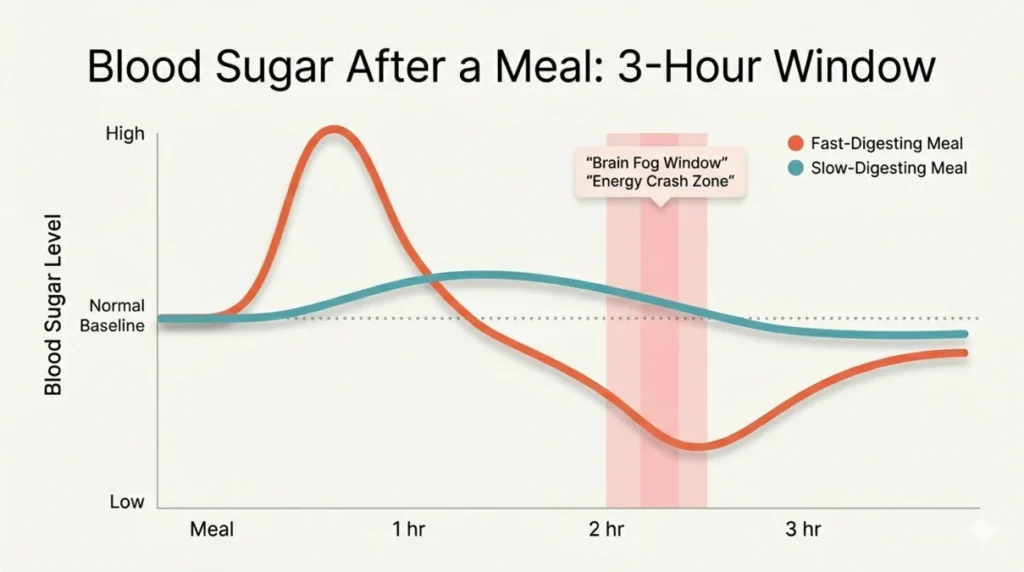
When that fuel arrives in a flood and drains away fast, your focus drains with it.
That’s the whole mechanism.
Researchers tested this in adults aged 49 to 71, comparing a slow-digesting breakfast against a fast-digesting one.¹ The slow-release group scored better on memory and attention for hours afterward.¹
This isn’t about willpower. It’s about timing.
A slow, steady rise in blood sugar keeps your brain’s fuel supply even.
A sharp spike followed by a crash does the opposite, and that crash is exactly when the fog lands.
You didn’t lose your focus. Your fuel supply got unstable, and your brain just responded the way any engine would when its fuel runs out and floods back in.
What you eat at lunch is still deciding how clear your head feels at three.
The Test That Misses What’s Actually Happening
Your last lab results came back normal. The fog must be something else, or so the thinking goes.
Here’s what almost nobody explains: a normal fasting glucose number reflects eight hours without food. It tells you almost nothing about the two hours after a real meal.
The fog is not your willpower failing after lunch, it’s your pancreas releasing insulin a little slower than it used to, and that’s a timing problem, not a character problem.

Standard screening wasn’t built to catch this.
One screening study compared fasting glucose and HbA1c testing against a full post-meal glucose test in patients checked for blood sugar problems.²
The fasting tests alone missed most of the people who actually had impaired blood sugar control once they were tested after a meal.²
Your fasting number can look perfectly fine while your post-meal spike is doing the damage.
Normal labs. Foggy afternoons.
So why does this get more common after 50? Insulin release is linked to normal aging and tends to slow gradually, even in people who are otherwise healthy.³
That shift is gradual, it’s common, and it’s not a diagnosis. It’s also rarely the subject of a five-minute appointment built around a fasting blood draw.
Ask your doctor specifically about post-meal glucose, not just your fasting number.
Most people never ask.
The Order You Eat In Changes How You’ll Feel After
Here’s something almost nobody tells you about food order: the same exact plate, eaten in a different order, can leave you feeling completely different an hour later.
Two people can eat the identical lunch and have very different afternoons depending only on which bite went first.
Talk to your doctor before changing your meal order or timing if you are pregnant, on medication, or managing a chronic condition.
In one study, people who ate vegetables before carbohydrates had a smaller blood sugar spike than when they ate the same foods in the reverse order.⁴
This held specifically in people managing blood sugar concerns, not the general population.⁴
This costs nothing and takes no extra time:
- Eat vegetables and protein first
- Eat your starch or bread last
- Keep the rest of the meal exactly the same

That’s the whole change. Nothing on the plate is different, only the order you pick it up in.
Try it tomorrow with the same lunch you’d normally eat anyway. Order alone will not fix every afternoon, though, and there’s a reason for that too.
A Walk After Eating Beats Reaching for Coffee
The three o’clock slump usually sends people straight for caffeine.
Coffee covers the fog. It doesn’t touch the cause.
A short walk does something coffee can’t: it gives your muscles somewhere to put that incoming glucose instead of letting it pool in your bloodstream.
In a study of older adults at risk for impaired glucose tolerance, three separate 15-minute walks after meals improved blood sugar control over a full 24-hour period, and did it more effectively than one long walk taken all at once.⁵

You don’t need a workout. You need ten to fifteen minutes, starting within about thirty minutes of finishing your plate.
A walk around the block counts. So does a few laps up and down the driveway, or pacing while you’re on the phone.
The research here is mostly short-term, lab-style studies. What this looks like sustained over months or years in everyday life is still being worked out.
That doesn’t make it useless. Treat it as a strong, testable habit, not a guarantee.
Walk for ten to fifteen minutes within thirty minutes of finishing your next big meal.
What This Fog Isn’t Necessarily Telling You
An occasional foggy afternoon is not a diagnosis, and that’s worth sitting with for a second before you start worrying.
One sluggish hour after a big lunch doesn’t mean diabetes or early cognitive decline.
Don’t treat every tired afternoon as a red flag.
That said, some patterns are worth a real conversation with your doctor. Bring it up if you notice:
- Fog that shows up no matter what or how much you eat
- Fog paired with unexplained weight loss or constant thirst
- Confusion or concentration problems that don’t lift within an hour or two

Most people reading this fall into the first category: an ordinary, fixable response to how meals move through the body, not a sign anything is wrong.
Knowing the difference is most of the relief.
A foggy Tuesday afternoon and a real medical pattern look nothing alike once you know what to watch for.
One Ordinary Lunch, Done Differently
Here’s what both fixes look like together, on a lunch you’d eat anyway.
Picture a normal Tuesday. Grilled chicken, rice, and a side salad, the kind of lunch nobody thinks twice about.
Eat the chicken and salad first.
Save the rice for last instead of mixing every bite together the way most people do automatically. Nothing about the ingredients changes, only the sequence you eat them in.
Finish eating, then take a ten-minute walk before sitting back down at your desk or the television.
Same food. Same kitchen. Same amount of time spent on lunch.
What changes is what your blood sugar does for the next two hours, and what your brain feels like because of it.
This is the entire fix. No supplements, no special foods, no tracking app required. Just order and movement, applied to a meal you were already going to eat anyway.
The Real Fix
You don’t need a different diet to stop the post-meal brain fog.
You need a different order on the plate and ten minutes on your feet, both fully in your control.
Walk for ten to fifteen minutes within thirty minutes of finishing your next big meal.
The fog was never proof that something is wrong with you.
It was your blood sugar asking for a little more structure around how and when it moves, and now you know exactly how to give it that.
⚠️DISCLAIMER:
This article is for informational purposes only and does not constitute dietary or medical advice. The content addresses managing post-meal blood sugar through eating order and timing and is meant for general educational purposes only. Nutritional needs differ based on age, health status, and individual circumstances, consult a registered dietitian or your healthcare provider before making significant changes to your diet.
References
- Nilsson A, Radeborg K, Bjorck I. Effects on cognitive performance of modulating the postprandial blood glucose profile at breakfast. Eur J Clin Nutr. 2012. https://pubmed.ncbi.nlm.nih.gov/22781020/
- Engström G, et al. Fasting glucose, HbA1c, or oral glucose tolerance testing for the detection of glucose abnormalities in patients with acute coronary syndromes. 2012. https://pubmed.ncbi.nlm.nih.gov/22456695/
- Chang AM, Halter JB. Aging and insulin secretion. Am J Physiol Endocrinol Metab. 2003. https://pubmed.ncbi.nlm.nih.gov/12485807/
- Imai S, Fukui M, Ozasa N, et al. Eating vegetables before carbohydrates improves postprandial glucose excursions. Diabetic Medicine. 2013. https://pmc.ncbi.nlm.nih.gov/articles/PMC3674531
- DiPietro L, Gribok A, Stevens MS, Hamm LF, Rumpler W. Three 15-min bouts of moderate postmeal walking significantly improves 24-h glycemic control in older people at risk for impaired glucose tolerance. Diabetes Care. 2013. https://pubmed.ncbi.nlm.nih.gov/23761134/