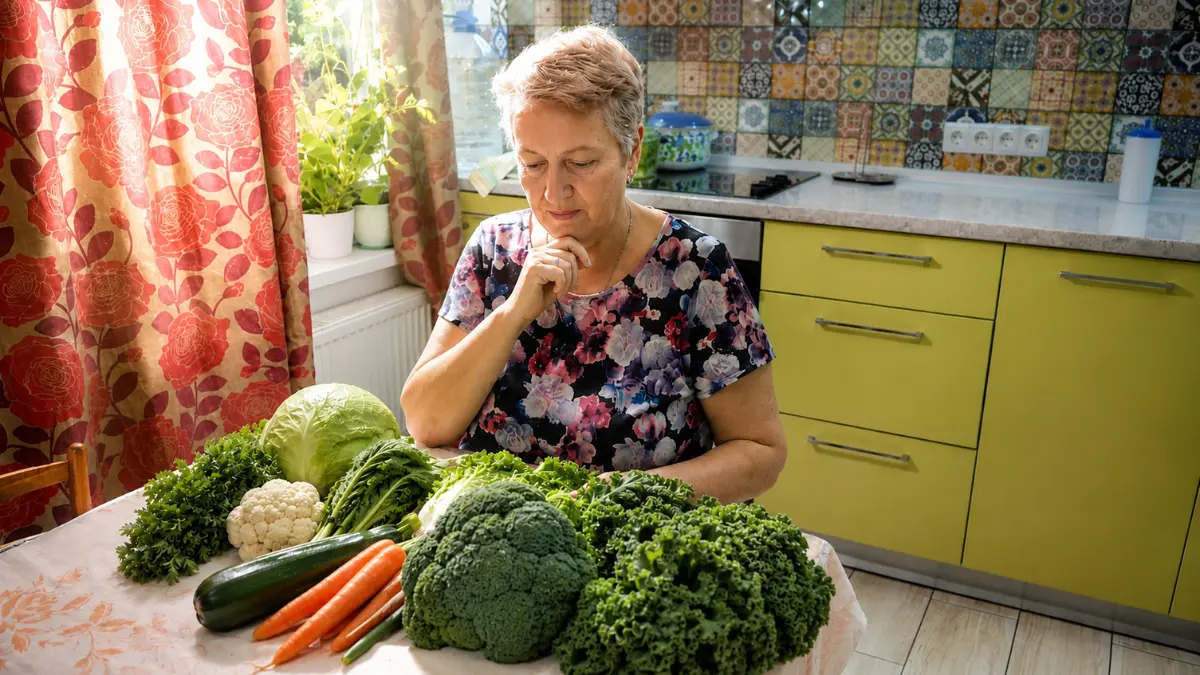
You add kale to the smoothie. You roast broccoli three nights a week. You’ve built the kind of diet every health article recommends, and your thyroid is still not cooperating.
The fatigue, the cold hands, the weight that won’t respond the way it used to. These symptoms show up in adults over 50 who eat well but still feel off, and they’re rarely traced back to the dinner plate.
Here’s the problem no one names directly: a family of compounds inside your most-praised vegetables can slow down your thyroid, the gland that regulates your energy, weight, and temperature. Past 50, that gland is already working harder just to keep up.
What you’ll discover in this article:
- Why the thyroid becomes more vulnerable precisely when healthy eating habits get more aggressive
- The one factor that determines whether your cruciferous vegetables are actually a problem
- What a four-week Brussels sprout trial revealed, and what it actually means for you
- How cooking method changes the risk equation in a way most food advice skips entirely
- The simple check that tells you whether any of this applies to your plate right now
Why Your Thyroid Is Already Under More Pressure After 50
Your thyroid has been losing ground for years before any symptom shows up. In older adults, the prevalence of subclinical hypothyroidism rises to between 3 and 16 percent, a range that reflects how quietly the shift happens.¹
Most people in that group feel something: a slower metabolism, a tendency to feel cold, energy that fades before noon. Nothing dramatic enough to send them to a doctor.
Subclinical hypothyroidism [mild thyroid underfunction where hormone levels are borderline low but lab results fall inside the normal range] is the specific condition that makes this age group more vulnerable.
The thyroid gland itself undergoes physical changes as the body ages: the tissue becomes more fibrous, the gland grows more nodular, and production of T3 [triiodothyronine, the form of thyroid hormone most directly available for the body to use] begins to fall in the oldest adults.²
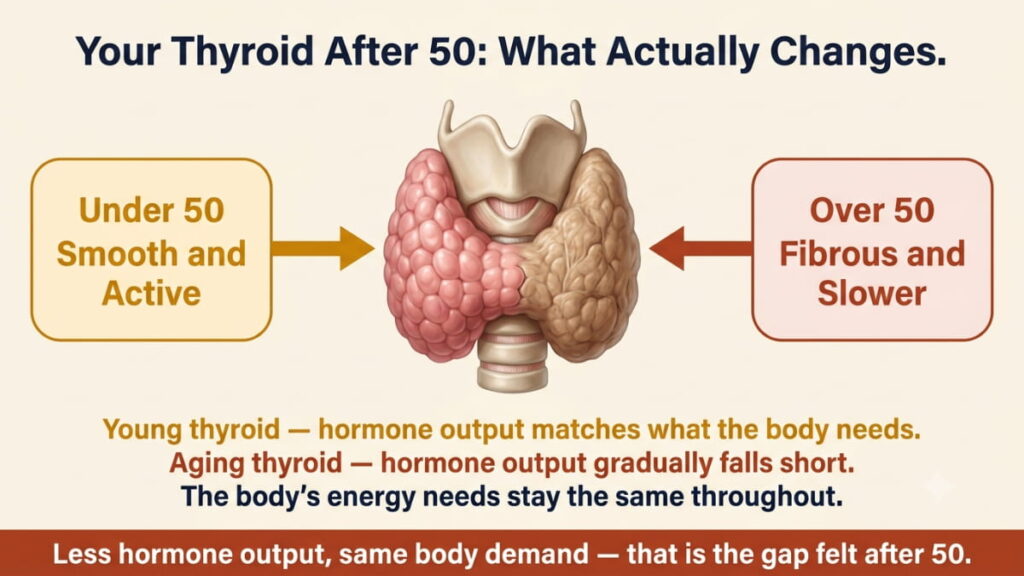
Demand stays the same. Output edges down.
This is the baseline. And it matters because anything that adds further drag on that function, including compounds in food, has more impact on a gland working close to its limit than it would on a younger, fully robust one.
Understanding this narrowed margin is what makes the food question worth asking at all.
The Three-Factor Collision Nobody Warns You About
You probably haven’t been told that three separate changes tend to converge around the same decade of life. Not because any one of them is catastrophic on its own, but because together they create a situation no individual warning label covers.
First factor: aging thyroid tissue. The gland becomes less efficient at producing hormones even without any external interference, as described in the previous section.
Second factor: declining iodine. Many adults over 50 gradually reduce their consumption of iodized salt and dairy products, two of the main dietary sources of iodine in the United States.
Iodine is the raw material the thyroid uses to build its hormones. Less iodine means less buffer against anything that blocks its uptake.
Third factor: the raw-vegetable habit. The past decade of health advice has pushed cruciferous vegetables harder than ever: kale smoothies, raw broccoli bowls, daily green juice.

These preparations maximize nutrient density while concentrating a group of compounds called glucosinolates [sulfur-containing plant chemicals that break down into goitrogenic substances during digestion, which can interfere with iodine uptake in the gland] in their most biologically active form.³
The kale smoothie you drink every morning to stay healthy may be the most thyroid-unfriendly thing on your counter, not because kale is bad, but because blending it raw concentrates the very compounds that block iodine uptake.
No single study tests all three of these factors together in the same group of adults. The connection is assembled from separate lines of evidence, each confirming one piece.
None of these three factors alone is likely to cause a clinical problem in most people. Together, they can.
But the research signal here is real: subclinical hypothyroidism already affects between 3 and 16 percent of adults over 60, yet the prevailing health narrative promotes heavy daily consumption of raw cruciferous vegetables without consistently flagging this gland’s reduced capacity to compensate.¹
The Surprising Truth About How Much Risk You Actually Carry
You’ve probably heard that cruciferous vegetables are dangerous for your health in this specific way. That’s the wrong conclusion from the right observation.
In one of the most cited human trials on this question, participants ate 150 grams of cooked Brussels sprouts every day for four weeks.⁴
Thyroid hormone levels, including TSH, T4, and T3, showed no meaningful change at the end of the study.⁴
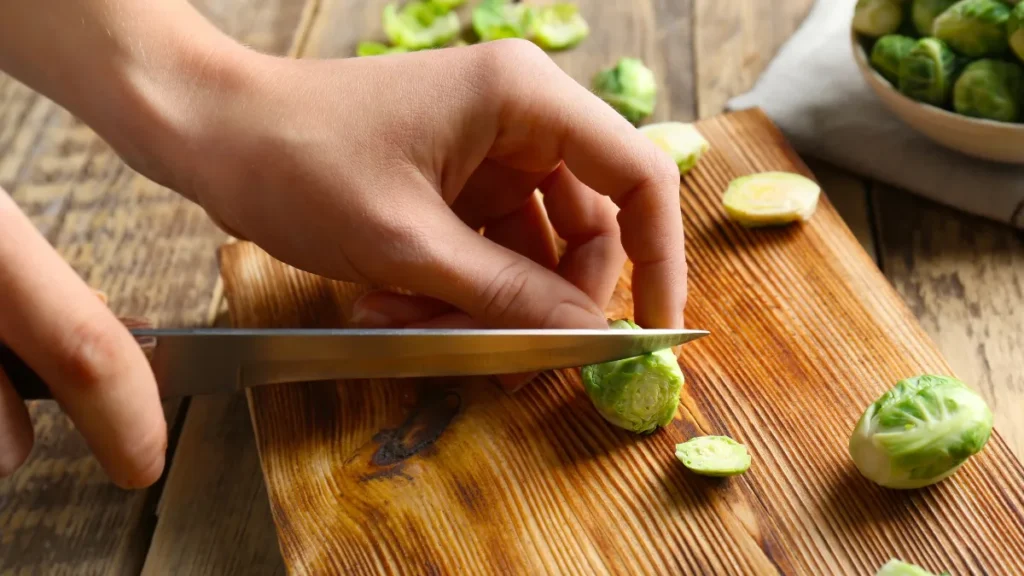
The same quantity consumed raw carries a meaningfully different risk profile, because the enzyme that produces the most active goitrogenic compounds is deactivated by heat.
A better question is not “are these vegetables safe” but “under which conditions do they become a problem.”
Three conditions appear to shift the risk significantly: eating large volumes of raw cruciferous vegetables consistently, having iodine intake at or below the recommended 150 micrograms per day, and having a thyroid gland already operating with reduced capacity.⁵
Remove even one of these three, and the risk drops substantially.
One reported case in the medical literature involved a woman who ate 1 to 1.5 kilograms of raw bok choy daily for several months, roughly 10 to 15 cups of raw leaves per day, and went into severe hypothyroid coma.⁶
Raw is the real variable here. Cooking changes the equation.
Why Iodine Status Changes Everything in This Equation
Cooking helps, but it is not the whole answer. The other half of the equation is whether your iodine supply is adequate to begin with.
When iodine stores are adequate, the gland has enough raw material to stay stable even when some iodine uptake is blocked.⁵ When iodine stores are low, any additional interference hits immediately.
The recommended daily intake for adults is 150 micrograms of iodine.⁵ The most accessible sources are iodized table salt, dairy products, eggs, and seafood.
Adults who follow low-sodium diets, avoid dairy, or shift toward plant-heavy eating without checking iodine status may be operating with a narrowed reserve without knowing it.
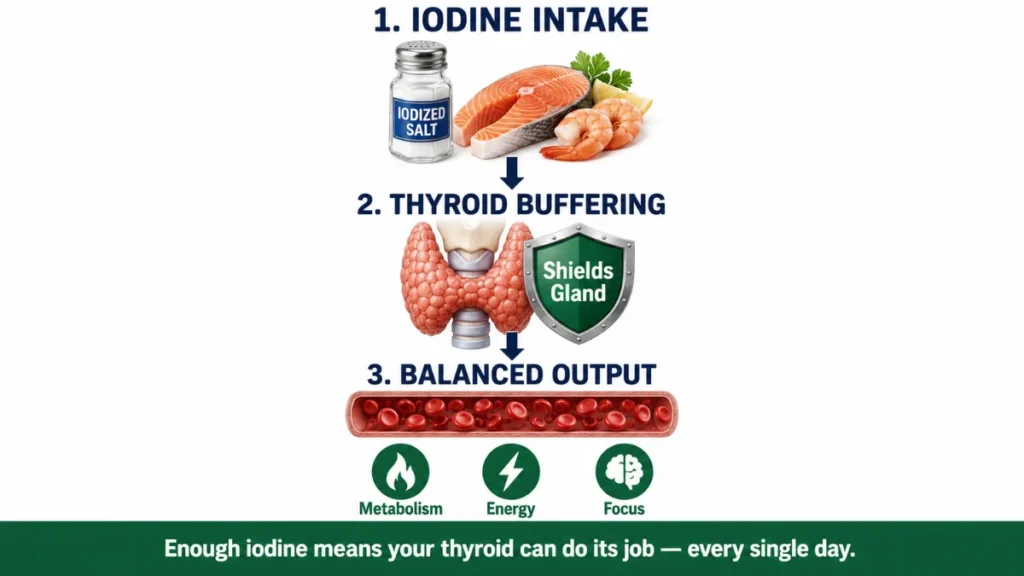
An endocrinologist at UCLA Health with expertise in thyroid and iodine nutrition has stated that adults with adequate iodine intake do not need to avoid cruciferous vegetables or soy when consumed in reasonable amounts.⁷
That recommendation contains its own important qualifier: adequate iodine.
Adequacy is not guaranteed. It has to be checked.
This is where the iodine story after 50 becomes most specific. Iodine adequacy removes most of the practical risk from normal cruciferous vegetable consumption. Inadequacy does not create a crisis, but it narrows the margin further in a gland already working at reduced efficiency.
The margin, not the vegetable, is the real concern here.
The Cooking Method That Solves Most of the Problem
Steaming your broccoli is not a compromise. It is a meaningful intervention.
When cruciferous vegetables are cut or chewed raw, a plant enzyme called myrosinase [an enzyme naturally present in cruciferous vegetables that, when activated by cutting or chewing, converts glucosinolates into their active goitrogenic form] activates and begins converting glucosinolates into their most thyroid-disruptive compounds. Heat inactivates myrosinase before that conversion fully occurs.⁸
Steaming cruciferous vegetables until cooked reduces their goitrogenic content by approximately two-thirds compared to the raw form.⁸
Boiling in water for 30 minutes reduces it further, eliminating up to 90 percent of the active compounds, because the water-soluble glucosinolates leach out of the vegetable.⁸
Cook it. Done.
Those three words are what the research earns: the practical answer fits in a single step.
Speak with your doctor before making significant dietary changes if you are managing a condition affecting this gland, taking levothyroxine or any related medication, or have been told your iodine or hormone levels need monitoring.
Simple cooking protocol for vegetable preparation:
- Steam broccoli, cauliflower, and cabbage until fully soft, not al dente
- Boil kale, collard greens, or Brussels sprouts in water and discard the cooking water when possible
- Use raw cruciferous vegetables occasionally rather than as the daily base of smoothies or salads
- If you take levothyroxine [a synthetic thyroid hormone taken by mouth to treat hypothyroidism], allow at least 60 minutes between your dose and your first meal, and note that high-fiber foods can reduce drug absorption⁹
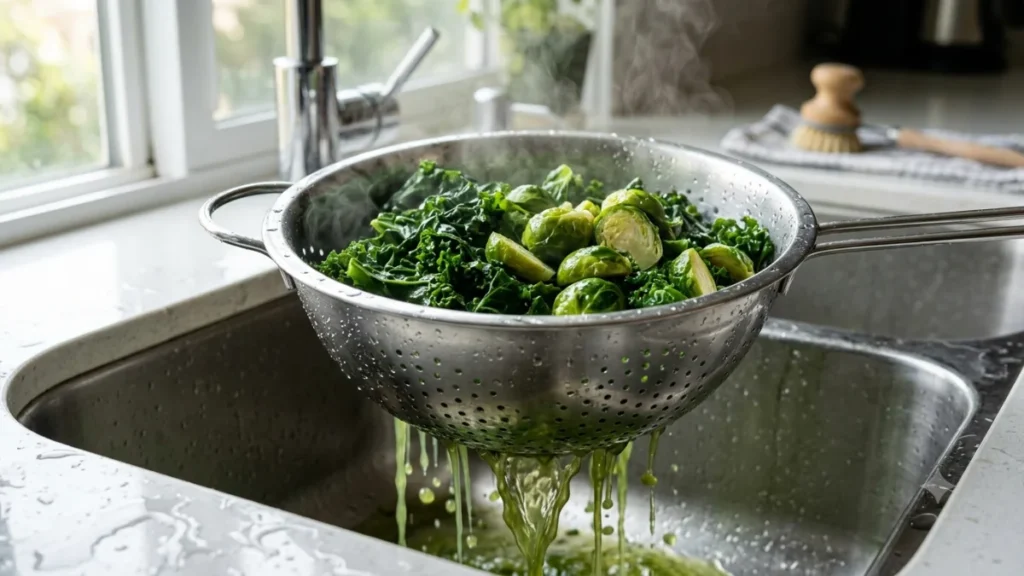
Collard greens, Brussels sprouts, and certain Russian kale varieties contain higher concentrations of goitrogenic precursors than broccoli, cauliflower, or turnip tops, which fall below 10 micromoles per serving.⁸ If you eat those higher-load vegetables, cooking matters most for those specific ones.
How to Keep the Vegetables and Protect the Thyroid
If you came here expecting a list of vegetables to cut out, you won’t find one. The evidence doesn’t support that conclusion for most people.
No human trial has demonstrated that eating normal amounts of cooked cruciferous vegetables causes hormonal dysfunction of this kind in adults with adequate iodine intake.⁴
The research supporting concern is largely drawn from animal studies, extreme case reports, and observational data from populations with iodine deficiency. Controlled trials testing moderate vegetable intake in otherwise healthy adults are absent.¹⁰
So the practical threshold for concern is higher than most headlines suggest.
Honest framing of current evidence is this: the risk is real, the threshold is high, and for most people with adequate iodine, cooking method closes most of the gap. For adults over 50 whose iodine status is uncertain, the picture is less clear.¹⁰
No randomized controlled trial has directly tested the combined effect of aging thyroid tissue, low iodine status, and regular raw cruciferous intake in the same group of adults.

What this article describes is assembled from separate lines of evidence, not from a single study that proves the connection end to end. That is a real limitation of the current research base.¹⁰
What the evidence does support is a simple framework. First, confirm your iodine status.
The NIH Office of Dietary Supplements provides a freely accessible guide to daily iodine requirements and food sources at ods.od.nih.gov/factsheets/Iodine-HealthProfessional.⁵
Second, cook the highest-risk vegetables. Third, if you take medication for this condition, time it carefully around food. Those three steps address every lever the current evidence identifies as meaningful.
The Vegetable Isn’t the Problem. The Context Is.
The question was never whether kale is good or bad. It’s whether your thyroid, your iodine status, and your preparation habits are aligned. For most adults over 50, cooking the vegetables closes most of the gap.
Ask your doctor to run a full thyroid panel at your next checkup, and mention how much raw cruciferous vegetables you eat each week.
Whether iodine testing becomes routine for adults over 50 who eat plant-heavy diets is a question the research hasn’t settled yet. That gap is worth knowing about.
⚠️DISCLAIMER
This article is for informational purposes only and does not constitute medical advice. If you have a thyroid condition or take thyroid medication, consult your doctor before making dietary changes.
References
- Gesing A. The thyroid gland and the process of aging. PMC. 2015. PMCID: PMC4480281. https://pmc.ncbi.nlm.nih.gov/articles/PMC4480281/
- Ajish TP, Jayakumar RV. Geriatric thyroidology: An update. Indian Journal of Endocrinology and Metabolism. 2012. PMCID: PMC3401753. https://pmc.ncbi.nlm.nih.gov/articles/PMC3401753/
- Felker P, Bunch R, Leung AM. Concentrations of thiocyanate and goitrin in human plasma, their precursor concentrations in brassica vegetables, and associated potential risk for hypothyroidism. Nutrition Reviews. 2016. https://pmc.ncbi.nlm.nih.gov/articles/PMC4892312/
- McMillan M, Spinks EA, Fenwick GR. Preliminary observations on the effect of dietary Brussels sprouts on thyroid function. Human Toxicology. 1986. https://pubmed.ncbi.nlm.nih.gov/2419242/
- National Institutes of Health Office of Dietary Supplements. Iodine: Fact Sheet for Health Professionals. NIH ODS. 2024. https://ods.od.nih.gov/factsheets/Iodine-HealthProfessional/
- Chu M, Seltzer TF. Myxedema coma induced by ingestion of raw bok choy. New England Journal of Medicine. 2010. https://www.nejm.org/doi/full/10.1056/NEJMc0911005
- Leung AM, Acosta GJ. “Thyroid Diet’: What’s the Evidence?” Medscape. December 31, 2020. https://www.medscape.com/viewarticle/943151
- Panduang T, Phucharoenrak P, Karnpanit W, Trachootham D. Cooking Methods for Preserving Isothiocyanates and Reducing Goitrin in Brassica Vegetables. Nutrients. 2023.https://www.ncbi.nlm.nih.gov/pmc/articles/PMC10573036/
- Wiesner A, Gajewska D, Paśko P. Levothyroxine Interactions with Food and Dietary Supplements–A Systematic Review. Nutrients. 2021. https://www.ncbi.nlm.nih.gov/pmc/articles/PMC8002057/
- Galanty A, Grudzińska M, Paździora W, Służały P, Paśko P. Do Brassica Vegetables Affect Thyroid Function?—A Comprehensive Systematic Review. PMC. 2024. PMCID: PMC11012840. https://www.ncbi.nlm.nih.gov/pmc/articles/PMC11012840/