
You have done everything right. You take your calcium. You take your vitamin D. You have a drawer full of bottles.
You still wonder if any of it is working.
Here is a thought you may have had but never said out loud: maybe the problem is not the amount. Maybe it is the method.
The real difference between Japanese women food nutrients and a Western supplement stack is not the molecule. It is the delivery system.
After 60, absorption drops and the margin for error gets smaller.
Women over 60 who are already taking supplements will learn here which three foods close the gap their capsules cannot.
This article is for informational purposes only and does not constitute medical advice. The foods and nutrients discussed are not intended to diagnose, treat, or prevent any condition. Consult your doctor before making changes to your diet, especially if you take warfarin or other medications affected by vitamin K.
What Japanese Women Food Nutrients Contain That a Pill Cannot Replicate
You pick up a supplement bottle and read the number. 400 mg magnesium. 1,000 IU vitamin D. You swallow the capsule and wonder whether that number actually reaches your bones.
The label does not tell you this. A nutrient inside food does not travel alone. It arrives with cofactors.
Cofactors are the helper compounds your body uses to absorb and activate the main nutrient.
When you eat magnesium inside a whole food, it comes with proteins, fibers, and minerals your gut already knows. When you take a capsule, the nutrient arrives alone.
Writing in the American Journal of Clinical Nutrition, Jacobs, Gross, and Tapsell argued that evidence of health benefit appears stronger for a whole dietary pattern than for individual foods or food constituents.1
A nutrient in a supplement arrives alone. A nutrient in food arrives with teammates. The body performs better with teammates.
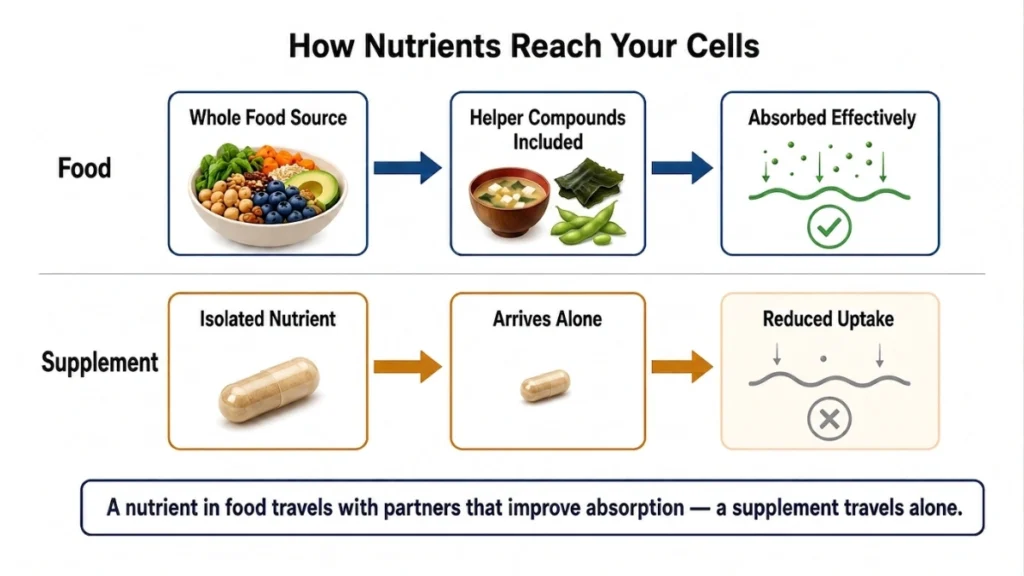
Japanese women food nutrients work this way. The advantage is not a better molecule. It is a better delivery system. That is what this article demonstrates.
This is not a new idea in nutrition science. The concept has a name: food synergy.
It means the health effect of nutrients eaten together inside a real food is greater than the effect of the same nutrients eaten separately as supplements.
The question is which specific foods carry that system, and whether you can add them to a meal you already cook.
The Calcium Gap: Why Wakame Outperforms a Tablet
You take calcium because bone loss speeds up after menopause. That instinct is correct. But calcium alone cannot do the job.
One pattern is consistent across Japanese women food nutrients studies: calcium always travels with its cofactors in traditional diets. In a supplement, it travels alone.
Your body needs magnesium to process calcium. It needs vitamin K2 to direct calcium into bone tissue instead of soft tissue.
A standard calcium carbonate tablet delivers one mineral and leaves out both partners.
In 100 grams of wakame, you get approximately 150 mg of calcium alongside 107 mg of magnesium.2 Wakame delivers two of those three partners in one bowl. The third, vitamin K2, arrives through natto.
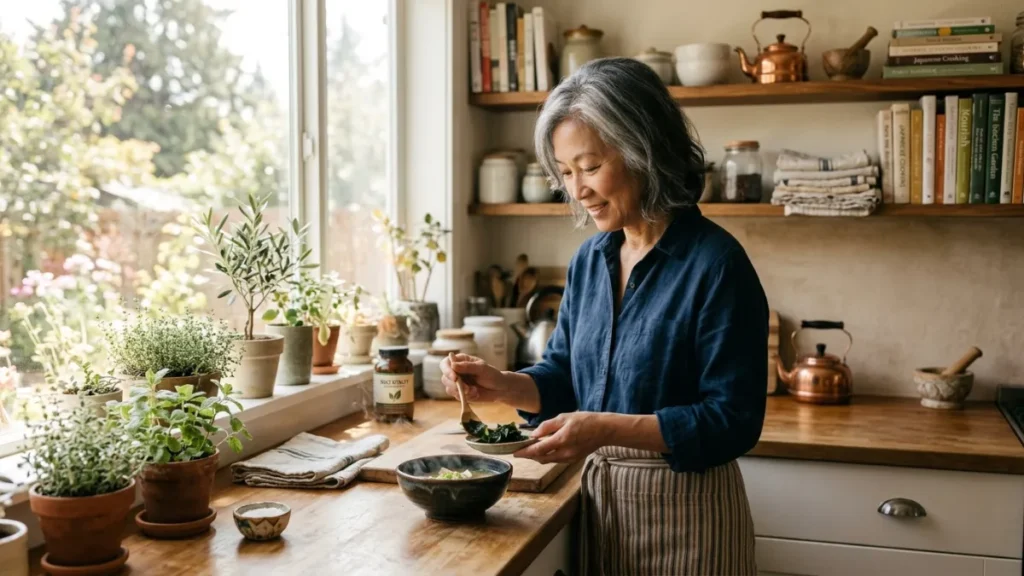
A normal serving is one to two tablespoons of rehydrated wakame in miso soup. That brings 15 to 30 mg of calcium with its cofactors already present.
The calcium does not wait for its partners. They are already there.
Here is the contradiction worth sitting with. You may absorb less usable calcium from a high-dose tablet than a Japanese woman absorbs from soup.
Her bowl delivers calcium and magnesium together. Yours delivers calcium alone.
Natto and the Bone Loss Numbers
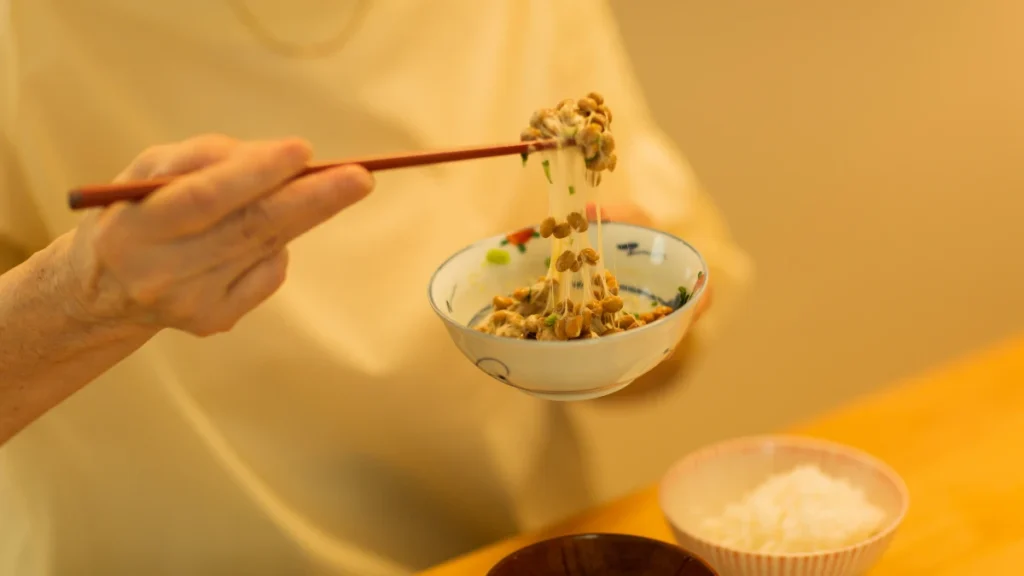
Natto is a fermented soybean food most Americans have never tried. It is sticky. It has a strong smell.
It is one of the richest dietary sources of MK-7 on the planet.
MK-7 is menaquinone-7, a form of vitamin K2. Plain language: it is the compound that activates the protein your bones use to lock calcium into place.
Without enough MK-7, calcium stays in your blood. It does not reach bone.
One 40-gram pack of natto, a single Japanese serving, contains approximately 380 micrograms of MK-7.3
Population data from Japan tells a clear story. Post-menopausal women who ate more than four natto packs per week lost femoral neck bone mineral density at 0.5 percent per year. Women who ate no natto lost it at 1.6 percent per year.4
Women who ate natto regularly lost femoral neck bone at less than one-third the speed of women who ate none.4
That gap is not explained by genes or luck. It is explained by what was on the plate.
The delivery of vitamin K2 through food, not a capsule, is the variable that changed outcomes.
You can buy a K2 supplement with MK-7. The molecule is identical. But natto is a whole soybean food, and it carries protein and other soy compounds the capsule does not include.
The food-first data is stronger than the supplement data. The research has not fully explained why.
What it shows is that the whole food produces better outcomes in real women.
That is the consistent finding across Japanese women food nutrients research: the matrix matters as much as the molecule.
The Soy Isoflavone Confusion: Why Supplement Trials Mislead
A two-year trial gave post-menopausal women 300 mg of isolated soy isoflavones per day. At the end of two years, bone mineral density had still declined. It matched placebo.5
Isoflavones are plant compounds with a structure loosely similar to estrogen. Plain language: they act like a weaker, plant-based version of estrogen in bone tissue.
So why does a Japanese dietary pattern consistently show stronger bones in older women, if the isolated compound failed in a controlled trial?
The answer is delivery form. Isoflavone interventions with at least 50 mg of genistein per day can effectively improve bone mineral density in post-menopausal women.6
Genistein is one specific isoflavone. Traditional Japanese diets deliver it through edamame, miso, and natto daily.
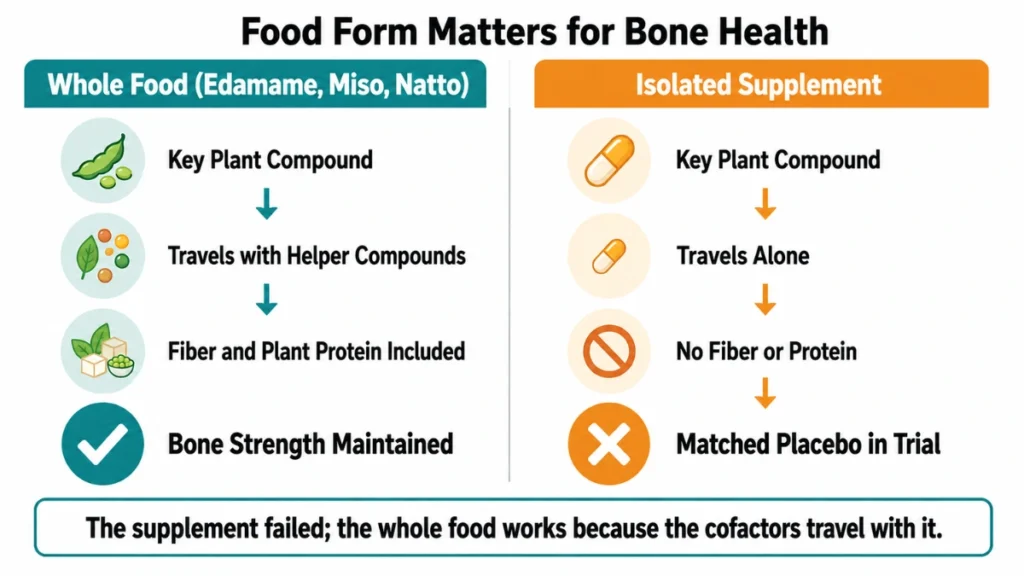
It travels with fiber, plant protein, and cofactors that change how the body uses it. A supplement isolates it from all of those.
Here is the next danger. If you read that soy supplements do not help bones and stop eating soy foods, you lose the delivery advantage the trials were never testing.
Why Miso Does What Your Probiotic Attempts
Safety caveat: Miso is high in sodium. If you have high blood pressure, use low-sodium miso and limit to one small bowl a day. Check the label too, because shelf-stable miso is usually pasteurized and will not carry live organisms.
People on warfarin should speak with their doctor before adding natto, because its high vitamin K2 content can affect medication dosage.
Raw soybeans contain phytic acid. Phytic acid is a mineral blocker. It binds to calcium, magnesium, and zinc in your gut and stops your body from absorbing them.
Fermentation breaks phytic acid down. It changes the minerals left behind from a large molecular form to a smaller, more absorbable one. 7,8
Smaller molecules absorb more easily. That is the mechanism.
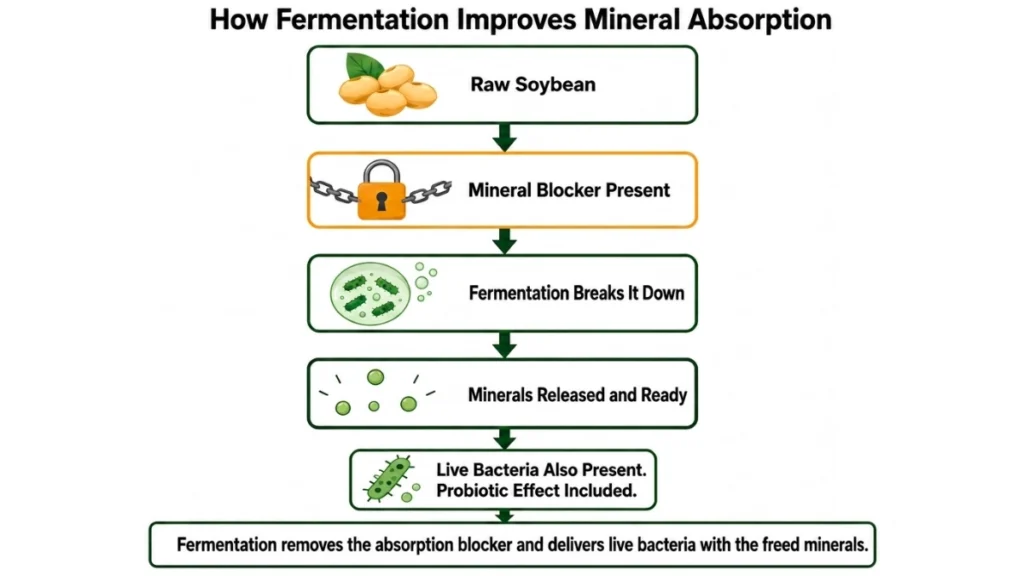
Unpasteurized miso carries live organisms alongside those minerals. A probiotic capsule delivers organisms alone. Miso delivers them together with the more absorbable minerals fermentation left behind.
A large Japanese cohort study following 92,915 adults for roughly fifteen years found that those who ate the most fermented soy, primarily natto and miso, had about a 10% lower risk of death from all causes compared with those who ate the least.9
One bowl of miso does the work of two supplements. A probiotic capsule cannot also remove the mineral blocker that was preventing absorption in the first place.
Ikeda’s cohort and Katagiri’s cohort never overlapped. One study was measuring femoral neck bone loss. The other was tracking who died over fifteen years. Neither was designed to test the other’s question. But both found the same internal contrast: women eating fermented soy had better outcomes. Women eating tofu or other unfermented soy forms did not. Two different researchers. Two different outcomes. One consistent finding.
This is the mechanism behind Japanese women food nutrients: the food removes the obstacle and delivers the nutrient at the same time.
The Four Supplements Edamame Replaces
Most women over 60 carry at least four of these on their shelves.
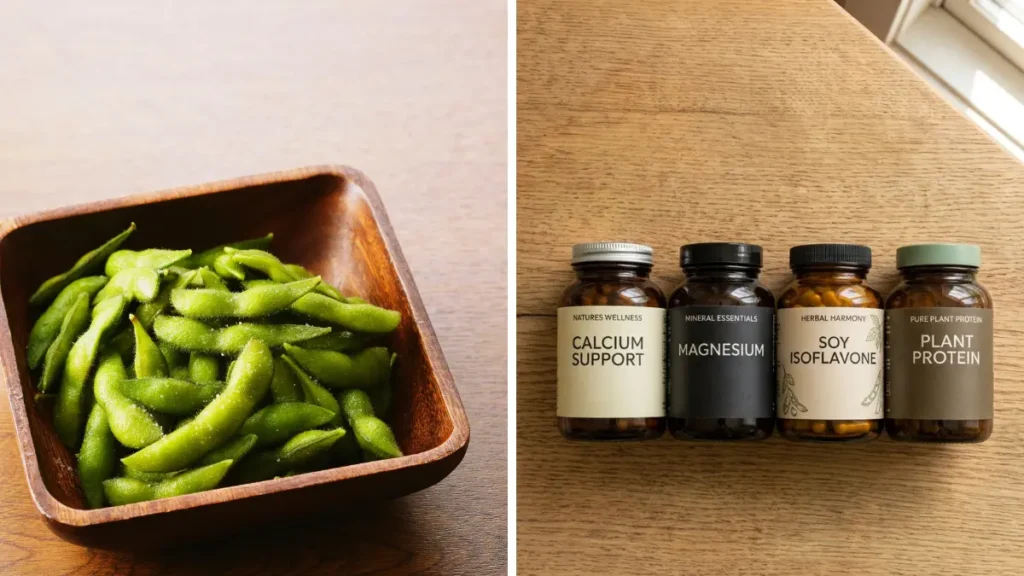
What half a cup of edamame covers:
- Calcium support: Edamame delivers magnesium and isoflavones together, supporting how bones use calcium, without the cofactor problem of an isolated calcium tablet.
- Isoflavone intake: Edamame delivers genistein inside a whole food matrix, the form bone research actually supports.
- Magnesium intake: Half a cup of shelled edamame contains approximately 50 mg of magnesium alongside plant protein and fiber.10
- Plant protein: Edamame provides roughly nine grams of complete plant protein per half cup, supporting both muscle and bone mass.10
The supplement you are most likely missing is not a fifth bottle. It is one food that covers the ground of four.
You have been buying four products to fill four gaps. Half a cup of edamame at dinner covers that same ground.
It delivers what those capsules were built to promise, inside a matrix that actually works.
Japanese women food nutrients are not exotic. Edamame is on the menu at every sushi restaurant.
Miso comes in a jar at most grocery stores. Natto is in the freezer section at Asian markets.
These are not supplements pretending to be food. They are the original delivery system that supplements were designed to copy.
That is the short version of what sets Japanese women food nutrients apart from a bottle on a shelf.
Among G7 nations, life expectancy and healthy life expectancy are both longest in Japan, and longevity is particularly high in women.11
The pattern in Japanese women food nutrients research does not point to a single pill. It points to a daily habit made of real food.
What to Do Next
Start with one food, not three. Add it to a meal you already cook this week.
Before you open another supplement bottle, pick one of these three foods, natto, edamame, or miso, and add it to a meal you are already making this week.
The delivery system is already working. You do not have to change everything to start.
References
- Jacobs DR Jr, Gross MD, Tapsell LC. Food synergy: an operational concept for understanding nutrition. American Journal of Clinical Nutrition. 2009;89(5):1543S-1548S. https://www.sciencedirect.com/science/article/pii/S000291652323823X
- USDA FoodData Central. Seaweed, wakame, raw. SR Legacy FDC ID 170496. https://fdc.nal.usda.gov/food-details/170496/nutrients
- Fujita Y, Iki M, Tamaki J, et al. Association between vitamin K intake from fermented soybeans, natto, and bone mineral density in elderly Japanese men: the FORMEN study. Osteoporosis International. 2012;23(2):705-714. https://www.med.kindai.ac.jp/life/files/h23/2012022301_iki.pdf
- Ikeda Y, Iki M, Morita A, et al.Intake of Fermented Soybeans, Natto, Is Associated with Reduced Bone Loss in Postmenopausal Women: Japanese Population-Based Osteoporosis (JPOS) Study. Journal of Nutrition. 2006;136(5):1323-1328. https://jn.nutrition.org/article/S0022-3166(22)08249-9/fulltext
- Tai TY, Tsai KS, Tu ST, et al. The effect of soy isoflavone on bone mineral density in postmenopausal Taiwanese women with bone loss: a 2-year randomized double-blind placebo-controlled study. Osteoporosis International. 2012;23(5):1571-1580. https://pmc.ncbi.nlm.nih.gov/articles/PMC3332377/
- Inpan R, Na Takuathung M, Sakuludomkan W, et al. Isoflavone intervention and its impact on bone mineral density in postmenopausal women: a systematic review and meta-analysis of randomized controlled trials. Osteoporosis International. 2024;35(3):413-430. https://pubmed.ncbi.nlm.nih.gov/37875614/
- Nkhata SG, Ayua E, Kamau EH, Shingiro JB. Fermentation and germination improve nutritional value of cereals and legumes through activation of endogenous enzymes. Food Science and Nutrition. 2018;6(8):2446-2458. https://pmc.ncbi.nlm.nih.gov/articles/PMC6261201/
- Gan J, Kong X, Wang K, et al. Effect of fermentation using different lactic acid bacteria strains on the nutrient components and mineral bioavailability of soybean yogurt alternative. Frontiers in Nutrition. 2023;10:1198456. https://www.frontiersin.org/journals/nutrition/articles/10.3389/fnut.2023.1198456/full
- Katagiri R, Sawada N, Goto A, et al. Association of soy and fermented soy product intake with total and cause specific mortality. BMJ. 2020;368:m34. https://www.bmj.com/content/368/bmj.m34
- USDA FoodData Central. Edamame, frozen, prepared. SR Legacy FDC ID 168411. https://fdc.nal.usda.gov/food-details/168411/nutrients
- Tsugane S. Why Japan has become the world’s most long-lived country. European Journal of Clinical Nutrition. 2021;75:921-928. https://www.nature.com/articles/s41430-020-0677-5