
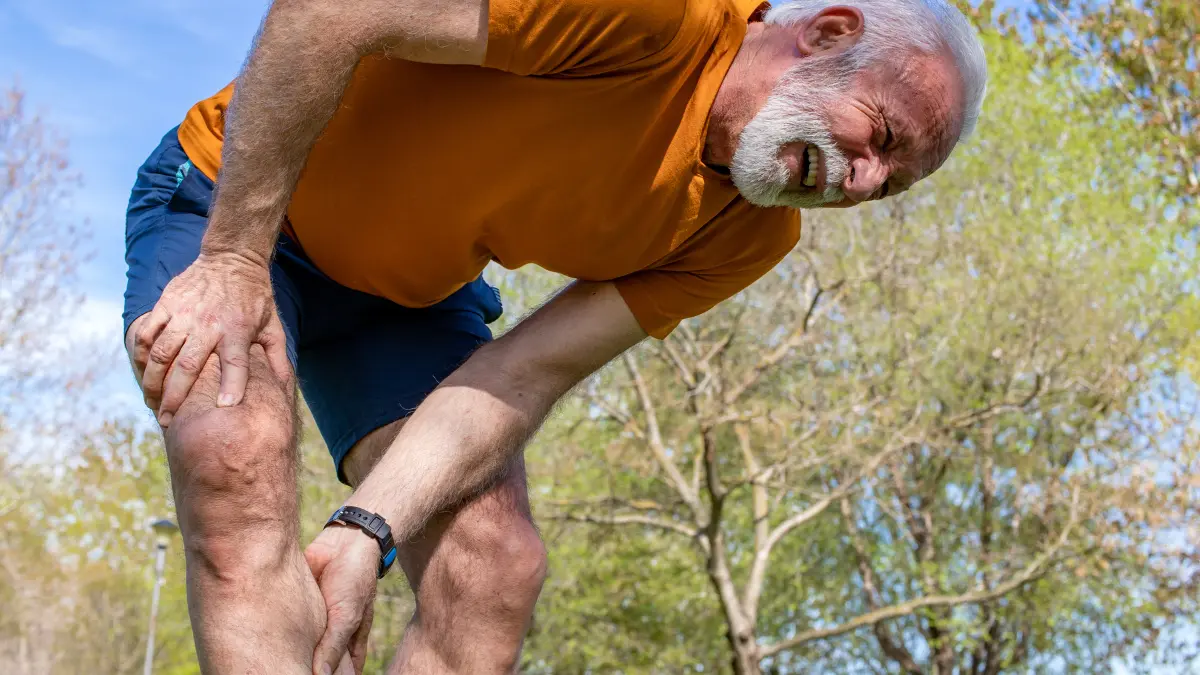
You finished the workout, drove home, felt perfectly fine, and then woke up two days later unable to walk down the stairs without gripping the railing. If you’re over 50 and exercise regularly, you already know this experience.
What you might not know is why delayed muscle soreness happens on that timeline, or what it actually means for your recovery.
This article explains the full timeline, from the moment you leave the gym feeling great to the moment the soreness peaks, and what adults over 50 should do differently because of it. You will not need to quit the workout. You may need to rethink when you intervene.
| # | What’s Coming | Open Question |
|---|---|---|
| 1 | Why nothing hurts yet | Why does the gym feel easy if damage is already happening? |
| 2 | Inside the muscle at hour 12 | What’s the body actually doing while you feel fine? |
| 3 | The 48-hour pain peak explained | If repair starts right away, why does the pain keep building? |
| 4 | Age is not the reason | If it’s not your age, what actually changed? |
| 5 | The window most people miss | When is the only time intervention actually works? |
| 6 | What the soreness is telling you | Is this a sign of progress or a warning you should stop? |
Why You Feel Nothing During the Workout
You feel fine at the gym because the type of movement most likely to cause delayed muscle soreness doesn’t produce much burn in the moment.¹ The damage happens quietly.
Eccentric contractions [muscle movements where the fiber is lengthening under load, such as the lowering phase of a squat or the downward part of a bicep curl] do more structural work on the muscle than the lifting phase does, but they also require less effort from your nervous system to execute.¹
That mismatch is exactly why you can walk out of the gym feeling strong and still be unable to sit down two days later.
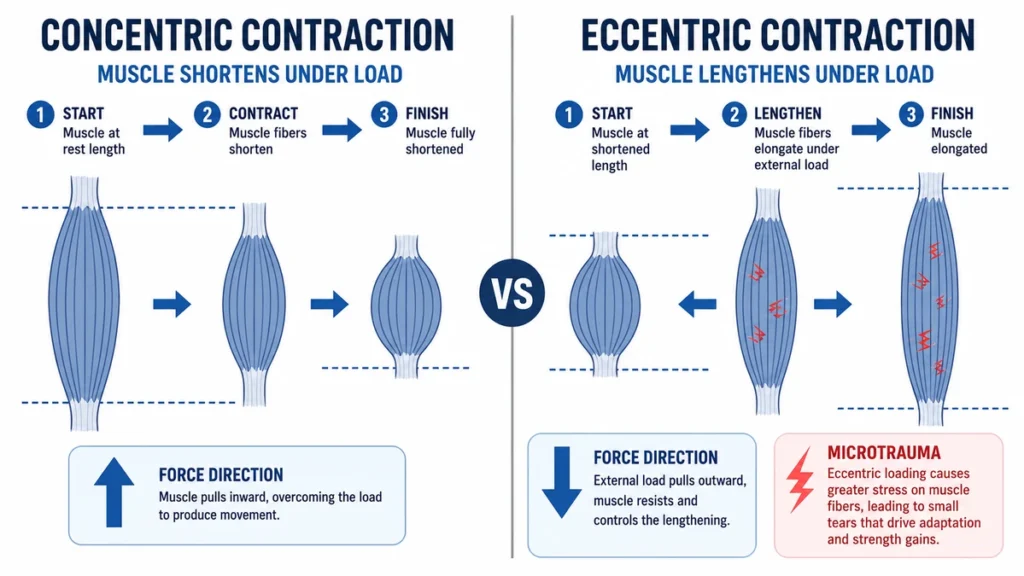
The nerve endings inside the muscle don’t respond to the tiny structural disruptions happening during exercise. They respond to chemical signals that accumulate afterward.¹ At the moment of the workout, those chemicals haven’t yet built up enough to reach the pain threshold.
The pain threshold [the level of stimulation the nervous system needs to register something as painful] simply isn’t crossed during the workout itself. The damage is real. The chemistry that registers it just runs on a delay.¹
Your body also suppresses pain signals during intense movement through heightened activity in the part of the nervous system that controls the stress response.¹ Once you stop exercising and that response winds down, the suppression fades with it.¹
That is why the gym feels fine. The next section explains what the body is already doing in the hours after you leave.
What Is Actually Happening Inside Your Muscle in the First 12 Hours
You finished the workout, drove home, made dinner, and felt nothing. That window of feeling fine is not rest. The repair process was already open.
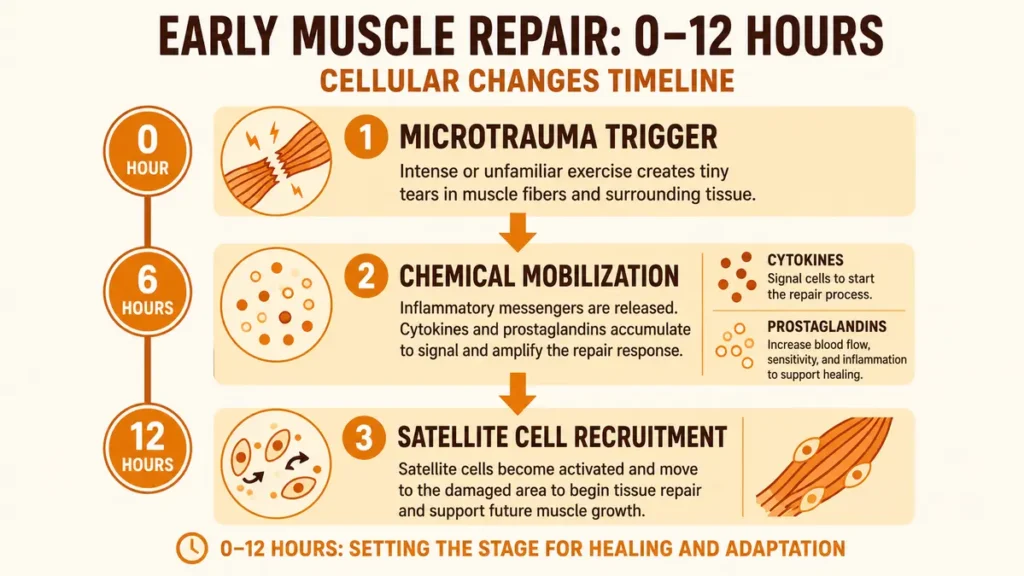
Within minutes of eccentric exercise, the structural disruption in muscle fibers triggers an inflammatory response.²
Cytokines [protein signals the body uses to coordinate the immune response] begin accumulating at the site of the microtrauma. Prostaglandins [chemical messengers that will eventually sensitize pain receptors] are produced by immune cells moving into the area.²
At this stage, their concentration is not yet high enough to reach the nerve threshold that registers pain.²
Satellite cells [the stem cells of muscle tissue that repair and rebuild damaged fibers] are recruited within hours of the exercise bout.² This is the growth signal. The same cascade that will eventually make you sore is also the mechanism that makes the muscle stronger.²
You may have assumed the soreness was the damage. It isn’t. The soreness is the notification, sent hours after the fact.
The pain-producing chemicals need time to accumulate.² In those first 6 to 12 hours, the inflammation is real and measurable in the blood, but the nerve endings haven’t been sufficiently sensitized to produce the aching you’ll feel by tomorrow morning.²
Why does it keep building after that window?
Why the Soreness Peaks at 24 to 48 Hours, Not Sooner
The pain gets worse after the workout, not because new damage is happening, but because the chemicals that register damage keep accumulating.³
Bradykinin [a chemical the body produces during inflammation that directly activates pain receptors] and prostaglandins [introduced in the previous section] reach their highest concentrations in the 24 to 48 hours after eccentric exercise.³
As those concentrations climb, they progressively sensitize the nociceptors [the nerve endings that detect and transmit pain signals] inside the muscle.³
The result is that pressure that felt perfectly normal on Tuesday morning becomes painful by Wednesday night, even though nothing new has broken.
Peak soreness is a chemical peak.
Not a damage peak.
This is why chasing the soreness with ice baths at hour 48 is like calling the fire department after the house already burned. The structural damage was done the moment you finished your last rep; trying to fix the ‘soreness’ now doesn’t undo the micro-tears that already occurred.³
Research shows that DOMS typically peaks between 24 and 72 hours after exercise and subsides within five to seven days as the inflammatory mediators clear and the sensitized nerve endings return to their normal threshold.³
The pain you feel on day two or three is not the moment of maximum injury. It is the delayed receipt for work that was already done.
Most people who train after 50 have already asked this.
Why Age Is Not the Reason You Hurt More After 50 (And What Is)
You may have blamed your age. Most people do. The research says something different.
A 2025 systematic review and meta-analysis of 36 studies found that advancing age is not associated with greater exercise-induced muscle damage.⁴
Muscle soreness levels, strength loss after exercise, and markers of muscle breakdown in the blood were not meaningfully different between older and younger adults across those studies.⁴
The structural damage from an eccentric workout is roughly the same whether you are 28 or 58.⁴
What does change is how well the body damps down the pain once it starts.⁵
Older adults have less effective endogenous pain inhibition [the body’s own internal system for reducing pain signals after they are generated].⁵ This means the pain that both age groups produce gets quieter faster in younger adults and lingers longer in older ones.⁵
The same chemical peak produces a different subjective experience.

The other real variable is novelty.
In clinical and training contexts, this often shows up as: the muscle groups that produce the most severe delayed muscle soreness in adults over 50 are not the ones that worked hardest, but the ones that absorbed unexpected eccentric load during a movement that felt routine.
A common example is the quads absorbing body weight while walking downhill after a leg session, or the hamstrings during a lunge angle that was slightly different from last week.
Type II muscle fibers [the fast-twitch fibers involved in power and quick movements, which decline with age] are less abundant in older adults, which means the eccentric load gets distributed differently across the remaining fibers.⁴
A stimulus that was routine a year ago may be a genuinely new load on the current composition of the muscle.
Age is not the problem. Eccentric novelty is.
The Recovery Window Most People Miss Entirely
Most people try to manage soreness when they feel it. By then, the most useful window for intervention has already passed.
The body’s repair process begins within hours of the workout, not when the pain peaks.⁶
The protein synthesis response, the process by which the body uses amino acids to rebuild damaged muscle fibers, is elevated for several hours after exercise and then begins to decline.⁶
Waiting until day two to eat well, rest, or do anything intentional about recovery is waiting past the window that mattered.
Talk to your doctor before changing your exercise or nutrition routine if you’re managing a chronic condition, on medication, or recovering from a recent injury.
Three things that work with the repair window, not against it:
- Eat protein within 90 minutes of finishing. Research in healthy adults shows that consuming protein in the post-exercise period supports the muscle protein synthesis response elevated by the workout.⁶ A whole-food source such as eggs, Greek yogurt, or chicken is sufficient.
- Take a short walk within 24 hours. Light movement in the day following exercise is associated with reduced DOMS and improved clearance of inflammatory byproducts.⁷ It does not need to be intense.
- Protect sleep that night. Muscle protein synthesis rates are elevated during overnight sleep, making it a primary window for cellular repair.⁸ Cutting sleep short is associated with reduced recovery from exercise.

Many people get this wrong: applying heavy ice or cold immersion at peak soreness (hour 24 to 48) may reduce how much you feel, but research in healthy adults suggests it can blunt the inflammatory signals that drive the repair and adaptation process.⁹
Most of this research was conducted in younger adults, so the exact magnitude of the effect in adults over 50 has not been established in controlled trials. The principle is this: the inflammatory response is part of the repair, not a problem to eliminate, and that holds regardless of age.
Intervening at hour 48 is treating the notification of delayed muscle soreness. The useful work happens at hours one through 12.
What the Soreness Is Telling You
Mild to moderate soreness two days after a workout is information. It is not a warning to stop training.
The American College of Sports Medicine notes that delayed muscle soreness typically begins developing 12 to 24 hours after exercise, peaks at 24 to 72 hours, and is mostly resolved within three to five days.¹⁰
Pain that fits that profile and is spread across a muscle group, dull rather than sharp, is the normal response to a sufficient training stimulus.

These patterns point toward something other than DOMS:
- Pain that is sharp or localized to a single point rather than spread across the muscle
- Pain that starts during the workout rather than a day later
- Pain located in a joint or tendon rather than the muscle belly
- Pain that gets worse over three or more days instead of fading
- Significant swelling or bruising at the site
Soreness that doesn’t fit the DOMS timeline, or that keeps intensifying past the 72-hour mark, warrants a conversation with a doctor or sports medicine provider.
The soreness you feel two days after a good workout is the body’s receipt for work done. Reading it accurately is more useful than trying to silence it.
The Delay Is the Process
The most important thing to understand about delayed muscle soreness after a workout is that the timing gap between damage and pain is not a malfunction. It is how muscle repair works.
Reduce the intensity of the eccentric portion of your workouts for the next two weeks and track whether your soreness timing or severity changes. That one variable, more than anything else, predicts how much soreness you carry into the week.
Muscle soreness after a workout is a signal worth reading. It stops being useful when you try to outrun it.
⚠️DISCLAIMER:
This article is for informational purposes only and does not constitute medical or professional fitness advice. The content addresses delayed muscle soreness, its causes, and post-workout recovery timing and is intended for general educational purposes only. Exercise carries inherent risk, consult a qualified healthcare or fitness professional before beginning or modifying any training program, particularly if you have an existing injury or medical condition.
References
- Kancherla et al. “Advances in Non-Pharmacological Strategies for DOMS: A Scoping and Critical Review of Recent Evidence.” Journal of Functional Morphology and Kinesiology (MDPI). 2025. https://www.mdpi.com/2411-5142/10/4/452
- Pereira Pinto Lambertucci et al. “Pathophysiology of Exercise-Induced Muscle Damage and Its Structural, Functional, Metabolic, and Clinical Consequences.” PMC / International Journal. 2021. https://pmc.ncbi.nlm.nih.gov/articles/PMC8549894/
- Petrucci et al. “Insights into the Molecular Etiology of Exercise-Induced Inflammation.” Journal of Inflammation Research (Dove Press). 2016. https://www.dovepress.com/insights-into-the-molecular-etiology-of-exercise-induced-inflammation–peer-reviewed-fulltext-article-JIR
- Tucker et al. “Advancing Age Is Not Associated With Greater Exercise-Induced Muscle Damage: A Systematic Review, Meta-Analysis, and Meta-Regression.” PubMed. 2025. https://pubmed.ncbi.nlm.nih.gov/40174882/
- Wood et al. “Physiological Changes From Ageing Regarding Pain Perception and Its Impact on Pain Management for Older Adults.” PMC. 2022. https://pmc.ncbi.nlm.nih.gov/articles/PMC9345212/
- Churchward-Venne et al. “Achieving Optimal Post-Exercise Muscle Protein Remodeling in Physically Active Adults Through Whole Food Consumption.” PMC / Nutrients. 2018. https://pmc.ncbi.nlm.nih.gov/articles/PMC5852800/
- Dupuy et al. “An Evidence-Based Approach for Choosing Post-exercise Recovery Techniques to Reduce Markers of Muscle Damage, Soreness, Fatigue, and Inflammation: A Systematic Review With Meta-Analysis.” Frontiers in Physiology. 2018. https://pmc.ncbi.nlm.nih.gov/articles/PMC5932411/
- Erlacher and Vorster. “Sleep and muscle recovery: Current concepts and empirical evidence.” Current Issues in Sport Science. 2023. https://ciss-journal.org/article/view/9347
- Fyfe et al. “Cold water immersion attenuates anabolic signaling and skeletal muscle fiber hypertrophy, but not strength gain, following whole-body resistance training.” Journal of Applied Physiology. 2019. https://journals.physiology.org/doi/full/10.1152/japplphysiol.00127.2019
- American College of Sports Medicine. DOMS brochure: delayed onset muscle soreness characteristics and guidelines. ACSM. Current. https://pdfs.semanticscholar.org/f7f8/df8a4dcc9f5d6cc480e9f85bf9a9d4b2e6bf.pdf