You lace up every morning. You hit your step goal.
You feel better than you did at 45. So it comes as a quiet shock when a bone scan or a stumble on the stairs reminds you that something has been slipping anyway.
Walking after 50 is genuinely good for you, but it was built for a different job than the one your bones and muscles need most.
If walking is your only exercise, it is likely slowing your bone and muscle loss but not stopping it, and most adults over 50 who walk regularly and think that’s enough won’t find out until a fracture or a fall tells them.
Why keep reading?
- The one thing walking does better than almost any other exercise, and why it still isn’t enough
- Which bones your daily walk almost never reaches
- The specific type of muscle fiber you lose fastest after 50, and why daily walks don’t recruit it
- A real plan that keeps your walks and adds what they’re missing
Why Walking Feels Like Enough After 50 (but the numbers say otherwise)
You feel it working. Your heart rate climbs, your legs get tired, and you come home sweaty and satisfied. That feeling is real evidence that walking is doing something.
The problem is not that walking is bad. It is that the standard most people use to judge “enough” has never been designed to measure what bones and muscles need after 50.
The numbers don’t wait. After age 50, muscle mass decreases at a rate of one to two percent per year.¹
During and after menopause, bone loss can accelerate sharply, research indicates that up to 20% of bone loss may occur during the menopausal transition itself, and the decline continues at a slower but steady pace afterward.²
Those rates run quietly in the background whether you walk or not.
Your morning walk slows cardiovascular decline, improves mood, and keeps joints moving. Those are genuine benefits, and this article is not arguing against your routine.
But “better than sitting” is not the same as “enough to counter what 50-plus biology is doing.”
A daily walk is doing less for your bones and muscles after 50 than most people assume. Not because walking fails, but because the demands on your skeleton and your muscle tissue after 50 are specific in ways walking was never designed to meet.
What Walking Actually Does Well After 50
Maybe you heard “walking is weight-bearing” and assumed that covered your bases. That’s a reasonable conclusion to draw, and most people draw it. It is weight-bearing. It does load your legs against gravity, and that load is real. The issue is what else “weight-bearing” implies, and what it does not.
Heart and circulation. It is one of the clearest, best-studied things you can do for your heart after 50. A 2023 review in Geroscience found that walking is associated with reduced risk of cardiovascular and cerebrovascular disease, with dose-response relationships established for both walking duration and intensity.³
That is a real, meaningful benefit.
Hip fracture risk. A large study following 61,200 postmenopausal women over multiple years found that walking four or more hours per week was linked to a 41 percent lower risk of hip fracture compared to those who walked the least.⁴
Notice what that study is measuring: fracture risk, which is shaped by balance, muscle coordination, and overall physical activity, not just bone density alone.
Mood, sleep, and mobility. It improves mood, reduces anxiety, and helps keep joints moving through their range of motion. For adults over 50, those benefits translate directly to quality of life and independence.
It earns its reputation. The question is not whether it is good. The question is whether it reaches the two specific problems accelerating in your body right now: bone density loss and muscle mass decline. Does it?
The Bone Problem Walking Cannot Fully Solve
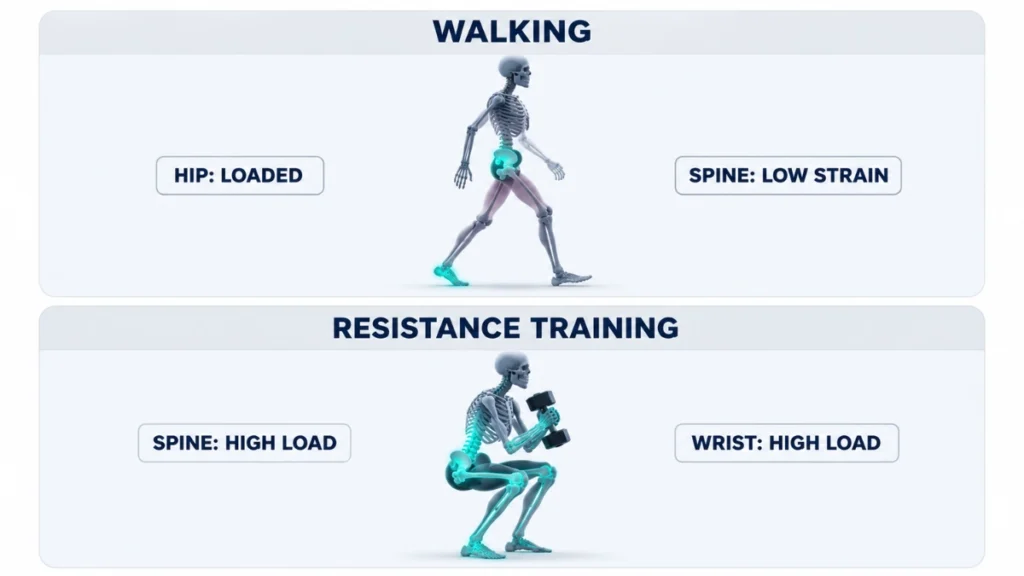
Your spine and wrists are among the most common fracture sites in people over 50. Walking reaches neither of them.
What bone tissue actually needs. Bone responds to mechanical load, the force your muscles and body weight apply to it. When that force exceeds a threshold, bone cells activate and begin rebuilding.
When it stays below that threshold, they don’t. It loads your hips and legs against gravity. Slow, steady movement at walking pace does not generate enough force to cross the activation threshold at the spine or upper body.⁵
The review finding most articles skip. A review published in BioMed Research International concluded that walking alone does not appear to improve bone mass.⁵ It can slow progressive loss in the lower limbs, but it cannot stimulate the bone remodeling response at the spine or wrists.
A separate NIH-indexed review confirmed that regular aerobic walking has little or no effect on preventing bone loss, because the low-impact load it generates does not reach the magnitude, rate, or distribution needed to trigger an adaptive skeletal response.⁶
Here is the research signal most articles on this topic miss.
A 2022 meta-analysis in Sports Medicine found that progressive resistance training increased femur and hip bone mineral density by an average of 2.77 percent in adults 65 and older, but did not significantly improve lumbar spine bone mineral density without combined weight-bearing exercise.⁷
Neither walking alone nor resistance training alone fully covers both critical fracture sites. That is the honest picture, and it is assembled from several separate bodies of evidence, not from one study that tested all of this at once.
An important limit on the evidence. Most studies on exercise and bone density focus on postmenopausal women or adults with low bone mass. Evidence in men and in adults under 60 is thinner.
What we know confidently is that the mechanical principle applies across groups: bone responds to load, and walking provides a low load.
The Muscle Problem Walking Cannot Solve at All
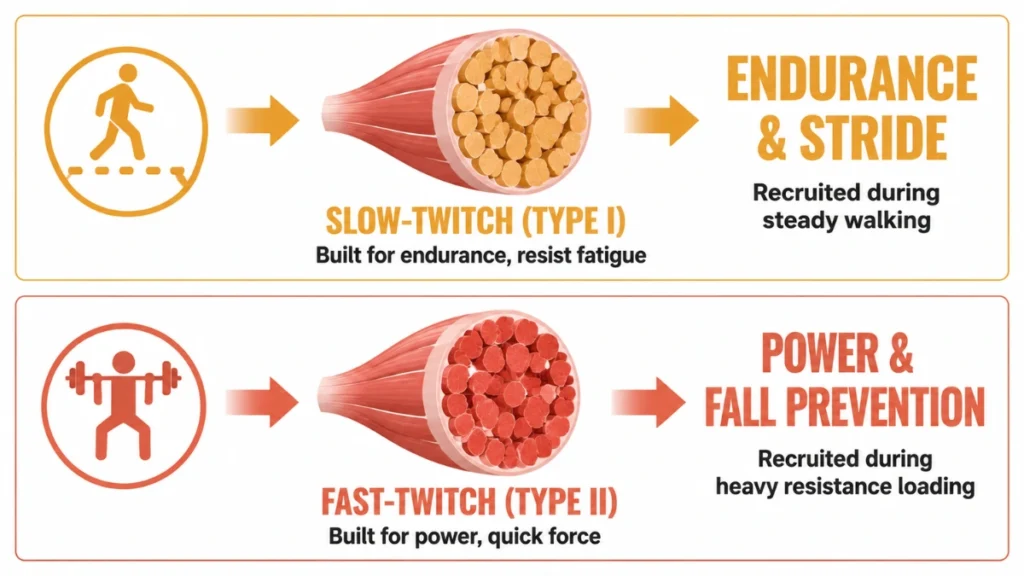
You may feel your legs working when you walk. What you are mostly feeling is your slow-twitch muscle fibers doing their job: the ones built for endurance, for sustained, repetitive effort. Those fibers respond reasonably well to walking.
The fibers actually under threat. After age 50, the body preferentially loses fast-twitch type II muscle fibers.⁸ These are the fibers that produce power, speed, and the ability to catch yourself when you stumble.
Sarcopenia [the age-related loss of muscle mass and strength] begins its most visible decline after 50, with muscle mass falling at roughly one to two percent per year.¹ Strength falls two to five times faster than mass, because it is the high-power type II fibers going first.⁹
Walking uses type I slow-twitch fibers almost exclusively. It does not recruit the fast-twitch type II fibers in any meaningful way, because it does not require the power output that activates them.
Walking trains the muscles your body already uses most; resistance training forces the muscles your body has quietly been losing since age 50.
The evidence on reversing this loss is actually encouraging. Progressive resistance training can produce substantial increases in strength and muscle size in older adults, including those in the oldest age groups.¹⁰ The muscle system responds to the right kind of demand at almost any age.
That is the real finding here: these fibers are not gone, they are simply not being asked to work.
Sarcopenia affects an estimated five to 13 percent of adults aged 60 to 70, rising to 11 to 50 percent in those over 80.¹ If you want to protect those fibers, you need to load them.
What Closing Both Gaps Actually Looks Like
You do not need to stop walking. You need to add two things your daily walks cannot do.
For bones: higher load, more sites. Progressive resistance training with moderate to high loads, exercises like squats, deadlifts, and overhead press, can increase bone mineral density at the lumbar spine and hip with one closely watched trial showing approximately 4% improvement at the spine and 2% at the hip over eight months.¹¹
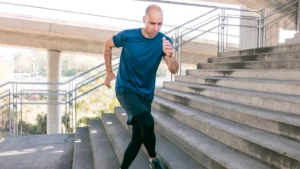
Adding impact activities such as stair climbing or jumping further stimulates bone cells at sites walking never reaches.⁶
The LIFTMOR evidence. A closely watched clinical trial in postmenopausal women with low bone mass found that high-intensity resistance and impact training produced approximately four percent better lumbar spine bone mineral density and approximately two percent better femoral neck bone mineral density compared to a lower-intensity program, over eight months.¹¹
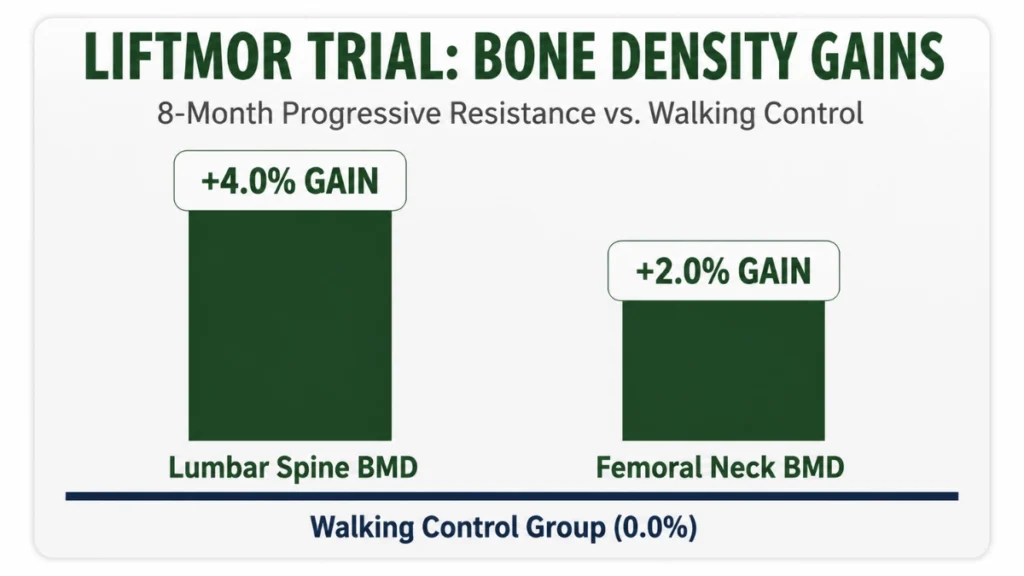
All participants were over 58 and had existing bone loss. Vigorous resistance work improved their bone density at both sites.¹¹
Walking is good for your cardiovascular system. Resistance training is necessary for your bones and muscles. Both statements are true, and neither cancels the other.
For muscles: progressive overload. Muscles rebuild in response to demands that exceed what they already handle. That means resistance training at increasing intensities over time, not higher step counts.
Two sessions per week targeting major muscle groups, including upper body and lower body, is recommended and can lead to measurable changes in strength over several weeks to months.⁶
A Simple Weekly Plan That Works With Your Walks
No gym membership required. You just need a plan specific enough to actually follow.
Here is a starting framework for the week. Talk to your doctor before starting a resistance program if you have osteoporosis, a recent fracture, joint replacement, or any condition that affects balance or bone integrity.
What “progressive” means in practice. When an exercise feels easy for two sessions in a row, make it harder: add a resistance band, slow the movement down, or add a second set. The body adapts quickly, and the adaptation is the point.⁶
The NOF resource. The National Osteoporosis Foundation publishes a free guide called “Exercise for Your Bone Health” at nof.org. It includes bone-safe modifications for common exercises and a printable log you can bring to a doctor’s appointment.
Keep your walks. They are doing real work for your heart, your joints, and your mind. Add what they cannot do for your bones and muscles, and you have covered the full picture.
Your Walk Was Never the Problem
Walking after 50 does one job well. It was never built for the second. The gap is not in your effort. It is in what your body needs after 50 that walking alone cannot provide.
Add two resistance training sessions per week to your walking routine, starting with bodyweight squats, lunges, and a push-up variation, and build from there.
The research on resistance training and bone density is encouraging. What it does not yet answer is how much load, at which sites, produces the best long-term protection for each person. Still being studied.
⚠️DISCLAIMER
This article is for informational purposes only and does not constitute medical advice. Consult your doctor or a qualified healthcare provider before beginning any new exercise program, particularly if you have osteoporosis, a history of fractures, joint replacement, or any cardiovascular or musculoskeletal condition.
References
- von Haehling S, Morley JE, Anker SD. From muscle wasting to sarcopenia and myopenia: update 2012. Journal of Cachexia, Sarcopenia and Muscle. 2012. https://pmc.ncbi.nlm.nih.gov/articles/PMC3505577/
- Endocrine Society. Menopause and Bone Loss. 2022. https://www.endocrine.org/patient-engagement/endocrine-library/menopause-and-bone-loss
- Ungvari Z, Fazekas‑Pongor V, Csiszar A, Kunutsor SK. The multifaceted benefits of walking for healthy aging: from Blue Zones to molecular mechanisms. Geroscience. 2023. https://pubmed.ncbi.nlm.nih.gov/37495893/
- Feskanich D, Willett W, Colditz G. Walking and leisure-time activity and risk of hip fracture in postmenopausal women. JAMA. 2002.https://jamanetwork.com/journals/jama/fullarticle/195504
- Benedetti MG, et al. The effectiveness of physical exercise on bone density in osteoporotic patients. BioMed Research International. 2018. https://www.ncbi.nlm.nih.gov/pmc/articles/PMC6323511/
- Hong AR, Kim SW. Effects of resistance exercise on bone health. Endocrinology and Metabolism. 2018. https://pmc.ncbi.nlm.nih.gov/articles/PMC6279907/
- O’Bryan SJ, Giuliano C, Woessner MN, Vogrin S, Smith C, Duque G, Levinger I. Progressive Resistance Training for Concomitant Increases in Muscle Strength and Bone Mineral Density in Older Adults: A Systematic Review and Meta-Analysis. Sports Medicine. 2022. https://pubmed.ncbi.nlm.nih.gov/35608815/
- Deschenes MR. Effects of aging on muscle fibre type and size. Sports Medicine. 2004. https://pubmed.ncbi.nlm.nih.gov/15462613/
- Mitchell WK, Williams J, Atherton P, Larvin M, Lund J, Narici M. Sarcopenia, dynapenia, and the impact of advancing age on human skeletal muscle size and strength; a quantitative review. Frontiers in Physiology. 2012. https://pmc.ncbi.nlm.nih.gov/articles/PMC3429036/
- Evans WJ. Reversing sarcopenia: how weight training can build strength and vitality. Geriatrics. 1996;51(5):46-53. https://pubmed.ncbi.nlm.nih.gov/8621102/
- Watson SL, et al. High-Intensity Resistance and Impact Training Improves Bone Mineral Density and Physical Function in Postmenopausal Women With Osteopenia and Osteoporosis: The LIFTMOR Randomized Controlled Trial. Journal of Bone and Mineral Research. 2018. https://melioguide.com/osteoporosis-exercises/liftmor-osteoporosis-osteopenia/