

You did the right thing. Adults over 50 who cut screen time before bed often do everything sleep advice recommends, and still wake up tired. The light sources most people never think to check are still working against your sleep every single night.
The phone was the most visible problem, so that’s where attention went. But bedroom light sleep disruption doesn’t stop at the nightstand. It comes from the bulb overhead, the clock across the room, the streetlight edging around the curtain, and the small blinking indicator on the router you stopped seeing years ago.
Every one of them has a biological effect your body cannot opt out of.
Why this matters:
- Why putting the phone down solves less than half the light problem
- Why your brain responds to room light the same way it responds to a phone screen
- Which bedroom bulb color quietly delays your sleep hormone every evening
- The overlooked reason adults over 50 may feel this more
- A three-minute check you can do tonight that costs nothing
Why Giving Up Your Phone Before Bed Is Not the Full Answer
You already know this feeling: you put the phone down an hour before bed, you do everything right, and you still lie there waiting for sleep that takes too long to come.
The phone was one source of bedroom light sleep disruption. It was not the only one, and fixing it alone rarely resolves the problem.
Melatonin [the hormone your brain releases at night to make you feel sleepy] follows a simple rule: any meaningful light signal in the hours before sleep tells the brain the day is not over. Your phone emits that signal.
So does the overhead light you switch off five minutes before bed. So does the warm glow of the lamp on the dresser, the streetlight filtering through the gap in your curtains, and the green LED on the power strip behind the nightstand.
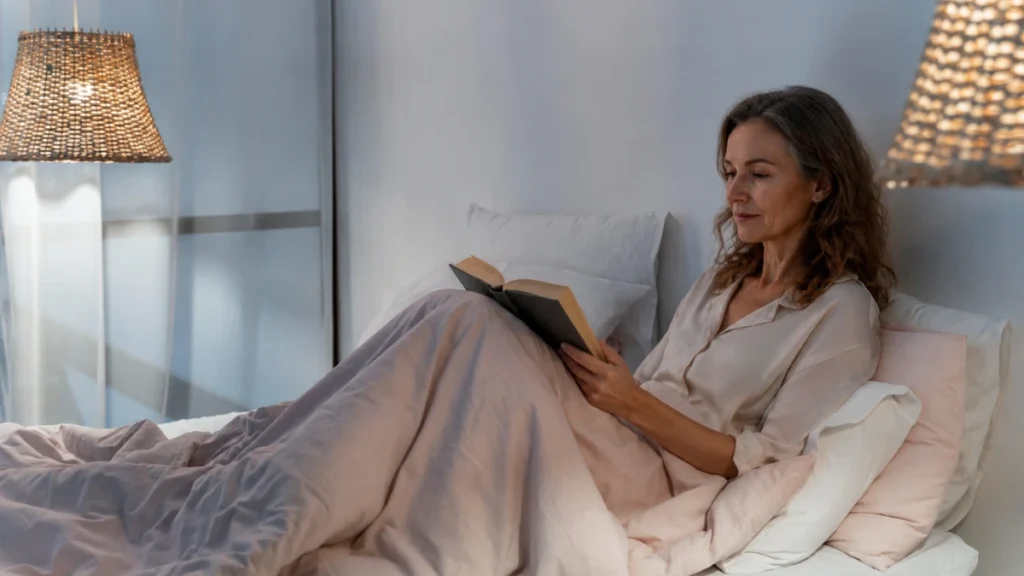
Most sleep guidance focuses on screens because screens are interactive and because the behavior of looking at them is obvious. The other light sources sit there passively. They never ask for your attention, so they never get blamed.
Stopping at the phone is a partial fix applied to an environment that has not changed. The rest of the bedroom is still sending signals.
What Ordinary Room Light Actually Does to Your Sleep Hormone
Your body starts preparing for sleep long before you get into bed. Part of that preparation is a steady rise in melatonin that begins in the late evening.
Ordinary room light disrupts that rise.
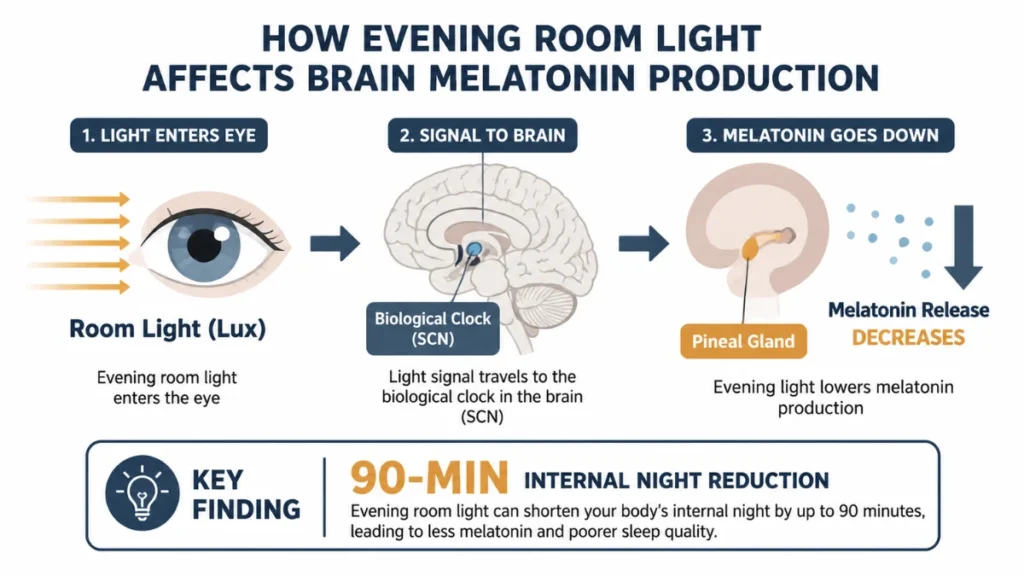
In a controlled study of 116 adults, exposure to typical room light in the hours before bedtime suppressed melatonin onset in 99% of participants and shortened the body’s internal night by roughly 90 minutes.¹
Not dim light. Not screens. Standard room lighting. Room light.
The phone was never the only problem, it was just the most obvious one, and fixing it while leaving everything else untouched is like patching one hole in a leaky boat.
This is the finding most sleep articles skip entirely: your brain does not grade light exposure by what you intend. It grades it by lux [a unit measuring how much light actually reaches your eyes].
No single study has tested all non-screen bedroom light sources together in one trial.
The picture here is assembled from several lines of research: melatonin suppression studies, light-during-sleep cardiometabolic work, and lamp-comparison data.
Each piece is well-supported; the full picture is a synthesis, not a single proven claim.
A bedside lamp left on while you read a paper book carries a similar biological signal to a phone screen. The device you put down is not the only source; the room itself is one.
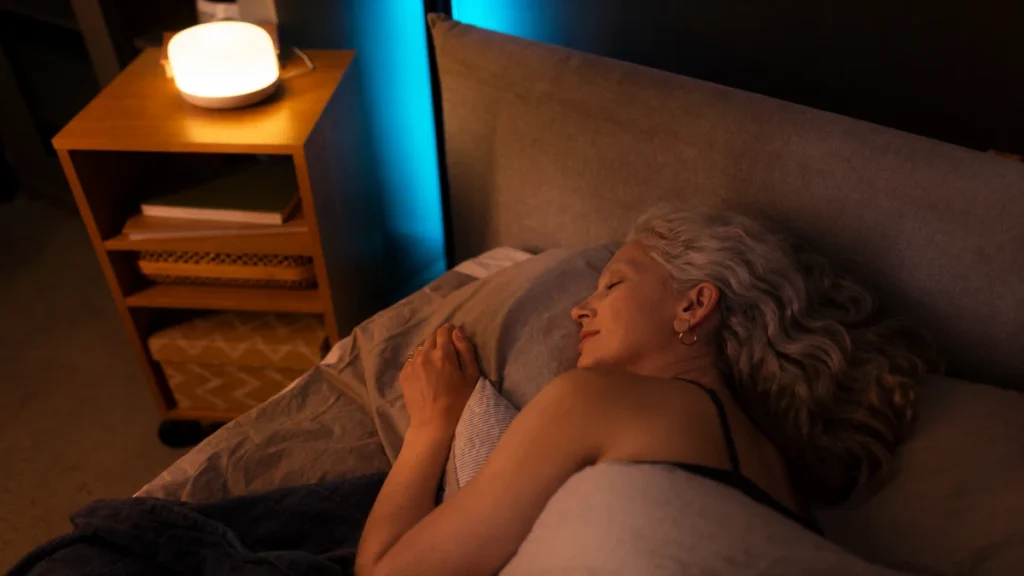
A separate laboratory study found that sleeping in moderate ambient light (not pre-bed exposure, but light present during sleep itself) increased nighttime heart rate and raised insulin resistance the following morning.²
Participants reported sleeping fine. Their bodies disagreed.
This is not a small effect. A 90-minute reduction in your body’s internal night is not a marginal cost.
The Light Sources You Stopped Seeing Years Ago
You live with certain things so long they stop registering. A clock that ticks quietly enough goes unheard within days. A smell that never changes stops registering within minutes. The brain filters out stimuli that stay constant, and light works the same way.
Think about the last time you noticed the alarm clock display across the room. You probably stopped seeing it sometime in the first month you owned it. Your conscious mind tuned it out.
Your suprachiasmatic nucleus [the small cluster of cells in the brain that controls your internal clock and responds to light signals] never did.
Room light before bedtime suppressed melatonin in 99% of study participants in one controlled trial.¹ Your eyes adapt to the dark when you lie down, which means even a small light source becomes more effective at sending a signal to your brain.
The clock is always on. You sleep next to it every night.
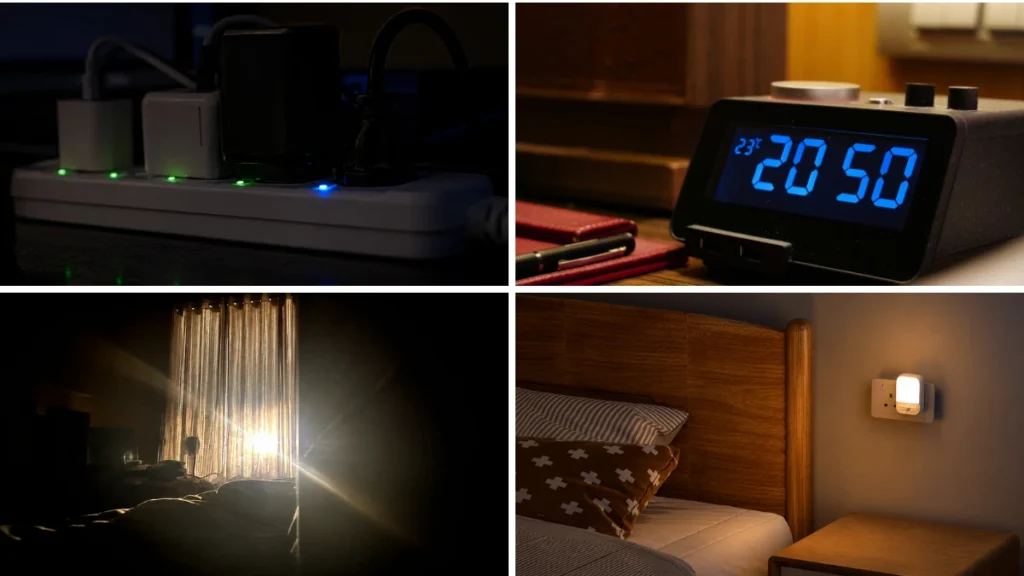
The same logic applies to a short list of sources most people have inside their bedrooms right now:
- Standby LEDs on televisions, routers, air purifiers, and chargers. Individual LEDs produce very little light, but three to seven of them scattered around a dark room combine into a measurable ambient glow and research shows that even weak light from LEDs can suppress melatonin.⁶
- Digital alarm clocks with bright displays, especially those with red or blue digits.
- Streetlight seep around curtains that do not seal at the edges. Standard curtains leave gaps at the sides, top, and center that allow light from outside to reach the bed.
- Nightlights placed in or near the bedroom, particularly those with white or blue LED bulbs.
That sense of recognition, the one where you’re now mentally scanning your bedroom and counting lights, is the right reaction.
How many of those sources do you actually have in your bedroom right now?
Your Bedroom Bulb May Be the Quietest Sleep Disruptor in the Room
You might have replaced your old bulbs with LEDs years ago to save energy. That was a sensible choice for your electricity bill. It may have been a poor one for your sleep, depending on the color of light those bulbs emit.
Color temperature [a number in Kelvin (K) that describes how warm or cool a bulb’s light appears, where lower numbers mean warmer, more orange light and higher numbers mean cooler, more blue-white light] matters more than most people realize when it comes to sleep.
A 2025 study published in Scientific Reports tested 52 different home lamps across three technology types and measured their estimated circadian impact.³
Cool white LEDs were associated with roughly 3.4 times greater melatonin suppression than warm white LEDs at the same brightness.³
Changing which bulb you screw in and doing nothing are not equivalent choices.³
The same study found that tunable LED lamps shifted from a cool white setting (5,700 K) to a warm white setting (2,100 K) showed estimated melatonin suppression drop from roughly 10% to 0.1%.³ That is not a rounding error.
That is the difference between a light that cooperates with your body’s preparation for sleep and one that actively works against it.
Most modern bedrooms have neutral or cool white LED fixtures. The boxes they came in call them bright, crisp, or daylight.
What those words mean in sleep terms is blue-spectrum light in the hours when your body is trying to wind down.
Fixing LED light color temperature is one of the least expensive changes available: a warm white bulb rated at or below 2,700 K.
Why This Matters Differently After 50
For adults over 50, the bulb swap matters more than most sleep guides acknowledge.
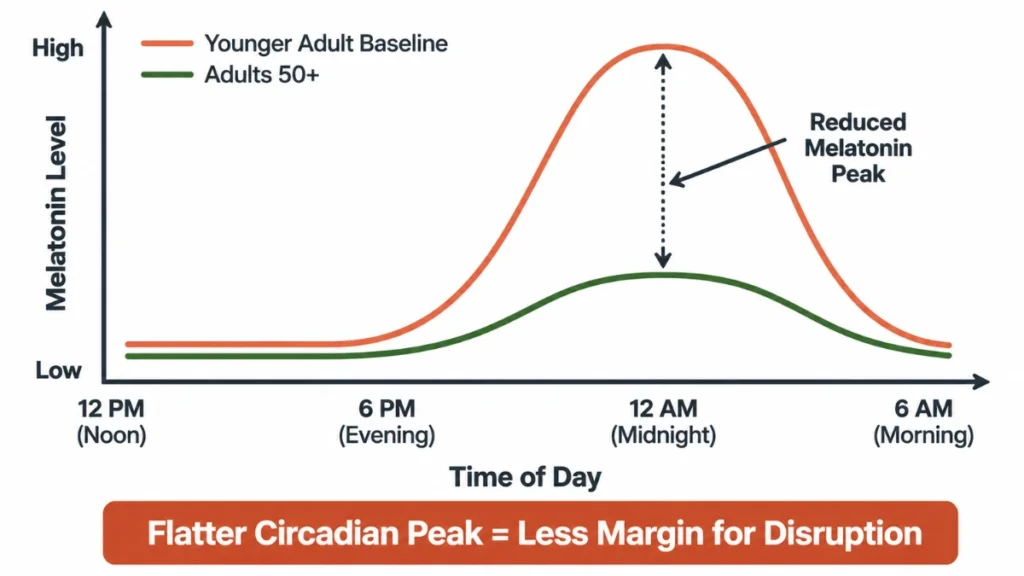
The circadian rhythm [your body’s 24-hour internal clock that controls when you feel sleepy and when you feel alert] shifts earlier after 50, so you feel tired sooner in the evening and wake earlier in the morning.⁴
The rhythm also tends to become less robust, meaning the peaks and troughs of your daily hormonal cycle are not as sharp.⁴
That second change is the more consequential one. A less robust circadian rhythm recovers less quickly from disruption.
Evening light that pushes your melatonin onset back by roughly 90 minutes¹ lands differently when your body’s internal night was already shorter than it used to be.
There is an honest complexity to this. Research on whether older adults are more or less sensitive to light’s direct effect on melatonin has produced mixed results, and no single study settles it cleanly.⁵
An aging lens transmits less blue light, which could theoretically reduce the effect. Some studies found this reduced sensitivity; others found melatonin suppression in older adults was comparable to younger participants.⁵
Researchers have noted that compensatory mechanisms in the aging eye may preserve circadian light sensitivity even as lens transparency decreases.⁵
What the evidence does consistently support is this: the circadian rhythm in adults over 50 is running on a tighter schedule and leaves less room for disruption.⁴
Whether or not your eyes let in the same amount of light they did at 30, the system that interprets that light is working with less margin.
This is not about declining health. Your bedroom environment matters more now than it once did, and the reasons for that are biological, not behavioral.
How to Audit Your Bedroom for Light in Under Three Minutes
You do not need to buy anything to find out if your bedroom has a light problem. The audit is physical, not technical, and takes less time than making the bed.
Turn off every light you control. Close the door. Let your eyes adjust for one full minute, then hold your hand at arm’s length. If you can see it clearly, your room has more ambient light than your body needs for sleep.

Dr. Phyllis Zee, chief of sleep medicine at Northwestern University Feinberg School of Medicine, recommended this test after her team found that a single night of moderate ambient light during sleep impaired cardiometabolic function in healthy adults.²
One night. Not a decade of poor sleep habits, not a chronic disorder, not years of shift-work damage. A single night of light during sleep moved the needle on heart rate and blood sugar.
The problem is not always what you can see when you walk in. It is what becomes visible once the main light goes off and your eyes finish adapting.
Work through this checklist once your eyes have adjusted:
- Overhead bulb color temperature. Look at the fixture. If it is bright white or bluish white, that bulb works against your sleep every evening it is on before bed. Replace it with a warm white LED rated at or below 2,700 K.
- Standby device LEDs. Count every small indicator light visible in the dark. Cover any that cannot be turned off, using black electrical tape or a small piece of opaque material.
- Digital alarm clock display. If the digits are bright enough to read easily from bed, move the clock to a drawer, turn it face-down, or replace it with an analog model.
- Curtain gaps. Stand at the window after dark and look for light seeping around the edges. If you see it, a fitted blackout blind or a curtain that extends beyond the window frame on all sides will reduce that seep significantly.
- Nightlights. If a nightlight is necessary for safety when getting up at night, choose one with a red or amber bulb rather than white or blue.
The National Sleep Foundation’s bedroom environment guide at sleepfoundation.org/bedroom-environment/light-and-sleep provides free, additional detail on each of these factors.
Most people doing this audit find two or three sources they had stopped noticing. That is not carelessness. That is how habituation works.
Start With the Room, Not Just the Screen
The phone was a reasonable first target. It is not the whole problem. Adults over 50 who still sleep poorly after cutting screen time have usually left the bedroom unchanged.
Tonight, do the hand test: turn off every light in your bedroom, let your eyes adjust for one minute, then hold your hand at arm’s length. If you can see it clearly, your room has too much light, and fixing that is where better sleep starts.
Individual sensitivity varies. The bedroom environment is the factor most often ignored.
⚠️DISCLAIMER
This article is for informational purposes only and does not constitute medical advice. If you are experiencing persistent sleep problems, speak with your doctor or a sleep specialist.
References
- Gooley JJ, Chamberlain K, Smith KA, et al. Exposure to room light before bedtime suppresses melatonin onset and shortens melatonin duration in humans. Journal of Clinical Endocrinology and Metabolism. 2011. https://pubmed.ncbi.nlm.nih.gov/21193540/
- Mason IC, Grimaldi D, Reid KJ, et al. Light exposure during sleep impairs cardiometabolic function. PNAS. 2022. https://www.pnas.org/doi/10.1073/pnas.2113290119
- Terán E, Yee-Rendon CM, Sosa-Arámbula HJ, De La Herrán-Arita AK, Woods RL. Characterizing the circadian impact of common home lighting technologies. Scientific Reports. 2025. https://www.nature.com/articles/s41598-025-29882-7
- Hood S, Amir S. The aging clock: circadian rhythms and later life. J Clin Invest. 2017;127(2):437-446. https://pmc.ncbi.nlm.nih.gov/articles/PMC5272178/
- Swope CB, Rong S, Campanella C, Vaicekonyte R, Phillips AJK, Cain SW, McGlashan EM. Factors associated with variability in the melatonin suppression response to light: A narrative review. Chronobiology International. 2023;40(4):542-556. https://www.tandfonline.com/doi/full/10.1080/07420528.2023.2188091
- McIntyre IM, et al. Human melatonin suppression by light is intensity dependent. Journal of Pineal Research. 1989. PMID: 2915324. https://pubmed.ncbi.nlm.nih.gov/2915324/