

After 50, the biggest threat to your strength isn’t age. It’s the fear of getting hurt. That fear makes sense. Your knees ache when you climb stairs. Your shoulders ache after carrying groceries. You’ve read enough about torn rotator cuffs and blown-out knees that the gym feels more like a danger zone than a solution.
So you hold back. Or you stop entirely. That decision is costing you more than you think. Muscle loss after 50 is real, it’s fast, and it quietly sets off a chain reaction that affects everything: your joints, your energy, your balance, and your long-term health. You don’t need to lift heavy weights. You don’t need to go through pain. And you don’t need more than a few hours per week.
4-week strength training plan built specifically for people over 50 who want to build muscle without wrecking their joints. Every exercise, every recovery tip, and every nutrition suggestion here is backed by research published in 2024 and 2025.
Why Muscle Loss After 50 Is More Dangerous Than You Think?
Most people assume joint pain is the main thing they need to worry about after 50. Muscle loss is the real problem. And it’s already happening to you right now.
Between ages 50 and 70, adults lose up to 30% of their muscle mass. That’s not a gradual slide. That’s nearly a third of the muscle you built over a lifetime gone in two decades, often without you noticing until the damage is done.
This isn’t just a fitness issue. It’s a health crisis that most doctors underdiagnose. The condition has a name: sarcopenia. It affects around 8.85% of adults between 40 and 64. But once you hit 65, that number nearly doubles to 15.51%. When your body loses muscle, it doesn’t leave space. It replaces that muscle with fat.
Think of your muscles as shock absorbers on a car. When shock absorbers are in good shape, they protect the entire vehicle from bumps and pressure. When they wear out, every pothole sends a shockwave straight into the frame. Your joints are the frame. Weak muscles are worn-out shock absorbers.
Joint pain is often not a joint problem. It’s a muscle problem. When the muscles around your knee are weak, your knee cartilage absorbs forces it was never designed to handle alone. Every step, every stair, every squat drives compressive stress directly into the joint. Stronger muscles mean less pressure on your joints. Not more.
The Science: Resistance Training Actually Protects Your Joints
You might have been told to take it easy on your joints. That advice is outdated.
A systematic review published in the Journal of Personalized Medicine looked at resistance training across multiple studies in people with osteoarthritis. The findings were clear: resistance training reduced pain, improved strength, and improved function. Not a little. Significantly.
A separate focus on isometric exercise, a type of training where your muscle contracts but your joint doesn’t move, found even stronger results. Across 9 studies and 688 participants, isometric exercise reduced knee pain with a standardized mean difference of 0.69. In plain terms, that’s a large, measurable reduction. Not subtle. Not just a little better.
It also improved physical function with a similar effect size of 0.63. Over 50: You don’t need to lift heavy to get these results. Research published in 2025 confirmed that both low-intensity protocols 20% of your one-rep max and higher-intensity protocols 70% of your one-rep max improved pain and function in people with knee osteoarthritis.
That means even light resistance, a band, a chair, or your own bodyweight, produces real, documented results. One study found that a 12-session program spread over just four weeks reduced knee pain in osteoarthritis patients. The effects lasted at least 12 months after the program ended.
What Joint-Friendly Actually Means And What to Avoid?
Most people think low-impact means light. It doesn’t. Low-impact means the exercises don’t pound or jar your joints. You can still work hard. You can still build real strength. You just do it in a way that protects the joint instead of grinding it down. Controlled range of motion. You move through a range your joint can handle today, not the range you had at 30.

Over time, that range expands safely. Slow tempo. Specifically, a 3-second lowering phase. When you lower yourself down in a chair squat, count to three. This eccentric phase builds more muscle fibre than the lifting phase, and it puts less impact stress on the joint.
Muscle before joint. Each exercise in this plan loads the surrounding muscles before they stress the joint.
The muscle does the work. The joint just moves along for the ride. No ballistic movement. Bouncing at the bottom of a squat, jerking resistance bands, jumping from a resting position, these create spikes of force that joints can’t absorb safely.
Here’s a quick comparison of what to swap out:
| High-Impact (Avoid) | Joint-Friendly (Use Instead) |
|---|---|
| Running on pavement | Walking in water or on grass |
| Barbell back squat | Chair squat |
| Floor push-up (if painful) | Wall push-up |
| Jumping exercises | Controlled step-ups |
| Ballistic stretching | Slow, held stretches |
Your 4-Week Joint-Friendly Strength Plan
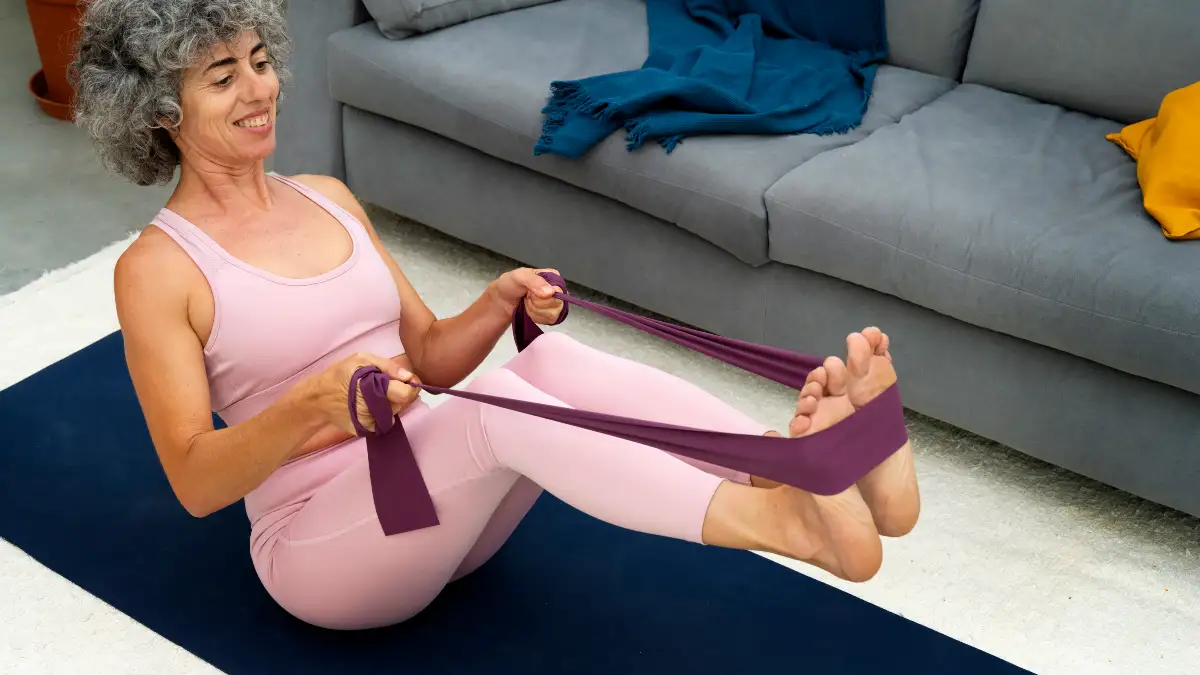
Week 1 will feel easy. That’s by design. Strength training after 50 isn’t about how much you can suffer through in the first session. It’s about building a pattern your body can repeat without breaking down. The first two weeks are for learning the movements correctly. Weeks 3 and 4 are where the real progress kicks in.
The basics:
- Frequency: 2 non-consecutive days per week in Weeks 1,2. Add a third day in Weeks 3,4.
- Intensity: 12,20 reps per set, using resistance that lets you maintain perfect form throughout.
- Tempo: Always 3 seconds on the lowering phase.
- Rest between sets: 60,90 seconds.
Your Weekly Schedule
Weeks 1–2 (2 days per week)
| Day | What to Do |
|---|---|
| Monday | Full workout (all 6 exercises, 2 sets each) |
| Tuesday | Rest or gentle walk |
| Wednesday | Rest |
| Thursday | Full workout (all 6 exercises, 2 sets each) |
| Friday–Sunday | Rest or light movement |
The Recovery Rules That Make This Plan Work
The workout doesn’t build strength. The recovery does. This is one of the most misunderstood things about exercise, especially after 50. The session is just a signal. Your body rebuilds and gets stronger in the hours and days after. If you skip recovery, you skip the results.

Warm up every single time: Spend 5,10 minutes on light movement before every session. March in place, do gentle arm circles, and rotate your hips slowly. This isn’t optional. It increases blood flow to your muscles and helps your joints produce synovial fluid, the natural lubricant that protects your cartilage during movement.
Follow the 48,72 hour rule: Never train the same muscle groups two days in a row. After 50, muscle repair takes longer. Your body needs that window to actually rebuild what the workout broke down. This is why the plan runs on non-consecutive days.
Know the difference between muscle soreness and joint pain: Delayed onset muscle soreness DOMS that stiff, achy feeling 24,48 hours after a workout, happens in the belly of the muscle. It’s normal. It fades. Pain that sits directly on or inside a joint is different. That’s a warning. Don’t push through it.
Drink water: Cartilage is 60,80% water. When you’re even mildly dehydrated, its ability to cushion your joints drops. Aim for 6,8 glasses a day, more on workout days.
Sleep: Growth hormone, the hormone your body uses to repair muscle, peaks during deep sleep. Seven to nine hours isn’t a luxury. It’s part of the training plan.

Nutrition That Actually Supports Muscle Building After 50
You can do everything right in the gym and undermine it at the dinner table. This isn’t about dieting. It’s about giving your body what it needs to repair and rebuild.

Protein is the most important thing to get right: After 50, your body becomes less efficient at using protein to build muscle. Researchers call this anabolic resistance. To work around it, you need more protein than the standard recommendations suggest, around 1.2 to 1.6 grams per kilogram of body weight per day.
For a 75 kg 165 lb person, that’s roughly 90,120 grams of protein per day. Practical examples: two eggs and Greek yogurt at breakfast, chicken or fish at lunch, a palm-sized portion of meat or legumes at dinner, with a small protein snack in between.
Spread it out: Don’t save all your protein for dinner. Your muscles can only use so much at once. Spreading protein across 3,4 meals is more effective than loading up on one big plate.
Add anti-inflammatory foods. Fatty fish, salmon, mackerel, leafy greens, berries, and olive oil all reduce inflammation in your joints. You don’t need a special diet. Just make these a regular part of what you already eat.
Reduce the foods that make joints worse. Ultra-processed foods, too much sugar, and refined vegetable oils all increase inflammation. You don’t need to be perfect. Cutting back by 20,30% makes a real difference.
Consider Vitamin D. Low Vitamin D is common after 50 and is linked to muscle weakness and joint pain. A simple blood test can tell you where you stand. Talk to your doctor before supplementing.
Conclusion
Muscle loss after 50 is real. It’s already happening. But it is not permanent. Research from 2024 and 2025 confirms that low-impact resistance training reduces joint pain, builds real muscle strength, and improves how you move in as little as four weeks. These aren’t small effects. They’re measurable, significant, and last long after the program ends.
The 4-week plan in this article gives you the exact starting point. The exercises protect your joints while building the muscles around them. The recovery rules make the training stick. The nutrition basics make the results last. You don’t need to be pain-free to start. You don’t need a gym. You need a chair, a resistance band, and two non-consecutive days per week.
⚠️MEDICAL DISCLAIMER
This article is for informational purposes only. It does not replace medical advice, diagnosis, or treatment. The information covers muscle loss after 50, sarcopenia, resistance training, isometric exercise, low-intensity protocols, joint-friendly exercises, controlled range of motion, tempo, eccentric phase, recovery rules, warm-up, muscle soreness vs. joint pain, hydration, sleep, protein intake, anabolic resistance, anti-inflammatory foods, and Vitamin D.
Individual results vary based on age, health status, and fitness level. Before changing your exercise routine, diet, or supplement use, talk to your doctor or a qualified health professional first. If you experience chest pain, dizziness, severe joint pain, or any sudden symptom during or after exercise, stop immediately and seek medical care.