
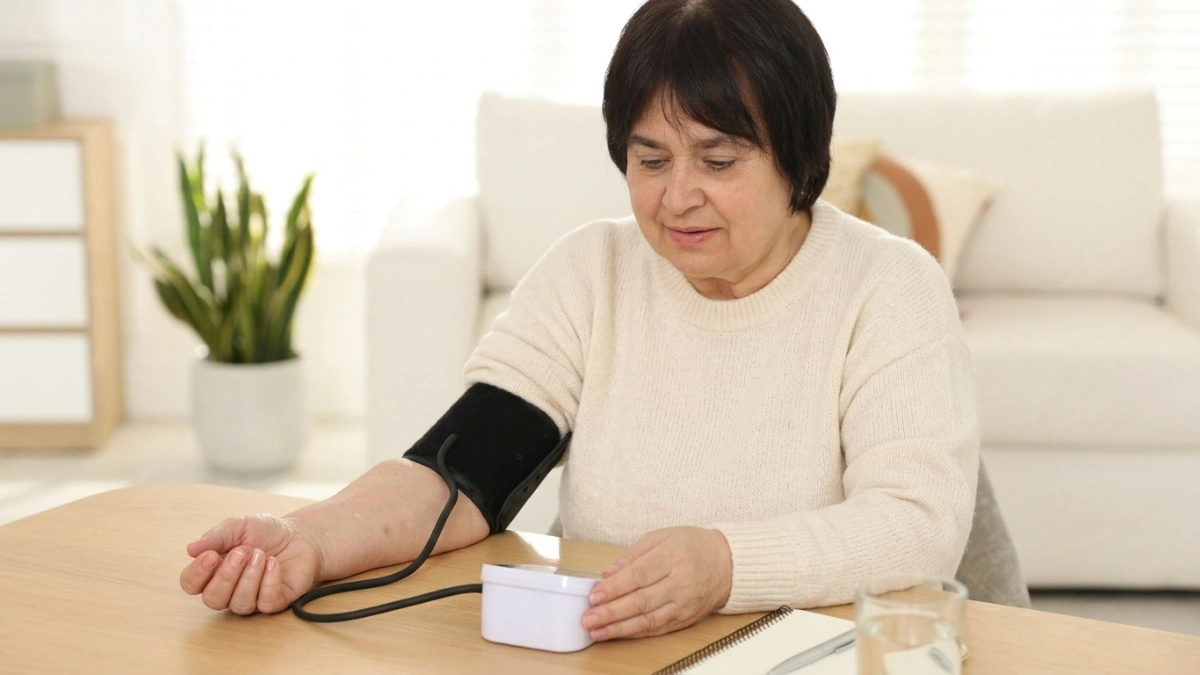
You got a normal blood pressure reading. The doctor said nothing alarming, the nurse moved on, and you left feeling fine about it, except you didn’t, quite. Something has been telling you that the number on the cuff isn’t the whole story.
For adults over 50 with “normal” blood pressure readings, that instinct is often correct.
A reading of 118/72 tells you about pressure. It tells you almost nothing about flexibility. Arterial stiffness signs can be present for years before blood pressure climbs, and your body has already been showing them to you in plain sight.
Why Read This
- Why your diastolic number drifting downward over the years is the opposite of reassuring
- What stiff arteries have to do with memory slips and afternoon brain fog
- The specific kind of exercise fatigue that points to a vascular problem, not a fitness problem
- Why aerobic exercise can measurably reverse early arterial stiffening
- The five questions to bring to your next checkup that most doctors will not raise on their own
The Number on Your Blood Pressure Cuff That Most Doctors Skip Right Past
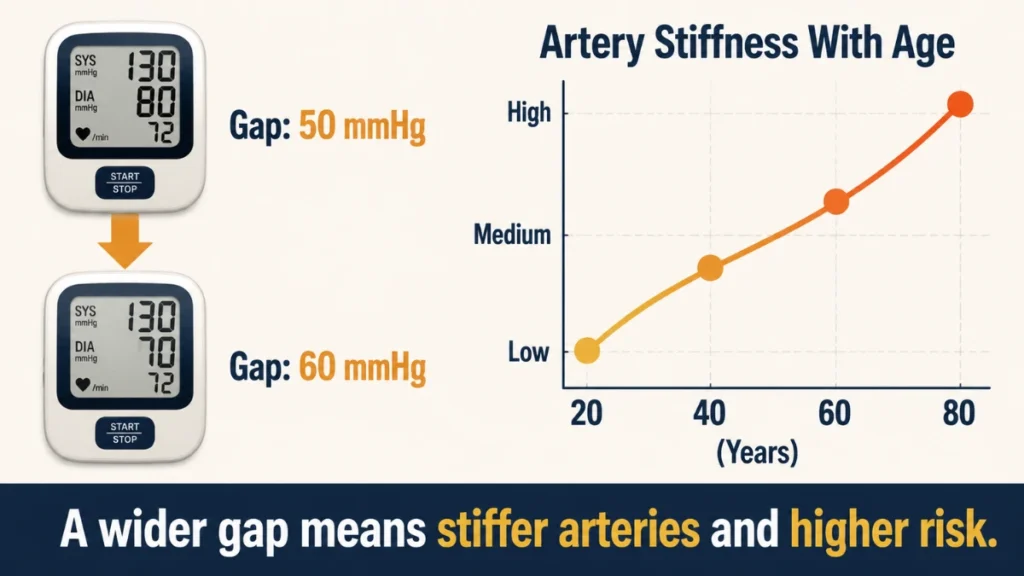
You walk out of every checkup with two numbers, systolic on top and diastolic on the bottom, and almost no one explains what the gap between them means. That gap is your pulse pressure [the difference between the top and bottom number on a blood pressure reading].
A reading of 130/80 gives you a pulse pressure of 50. A reading of 130/70, one year later, gives you a pulse pressure of 60.
That silent ten-point shift is one of the earliest, most readable arterial stiffness signs available from a standard cuff.
Most doctors focus on whether either number crosses a clinical threshold. Pulse pressure as a standalone signal tends to go unremarked.
Framingham Heart Study data show that pulse wave velocity [the speed at which a pressure wave travels through your arteries, a direct measure of wall stiffness] increases sharply from midlife onward, with high-risk values rising from a few percent before age 50 to over 60% after age 70.¹
What matters is the sequence: aortic wall stiffening appears to precede the widening of pulse pressure, meaning your arteries may already be losing flexibility before your blood pressure readings look alarming.¹
Normal readings today do not rule out stiffening that started years ago. That is the direct challenge buried in every routine checkup.
Pulse pressure is available in every reading ever taken, yet research describes it as a measure that is “generally ignored when stratifying risk.”¹
If you have records from checkups over the past five to ten years, the trend in your bottom number is worth examining.
When Your Diastolic Number Keeps Dropping, Pay Attention
You have probably been told not to worry when your diastolic reading is on the low side. Low diastolic sounds safe.
It sounds like your heart is relaxed between beats, not straining. But what is actually happening to arteries as they stiffen is the opposite of reassuring.
Before age 50, both your systolic and diastolic numbers typically rise together as peripheral vascular resistance increases.²
After 50, the pattern splits. Systolic blood pressure continues to climb in response to age-related arterial stiffening, while diastolic blood pressure plateaus and then falls.²
The top number goes up. The bottom number goes down. The gap between them grows. That growing gap is called pulse pressure widening, and research identifies it as a sign of arterial aging driven by stiffening of the large elastic arteries.²
Your diastolic number quietly dropping over the years while your systolic climbs is your blood pressure cuff telling you what it was never designed to say: your arteries are getting stiffer.
Most people who notice this pattern assume it is good news. It is not a concerning sign, they think, because the bottom number is not high. This is one of the most commonly missed readings in routine care.¹
The misconception worth addressing: a falling diastolic is not your arteries relaxing. It reflects a loss of elastic recoil that once maintained pressure between heartbeats.²
Healthy arteries expand and snap back with each pulse. Stiffer arteries expand less and rebound more slowly, so diastolic pressure drops even as systolic climbs.²
The Brain Fog and Memory Slips That Stiff Arteries Cause
That afternoon fogginess you chalk up to age or sleep quality may have a vascular explanation. Your brain depends on a steady, smooth blood supply.
When arteries stiffen, they transmit pulse energy more forcefully into the brain’s small, delicate vessels, which are not built to absorb that kind of pressure.⁵
This is the mechanism: healthy large arteries act as pressure buffers, absorbing each heartbeat’s force and releasing blood smoothly. Stiffer arteries skip that buffering. Each pulse travels harder and faster into cerebral microvessels, damaging them over time. ⁵
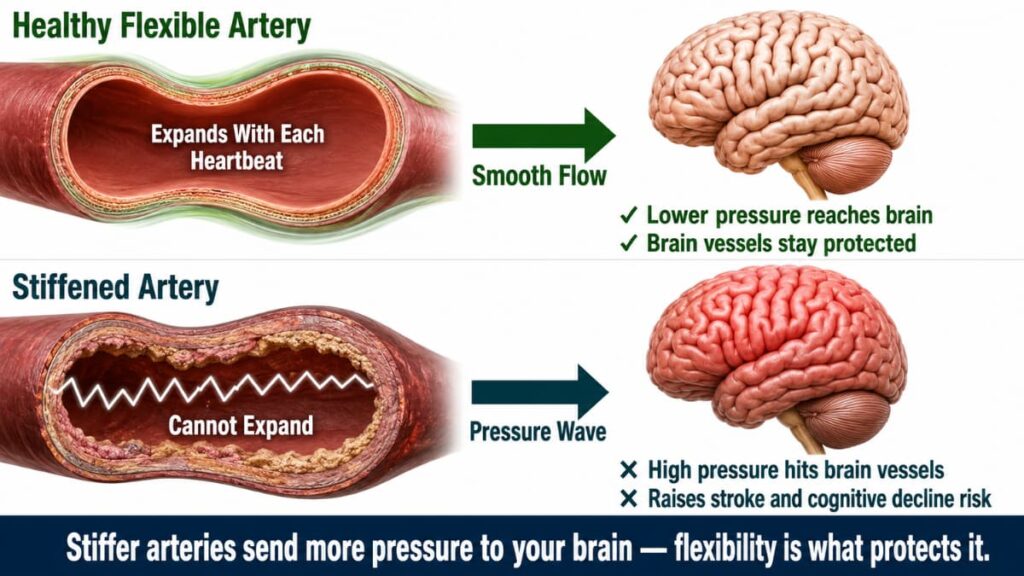
In a large study of 1,223 adults from the Framingham Offspring Cohort, elevated arterial stiffness was associated with progression of subclinical vascular brain injury [small, undetected damage to the brain’s blood vessels, without causing a stroke] and greater neurocognitive decline over about six years, independent of blood pressure.³
A separate analysis using the Health and Retirement Study found that higher estimated arterial stiffness increased the odds of both cognitive impairment and progression to dementia, after controlling for age, cardiovascular disease history, and other risk factors.⁴
No single study tests all five of these signs together; each is supported by independent research drawing on different populations and outcomes.
The finding is direct: arterial stiffness damages the brain through vascular pathways before any measurable stroke or memory diagnosis appears on a chart.
This matters most to people who write off their cognitive slips as normal aging. Some of it may be. But some of it may be stiff arteries reaching the brain years before any doctor flags a problem.
Why Stairs and Short Walks Wear You Out More Than They Should
You used to walk to the end of the street without thinking about it. Now a flight of stairs leaves you needing a moment at the top. Fitness decline is one explanation. Stiff arteries are another, and most people never consider it.⁵

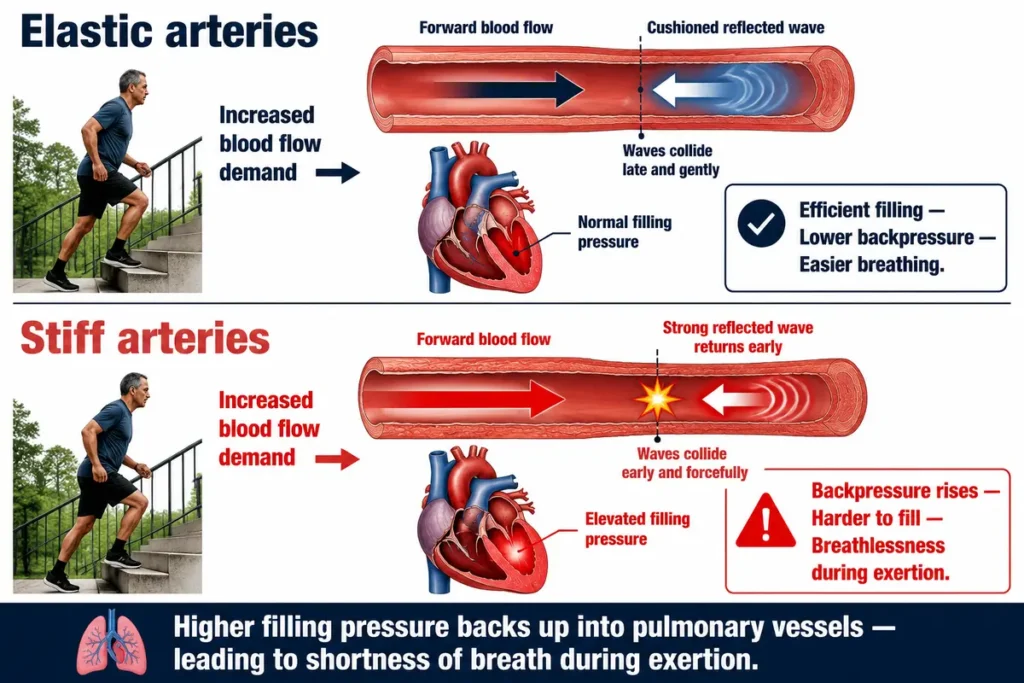
Here is how this connection works: when your arteries are flexible, they help push blood forward between heartbeats, easing the heart’s workload during exercise. When they stiffen, the heart must generate more force on its own to move the same volume of blood.⁵
Diastolic dysfunction [when the heart’s lower chamber does not relax and fill efficiently between beats] is closely linked to arterial stiffness in research involving older adults.⁵
The two conditions reinforce each other: stiff arteries increase the pressure the heart pushes against, which over time impairs the heart’s own relaxation.⁵
During physical activity, this impaired relaxation limits how much blood the heart can receive and send out, producing the breathlessness and fatigue that feel like a fitness problem but have a vascular root.
This exercise intolerance and arterial stiffness connection is especially relevant for people whose effort tolerance has dropped without a change in activity level.
A gradual, unexplained decline in how much exertion you can handle, without injury or illness to explain it, is worth raising with a doctor.
Is your breathlessness on stairs really just being out of shape, or is it your heart working harder than it should have to?
The One Lifestyle Change Proven to Reverse Early Arterial Stiffening
Your arteries are not permanently fixed at their current level of stiffness. That is the part most people do not hear. Early arterial stiffening can be measurably reduced, and the intervention with the strongest evidence is aerobic exercise.⁶

In a controlled trial of older adults with type 2 diabetes, hypertension, and high cholesterol, three months of aerobic training significantly decreased arterial stiffness as measured by pulse wave velocity in both the radial and femoral arteries.⁶
The improvements occurred without changes in blood pressure, weight, or aerobic fitness, suggesting the effect on the arterial wall was direct rather than secondary to those other outcomes.⁶
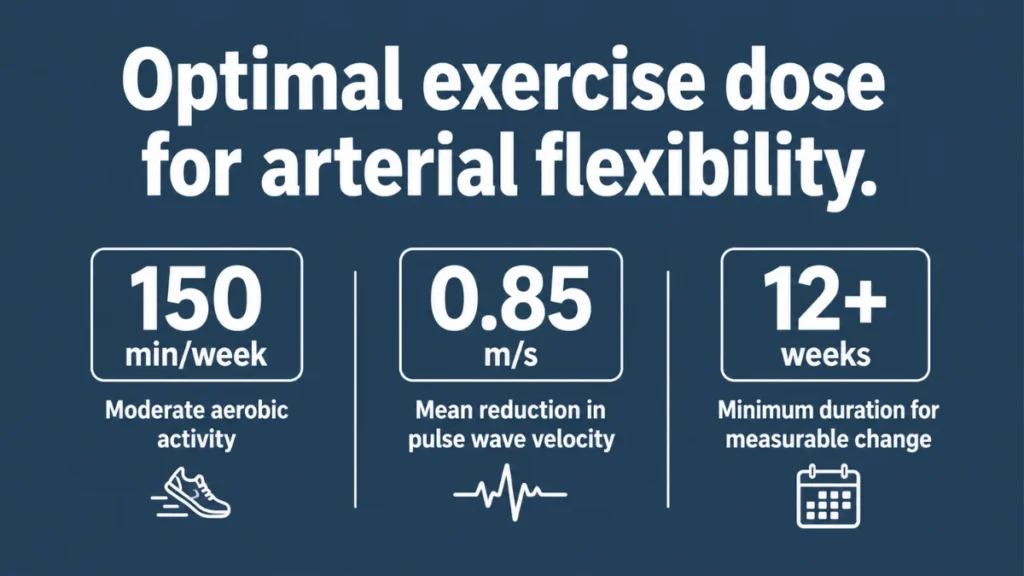
A 2025 systematic review of exercise modalities found that combined aerobic and resistance training consistently reduced arterial stiffness across diverse older adult populations, with a mean reduction in pulse wave velocity of 0.85 m/s.⁷
One important limitation: the trial did not follow participants beyond three months, so we do not yet know if the benefits persist. That uncertainty is a strong reason to treat consistent, long-term exercise as the real goal.⁶ What works, works only while you keep doing it.
Consult your doctor before starting or significantly changing an exercise program, particularly if you have heart disease, uncontrolled blood pressure, or joint conditions.
Practical starting point based on the aerobic training evidence:
- Aim for 150 minutes of moderate-intensity aerobic activity per week
- Walking, cycling, and swimming all qualify
- Combine resistance training with aerobic exercise for the strongest arterial effect.⁷
- Consistency over months matters more than any single session
Five Questions to Bring to Your Next Doctor Appointment
Most people leave checkups with only whatever their doctor volunteered. You can change that with five prepared questions about your vascular health that most doctors will not raise unless you ask. These are specific, answerable, and grounded in everything covered above.
Save this list before your next appointment:

- Has my pulse pressure been widening over the past five years? Ask your doctor to calculate the difference between your systolic and diastolic readings across several visits. A growing gap signals arterial stiffening.
- What is my diastolic trend, not just today’s reading? A diastolic number that has quietly dropped five to ten points over three to five years, while systolic climbed, is a pattern worth naming.
- Is my exercise tolerance declining in a way that could be vascular? Bring up any unexplained drop in how much physical effort you can sustain compared to two to three years ago.
- Should I have a pulse wave velocity test? This non-invasive test measures how fast a pressure wave travels through your arteries. It is the gold standard for detecting stiffness that blood pressure alone cannot show.
- Is my arterial age higher than my chronological age? Some cardiovascular assessments can estimate vascular age. Knowing this number changes the risk conversation.
Arterial stiffening is measurable, partially reversible, and not always tied to blood pressure. These questions put that conversation in your hands.
What a Normal Reading Does Not Tell You
A clean blood pressure reading is not a clean bill of arterial health. The signs above show up in existing records, in how stairs feel, in afternoon brain fog, and in a diastolic number nobody tracked.
Stiffness builds for years before a diagnosis names it. ²
Ask your doctor to calculate your pulse pressure at your next visit, and if it has been widening over the years, ask about a pulse wave velocity test.²
Whether improved arterial flexibility reduces cardiovascular events long-term is an open question.² The biology is clear. The outcome data are catching up.
⚠️DISCLAIMER
This article is for educational purposes only and is not a substitute for professional medical advice, diagnosis, or treatment. Exercise recommendations and information about medical tests are general guidelines and should be discussed with a qualified healthcare provider, especially if you have an existing medical condition or ongoing symptoms. Never ignore or delay seeking professional medical care based on information in this article.
References
- Mitchell GF. Arterial stiffness and hypertension: chicken or egg? Hypertension. 2014;64(2):210-214. doi:10.1161/HYPERTENSIONAHA.114.03401 (or relevant DOI). PMCID: PMC4185002. https://pmc.ncbi.nlm.nih.gov/articles/PMC4185002/
- Laurent S, Boutouyrie P. Arterial stiffness and hypertension in the elderly. Frontiers in Cardiovascular Medicine. 2020;7:544302. doi:10.3389/fcvm.2020.544302.
https://www.frontiersin.org/journals/cardiovascular-medicine/articles/10.3389/fcvm.2020.544302/full - Tsao CW, Himali JJ, Beiser AS, et al. Association of arterial stiffness with progression of subclinical brain and cognitive disease. Neurology. 2016;86(7):619-625. doi:10.1212/WNL.0000000000002368. PMCID: PMC4762417. https://pubmed.ncbi.nlm.nih.gov/26791155/
- Heffernan K, Wilmoth J, London A. Estimated arterial stiffness, cognitive decline, and dementia among middle-aged and older adults. The Journals of Gerontology: Series A. 2023. doi:[insert if known] PMCID: PMC10737553. https://www.ncbi.nlm.nih.gov/pmc/articles/PMC10737553/
- Ambrosino P, Cuspidi C, Candia C, et al. Beyond Blood Pressure: Arterial Stiffness as a Hemodynamic and Neuroadrenergic Axis Linking Hypertension, Cardiac Remodeling, and Heart Failure. Life (MDPI). 2026;16(4):682. doi:10.3390/life16040682. https://doi.org/10.3390/life16040682
- Madden KM, Lockhart C, Cuff D, et al. Short-term aerobic exercise reduces arterial stiffness in older adults with type 2 diabetes, hypertension, and hypercholesterolemia. Diabetes Care. 2009;32(4):653-657. doi:10.2337/dc08-2254. PMCID: PMC2713633. https://www.ncbi.nlm.nih.gov/pmc/articles/PMC2713633/
- Li Y, Chen H, Liu X, et al. Effects of different exercise modalities on arterial stiffness in older adults: a systematic review and network meta-analysis. Frontiers in Public Health. 2025;13:1701763. https://www.frontiersin.org/journals/public-health/articles/10.3389/fpubh.2025.1701763/full