
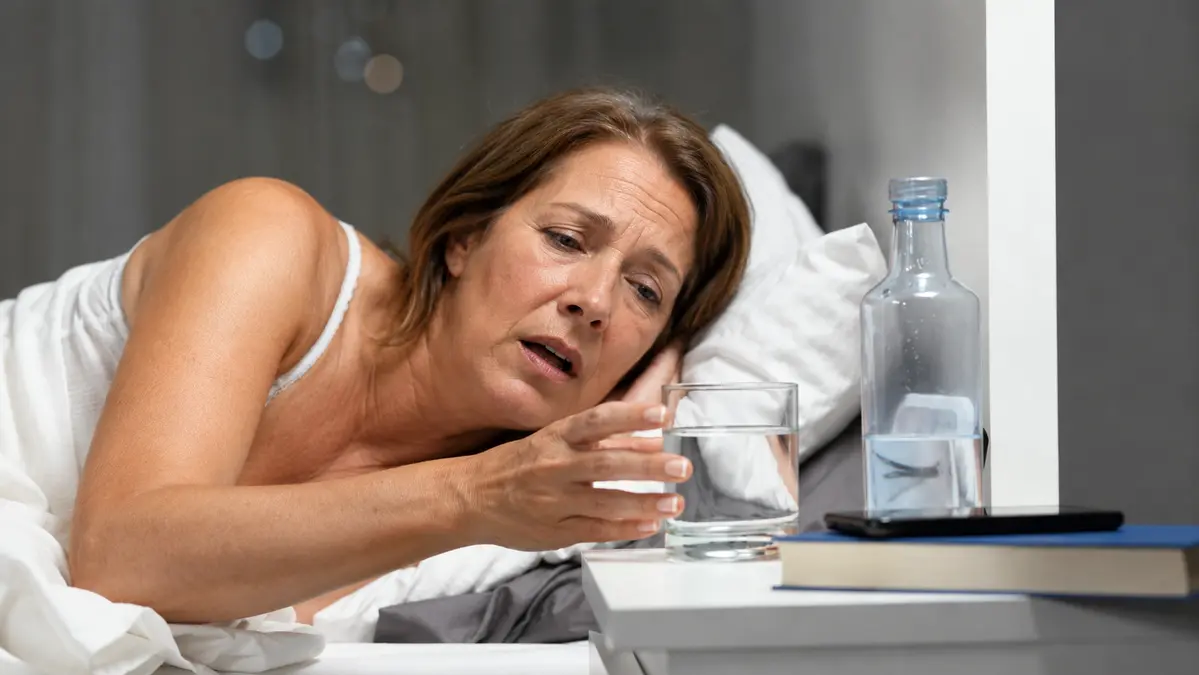
You wake up. Your mouth feels like sandpaper. You reach for water again. If this happens every morning, you have probably blamed dehydration. But here is the truth: if you are over 50 and this keeps happening, water is not the problem. And water alone will not fix it.
About 30% of adults over 65 live with chronic dry mouth. And for most of them, a glass of water before bed changes nothing. Because the real cause is not how much you drink, it is what is happening inside your body while you sleep.
This article will show you the four real reasons dry mouth happens after 50. You will also learn when to see a doctor, and what actually works at night to get relief.
What Is Xerostomia — And Why Should You Care?
Xerostomia is just the medical term for chronic dry mouth. But it is not a minor comfort issue. Saliva does serious work in your mouth. It fights bacteria, protects your enamel, helps you swallow, and neutralizes acids after meals. Without enough saliva, your mouth becomes a breeding ground for decay.
Cavities form faster. Gum disease becomes more likely. Fungal infections like oral thrush can take hold, especially in adults over 50.
Saliva production slows naturally during sleep. Healthy people compensate for this. But after 50, the systems that support saliva production, hormones, medications, and nerves often start working against you.
Waking up dry once in a while is normal. Waking up dry every single morning is a signal. It is telling you something in your body needs attention.
Cause #1: Your Medications May Be the Culprit
This is the most common cause and the one most people never suspect. Over 400 medications list dry mouth as a side effect. These include drugs for high blood pressure, depression, anxiety, allergies, bladder control, and sleep.
If you take three or more medications daily, research shows you have up to a 78% chance of experiencing dry mouth as a result.
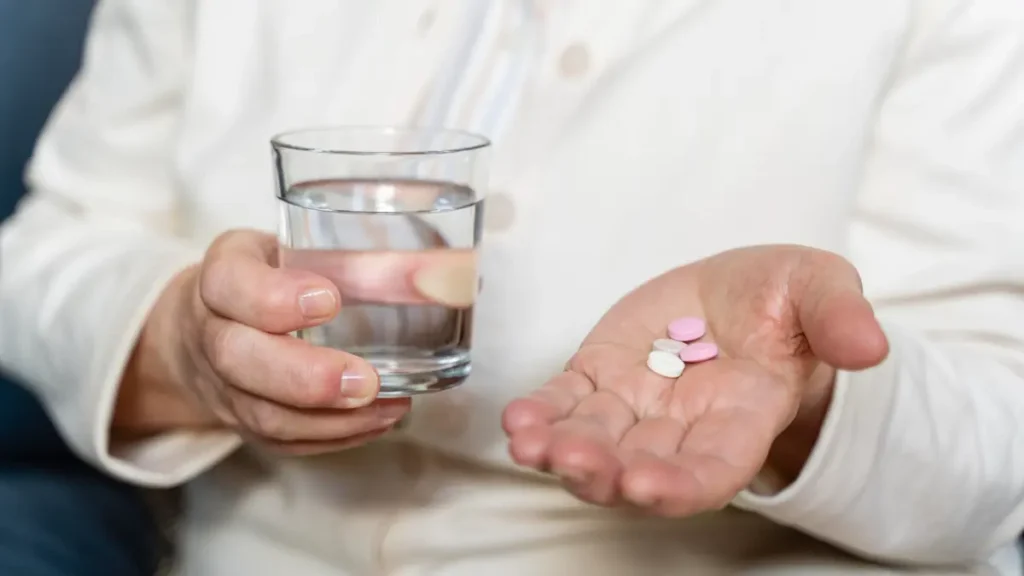
The highest-risk drugs are those with anticholinergic effects. These include tricyclic antidepressants, antihistamines, and bladder medications.
A 2024 NIH study found that 61% of patients on these drugs had measurable drops in saliva, compared to just 6.8% of people not taking them.
Do not stop your medication. Instead, bring your full medication list to your doctor or dentist and ask, Could any of these be causing my dry mouth? Sometimes a timing change or a different drug fixes it completely.
As of 2026, the American Dental Association now lists GLP-1 drugs like Ozempic and Wegovy as dry mouth contributors.
If you recently started one and your dry mouth appeared around the same time, that connection is worth discussing with your doctor.
Cause #2: Menopause Is Drying Out More Than You Think
Most women know menopause brings hot flashes. Few know it can dry out their mouth, too. Estrogen receptors exist in the cells of your salivary glands. When estrogen drops during perimenopause and menopause, those glands may produce less saliva.

Research from Tehran University found that women who reported dry mouth had significantly lower estrogen levels than those who did not. About 1 in 3 menopausal women experience some form of dry mouth.
And here is a striking number: 84% of women do not realize their oral symptoms could be linked to menopause at all.
Many suffer in silence for years without connecting the dots. This is not just a minor annoyance. Lower saliva during menopause raises your risk of cavities, gum disease, and changes in taste.
Some studies show that hormone replacement therapy (HRT) increases salivary estradiol and reduces dry mouth symptoms in postmenopausal women.
This is a conversation worth having with your gynecologist or menopause specialist, especially if you are already exploring HRT for other reasons.
Cause #3: A Health Condition May Be Behind It
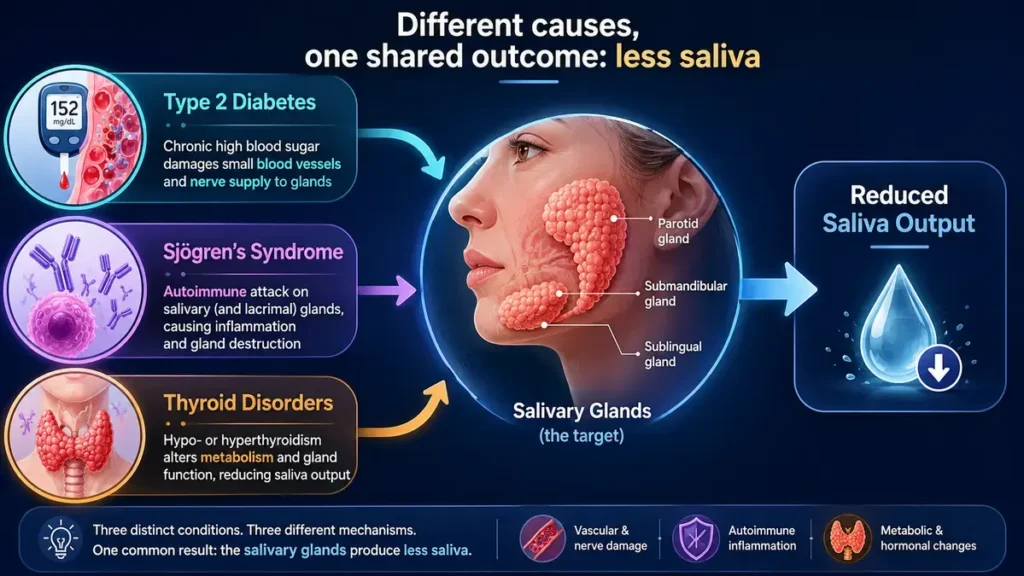
Sometimes dry mouth is your body’s way of flagging something bigger.
Type 2 diabetes reduces saliva production. In fact, persistent dry mouth can sometimes be an early warning sign of undiagnosed diabetes, especially when it comes with increased thirst or frequent urination.
Sjogren’s syndrome is an autoimmune condition that attacks the salivary and tear glands. Nearly 100% of people with Sjögren’s experience chronic dry mouth. It affects about 4 million Americans, and many go years without a diagnosis.
Thyroid disorders, both an underactive and an overactive thyroid, can also interfere with saliva output.
If your dry mouth has not improved after trying other fixes, these conditions are worth ruling out. Ask your doctor for a blood glucose test, a thyroid panel, and possibly an ANA test to screen for autoimmune activity. You do not need to self-diagnose. You need to ask.
Cause #4: You Are Breathing Through Your Mouth at Night
This one is often overlooked, and it is more common than people realize. If you snore, have nasal congestion, or have undiagnosed sleep apnea, you are probably breathing through your mouth while you sleep.
That airflow rapidly dries out oral tissue. You wake up parched, and no amount of water before bed will stop it.
Sleep apnea is significantly underdiagnosed in adults over 50. And it does not always look like loud snoring. Signs include waking with a dry mouth, headaches in the morning, or feeling tired even after a full night of sleep.
In 2026, you can get a home sleep test through telehealth services like ResMed or Lofta, with no overnight clinic stay required.
If sleep apnea is confirmed, a CPAP machine or a mandibular advancement device can resolve the mouth breathing entirely. Many people see their dry mouth disappear within weeks of starting treatment.
When You Need to See a Doctor
Do not wait months hoping it goes away on its own. These signs mean it is time to make an appointment within one to two weeks:
- Dry mouth has persisted for more than two weeks
- You also have dry eyes (possible Sjögren’s)
- You feel unusually thirsty, tired, or urinate frequently (possible diabetes)
- You recently started a new medication
- You snore, wake with headaches, or feel exhausted despite sleeping (possible sleep apnea)

Your primary care doctor or dentist can be your first stop. They will review your medications, possibly order bloodwork, and check your saliva flow. You do not need to arrive with answers; just bring your medication list and describe when the dryness started.
Conclusion
Dry mouth after 50 is a signal, not a side effect of aging. In most cases, something specific is causing it: a medication, a hormonal shift, an undiagnosed condition, or nighttime mouth breathing.
Start by checking your medication list and tracking your symptoms for two weeks. Then bring that information to your doctor. Relief is possible.
⚠️MEDICAL DISCLAIMER
This article is for informational purposes only. It does not replace medical advice, diagnosis, or treatment. The information covers dry mouth, saliva production, medication side effects, menopause and estrogen, underlying health conditions, and sleep apnea. Individual results vary based on age, health status, and fitness level.
Before changing your exercise routine, diet, or supplement use, talk to your doctor or a qualified health professional first. If you experience chest pain, dizziness, severe joint pain, or any sudden symptom during or after exercise, stop immediately and seek medical care.