

You are eating the same breakfast you ate ten years ago. Same eggs, same toast, same coffee.
By 10 a.m., your stomach feels like a drum. That tight, pressurized feeling after meals that used to mean you ate too much now shows up after a normal portion.
And you have not changed a thing. This article explains why new bloating after meals almost always has a biological reason rooted in how the gut changes after 50, and what you can do about it.
Adults over 50 who are eating the same foods they always have are not imagining the difference. The gut itself has changed.
Why keep reading?
- Learn why the meal did not change but your gut’s response to it did, and what shifted inside
- Find out the stomach acid claim almost every health article gets backward
- Discover which three diagnosable conditions explain most new post-meal bloating in this age group
- See exactly which symptoms mean this needs a doctor’s visit, not a diet change
Why the Same Foods Suddenly Feel Different After 50
That tight belly after dinner is not a sign you overate. You already know that, and it makes the whole thing more frustrating.
Bloating after meals is more common than most people realize.
A 2023 study of more than 51,000 adults across 26 countries found that nearly 17% of the global population experiences bloating at least once a week.¹
Women reported it at nearly twice the rate of men.¹

What that number doesn’t show is how many of those people are eating the same food they always did, wondering why their body suddenly objects.
Why now? The most honest answer is that no single study has directly tested why bloating starts in previously unbothered adults after 50.
What exists instead is strong evidence for several distinct changes in how the aging gut functions. When those changes overlap, the result is a stomach that reacts to meals it used to handle without a complaint.
This article draws on that separate evidence to explain each change. Understanding them individually is what makes it possible to target the right one.
Gastric motility [the speed at which food moves through the stomach and intestines], microbiome composition, enzyme output, and the bacteria living in your small intestine can all shift after midlife.
Each shift, on its own, may cause mild symptoms. When two or three occur together, what used to feel like a normal lunch starts to feel like a problem.
You are not broken. Your gut is operating under conditions that are genuinely different from the ones it ran on a decade ago.
The Microbiome Shift Nobody Mentions at the Doctor’s Office
You sit down with the same plate you have eaten for years and feel it within an hour: fullness that sits wrong, gas that builds quietly, a belly that looks different than it did before lunch.
Your gut microbiome [the trillions of bacteria, fungi, and other microorganisms living in your digestive tract] changes in measurable ways as you age. Research shows that microbial diversity declines in older adults, with levels of beneficial bacteria such as Bifidobacteria and Lactobacilli falling and populations of pro-inflammatory bacteria rising.²
This shift, called dysbiosis [an imbalance in gut bacteria that disrupts normal digestive and immune function], is now recognized as a feature of aging, not just of illness.²
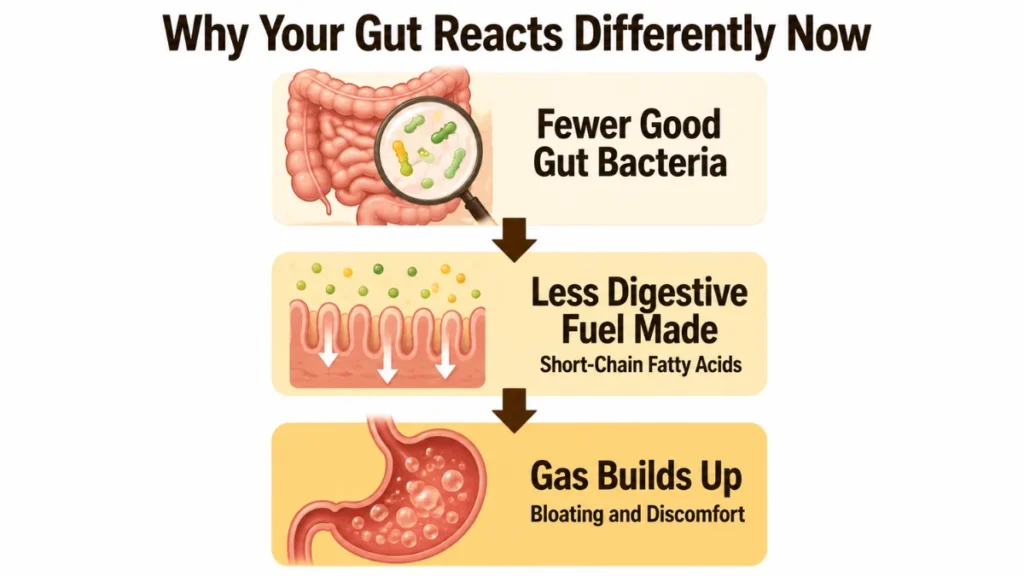
The foods that bloat you now are not the problem; the gut that processes them differently than it used to is.
Here is why dysbiosis matters for bloating specifically. Beneficial bacteria produce short-chain fatty acids [chemical compounds that help regulate gut movement, reduce inflammation, and maintain the intestinal lining].
When those bacteria decline, short-chain fatty acid production drops.³
A gut running short on short-chain fatty acids is one step further into the broader dysbiosis described here, and that combination is what turns a meal you used to tolerate into one that leaves you bloated. ³
Gut microbiome after 50 research also shows that these bacterial shifts are driven partly by factors you can influence: diet variety, physical activity, antibiotic use, and medication load.²
An older adult taking multiple medications, eating a narrower range of foods, and moving less than in earlier decades is giving dysbiosis ideal conditions to develop.
This matters because most bloating treatments aimed at adults over 50 address symptoms, not the bacterial environment producing them.
Your Stomach Acid Story Is More Complicated Than You Think
You have probably heard that stomach acid declines as you age. It is one of the most repeated claims in gut health writing.
It is also mostly wrong.
A 2025 scoping review published in the journal Biomedicines analyzed 15 studies on aging and gastric secretion and suggest that aging does not directly reduce acid output in most people.⁴
Reduced acid in older adults is more often linked to atrophic gastritis [a condition where the stomach lining thins and loses the ability to produce adequate acid and enzymes], or to the widespread use of proton pump inhibitors [acid-blocking medications commonly prescribed for reflux].⁴
Both are diagnosable. Both are distinct from the normal aging process.
Helicobacter pylori [a bacterial infection that damages the stomach lining] is the main driver of atrophic gastritis and affects a large portion of older adults.⁵

That is the direct challenge to what most articles tell you: your stomach acid is probably fine unless you have an untreated infection or you are taking acid-blocking medication.
When atrophic gastritis does develop, it creates a cascade that goes beyond reflux. Reduced stomach acid changes the environment of the small intestine, allowing bacteria to colonize areas where they normally would not.⁵
That bacterial shift, described more specifically in the next section, is a direct route to bloating after meals.
The assembled evidence here is also important to name directly. No single study has proven that the combination of microbiome shift, motility change, and altered acid environment causes new bloating in previously unbothered adults after 50.
Each mechanism has its own evidence base. When your doctor says the cause is unclear, that is an accurate statement, not a failure to look.
Have you or your doctor actually tested your acid levels, or have you been managing a symptom based on a common assumption?
When the Gut Slows Down and Gas Has Nowhere to Go

You eat, and then you wait. The fullness does not resolve in an hour the way it used to.
By evening, the pressure that started at lunch has not moved.
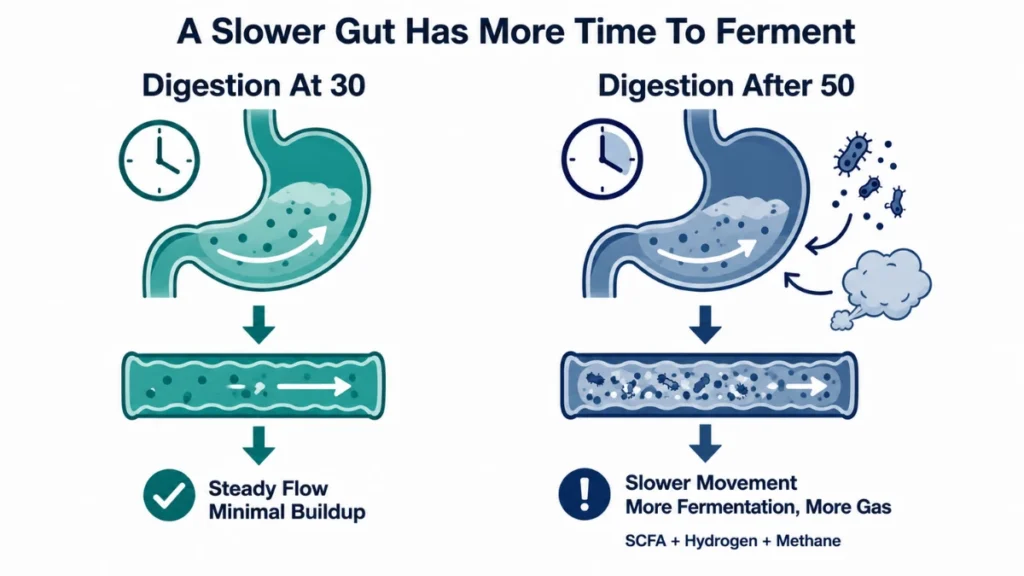
Slow digestion after 50 has a measurable basis. Studies comparing younger and older adults show that gastric emptying [the process by which the stomach moves food into the small intestine] is modestly slower in healthy older subjects.⁶
In fit older adults, this slowing is usually mild and stays within the normal range.⁶ But mild does not mean imperceptible.
When food moves more slowly, bacteria in the gut have more time to ferment it. Fermentation produces gas.
In a gut that already has less microbial diversity and potentially altered small-intestine bacteria, the fermentation load increases and gas production can outpace the gut’s ability to clear it.
Interstitial cells of Cajal [pacemaker cells in the stomach wall that coordinate the muscular contractions of digestion] decline in number with aging.⁷ Studies have shown a roughly 13% reduction per decade.⁷
Fewer pacemaker cells changes how the stomach’s contractions are coordinated, though researchers are still working out exactly how.⁷
Losing the gut’s internal pacemaker cells is not a metaphor. It is a structural change that shifts how meals move, and no amount of dietary adjustment replaces what those cells did.
Medical conditions and medications that affect gastric motility are understood to have a more significant effect on gastric emptying than the mild slowing seen in otherwise healthy aging.⁶
Diabetes, hypothyroidism, and Parkinson’s disease all affect motility. So do opioid pain medications, antidepressants, and anticholinergic drugs, which are common in adults over 50.
The intervention changes completely depending on the cause. Dietary fiber timing addresses one version; a medication review addresses another.
Three Diagnosable Causes Most Doctors Do Not Test For First
Your bloating has a pattern. It is worse after certain foods, or it comes on within an hour of eating, or it showed up around the same time you started a new medication.
That pattern is a clue.

H. pylori infection. Helicobacter pylori is the most common driver of atrophic gastritis, which reduces stomach acid and creates the conditions for bloating described in the previous section.⁵
It is diagnosable with a simple breath test or stool antigen test, and it is treatable. Many adults carry the infection without knowing it.
Lactose malabsorption. The enzyme lactase [a protein produced in the small intestine that breaks down the milk sugar lactose into simpler sugars the body can absorb] declines with age in a large portion of adults.⁸
Studies show a significantly higher rate of positive lactose breath tests in individuals 50 and older compared to younger adults.⁸ A person who tolerated dairy without symptoms for decades may find the threshold has shifted.
Small intestinal bacterial overgrowth (SIBO) [a condition in which colonic bacteria proliferate in the small intestine, where they ferment food prematurely and produce gas] is associated with bloating, particularly when symptoms appear soon after eating even small amounts of food.
Research consistently finds that SIBO is rare in healthy, active older adults and much more common in those with underlying gut disease, low physical activity, or conditions that slow intestinal movement.⁹
If you are otherwise healthy, SIBO is less likely to be the cause, though still worth ruling out if other causes have been excluded.
Talk to your doctor before changing your diet or stopping medication based on a suspected diagnosis, particularly if you manage diabetes, take blood thinners, or have a history of gastrointestinal disease.
If you have been cutting foods for months without a clear result, consider getting tested before cutting anything else.
What You Can Change Today, and What Needs a Real Answer
You do not need a diagnosis to start making changes. But knowing whether your symptoms have a treatable cause changes what those changes should be.
Here is what the evidence supports for managing bloating after meals in adults over 50. Speak with your doctor before making significant dietary changes or stopping any current medication, especially if you have a chronic condition, take prescription drugs, or have not had a recent abdominal exam.
- Reduce fermentable carbohydrates temporarily. A low-FODMAP diet, which limits fermentable sugars found in foods like onions, garlic, wheat, and certain legumes, has been shown to reduce bloating and abdominal discomfort in adults with functional gut symptoms.¹⁰ This is a short-term diagnostic tool, not a permanent eating plan.
- Eat smaller portions at each meal. A stomach with slowed motility handles smaller loads more effectively. Spreading the same total food across four or five smaller meals reduces the fermentation load at any one time.
- Move after eating. Light physical activity after meals, such as a short walk, supports gut motility and reduces the time food sits in the stomach fermenting. This is one of the lowest-effort, highest-return changes for post-meal bloating.
- Review your medications with your doctor. Several drug classes commonly prescribed to adults over 50, including proton pump inhibitors, opioids, antidepressants, and anticholinergic drugs, can affect gut motility or stomach acid levels. A conversation with your prescribing doctor may identify a contributing factor that dietary changes cannot address.
- Ask for targeted testing. A breath test for H. pylori and a glucose or lactulose breath test for SIBO are non-invasive ways to get a specific answer. The hydrogen breath test for lactose malabsorption is less reliable in older adults, with a higher rate of false positives ⁸, so a doctor’s clinical evaluation matters more than the test result here.

See a doctor promptly if your bloating comes with any of the following: unintentional weight loss, blood in the stool, persistent abdominal pain, fever, difficulty swallowing, or new symptoms that started after age 50 with no obvious dietary cause. These are not signs of normal aging.
NIDDK’s digestive disease resource (https://www.niddk.nih.gov/health-information/digestive-diseases) provides plain-language guides for each of these conditions and can help you prepare for a doctor’s conversation.
Your Gut Changed. The Food Did Not.
New bloating after meals is not a sign your diet has failed. It is a sign that the gut processing that diet has shifted in ways that are real, measurable, and in most cases testable.
Talk to your doctor about testing for H. pylori, lactase decline, or SIBO: three diagnosable conditions that can be treated and that explain most new post-meal bloating in people over 50.
Not every case maps cleanly to one cause. That uncertainty is honest, and it is where good clinical care begins.
⚠️DISCLAIMER
This content is for educational purposes only and does not constitute medical advice, diagnosis, or treatment. Always consult your physician before making dietary, medication, or lifestyle changes, especially if you have a chronic condition or take prescription drugs. Do not ignore or delay professional medical care because of anything you have read here.
References
- Ballou S, Singh P, Nee J, et al. Prevalence and Associated Factors of Bloating: Results From the Rome Foundation Global Epidemiology Study. Gastroenterology. 2023.https://www.gastrojournal.org/article/S0016-5085(23)00826-0/fulltext
- Kanimozhi NV, Sukumar M. Aging through the lens of the gut microbiome: Challenges and therapeutic opportunities. Ageing Research Reviews. 2025. https://www.sciencedirect.com/science/article/pii/S2950307825000244
- Tseng CH, Wu CY. From dysbiosis to longevity: a narrative review into the gut microbiome’s impact on aging. Frontiers in Aging. 2025. https://pmc.ncbi.nlm.nih.gov/articles/PMC12515389/
- Vara‑Luiz F, Mendes I, Palma C, et al. Age‑Related Decline of Gastric Secretion: Facts and Controversies. Biomedicines. 2025. https://pubmed.ncbi.nlm.nih.gov/40722622/
- Saltzman JR, Russell RM. The aging gut. Nutritional issues. Gastroenterol Clin North Am. 1997. https://pubmed.ncbi.nlm.nih.gov/9650019/
- Horowitz M, Maddern GJ, Chatterton BE, Collins PJ, Harding PE, Shearman DJ. Changes in gastric emptying rates with age. Clin Sci (Lond). 1984. https://pubmed.ncbi.nlm.nih.gov/6744789/
- Wang TH‑H, Angeli TR, Ishida S, et al. The influence of interstitial cells of Cajal loss and aging on slow wave conduction velocity in the human stomach. Physiol Rep. 2020;8:e14659. https://www.ncbi.nlm.nih.gov/pmc/articles/PMC7757374/
- Gallo A, Marzetti E, Pellegrino S, Montalto M. Lactose malabsorption and intolerance in older adults. Curr Opin Clin Nutr Metab Care. 2024;27(4):333‑337. https://journals.lww.com/co-clinicalnutrition/fulltext/2024/07000/lactose_malabsorption_and_intolerance_in_older.5.aspx
- Mitsui T, Shimaoka K, Goto Y, Kagami H, Kinomoto H, Ito A, Kondo T. Small bowel bacterial overgrowth is not seen in healthy adults but is in disabled older adults. Am J Gastroenterol. 2006. https://pubmed.ncbi.nlm.nih.gov/16506381/
- Altobelli E, Del Negro V, Angeletti PM, Latella G. Low‑FODMAP Diet Improves Irritable Bowel Syndrome Symptoms: A Meta‑Analysis. Nutrients. 2017.https://www.ncbi.nlm.nih.gov/pmc/articles/PMC5622700/