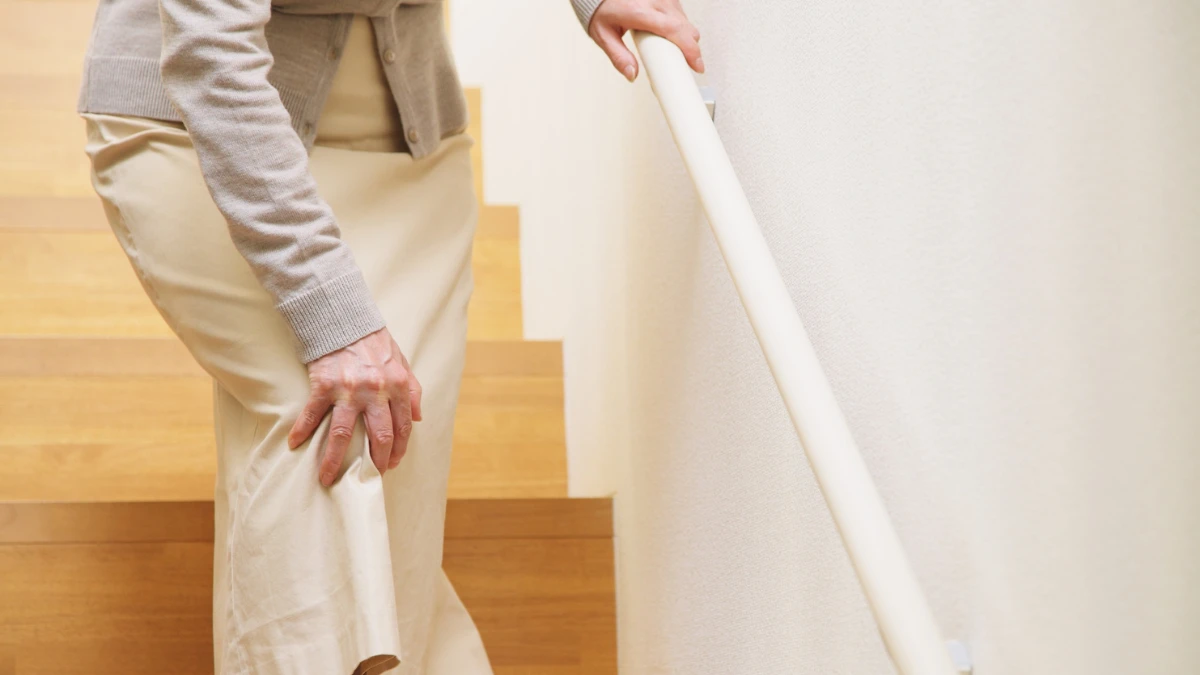
You feel it the moment your foot lifts onto the first step. Not a sudden pain, more of a reluctant ache right above the kneecap, tightening with every step you climb.
You walked to the mailbox and back without a single complaint. But knee pain going up stairs is different, and you already know it before you get to the top.
Here is the part most adults over 50 dealing with knee pain on stairs never hear: this problem rarely starts in the knee. The stairs didn’t break something.
They found something that was already there, and amplified it. The muscle most likely driving that ache may not be where any standard exercise plan looks.
Why Read This
- Why stairs produce pain that flat walking never does, and what that gap reveals about your joint mechanics
- The reason your kneecap gets blamed for a problem that often starts somewhere else
- What a peer-reviewed study says about the exercises most people use to fix this
- Why hip strength turns out to matter more than most knee-focused treatments assume
- The three-move protocol the current evidence actually supports
Why Your Knee Hurts on Stairs but Feels Fine on Flat Ground
Your knee is not failing you on stairs. It is telling you something it cannot say on flat ground.
Your joint handles the load of walking without complaint in most people. Climbing a stair immediately changes the mechanical picture.
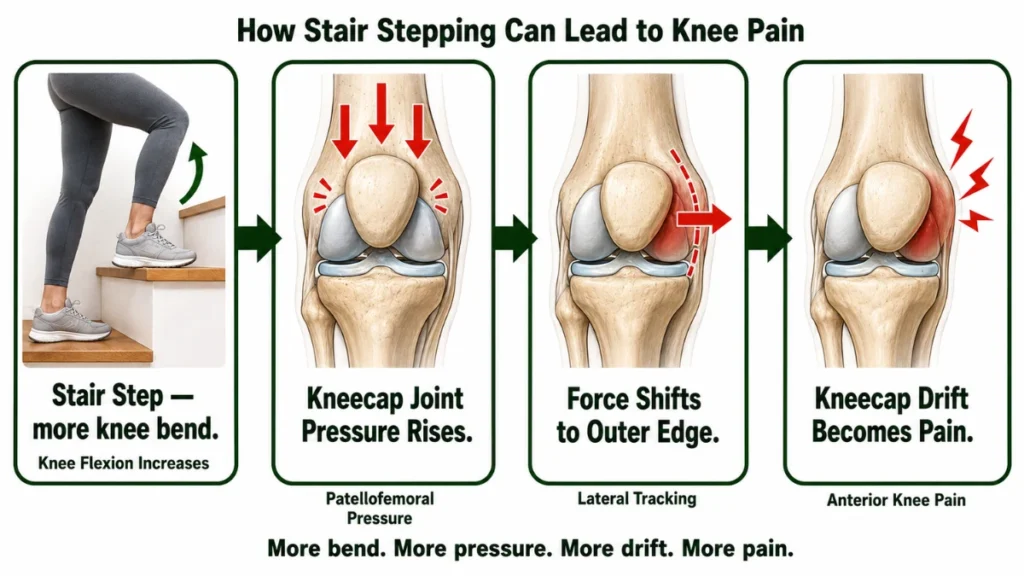
Biomechanical testing using cadaveric knees found that stair climbing increases patellofemoral [the joint between your kneecap and the end of your thigh bone] pressure and pushes force further toward the outer edge of the kneecap compared to level walking.¹
The same mechanical environment that feels fine on a sidewalk becomes something the joint has to work significantly harder to manage.
The revealing gap is the key idea here.
Many adults over 50 notice that flat walks feel normal, but that first step onto a stair triggers an ache right at or just above the kneecap.
This is not because the stairs are damaging the joint.
It is because stair climbing amplifies forces that are already slightly mismanaged at rest, making a small tracking fault visible under load that stayed hidden during lighter activity.
You have probably assumed the pain means the joint itself is deteriorating.
That assumption leads most people straight to compression braces, anti-inflammatory creams, or rest, none of which address what is actually causing the mistracking in the first place.
What Is Actually Happening Inside Your Knee When You Climb
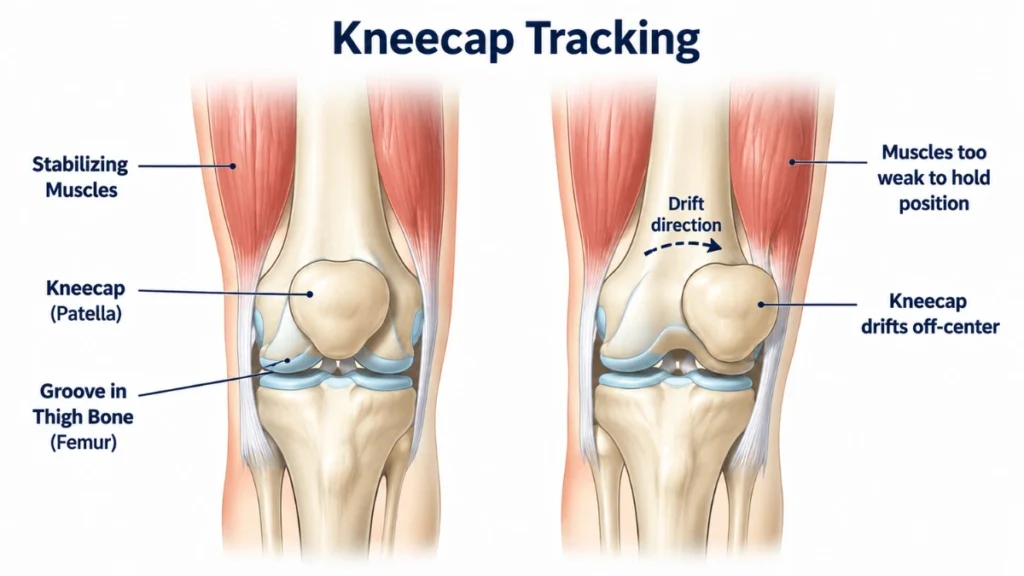
The kneecap is not a fixed bone. It floats.
It sits in a groove at the base of your thigh bone and glides up and down inside that groove every time it bends and straightens. Under normal conditions, the surrounding muscles keep it centered in that groove.
Under stair-climbing conditions, the demand on those muscles increases sharply, and any weakness or timing problem in them becomes impossible to hide.
Patellofemoral pain [discomfort at the joint where the kneecap meets the thigh bone, caused by pressure or abnormal tracking] is present in roughly 23% of the general adult population.²
The pain gets worse during activities like stair climbing, squatting, or sitting for long periods, because all of these require it to flex under load, and that is exactly the condition that reveals a tracking problem.
Here is the insight that almost no stair-pain article mentions. The ache you feel on the stairs is not a stair problem. It is a tracking problem that was already there, quiet and undetected, until the load of stair climbing made it loud enough to feel.
No single study has tested that full chain from start to finish. The picture comes from several lines of research, each covering a different piece.
You did not develop this problem on the stairs. The stairs simply exposed it.
This distinction matters for how you fix it. If the stairs were the problem, rest would solve it. Most people who rest find the pain returns the next time they climb, because the underlying tracking fault is still there waiting.
The Muscle Most Treatments Never Address
Search for “knee pain on stairs exercises” and almost every result will tell you the same thing: strengthen your VMO.
The VMO [vastus medialis oblique, a small, teardrop-shaped muscle on the inner side of the lower thigh that helps pull the kneecap toward the midline] is routinely blamed for patellar mistracking.
Physical therapists, YouTube channels, and self-help articles all prescribe terminal knee extensions, inner-range squats, and leg press variations with toes turned out, all described as targeting this muscle.
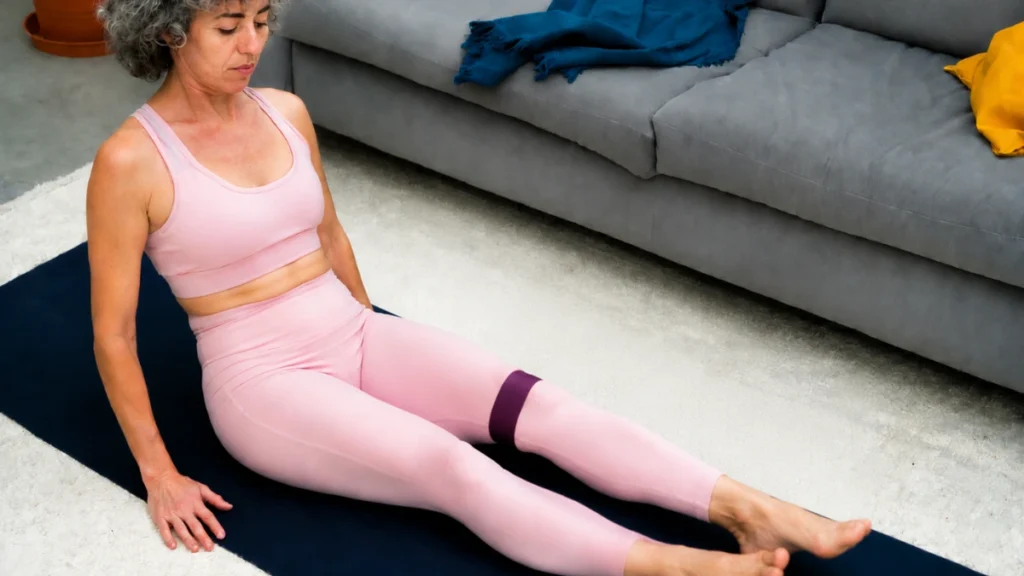
The muscle most treatments never address is not in your knee at all. It sits in your hip, and until you train it, every kneecap exercise you do is fixing the symptom while leaving the cause intact.
But here is what most of those articles do not tell you.
A study published in the Journal of Orthopaedic and Sports Physical Therapy found that the VMO could not be significantly isolated from the rest of the quadriceps during nine standard strengthening exercises, including terminal knee extensions and isokinetic extensions.³
The electrical activity of the VMO was not meaningfully greater than that of the vastus lateralis and other quad muscles during any of the tested movements.³
More recently, a 2024 study in young women with lateral patellar compression syndrome found that isokinetic extension with maximum tibial external rotation could produce selective VMO strengthening.⁴
The research is not settled. Both findings are real, and both are relevant.
What the debate reveals is something more useful than either answer.
Whether or not you can fully isolate the VMO, the standard exercises prescribed for stair pain were not designed or verified to fix the upstream cause of the mistracking. They address the kneecap. So where does the actual problem begin?
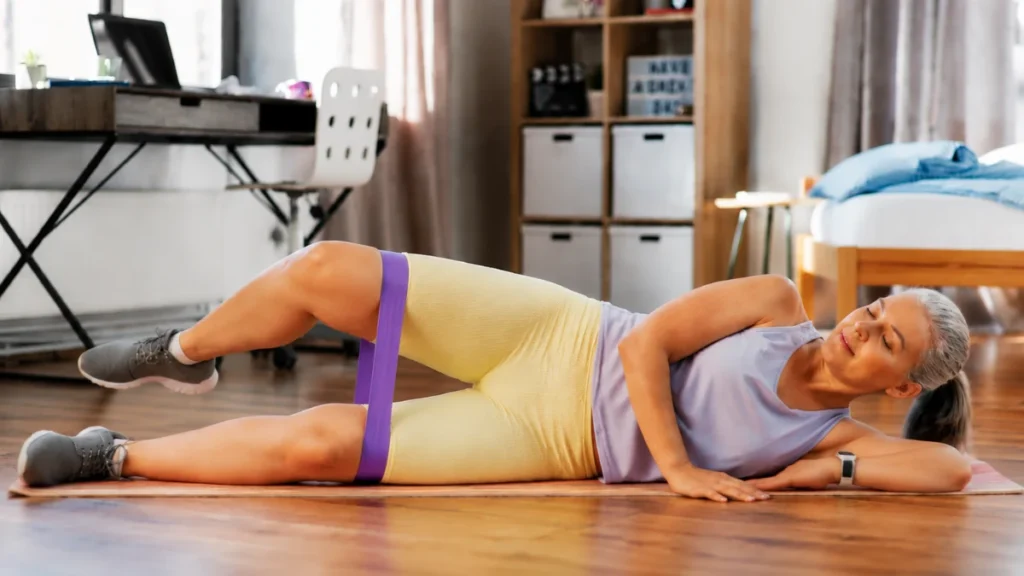
Why the Problem Often Starts at the Hip, Not the Kneecap
Your hip controls where your knee points during every step you take. When the hip muscles that stabilize your pelvis and thigh are weak, the entire leg shifts inward, and the kneecap bears the consequences.
Research comparing women with and without patellofemoral pain found that those with knee pain generated 24% less hip external rotator torque and 26% less hip abductor torque than pain-free controls.⁵ That is not a small difference.
It means the muscles that hold the thigh bone in line during single-leg weight-bearing, the kind of stability you use on every stair step, were substantially weaker in the group experiencing pain.
in the knee-pain group
in the knee-pain group
Hip strengthening for knee pain is now among the best-supported interventions in the research.
A systematic review and meta-analysis covering 14 randomized and controlled trials and 673 participants found that combining hip and knee strengthening was superior to knee strengthening alone for both reducing pain and improving activity in people with patellofemoral pain.⁶
The improvements held beyond the intervention period.⁶ The real finding here is that the knee was being treated for a problem the hip created, and treating both together is what actually works.
The evidence was assembled from multiple studies, each testing different pieces of this relationship. No single trial directly follows adults over 50 with stair-specific knee pain through a hip-strengthening program and measures stair outcomes.
The most applicable research currently available was conducted largely in younger adults. That limitation is worth naming rather than hiding.
Hip weakness is associated with reduced control of thigh rotation, and reduced thigh rotation control is linked to changes in how the kneecap tracks. That is the mechanism, and observational studies, clinical trials, and biomechanical analyses all point to the same conclusion.
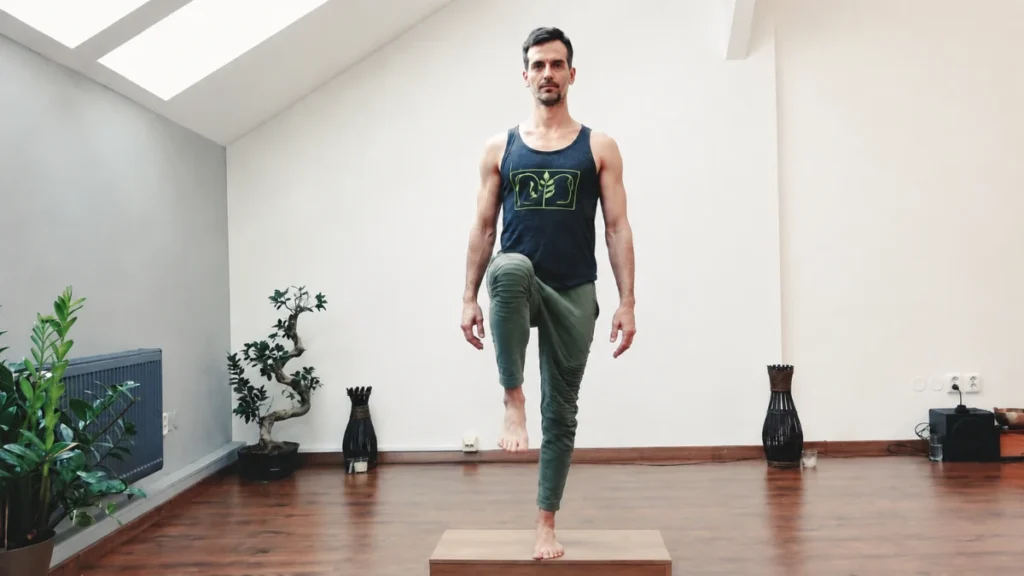
A Three-Move Protocol Grounded in the Evidence
The exercises below are not a diagnosis or a treatment plan. They are drawn from the movements that appeared most consistently in the hip-and-knee strengthening research showing benefit for patellofemoral pain.⁷
Talk to your doctor before starting a new exercise routine if you have an existing knee injury, a recent hip or knee replacement, or any condition that limits your ability to bear weight on one leg.
Clamshells. Lie on your side with knees bent at 90 degrees. Keeping your feet together, lift the upper leg’s knee toward the ceiling while keeping your feet stacked, then lower slowly. This targets the hip abductors, the group shown to be significantly weaker in people with patellofemoral pain.⁵
Start with 15 (give or take) repetitions per side for two sets.
Single-leg wall sit. Stand with your back against a wall, feet hip-width apart, and lower until your knees are at roughly 45 degrees. Lift one foot an inch off the floor and hold for 10 seconds. This loads the hip stabilizers and quadriceps together in a position close to stair descent mechanics.
Three sets of 10-second holds per leg.
Step-down with control. Stand on a low step, feet hip-width. Slowly lower your opposite heel toward the floor, maintaining a straight line from hip to knee to second toe on the standing leg, then return. The slow eccentric phase is where the hip musculature and quadriceps work together under load.
Eight to 10 repetitions per side, two sets.
None of these requires equipment. All three can be done in seven minutes. The goal is not to feel them burn immediately. Give these three moves two weeks before you decide whether they are working.
When Knee Pain on Stairs Is Not a Muscle Problem
Those exercises work for the most common pattern. Not every stair pain fits that pattern.
The pattern described in this article: an ache above or around the kneecap that appears on stairs and eases on flat ground, without swelling or a specific injury event, is consistent with patellofemoral pain and is generally considered safe to address with graduated exercise.
Certain features suggest something different is happening and warrant a visit to a physician or physical therapist before you begin a self-directed program:⁸
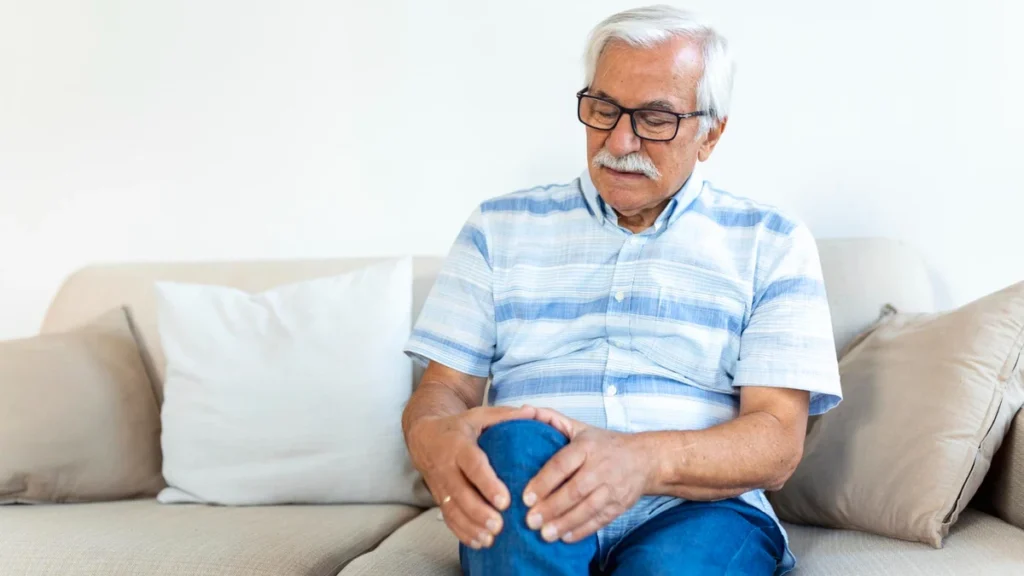
- Significant swelling inside the joint, especially if it appeared after a specific incident
- Pain that is sharp and catches suddenly rather than building gradually on stairs
- A locked feeling in the joint or inability to fully straighten or bend it
- Pain that is clearly worse after rest and improves briefly with movement, which can indicate an inflammatory condition
- Any recent trauma, even mild, that preceded the onset of stair pain
- Pain that has worsened steadily over weeks despite reduced activity
These signs do not necessarily mean something is seriously wrong, but they do mean the cause needs to be identified before you start loading the joint with resistance exercise.
Most stair knee pain in adults over 50 does not start in the knee. But some of it does, and knowing which kind you have determines how you begin.
The Real Fix Is Further Up Than You Think
The ache above your knee on stairs is not a knee problem. It is a hip-and-tracking problem that stairs make impossible to ignore.
Add three sets of clamshells and one wall-sit with toes turned out slightly to your daily routine this week, and track whether your stairs feel easier within ten days.
The Kujala Anterior Knee Pain Scale (free) lets you track improvement over time. Whether exercise alone closes the gap is an open question for some. But for most, the muscle no treatment ever addressed is the one that was never trained.
⚠️DISCLAIMER
This article is for educational purposes only and does not replace professional medical advice. Consult your physician or physical therapist before starting any exercise program, especially if you have an existing injury or experience sharp pain. Do not disregard professional medical advice based on any content in this article.
References
- Goudakos IG, König C, Schöttle PB, Taylor WR, Singh NB, Roberts I, Streitparth F, Duda GN, Heller MO. Stair climbing results in more challenging patellofemoral contact mechanics and kinematics than walking at early knee flexion under physiological-like quadriceps loading. Journal of Biomechanics. 2009. https://pubmed.ncbi.nlm.nih.gov/19656517/
- Smith BE, Selfe J, Thacker D, et al. Incidence and prevalence of patellofemoral pain: a systematic review and meta-analysis. PLOS ONE. 2018. https://pmc.ncbi.nlm.nih.gov/articles/PMC5764329/
- Mirzabeigi E, Jordan C, Gronley JK, Rockowitz NL, Perry J. Isolation of the vastus medialis oblique muscle during exercise. The American Journal of Sports Medicine. 1999. https://pubmed.ncbi.nlm.nih.gov/9934418/
- Hosseini SH, Farahmand F. Is it truly impossible to strengthen the vastus medialis in isolation from the entire quadriceps muscle group? Heliyon. 2024. https://www.ncbi.nlm.nih.gov/pmc/articles/PMC11667613/
- Bolgla LA, Malone TR, Umberger BR, Uhl TL. Hip strength and hip and knee kinematics during stair descent in females with and without patellofemoral pain syndrome. J Orthop Sports Phys Ther. 2008. https://pubmed.ncbi.nlm.nih.gov/18349475/
- Nascimento LR, Teixeira-Salmela LF, Souza RB, Resende RA. Hip and Knee Strengthening Is More Effective Than Knee Strengthening Alone for Reducing Pain and Improving Activity in Individuals With Patellofemoral Pain. Journal of Orthopaedic and Sports Physical Therapy. 2018. https://www.jospt.org/doi/10.2519/jospt.2018.7365
- Halabi MH, Alturkistani BA, Abuhadi RH, Garout AN, Almuqbil FB, Alshehri MS. The Efficacy of Hip and Knee Muscles Strengthening Versus Knee Muscle Strengthening Alone in Managing Patellofemoral Pain Syndrome: A Systematic Review and Meta-Analysis. Musculoskeletal Care. 2025. https://pubmed.ncbi.nlm.nih.gov/39934098/
- Gaitonde DY, Ericksen A, Robbins RC. Patellofemoral Pain Syndrome. American Family Physician. 2019;99(2):88-94. https://www.aafp.org/pubs/afp/issues/2019/0115/p88.html