

You go to bed at a reasonable hour, you stay there for eight hours, and you still wake up feeling like you ran a race in your sleep. You’re not imagining it.
For adults over 50 who struggle to fall asleep or stay asleep, the answer most doctors reach for is a pill. But the problem that wakes you at 3:00 am may not need a sedative. It may need magnesium.
Many adults over 50 may be running low on the one mineral their brain needs to wind down at night, and they don’t know it because the symptoms look exactly like normal aging.
Magnesium for sleep is not a new idea, but the reason it works is more specific than most articles admit.
Why Read This
- What happens inside your brain when levels drop, and why aging makes the gap worse
- The one mechanism that sets this mineral apart from melatonin and every common sleep aid
- What a controlled trial in elderly adults actually found, and where the evidence honestly stops
- Why the form you take changes what you absorb, and which forms researchers have studied
Why your body is losing magnesium faster than you think after 50
You might be eating the same foods you always have, but your body is working with less magnesium than it used to. That’s not a diet problem. It’s a physiology problem.
The gut absorbs less magnesium as the body ages.¹ At the same time, the kidneys become less efficient at holding onto it.¹ More of it leaves in urine, and the gap between what you take in and what your body actually uses widens quietly.¹
This matters for sleep because mild shortfalls in older adults may show up as sleep disturbances, fatigue, and mood changes.¹ These are also common complaints that get written off as just getting older.

That connection is why so many people never address a nutrient that is actually within reach.
Here is the research signal most articles skip: the absorption problem means that intake figures alone understate how far behind many older adults actually are.²
Even 48% of all Americans consume less than their estimated average requirement, based on data from the National Health and Nutrition Examination Survey.²
For adults over 70, the gap is wider still.² The body needs 320 to 420 milligrams per day depending on age and sex.² Most people do not meet that number, and the aging gut delivers a smaller fraction of what does get eaten.
No single study has measured this combined shortfall directly in older adults. The full picture is assembled from separate lines of evidence rather than one trial.
Sleep disturbance is one condition the research links to mild deficit in the elderly.¹ The authors note that the symptoms are non-specific and are often mistaken for normal age-related changes.¹
What magnesium actually does inside your brain at night
Most people assume the brain just gets tired and switches off on its own. That’s not quite right.
The brain has a built-in calming system. Two key parts are GABA [a chemical messenger that slows nerve activity and tells the brain it is safe to rest] and the NMDA receptor [a nerve-cell switch that, when overactive, keeps the brain on alert].
Magnesium works on both.³ It acts as a natural GABA agonist, which means it helps activate the brain’s calming signals.³ It also blocks the NMDA receptor, which reduces the excitatory signals that keep you alert.³
More quiet, less noise. The two effects work in the same direction at the same time.
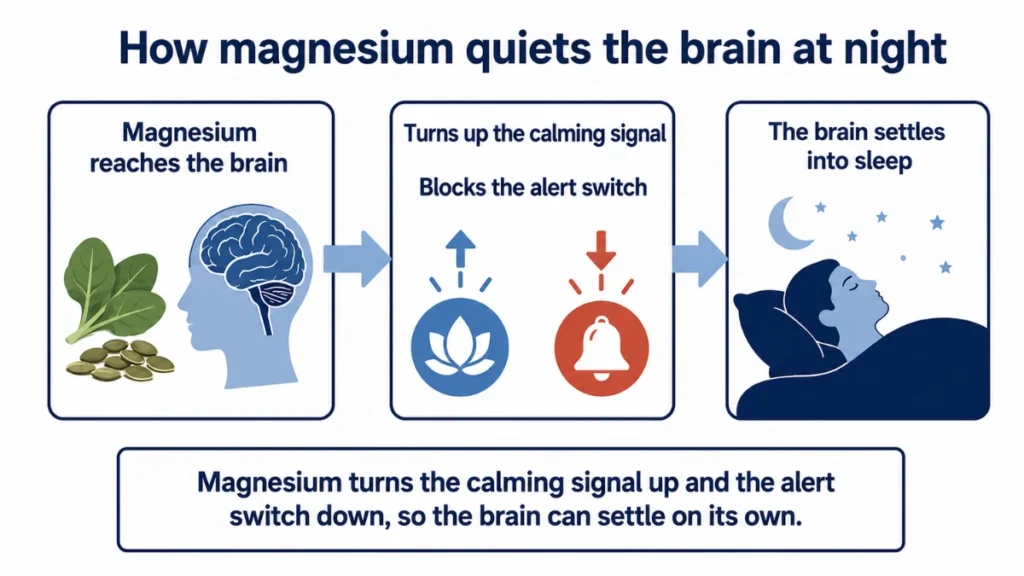
Magnesium does not appear to sedate you the way a sleeping pill does; rather, it may restore the chemistry your brain needs to switch off on its own.
Research also suggests it may support melatonin production and lower cortisol, the stress hormone that is highest in the morning and is supposed to fall by evening.³
When cortisol stays elevated into the night, falling asleep can become a fight rather than a drift.
A sleeping pill overrides this system with sedation. Magnesium works within it.
Sleep aids replace the off switch. Magnesium fixes the wiring.
The one thing this brain-chemistry picture does not do is predict exactly how much improvement any individual will feel.
The mechanism is well-described; the clinical size of the effect is a separate question, and that is what the next evidence section answers.
What the clinical trials found and where the evidence stops
Theory is useful. Numbers are more useful.
In a double-blind, placebo-controlled trial, 46 elderly adults with primary insomnia, average age 65, received either 500 milligrams of magnesium or a placebo daily for eight weeks.⁴
By the end, the supplement group showed clear improvements in sleep efficiency and sleep onset latency.⁴ Their serum melatonin rose and their serum cortisol fell.⁴
Sleep efficiency moved from 0.63 to 0.73 in the supplement group.⁴ Total sleep time did not improve between groups at a measurable level.⁴
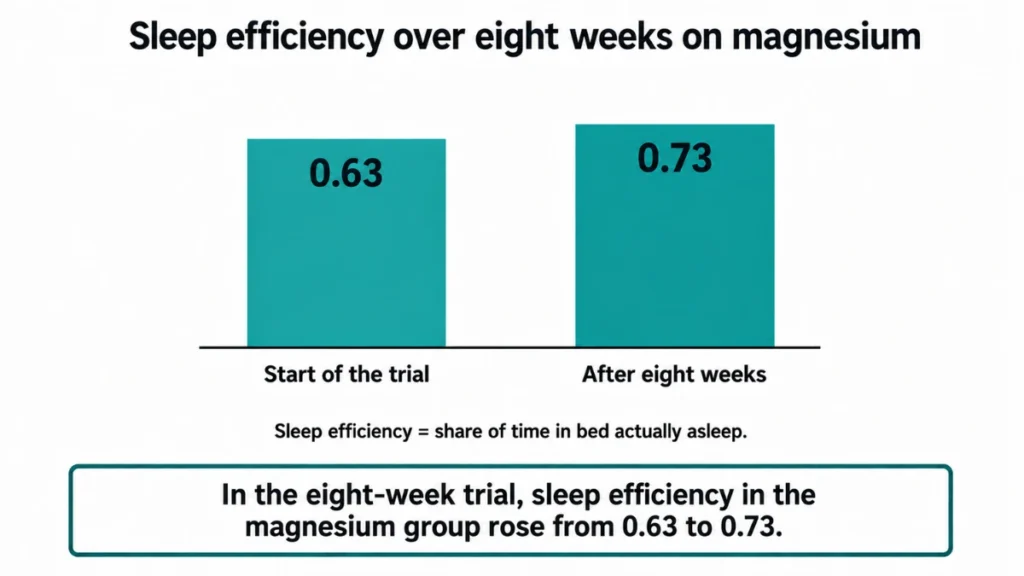
That answer is real but narrow: it applied to older adults with confirmed insomnia, not to people with milder sleep disruption.
A more recent trial tested a younger and less severely affected group to see if the effect held.
In a 2025 randomized trial, 155 adults aged 18 to 65 with poor sleep quality received 250 milligrams of elemental magnesium as magnesium bisglycinate daily for 28 days.⁵ Insomnia scores fell by a measurable margin compared to placebo.⁵ Most of the improvement happened in the first 14 days.⁵
Between-group difference: 1.6 points on a 28-point scale, Cohen’s d of 0.2.⁵ Modest.
Pooled data from two randomized trials in 55 older adults found that supplementation may reduce the time it takes to fall asleep by about 17 minutes compared to placebo.⁶
Seventeen minutes. Worth knowing.
Now the honest part: the authors of that meta-analysis rated the quality of evidence as low.⁶ They noted that the clinical meaning of a 17-minute improvement is open to debate.⁶ The 2025 trial relied on self-reported sleep data with no objective measurement.⁵
Researchers behind the 2012 trial also noted that eight weeks may not have been long enough.⁴ Serum differences between groups were only marginally measurable.⁴
These are real limitations. But the direction of the evidence is consistent. Across trials of different designs and populations, supplementing with it appears to move sleep in the right direction for people who are short on it.
Why the form of magnesium you take changes everything
Not all supplement forms work the same way. The form matters more than the label’s milligram count.
Oxide is a widely available supplement form. It contains a high percentage of elemental magnesium by weight, but has poor absorption compared to other forms.²

Forms that dissolve well in liquid are absorbed more completely in the gut.² Better-absorbed options include magnesium citrate, lactate, and aspartate.² Glycinate, also called bisglycinate, falls into this category as well.
Glycinate has an added property: it is bonded to glycine, an amino acid with inhibitory effects on the nervous system that researchers have explored for sleep benefits.
The 2025 Schuster trial tested glycinate specifically to examine whether this combination might offer advantages over other forms.⁵
That trial used 250 milligrams of elemental magnesium delivered as bisglycinate and found a modest but measurable reduction in insomnia scores.⁵
By contrast, the 2012 Abbasi trial used oxide and still found improvements in sleep efficiency and cortisol.⁴
What appears to matter most is correcting the underlying shortfall.³ The form is secondary to ensuring enough elemental magnesium is actually absorbed.
Supplemental forms carry an upper limit of 350 milligrams per day for adults.² Higher doses from supplements can cause digestive side effects.²
So which gap are you actually trying to close: a diet problem, an absorption problem, or both?
The best foods for raising your magnesium levels

Food is the safest way to raise intake, and the foods richest in it are not exotic. Most of them are already in a typical kitchen.
Pumpkin seeds [small, flat seeds from inside a pumpkin, also sold as pepitas] lead the list by a wide margin. One ounce delivers 156 milligrams of magnesium, which is 37% of the daily value for an adult.²
Chia seeds provide 111 milligrams per ounce.² They are easy to stir into yogurt or oatmeal without changing the flavor of either.
Almonds, dry-roasted, provide 80 milligrams per ounce.² Half a cup of boiled spinach delivers 78 milligrams.²
Cashews come in at 74 milligrams per ounce, and black beans, cooked, provide 60 milligrams per half cup.²
The body absorbs roughly 30% to 40% of what it takes in from food.² That fraction is better than what most cheap supplement forms deliver.
It also comes packaged with fiber, protein, and other nutrients that supplements do not replicate.
Before starting magnesium supplementation, speak with your doctor if you take diuretics, proton pump inhibitors, or antibiotics, as these medications can interact with magnesium or affect how much the body retains.²
- Add one tablespoon of pumpkin seeds to breakfast, yogurt, or a salad daily
- Swap white rice for brown rice or quinoa twice a week
- Keep a small handful of almonds or cashews as a regular afternoon snack
- Use black beans or edamame as a base for at least one meal each week
Building intake from food takes longer than a supplement to close a large gap.
For adults over 50 with lower gut absorption, diet alone may not be enough.
How to know if a supplement is the right next step for you
You’ve read the evidence. Now the question is whether any of it applies to you.
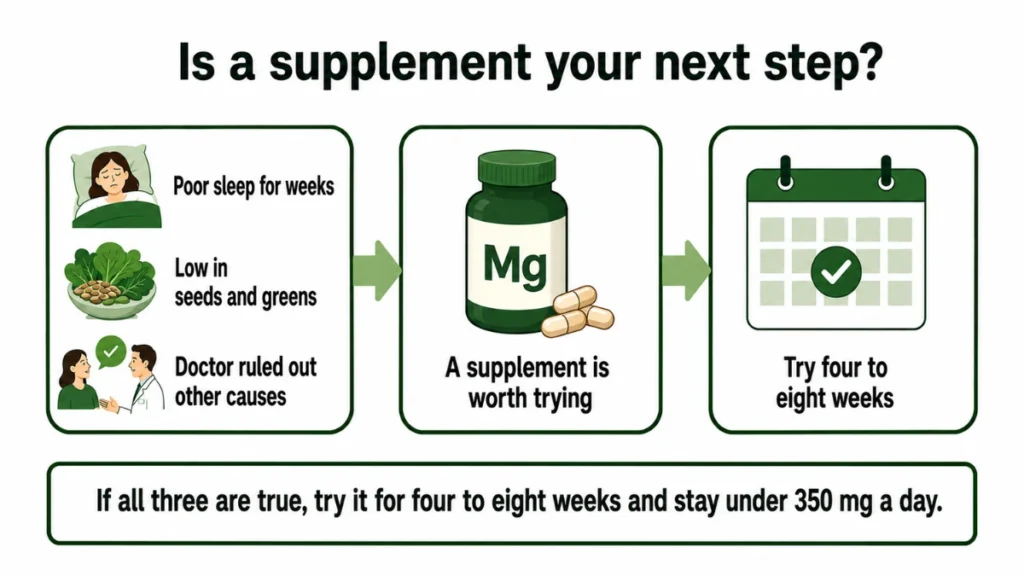
A supplement makes the most sense when diet alone is unlikely to close the gap. That scenario is common in adults over 50 who eat little in the way of seeds, legumes, and leafy greens, or who take diuretics or proton pump inhibitors that reduce mineral retention.²
There is no standard blood test for total body levels. Serum levels, which most labs measure, do not accurately reflect what is stored in tissues and bone.² This makes it hard to confirm a shortfall without a clinical assessment.
Start here:
if your sleep is consistently poor, your diet is low in mineral-rich foods, and you have ruled out other causes with your doctor, a magnesium supplement is a reasonable and low-risk option to try for at least four to eight weeks.
Magnesium for sleep is not a guaranteed fix.
It works best for people who are genuinely low on it, and less reliably for people who are not, though this subgroup finding came from an exploratory analysis using a non-validated dietary assessment tool and should be treated as preliminary.⁵
Pooled data from two randomized trials in 55 older adults found that supplementation may reduce the time to fall asleep by about 17 minutes compared to placebo.⁶
That figure is pooled from just two small trials: one in adults with confirmed insomnia, one in healthy older adults. The authors themselves rated the evidence quality as low.
Not transformative, but real for someone who regularly lies awake struggling to fall asleep.
If you decide to try a supplement, choose a well-absorbed form such as magnesium citrate,² or magnesium glycinate, which has shown benefit in a clinical trial,⁵ rather than oxide.² Stay under 350 milligrams from supplements per day.²
For more guidance, the NIH Office of Dietary Supplements maintains a free consumer fact sheet at ods.od.nih.gov/factsheets/Magnesium-Consumer. Use it before you buy anything.
One mineral, one gap worth closing
Magnesium does not work like a sleep aid. It works within the brain’s own system, supporting the pathways that quiet things down when they are supposed to.
The gap in older adults widens with age, and most people never address it.
Add one tablespoon of pumpkin seeds to your breakfast three days this week and consider asking your doctor whether a magnesium supplement is right for you.
Whether food or a supplement closes the gap is secondary. Whether you are short on magnesium at all is still harder to confirm than it should be.
⚠️DISCLAIMER
This article is for informational purposes only and is not medical advice. It does not diagnose, treat, or replace guidance from a licensed healthcare provider. Individual results from magnesium supplementation vary, and some medications interact with magnesium as noted in the article. Talk to your doctor before starting any new supplement, especially if you take diuretics, proton pump inhibitors, antibiotics, or have kidney or heart conditions.
References
- Barbagallo M, Veronese N, Dominguez LJ. Magnesium in Aging, Health and Diseases. Nutrients. 2021. https://pmc.ncbi.nlm.nih.gov/articles/PMC7912123/
- National Institutes of Health Office of Dietary Supplements. Magnesium: Fact Sheet for Health Professionals. 2026. https://ods.od.nih.gov/factsheets/Magnesium-HealthProfessional/
- Arab A, Rafie N, Amani R, Shirani F. The Role of Magnesium in Sleep Health: a Systematic Review of Available Literature. Biological Trace Element Research. 2022. https://www.researchgate.net/publication/358731543_The_Role_of_Magnesium_in_Sleep_Health_a_Systematic_Review_of_Available_Literature
- Abbasi B, Kimiagar M, Sadeghniiat K, Shirazi MM, Hedayati M, Rashidkhani B. The effect of magnesium supplementation on primary insomnia in elderly: A double-blind placebo-controlled clinical trial. J Res Med Sci. 2012. https://www.researchgate.net/publication/249321801_The_effect_of_magnesium_supplementation_on_primary_insomnia_in_elderly_A_double-blind_placebo-controlled_clinical_trial
- Schuster J, Cycelskij I, Lopresti A, Hahn A. Magnesium Bisglycinate Supplementation in Healthy Adults Reporting Poor Sleep: A Randomized, Placebo-Controlled Trial. Nat Sci Sleep. 2025. https://pmc.ncbi.nlm.nih.gov/articles/PMC12412596/
- Mah J, Pitre T. Oral magnesium supplementation for insomnia in older adults: a Systematic Review & Meta-Analysis. BMC Complement Med Ther. 2021. https://www.ncbi.nlm.nih.gov/pmc/articles/PMC8053283/