
Does standing up from your favorite chair feel more like a chore than a natural movement? You aren’t alone. Many people feel a sense of stuckness when they try to get moving. This often happens as the leg muscles you use to stand get weaker. Your quadriceps, glutes and hamstrings are the main muscles you need to rise without a struggle.¹
If you feel like you have to rock back and forth just to get on your feet, your body is sending you a signal that it needs more functional mobility.
The good news is that you can fix this in your living room. Chair-based exercise is a scientifically backed way to regain your sit to stand strength.²
By using low impact strength training, you can wake up the muscles that have gone dormant from sitting. This isn’t about running marathons.
It’s about making sure your first step of the day feels light and steady. You will learn how to move with more confidence and less creaking in just a few minutes a day.
This article is for informational purposes only and is not a substitute for professional medical advice. The exercises described are general in nature and may not be suitable for everyone. Talk to your doctor before starting any new exercise routine, especially if you have a joint condition, chronic illness, or are recovering from injury.
Why Is Standing Up Suddenly Harder?
Standing up is a complex move for your body. It requires posterior chain strength. This is the team of muscles on your backside, including your glutes and hamstrings.³
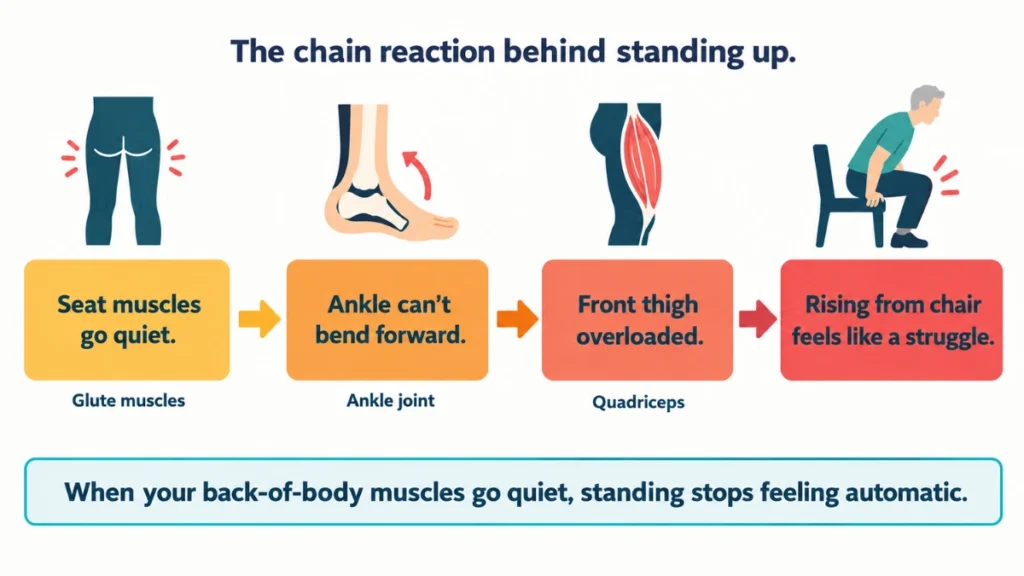
Weak glutes have been linked to knee pain, and training those same muscles has been linked to less pain when rising from a chair.⁴ Another secret to easy movement is ankle dorsiflexion.
This is just a fancy way of saying your ankles need to be flexible enough to lean your shins forward. Research shows that lower body strength helps predict who stays independent in daily life.⁵
Being able to stand up easily is one sign you can stay active and independent. This workout targets those exact pivot points to keep you moving.
How to Set Up a Safe Practice Space?
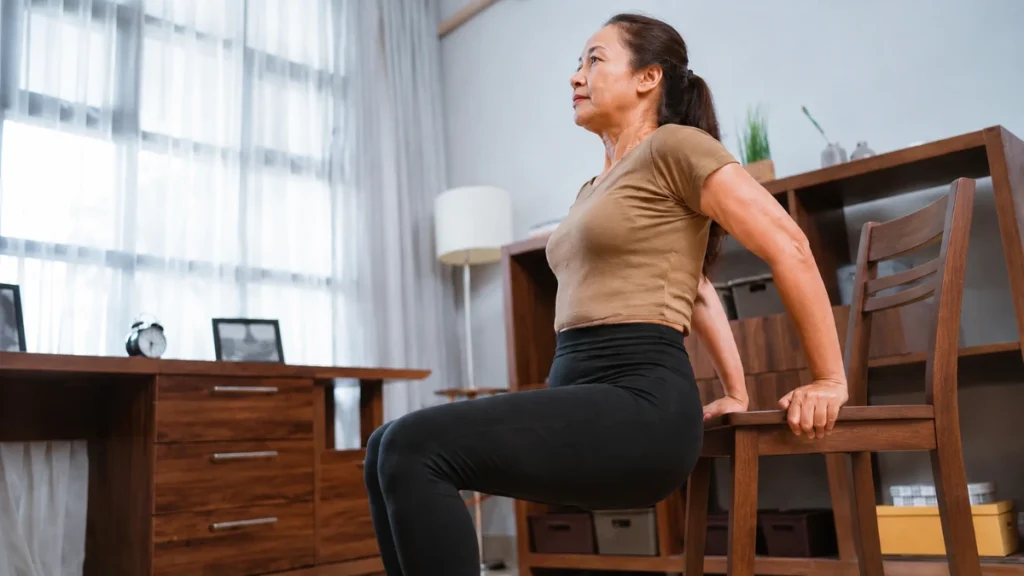
You don’t need a gym, but you do need the right setup. Chair stability is the most important part of safe home exercise. Choose a sturdy chair without wheels. A dining room chair usually works best.
Avoid using a folding chair or a soft, deep sofa, as these won’t give you the support you need. Make sure your chair is on a flat, non slip surface like a rug or a yoga mat.
You also need a clear zone around you. Clear away any rugs you might trip on or small coffee tables. Wear supportive shoes with a good grip. If you prefer to go barefoot, make sure you aren’t on a slippery wood floor. Taking sixty seconds to check your space prevents accidents before they happen.
Lighting is another key part of a safe setup that people often overlook. Make sure your exercise area is well lit so you can clearly see your feet and any nearby objects.
Shadows can trick your eyes and make you feel off balance, especially when you are transitioning from sitting to standing.
How to Move from the Chair to the Floor?
As you get stronger, you can scale this up. Most people start by using the armrests to push themselves up. That is fine for week one.
By week three, try to keep your hands in your lap while you stand. A great trick is the Hover technique. When you are sitting down, stop and hold your position just one inch above the seat for three seconds.
This activates your glutes.⁶ Once you can do ten hovers without shaking, you’ve mastered the move. Find that getting out of cars or off low couches becomes much simpler.
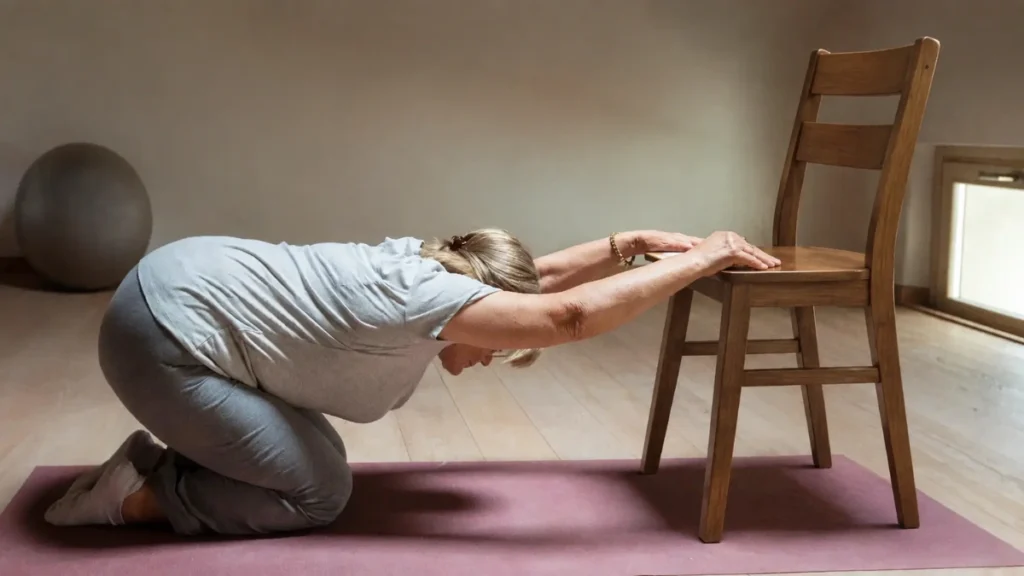
Moving from seated exercises to the floor can feel intimidating. The safest way to do this is by using your sturdy chair as a bridge.
Stand next to the chair and place both hands firmly on the seat. Lower one knee to the ground at a time, keeping your weight supported by your arms.
Once both knees are down, you can slowly sit back onto your heels or shift your weight to your side to reach a seated position on the floor.
Why Your Breathing Helps You Stand Faster?
Many people hold their breath when they try to stand up from a chair. This makes your body feel heavy and tight. It also puts extra strain on your heart.⁷ Instead, try to use a power breath. Exhale strongly through your mouth as you push your body upward.
This simple trick helps keep your core muscles working.⁸ When you breathe out as you rise, the movement feels lighter.
It turns a struggle into a smooth, controlled motion. Practice this every time you get up, even when you aren’t working out.
Proper breathing does more than just relax you; it acts like an internal support system for your spine. When you tighten your core as you breathe, you create intra abdominal pressure, which is like inflating a sturdy balloon inside your torso. This pressure helps steady your spine.⁹
How to Turn Your Daily Routine Into a Strength Builder?
You don’t have to wait for your official workout time to improve your mobility. You can use your chair throughout the day. Every time you need to stand up, try the Slow Motion Stand.
Take three full seconds to move from sitting to standing. Moving slowly forces your muscles to work harder for a longer time.¹⁰
It is a great way to wake up your glutes while you go about your day. You can also do this when you sit down. Lower yourself toward the seat as slowly as you can.
These small habits keep your muscles active and ready for movement. Your chair is already the only equipment you need.
You can turn every sit into a strength builder by practicing the Two Stage Landing. Instead of letting gravity take over when you sit down, lower yourself until you are just an inch above the chair, hold that position for two seconds, and then finish the seat.
This small pause makes your quads and glutes work under tension.
How to Track Your Success in 30 Seconds?
You need to know if you are getting stronger. A simple way to check is the 30 Second Sit to Stand Test. Sit in your chair with your arms crossed over your chest.
Set a timer for 30 seconds and count how many times you can stand up and sit down safely. This exact test is a reliable measure of your leg strength.¹¹

Write your number down and try the test again in two weeks. Seeing that number go up is a great way to stay motivated. It proves that your hard work is paying off and that your body is becoming more capable.
To make this test even more useful, pay attention to how your body feels, not just the number of reps you finish.
Along with your count, note how steady and controlled each stand feels. Tracking these small wins in a notebook or on your phone helps you see that you are getting stronger, even on days when the number doesn’t change.
This mental boost is just as important as the physical gain for staying consistent.
Simple Ways to Keep Your Joints Greased
Your muscles need more than just exercise to move well. Drinking enough water helps your body work at its best. Joints that don’t get enough movement can start to feel stiff and stuck.
Staying hydrated is a simple habit that supports your workout. It also helps your muscles recover after your 10-minute chair workout.
Try to drink a full glass of water right before you start your routine. This helps your body stay loose and ready for movement. You will feel less stiff the next morning if you keep your body hydrated today.
Beyond hydration, moving your joints through their full range of motion every morning is like spreading oil across a rusty hinge.
Simple movements like ankle circles or seated knee lifts keep your ankles and knees moving. Your joint cartilage gets its nutrients from the fluid inside the joint, and movement helps keep that fluid fresh and spread across the joint.¹²
Keep Moving, One Stand at a Time
You don’t need to spend hours exercising to see results. Doing it regularly is what counts. A 10-minute chair workout done three times a week is a simple way to build that habit. Notice how your legs feel after the very first session. You deserve to move without thinking twice about it.
It is easy to skip a workout when you feel tired. We all do it. But remember that your body was built to move. When you choose to do this 10-minute chair workout, you are choosing to stay active and independent for years to come. You aren’t just building muscle. You are building a life where you don’t have to think twice about standing up.
References
- Kumar V, Yoshiike T, Shibata T. Predicting Sit-to-Stand Adaptations due to Muscle Strength Deficits and Assistance Trajectories to Complement Them. Frontiers in Bioengineering and Biotechnology. 2022;10:799836. doi:10.3389/fbioe.2022.799836. https://pmc.ncbi.nlm.nih.gov/articles/PMC8971612/ | Tebbache N, Hamaoui A. Effect of Seat Backrest Inclination on the Muscular Pattern and Biomechanical Parameters of the Sit-to-Stand. Frontiers in Human Neuroscience. 2021;15:678302. doi:10.3389/fnhum.2021.678302. https://www.frontiersin.org/journals/human-neuroscience/articles/10.3389/fnhum.2021.678302/pdf
- Klempel N, Blackburn NE, McMullan IL, Wilson JJ, Smith L, Cunningham C, O’Sullivan R, Caserotti P, Tully MA. The Effect of Chair-Based Exercise on Physical Function in Older Adults: A Systematic Review and Meta-Analysis. International Journal of Environmental Research and Public Health. 2021;18(4):1902. doi:10.3390/ijerph18041902. https://pmc.ncbi.nlm.nih.gov/articles/PMC7920319/
- Kumar V, Yoshiike T, Shibata T. Predicting Sit-to-Stand Adaptations due to Muscle Strength Deficits and Assistance Trajectories to Complement Them. Frontiers in Bioengineering and Biotechnology. 2022;10:799836. doi:10.3389/fbioe.2022.799836. https://pmc.ncbi.nlm.nih.gov/articles/PMC8971612/ | Verlaan L, Boekesteijn RJ, Oomen PW, Liu WY, Peters MJM, Witlox MA, Emans PJ, van Rhijn LW, Meijer K. Biomechanical Alterations during Sit-to-Stand Transfer Are Caused by a Synergy between Knee Osteoarthritis and Obesity. BioMed Research International. 2018;2018:3519498. doi:10.1155/2018/3519498. https://onlinelibrary.wiley.com/doi/10.1155/2018/3519498
- Xie P, Bíró I, Liang M. The Relationship between Patellofemoral Pain Syndrome and Hip Biomechanics: A Systematic Review with Meta-Analysis. Healthcare. 2023;11(1):99. doi:10.3390/healthcare11010099. https://pmc.ncbi.nlm.nih.gov/articles/PMC9818693/ | Velusamy S, Anitha A, Ramana K, Kamalakannan M. Analysing the Relationship between Gluteus Maximus Muscle Activity and Hamstring Muscle Length and its Influence on Sit to Stand Activity in Persons with Sacroiliac Joint Dysfunction. Indian Journal of Physiotherapy and Occupational Therapy. 2024;18. doi:10.37506/z803y945. https://medicopublication.com/index.php/ijpot/article/view/19866
- Wang DXM, Yao J, Zirek Y, Reijnierse EM, Maier AB. Muscle mass, strength, and physical performance predicting activities of daily living: a meta-analysis. Journal of Cachexia, Sarcopenia and Muscle. 2020;11(1):3-25. doi:10.1002/jcsm.12502. https://pubmed.ncbi.nlm.nih.gov/31788969/ | Miri S, Farhadi B, Takasi P, Ghorbani Vajargah P, Karkhah S. Physical independence and related factors among older adults: a systematic review and meta-analysis. Annals of Medicine and Surgery. 2024;86(6):3400-3408. doi:10.1097/MS9.0000000000002100. https://pubmed.ncbi.nlm.nih.gov/38846859/
- Barton CJ, Kennedy A, Twycross-Lewis R, Woledge R, Malliaras P, Morrissey D. Gluteal muscle activation during the isometric phase of squatting exercises with and without a Swiss ball. Physical Therapy in Sport. 2014;15(1):39-46. doi:10.1016/j.ptsp.2013.02.006. https://pubmed.ncbi.nlm.nih.gov/23770356/ | Fisher BE, Southam AC, Kuo YL, Lee YY, Powers CM. Evidence of altered corticomotor excitability following targeted activation of gluteus maximus training in healthy individuals. NeuroReport. 2016;27(6):415-421. doi:10.1097/WNR.0000000000000556. https://pubmed.ncbi.nlm.nih.gov/26981714/
- Yu JH, Jung JY, Lee YB, Shim JM, Son YD, Yang J, Kang CK. Comparative Effects of Abdominal Bracing and Valsalva Maneuver on Cerebral and Peripheral Hemodynamics in Healthy Adults: A Randomized Crossover Study. Medicina (Kaunas). 2025;61(11):2031. doi:10.3390/medicina61112031. https://pubmed.ncbi.nlm.nih.gov/41303867/ | Taneja I, Medow MS, Clarke D, Ocon A, Stewart JM. Postural Change Alters Autonomic Responses to Breath-Holding. Clinical Autonomic Research. 2010;20(2):65-72. doi:10.1007/s10286-009-0046-x. https://pmc.ncbi.nlm.nih.gov/articles/PMC3378244/
- Kang JI, Jeong DK, Choi H. Effect of exhalation exercise on trunk muscle activity and oswestry disability index of patients with chronic low back pain. Journal of Physical Therapy Science. 2016;28(6):1738-1742. doi:10.1589/jpts.28.1738. https://pmc.ncbi.nlm.nih.gov/articles/PMC4932047/ | Kwon JW, Park SY, Baek KH, Youk K, Oh S. Breathing Exercise Called the Maximal Abdominal Contraction Maneuver. Medicina (Kaunas). 2021;57(2):129. doi:10.3390/medicina57020129. https://pmc.ncbi.nlm.nih.gov/articles/PMC7913092/
- Kang JI, Jeong DK, Choi H. Effect of exhalation exercise on trunk muscle activity and oswestry disability index of patients with chronic low back pain. Journal of Physical Therapy Science. 2016;28(6):1738-1742. doi:10.1589/jpts.28.1738. https://pmc.ncbi.nlm.nih.gov/articles/PMC4932047/
- Burd NA, Andrews RJ, West DWD, Little JP, Cochran AJR, Hector AJ, Cashaback JGA, Gibala MJ, Potvin JR, Baker SK, Phillips SM. Muscle time under tension during resistance exercise stimulates differential muscle protein sub-fractional synthetic responses in men. The Journal of Physiology. 2012;590(2):351-362. doi:10.1113/jphysiol.2011.221200. https://pmc.ncbi.nlm.nih.gov/articles/PMC3285070/
- Jones CJ, Rikli RE, Beam WC. A 30-s chair-stand test as a measure of lower body strength in community-residing older adults. Research Quarterly for Exercise and Sport. 1999;70(2):113-119. doi:10.1080/02701367.1999.10608028. https://pubmed.ncbi.nlm.nih.gov/10380242/
- O’Hara BP, Urban JPG, Maroudas A. Influence of cyclic loading on the nutrition of articular cartilage. Annals of the Rheumatic Diseases. 1990;49(7):536-539. doi:10.1136/ard.49.7.536. https://pmc.ncbi.nlm.nih.gov/articles/PMC1004145/