You’re doing everything right. You show up. You lift. You run. You haven’t quit.
The body is still responding. Just not to what you’re giving it. That’s the real problem, and it has nothing to do with effort. The question of why the body stops responding to exercise after 50 has a specific biological answer.
If you’re an active adult over 50 who hasn’t stopped training but stopped seeing results, this article is for you. Something shifted inside your body, and the program that worked at 38 is now speaking a language your muscles can barely hear.
By the end of this article, you’ll know exactly what changed and the four specific adjustments that make your body start responding again.
This article is for informational purposes only and does not replace professional medical advice. Individual results from exercise and nutrition changes vary based on health status, fitness level, and other factors. Talk to your doctor before making changes to your training or diet, especially if you are managing a chronic condition or taking medication.
Your Training Has Not Changed. That Is the Problem.
You’ve kept training. Your body stopped rewarding it. That disconnect makes most people assume something is broken.
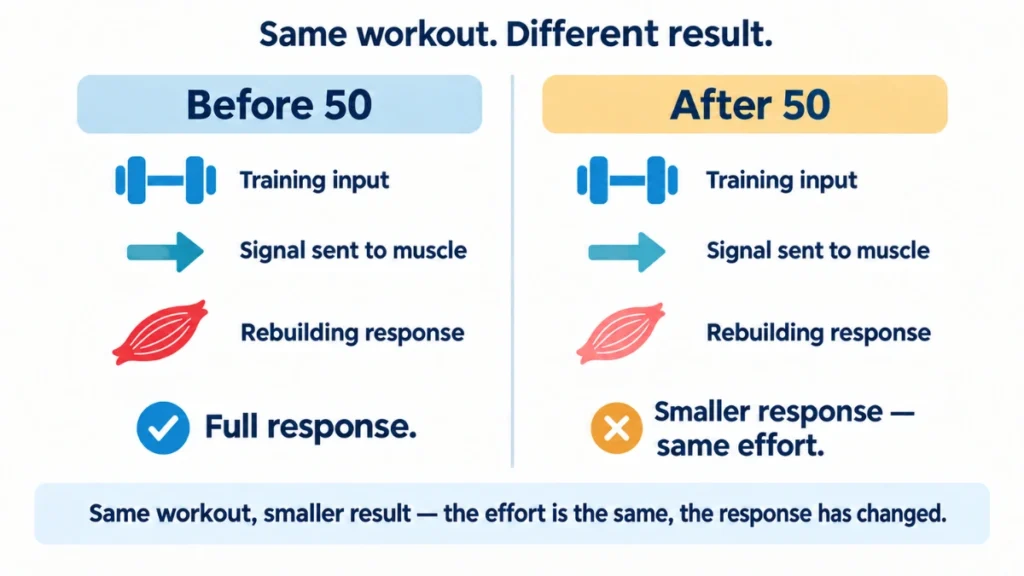
Nothing is broken. The mismatch is between the signal you’re sending and the signal your body now needs to respond. After 50, your muscles need a louder, more precise stimulus to do what the same workout used to trigger automatically. The program hasn’t failed. It’s become too quiet.
In controlled resistance training studies, older adults show meaningful increases in muscle strength and muscle size, although the gain may be smaller than in younger adults.¹
Same sets. Same reps. Same weight. A smaller result. The body isn’t refusing to adapt. It is adapting, but the magnitude of that adaptation is reduced.

The reason progress often feels slower with age is that the effort still feels the same. The soreness is still there. The sweat is still there. But the biological response downstream is often smaller than it once was.
This is referred to as anabolic resistance [a reduced sensitivity of muscle to the growth signals triggered by exercise and protein compared with younger adults]. It is not a disease. It is a shift in efficiency. Your muscles are not ignoring the work. They require a stronger or more optimized stimulus to achieve the same response.
What changes over time is not commitment. It is how the muscle cell responds to that commitment.
What Changed Inside Your Muscle Cells
Each muscle cell contains what works like an internal switch. When you lift something heavy or eat protein, that switch is supposed to flip on and tell the cell to rebuild stronger.
After 50, that switch doesn’t flip as easily. In a study comparing 16 older adults (average age 70) and 16 younger adults (average age 27), only the younger group showed significant increases in the key signaling proteins after an acute bout of resistance exercise.² The older group showed no statistically significant changes in those same proteins.
Your muscle cells after 50 are not ignoring the work. They are waiting for a louder knock.
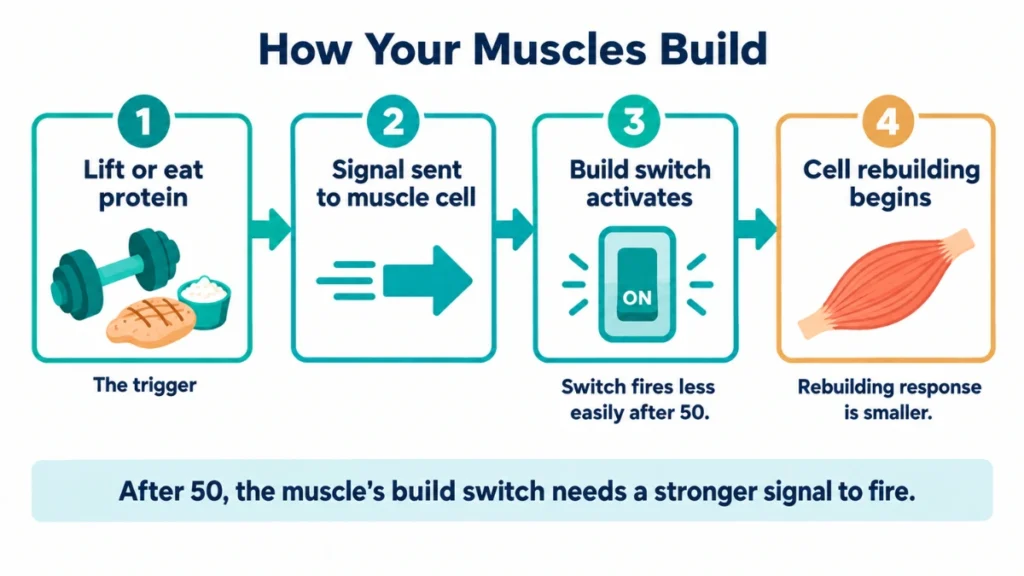
The switch is called mTORC1 [a protein pathway inside the muscle cell that controls whether the cell builds new muscle tissue]. When mTORC1 activates, it starts a chain of steps that leads to muscle protein synthesis [the process by which muscle cells build new protein to repair and grow muscle fibers].
Both are less responsive after 50, but neither is permanently switched off.
The signal still works. It just requires more precise conditions to fire fully. That’s the core of what makes anabolic resistance after 50 manageable rather than permanent. The cell isn’t broken. The input needs to change.
What most people don’t realize is that their recovery strategy after 50 may be making this worse, not better.
Rest Days Are Not Doing What You Think They Are
More rest is the standard advice after 50. Rest more, recover more, train less. It sounds right. It’s incomplete.
Research suggests that recovery from exercise-induced muscle damage [the microscopic tearing of muscle fibers that happens during training, which the body repairs to build back stronger] is delayed and less efficient in older adults.³ The missing piece is that passive rest without nutrition and movement doesn’t accelerate this recovery.
The repair process takes longer after 50. But adding rest days without changing what surrounds them doesn’t shorten that timeline. It leaves the body waiting for signals that aren’t coming.
Here’s what the recovery window actually needs after 50:
- Enough protein across the day, including after training⁷
- Light movement after training⁸
- At least seven hours of sleep⁹

The extra rest day you added might not be the problem. The empty recovery window around your training almost certainly is.
Rest alone is not recovery. It’s just absence. The body after 50 needs absence plus the right inputs to complete the repair cycle.
There’s a second reason the recovery window matters: what you eat during it determines how much of your protein intake actually reaches the muscle. That gap is bigger than most people expect.
Your Protein Is Not Getting Through
You probably eat enough protein. The problem is likely when you eat it and how much lands in each meal.
The leucine threshold [the minimum amount of the amino acid leucine needed in a single meal to activate muscle-building signals in the body] rises after 50. The same 20 grams of protein that triggered a strong muscle-building response at 30 may not be enough at 55.
Your muscles now need a higher concentration of leucine per meal before the building process turns on at all.
A systematic review published in Frontiers in Nutrition found that evidence supporting the leucine trigger hypothesis is stronger in older adults than in younger adults, suggesting that leucine availability may play a more important role in regulating muscle protein synthesis with aging.⁴
In practical terms, older adults may require a stronger protein and leucine stimulus per meal to achieve the same muscle-building response as younger individuals. This reflects a reduced sensitivity of muscle tissue to dietary protein, often described as anabolic resistance.
For this reason, distributing protein intake evenly across meals and including sufficient high-quality protein in each feeding may help maximize muscle protein synthesis throughout the day.
Typical research-based estimates suggest that around 20–30 grams of high-quality protein per meal may support muscle protein synthesis in older adults, depending on total body size and protein source.⁶
However, muscle adaptation does not appear to stop with age, but it does become less efficient and more dependent on protein distribution, exercise, and overall lifestyle.
One Hormonal Shift Changes the Math
Your body’s hormonal environment after 50 is different. Not broken. Not empty. Different. And that difference raises the cost of building and keeping muscle.
In men, testosterone declines gradually from the mid-30s, and the decline tends to accelerate with age.⁵ Research shows that 20 to 30 percent of men over 50 have testosterone levels below common clinical reference ranges.⁵
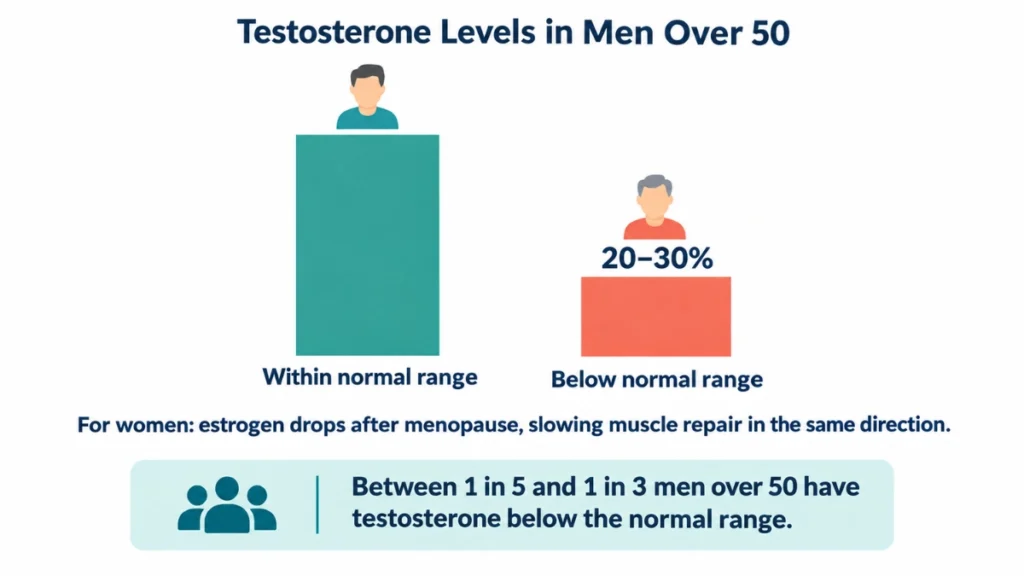
Testosterone [a hormone that plays a central role in signaling the body to build and maintain muscle tissue] isn’t the only factor in muscle building, but lower levels mean the body’s natural anabolic drive is weaker.
In women, the drop in estrogen [a hormone that helps maintain the stem cells muscle uses to repair itself] after menopause may also slow recovery from training.¹⁰,¹¹
In both cases, the body now needs a more precise external signal, through training and nutrition, to produce what it previously managed more automatically.

The ceiling hasn’t disappeared. The hormonal environment shifts the threshold. It doesn’t remove the capacity.
This means training harder isn’t the fix. Training more specifically is. The hormonal reality after 50 doesn’t require a medical intervention to work around. It requires understanding that sarcopenia [the age-related gradual loss of muscle mass and strength] is not inevitable when the stimulus and nutrition match what the body now needs.
One week of specific changes tells you more than months of the same program. That protocol is next.
Talk to your doctor before changing your training intensity, protein intake, or supplement routine if you’re managing a chronic condition, taking medication, or recovering from an injury.
The Recalibration Protocol
Every section in this article points to the same gap: your body after 50 needs a louder signal, enough protein, and active recovery, not passive rest. These four changes address all of it in one week.
Research shows that combining resistance exercise with post-exercise amino acid intake produces the greatest muscle-building response in older adults, and may bring it close to what younger adults achieve when enough protein is eaten.⁶
One-Week Recalibration
- Add 10 grams of protein to each main meal. Do not spread it across extra snacks.
- Consume 30 to 40 grams of protein after training.
- End each training session with light, low-intensity movement.
- Increase resistance by five to 10 percent on your main compound lifts, or add one set per movement.

Do not change all four at once and assume one of them worked. Run all four for seven days, then assess one thing: how does your post-training soreness and energy compare at day seven versus day one? That single measure tells you whether the recalibration is working.
This is a test, not a permanent overhaul. If it works, you’ve confirmed your body responds to exercise after 50 differently but still strongly. If it doesn’t, one of the four changes needs to increase, starting with protein.
One Signal Your Body Can Hear
Start with protein this week. That one change addresses the most common gap between what older adults are doing and what their body can actually use. The reason your body stops responding to exercise after 50 isn’t effort. Pick one signal from this article, make one change this week, and give your body something it can actually respond to. Your body hasn’t stopped listening. It’s waiting for a signal it can hear.
References
- Hunter GR, McCarthy JP, Bamman MM. Effects of resistance training on older adults. Sports Medicine. 2004. https://pubmed.ncbi.nlm.nih.gov/15107011/
- Fry CS, Drummond MJ, Glynn EL, et al. Aging impairs contraction-induced human skeletal muscle mTORC1 signaling and protein synthesis. Skeletal Muscle. 2011. https://skeletalmusclejournal.biomedcentral.com/articles/10.1186/2044-5040-1-11
- Li DCW, Rudloff S, Langer HT, Norman K, Herpich C. Age-associated differences in recovery from exercise-induced muscle damage. Cells. 2024. https://www.ncbi.nlm.nih.gov/pmc/articles/PMC10854791/
- Zaromskyte G, Prokopidis K et al. Evaluating the leucine trigger hypothesis to explain the post-prandial regulation of muscle protein synthesis in young and older adults: a systematic review. Frontiers in Nutrition. 2021. https://www.ncbi.nlm.nih.gov/pmc/articles/PMC8295465/
- Canal de Velasco LM, González Flores JE, Morales Arteaga JL. Testosterone replacement therapy in men aged 50 and above: a narrative review of evidence-based benefits, safety considerations, and clinical recommendations. Cureus. 2025. https://www.ncbi.nlm.nih.gov/pmc/articles/PMC12535424/
- Breen L, Phillips SM. Skeletal muscle protein metabolism in the elderly: interventions to counteract the anabolic resistance of ageing. Nutrition and Metabolism. 2011. https://www.ncbi.nlm.nih.gov/pmc/articles/PMC3201893/
- Schoenfeld BJ, Aragon AA, Krieger JW. The effect of protein timing on muscle strength and hypertrophy: a meta-analysis. Journal of the International Society of Sports Nutrition. 2013. https://pmc.ncbi.nlm.nih.gov/articles/PMC3879660/
- Dupuy O, Douzi W, Theurot D, Bosquet L, Dugué B. An evidence-based approach for choosing post-exercise recovery techniques to reduce markers of muscle damage, soreness, fatigue, and inflammation: a systematic review with meta-analysis. Frontiers in Physiology. 2018. https://pmc.ncbi.nlm.nih.gov/articles/PMC5932411/
- Watson NF, Badr MS, Belenky G, et al. Recommended amount of sleep for a healthy adult: a joint consensus statement of the American Academy of Sleep Medicine and Sleep Research Society. Sleep. 2015. https://pmc.ncbi.nlm.nih.gov/articles/PMC4434546/
- Hayes EJ, Stevenson E, Sayer AA, Granic A, Hurst C. Recovery from resistance exercise in older adults: a systematic scoping review. Sports Medicine – Open. 2023. https://pmc.ncbi.nlm.nih.gov/articles/PMC10317890/
- Collins BC, Arpke RW, Larson AA, et al. Estrogen regulates the satellite cell compartment in females. Cell Reports. 2019. https://pmc.ncbi.nlm.nih.gov/articles/PMC6655560/