

It’s 2 a.m., and you’re wide awake. You’re not in pain. You’re not anxious. You’re just staring at the ceiling in a quiet house, wondering what went wrong. Most adults over 50 who struggle with broken sleep have no idea their afternoon coffee is still chemically active in their body at midnight. That’s not a willpower problem. It’s not a stress problem.
It’s a timing problem, and it gets worse after 50 because your body now clears caffeine more slowly than it did a decade ago. 50 who still enjoy coffee daily and can’t figure out why sleep keeps getting harder. Your caffeine cutoff time after 50 matters more than you think. And the rule you’ve been following was never designed for your body.
How to Calculate Your Personal Caffeine Cutoff After 50?
You probably have a rule. No coffee after 2 p.m., maybe. Or you switched to tea after lunch. Good instinct. Wrong math. Your caffeine cutoff time after 50 should not be a fixed clock time. It should be tied to when you want to fall asleep.
Take your target sleep time. Subtract nine hours. That’s your outer limit. Now subtract 90 more minutes for a protective buffer. That’s your real cutoff. You want to be asleep by 10 p.m. Subtract nine hours: 1 p.m. Subtract 90 minutes: 11:30 a.m. That’s your last coffee window.
For many people over 50, that’s earlier than expected. It should be. Caffeine’s half life in healthy adults ranges from two to 10 hours. That means half the caffeine from your 2 p.m. coffee is still circulating in your blood somewhere between 4 p.m. and midnight, depending on your body. A single universal cutoff time cannot account for that range.
Write your cutoff down. Set a phone reminder at that time every day. That one step is the whole rule. Your one sentence rule: My last caffeine is at X time. I hold that line every day. If your current cutoff is later than the time you just calculated, tonight is the first test. And if you wonder what happens when you miss it, the next section explains why it matters more than you may realize.
Your Cutoff Formula
Step 1: Write your target sleep time. Step 2: Subtract 9 hours. That’s your outer limit. Step 3: Subtract 90 more minutes. That’s your cutoff. Example: 10 p.m. sleep target = last caffeine no later than 11:30 a.m. Set a phone reminder at your new cutoff time today.
Why does your body after 50 process caffeine differently?
Most people blame age for their sleep problems. Age is part of it. But there’s a more specific reason, and it has a fix. Your liver contains an enzyme called CYP1A2. It breaks down caffeine and clears it from your blood. This enzyme handles more than 90% of all caffeine metabolism. Think of it as the cleanup crew that removes caffeine from your system after you’ve used it.
That cleanup crew varies in speed. A lot. Some people clear caffeine in two hours. Others take 10. Age, body composition, medications, and other lifestyle factors all affect how fast it works. Alcohol slows it down significantly. Research shows that moderate alcohol intake can extend caffeine’s half-life by 72% and reduce its clearance rate.
Say that plainly. One glass of wine at dinner can keep your 3 p.m. coffee active in your bloodstream well past midnight. Many people over 50 have both an afternoon coffee and an evening drink. Each one, on its own, might be fine. Together, they stretch caffeine’s reach far into the night.
This isn’t about giving up either one. It’s about knowing they don’t cancel each other out. And the result shows up at 2 a.m. when you’re awake for no obvious reason. You’re not sleeping poorly because you’re getting older. You may be sleeping poorly because your caffeine habits were set for a body you no longer have.
What Caffeine Actually Does to Your Deep Sleep?
You fell asleep in 15 minutes. So why do you feel like you barely slept? Caffeine blocks a brain chemical called adenosine. Adenosine is what your body produces all day long to build sleep pressure. It’s the signal that says your body is tired and ready for rest. Caffeine doesn’t make you alert by adding energy. It blocks the signal that would otherwise slow you down.
When that block is still active during sleep, it suppresses your deepest sleep stage. That stage is called slow wave sleep. It’s the phase where your body does its most important repair work: cell recovery, immune function, and memory storage. Deep slow wave sleep accounts for roughly 19% of total sleep time in young adults.
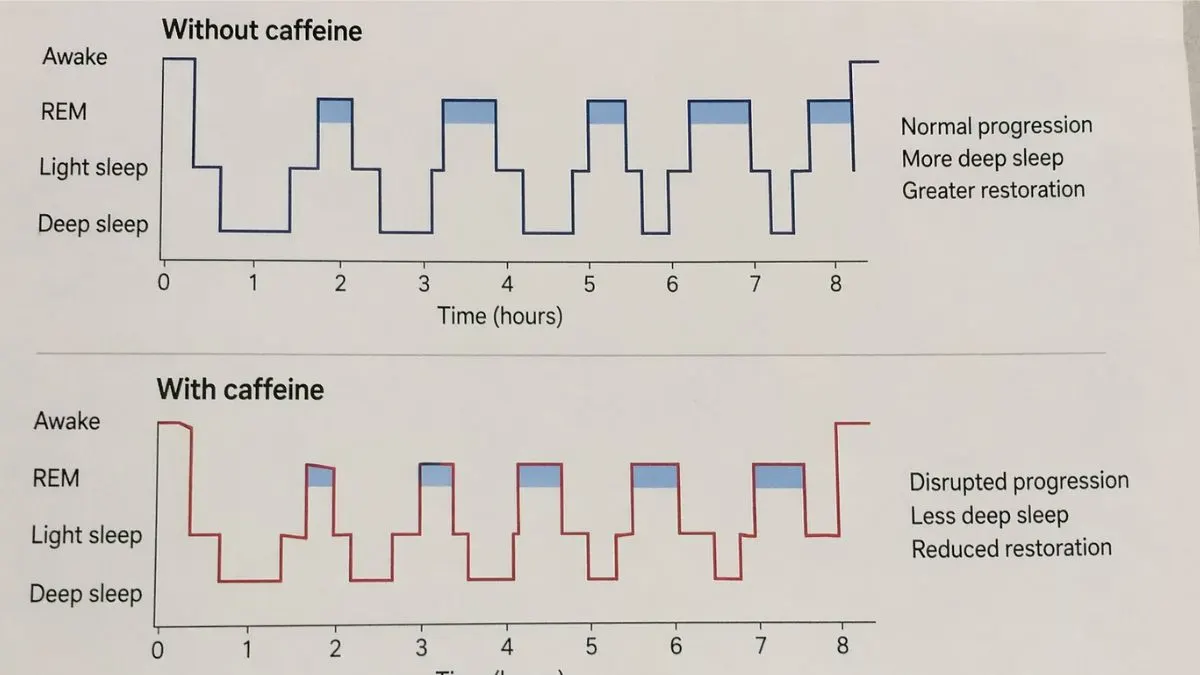
By midlife, ages 36 to 50, that drops to about 3.4%. By your 50s, you’re already producing far less deep sleep than you did at 25. Then caffeine arrives. Found that caffeine reduced deep sleep duration by 11.4 minutes and increased light sleep by 6.1 minutes. Caffeine doesn’t just shorten your night.
It swaps your deepest, most restorative sleep phase for lighter sleep that doesn’t restore you the same way. Middle-aged adults are also more sensitive to these effects than younger ones. The same dose hits harder after 50. You can fall asleep on time and still miss the repair your body came to bed for. That’s why you feel tired even after eight hours.
Why the No Coffee After 2 p.m. Rule Fails After 50?
The 2 p.m. rule. You’ve heard it. You may follow it. It comes from real research. Just do not research on your body. The study most often cited to support a six-hour caffeine cutoff used participants with an average age in their 30s and a dose of 400 mg, roughly four cups of coffee. That’s not the profile of a 58-year-old who drinks two cups and still can’t sleep.
A large population study found that caffeine-induced insomnia increases with age in both men and women, and that this effect holds even after controlling for how much caffeine people actually consume. Older adults are more likely to have their sleep disrupted by the same amount of caffeine than younger adults are.
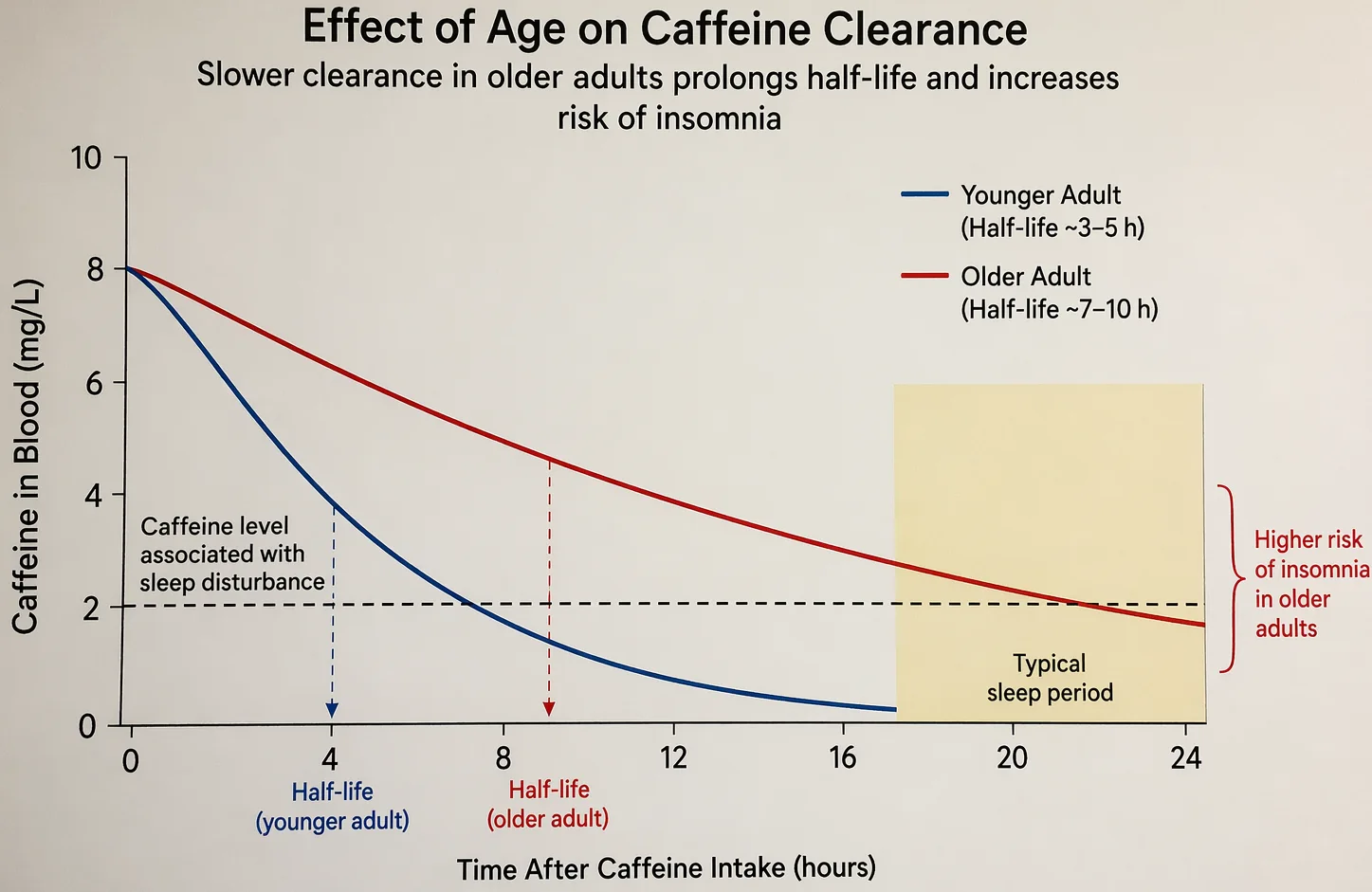
The 2 p.m. rule sets a fixed clock time. Your body doesn’t work by the clock. It works by the hour. The right question isn’t what time is it? The right question is how many hours before my target sleep time? For someone who sleeps at 11 p.m., 2 p.m. is nine hours before bed. That might be acceptable, though not comfortable.
For someone who sleeps at 9:30 p.m., 2 p.m. is only seven and a half hours out. That’s not enough margin. Two people with different bedtimes need different cutoffs. A rule that ignores your sleep time is a rule built for someone else. Before that rule can help you, though, you also need to know everything you’re actually counting as caffeine. Some of it may surprise you.
Hidden Caffeine Sources That Reset Your Cutoff Without Warning
You switched to tea after lunch. You’re being careful. Here’s what may still be running against you. These are the sources most people over 50 forget to count:
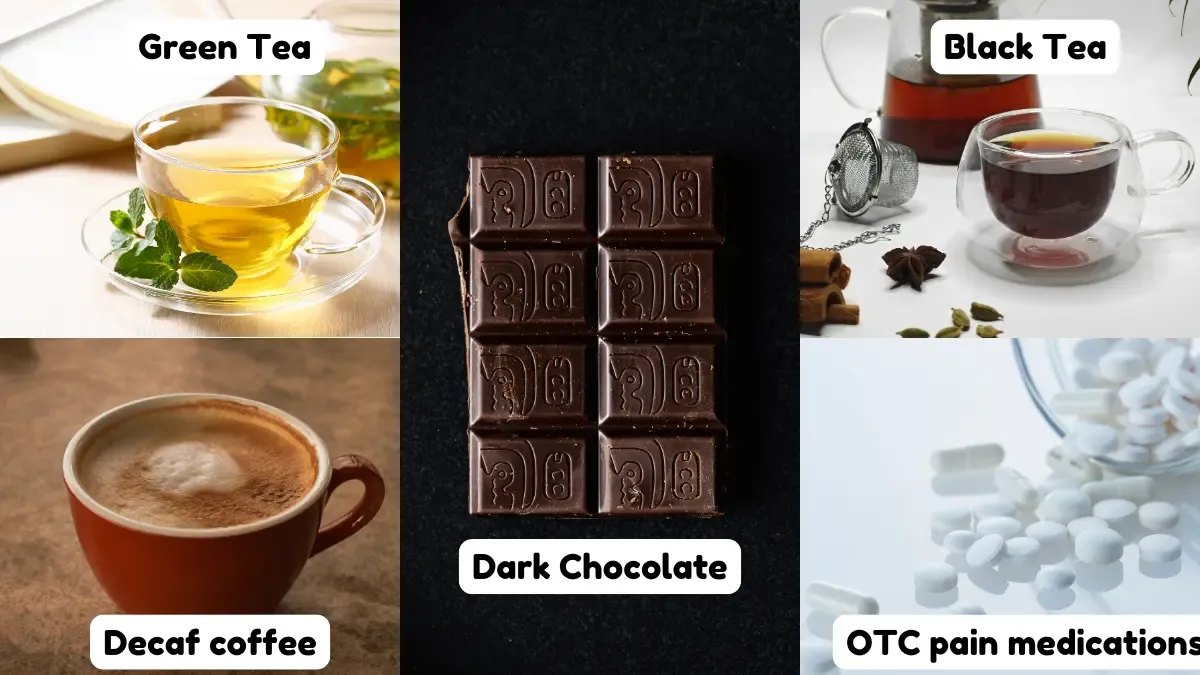
- Black tea contains 40 to 70 mg of caffeine per cup. That’s roughly half a cup of coffee. Many people who stop drinking coffee at noon switch to black tea at 3 p.m. and never connect the two.
- Decaf coffee is not caffeine free. It can contain up to 15 mg per cup. Three cups of decaf in the afternoon add up to 30 to 45 mg total.
- OTC pain medications can be a significant source. Excedrin Migraine contains 130 mg per two-caplet dose. Taking it at 4 p.m. for a headache resets your caffeine clock completely.
- Green tea, matcha, and kombucha all contain caffeine. Green tea delivers 20 to 30 mg per cup. Matcha delivers around 70 mg per teaspoon serving.
- Dark chocolate contains roughly 23 mg per ounce. A few squares after dinner, added to an afternoon tea, can push your evening total into disruptive territory.
None of these is a reason to panic. They’re reasons to count. If any of these are in your afternoon or evening, adjusting your coffee cutoff alone won’t be enough. That’s exactly where the reset protocol comes in.
The Seven-Day Reset Protocol and How to Track Whether It’s Working

Seven days. That’s all this asks. Before you start, a note: if you take medications, manage a heart condition, or have been advised to limit stimulants, talk to your doctor before adjusting your caffeine timing routine.
Step 1 (Day 1): Write down your current last caffeine time. Include all sources, not just coffee.
Step 2 (Days 2 and 3): Subtract 90 minutes from that time. Set a phone reminder at the new cutoff. Stick to it both days, including hidden sources.
Step 3 (Days 4 and 5): Each morning, note two things. First, whether you woke in the night and at what time. Second, how you feel at 7 a.m. on a 1 to 5 scale. Write both down.
Step 4 (Day 6): Review your notes. If you slept through even one night without waking, the rule is working. If not, check your hidden sources list from H2-5.
Step 5 (Day 7): Decide. Either hold the new cutoff permanently, or test pulling it forward by 30 minutes for three more days and observe what changes.
Step 6 (ongoing): Watch for drift. One late coffee feels harmless. It rarely stays that way. When the cutoff slips, the first bad night follows within days.
Research confirms that every hour closer to bedtime that caffeine arrives, sleep quality drops further. The 90 minute buffer isn’t a preference. It’s the minimum margin that protects what little deep sleep you have left after 50. This protocol works. The question is whether the cutoff slips back before it becomes a habit. That answer is yours to write.
Seven-Day Reset at a Glance
Day 1: Write the last caffeine time. Include all sources. Days 2-3: Set new cutoff 90 minutes earlier. Phone reminder on. Days 4-5: Track wake ups and morning energy on a 1-5 scale. Day 6: Review notes. One full night through means it’s working. Day 7: Hold your new cutoff or test 30 minutes forward. Ongoing: Watch for drift. One exception leads to another.
Conclusion
Your caffeine cutoff time after 50 isn’t a preference. It’s a biological necessity for protecting the deep sleep your body is already struggling to produce.
Move your last coffee or caffeinated drink to 90 minutes earlier than your current cutoff and hold that boundary for seven days. Count everything: the tea, the decaf, the evening chocolate. That’s the whole rule. Set the reminder today.
⚠️MEDICAL DISCLAIMER
This article is for informational purposes only. It does not replace medical advice, diagnosis, or treatment. The information covers caffeine cutoff time, metabolic clearance, caffeine half-life, CYP1A2 enzyme, alcohol’s effect on caffeine metabolism, sleep pressure (adenosine), deep sleep (slow wave sleep), sleep stages, caffeine-induced insomnia, hidden caffeine sources (tea, decaf, OTC medications, chocolate), and the seven-day reset protocol.
Individual results vary based on age, health status, and fitness level. Before changing your exercise routine, diet, or supplement use, talk to your doctor or a qualified health professional first. If you experience chest pain, dizziness, severe joint pain, or any sudden symptom during or after exercise, stop immediately and seek medical care.