

You’ve been doing push-ups. Squats. Maybe yoga. You show up every day. Your joints feel okay. Your energy is better.
But your muscles? They look exactly the same as six months ago.
If that sounds familiar, you’re not lazy. You’re not doing it wrong. The truth is simpler and a little uncomfortable.
Bodyweight exercise is a great start. But after 50, it often isn’t enough to build new muscle. Your body has changed. And the rules for building muscle have changed with it.
This article explains why that happens. More importantly, it tells you what actually works four specific things, all backed by real research.
What’s Actually Happening to Your Muscles After 50
Here’s something most fitness advice skips over: your body is fighting you.
Starting around age 50, your muscles shrink. Slowly at first. About 0.8% of muscle mass per year. That doesn’t sound like much. But strength goes even faster dropping 2 to 5% per year after 50, according to research published in the National Institutes of Health database.
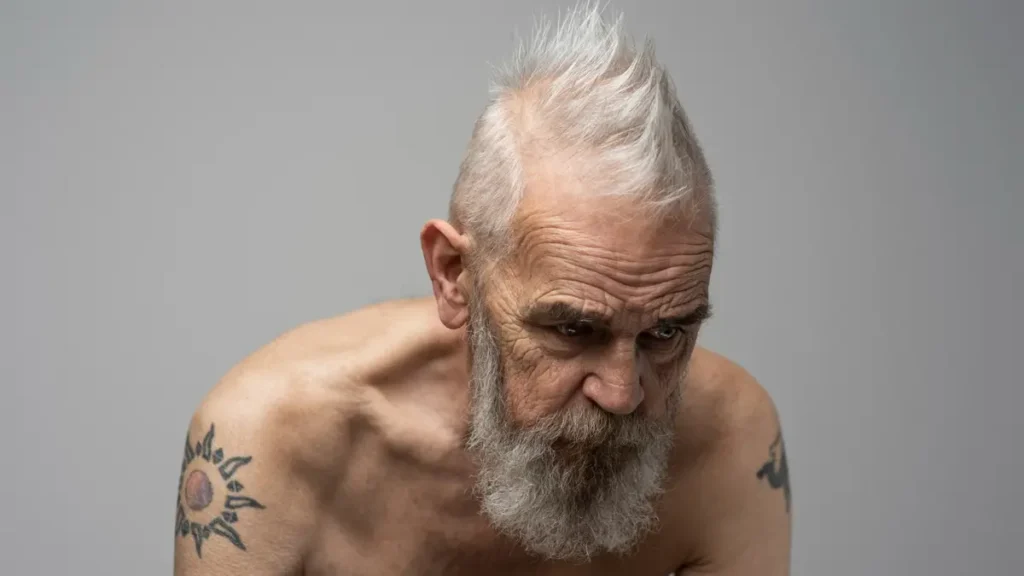
This condition has a name: sarcopenia. It affects about 1 in 5 adults between ages 50 and 70. By age 80, it affects about half of all people.
But muscle loss is only part of the problem. Three other things are working against you at the same time.
Your hormones are shifting
Testosterone, growth hormone, and IGF-1 all drop as you age. These are the hormones that tell your muscles to grow. Less of them means a weaker growth signal. At the same time, cortisol a stress hormone that breaks down muscle tends to rise. It’s a bad trade.
Your muscles ignore protein more
When you’re younger, eating protein is like texting a friend they respond fast. After 50, it’s more like leaving a voicemail. Your muscles still respond. They just need more to get the message.
Researchers call this anabolic resistance. Dr. Marta Oppezzo of Stanford put it plainly: “You need to speak louder more protein for your muscles to hear.”

Recovery takes longer
Your body needs more time to repair muscle after a workout. This isn’t weakness. It’s biology. Ignoring it leads to overtraining, not more muscle.
| The good news None of this is a life sentence. Sarcopenia is real, but it’s not inevitable. Research is very clear that older adults can build muscle. You just need the right tools. |
Why Bodyweight Training Has a Ceiling
Let’s give bodyweight training its credit. Doing push-ups, squats, and planks is better than sitting on the couch. It improves balance. It reduces inflammation. It helps you stay functional as you age.
But there’s a problem.
To build muscle not just maintain it your muscles need to be challenged beyond what they’re used to. This is called progressive overload. It’s the most important principle in all of strength training.
And bodyweight training runs out of overload, fast.
Think about it this way. You did push-ups three times a week for two months. Now you can do 15 with ease. What do you do next?
You can add reps. But there’s a limit to how many reps your body finds challenging. You can try harder variations like pike push-ups or decline push-ups. That helps for a while. But eventually, you adapt to those too.
A study published in the NIH found that suspension training was more effective than bodyweight-only training for countering muscle loss in older men because it allowed more consistent overload over time.
Here’s the uncomfortable truth: a 55-year-old who can knock out 15 easy push-ups has already adapted to that movement. Their body has no reason to build new muscle. It already did the job.
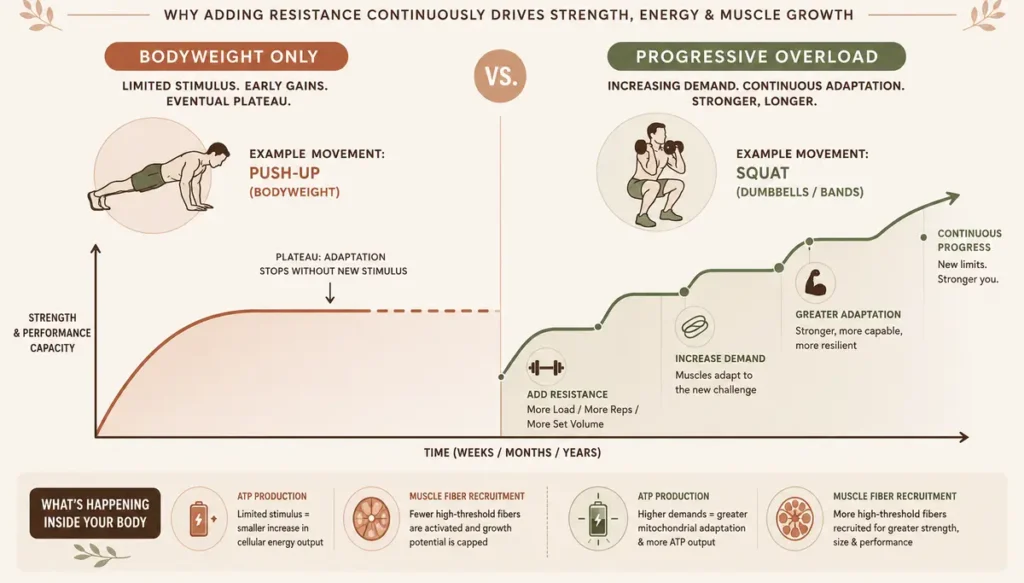
Bodyweight training can slow muscle loss. That matters. But slowing decline and building muscle are two different things.
The 4 Things That Actually Build Muscle After 50
This is the part that matters most. If you only read one section, make it this one.
Building muscle after 50 takes four things working together. Leave one out and the others don’t work as well.
1. External resistance with real progressive overload
Your body needs a load it can’t already handle. That means weight dumbbells, resistance bands, cables, or machines.
A major meta-analysis reviewed 49 studies of men ages 50 to 83 who did progressive resistance training. On average, they gained 2.4 pounds of lean muscle mass. That’s real, measurable muscle. From weights.
The key word is progressive. You increase the challenge over time. Not every session after 50, your body needs 2 to 3 weeks before bumping up the load. That’s not slower progress. That’s smarter progress that actually sticks.
| Practical tip Start with a weight that feels challenging by rep 10 or 12. If you finish 15 reps easily, the weight is too light. Two to three weeks later, add a little more. Log it every time. |
2. More protein than you think
Your muscles are struggling to hear the protein signal. So you need to speak louder.
Research from Stanford’s Lifestyle Medicine program recommends 1.2 to 1.5 grams of protein per kilogram of body weight every day for adults over 50. For a 170-pound person, that’s about 92 to 115 grams of protein daily.

Spreading it out matters too. Aim for 30 to 35 grams per meal not all at once. Your muscles can only use so much at one time.
Animal-based proteins eggs, chicken, fish, dairy, whey are more effective at triggering muscle growth than plant-based proteins at the same dose, according to research published in NIH’s PMC journal.
3. Sleep is a muscle-building tool
This one surprises most people. But the research is clear.
During the first two cycles of deep sleep, your body releases growth hormone. This is when muscles repair and grow. If you cut sleep short or sleep poorly you get less growth hormone and more cortisol. That combination breaks down muscle instead of building it.
A 2025 study from UC Berkeley confirmed that sleep directly drives muscle and bone building through growth hormone release.
Aim for 7 to 9 hours. Treat it like a training variable. Because it is.
| Real talk Matthew Walker, author of Why We Sleep, calls sleep “the greatest legal performance-enhancing drug most people are neglecting.” For anyone over 50 trying to build muscle, this is especially true. |
4. Train less often, but recover better
More is not better. Especially after 50.
Train each muscle group 2 to 3 times per week, with 48 to 72 hours of rest between sessions targeting the same muscles. This isn’t a suggestion it’s how your body actually builds muscle after training.

Younger adults might increase their training load every week. After 50, research shows the sweet spot is every 2 to 3 weeks. That’s not a limitation. That’s how you avoid injury and keep making progress for years.
How to Upgrade Your Routine Without Starting Over
You don’t have to scrap what you’re already doing. That’s not the point.
The point is to add external load to movements you already know. This keeps the learning curve small and the results real.
Here’s a simple before-and-after framework:
| What You Do Now | Add This | Result |
| Push-ups × 15 reps | Resistance band across back | Real muscle tension returns |
| Bodyweight squats | Hold a 15-lb dumbbell (goblet squat) | Quads and glutes must work harder |
| Plank holds | Slow tempo on push-ups (3s down, 2s up) | More time under tension = more growth signal |
| Daily workouts, every day | Rest 48–72 hrs between muscle groups | Muscles actually repair and grow |
Pick one change from this table. Do it this week. Track the weight and reps in a notebook or a free app.
If you don’t track, you can’t progress. And if you can’t progress, you can’t build muscle.
One more tool worth knowing about: a DEXA scan. It measures your muscle mass and body fat precisely. Getting one before you start gives you a real baseline. Getting one six months later shows you whether what you’re doing is actually working.
5 Mistakes That Erase Your Gains After 50
You can do everything right and still undo it with these five mistakes.
- Calling light activity “strength training.” Walking, water aerobics, and chair exercises are good for your health. But they can’t reverse sarcopenia. They don’t create enough overload to build new muscle.
- Eating too little protein. Most adults over 50 get 0.6 to 0.8 grams per kilogram of bodyweight. That’s not enough. You need almost double that. Check your intake honestly.
- Skimping on sleep. Even one week of poor sleep raises cortisol and suppresses growth hormone. You can train hard all week and lose ground by sleeping five hours a night.
- Training every single day. Rest days aren’t lazy days. They’re when your muscles actually grow. Skipping rest after 50 leads to overuse injuries, not better results.
- Chasing maximum weight too aggressively. Joint health matters more after 50. Consistent moderate-to-heavy loads beat irregular maximal efforts every time. Dr. Dominic King of Cleveland Clinic puts it this way: know when to stop pushing for your personal maximum weight.
| Bottom line Getting stronger after 50 is subtraction as much as addition. Avoid these five mistakes and your results will compound over time. |
What to Do This Week
Here’s the full picture in plain terms.
After 50, your body is losing muscle, your hormones are shifting, and your muscles are fighting you a little harder than they used to. Bodyweight training is good. But it has a ceiling and most people over 50 have already hit it without realizing it.
What actually builds muscle after 50 is this:
- Add external resistance — bands, dumbbells, or machines and increase the challenge every few weeks.
- Eat 30–35g of protein per meal and hit 1.2–1.5g per kilogram of bodyweight daily.
- Sleep 7–9 hours — this is when the actual muscle-building happens.
- Rest between sessions — 48 to 72 hours per muscle group, not every day.
You don’t need a fancy program. You need the right tools.
This week: pick one compound exercise with external load a goblet squat, a dumbbell press, or a resistance band row. Write down the weight and reps. Add a little more next session.
Building muscle after 50 is entirely possible. It just requires the right approach not harder versions of the wrong one.
⚠️MEDICAL/FITNESS DISCLAIMER
This article is for informational purposes only. It does not replace medical advice, diagnosis, or treatment. The information covers muscle loss, sarcopenia, aging and muscle mass, hormonal changes (testosterone, growth hormone, IGF-1, cortisol), anabolic resistance, protein intake and muscle growth, progressive overload, resistance training, bodyweight training, external resistance (dumbbells, bands, machines), recovery timing, rest between training sessions, sleep and growth hormone release, sleep and cortisol, overtraining, joint health, DEXA scan, compound exercises, and training frequency.
Individual results vary based on age, health status, and fitness level. Before changing your exercise routine, diet, or supplement use, talk to your doctor or a qualified health professional first. If you experience chest pain, dizziness, severe joint pain, or any sudden symptom during or after exercise, stop immediately and seek medical care.