

You slept eight hours. You still feel like you haven’t slept at all. If you’re over 50 and waking up exhausted, you’ve probably already tried the obvious fixes. More sleep. Earlier bedtime. Less caffeine. None of it worked, and somewhere in the back of your mind, you’ve started to wonder if this is just what getting older feels like. It isn’t.
The real cause of that energy drain after 50 isn’t how long you’re sleeping. It’s a cellular energy leak that standard medicine rarely tests for. Adults over 50 who are sleeping enough and still exhausted aren’t lazy and aren’t broken. Their cells’ power generators are losing output, and the fix is not more rest.
Why Adults Over 50 Still Feel Drained After a Full Night of Sleep?
You wake up, and the tiredness is already there. You didn’t toss and turn. You slept. And yet your body feels like it’s running on borrowed time before 9 a.m. Here’s the direct answer: persistent fatigue after 50 is usually not a sleep problem. A 2025 systematic review published in Scientific Reports, covering 21 studies and 17,843 participants, found that more than 4 in 10 older adults report persistent fatigue.
Nearly 6 in 10 say their bodies tire faster than they should during normal activity. A 2023 meta-analysis in Frontiers in Public Health found that unexplained fatigue, meaning fatigue with no clear medical cause, is 2.7 times more common than fatigue that doctors can explain. More sleep won’t close a leak that has nothing to do with sleep.

The real gap is what’s happening inside your cells, not what’s happening in your bedroom. Your body isn’t short on rest. It’s short on cellular energy output. And those are two very different problems with two very different fixes. The question isn’t how to sleep better. It’s where your energy is going before it reaches you.
The Mitochondrial Energy Leak — What Your Cells Are Doing Wrong
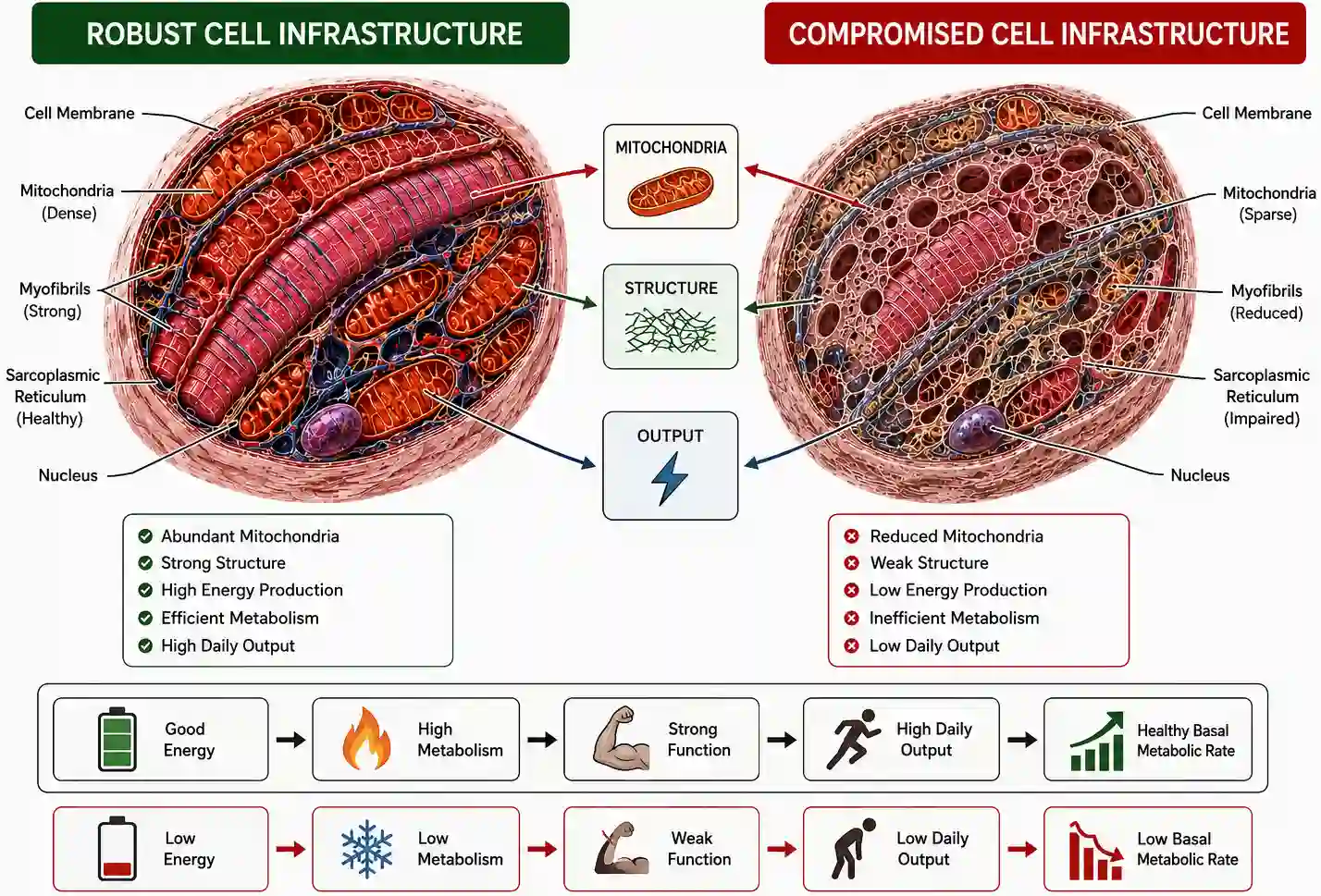
You’ve probably heard that mitochondria are the powerhouses of the cell. That part is right. Mitochondria, tiny structures inside your cells that turn food into usable energy, are responsible for most of the energy your body runs on. When they slow down or decrease in number, your whole system runs low, no matter how much you sleep.
Here’s the part almost no article tells you: fatigued older adults don’t have more cellular damage than energized ones.
A study from the University of Florida found that older adults with idiopathic chronic fatigue, long-term exhaustion with no clear medical cause, had significantly reduced mitochondrial content and lower levels of the proteins that tell muscle cells to make new mitochondria.
They showed no greater oxidative damage than their non-fatigued peers. The fatigue was not caused by destruction. It was caused by a loss of energy infrastructure. Think of it this way. Imagine a city where half the power plants quietly stopped operating. The ones still running are fine. But there aren’t enough of them to power the whole city.
That’s what’s happening in your muscles and organs after 50. Fewer generators mean less total output, even when the remaining ones work perfectly. Your body isn’t broken. It’s understaffed at the cellular level.
So where, exactly, is the energy going?
The 3 Leak Points Draining Your Energy Before Noon
You might be experiencing one of these. You’re almost certainly experiencing all three at once.
Leak 1 — Your Cellular Clock Is Off
Your body runs on a 24-hour internal schedule. Circadian rhythms [your body’s built-in daily timing system that tells your cells when to be active and when to rest] directly control when your mitochondria ramp up energy production. A 2024 review published in Animal Cells and Systems confirmed that the circadian clock governs mitochondrial biogenesis [the process where your body creates new mitochondria].
Oxidative phosphorylation [the process your mitochondria use to turn nutrients into usable energy], and key enzyme activity.⁴ The enzymes your mitochondria need most are most active right after you wake up in natural light.⁵ If your circadian timing is disrupted, that peak never fires. You run on low power from the first hour you’re awake.
Leak 2 — You Have Fewer Power Generators

From age 40 onward, your body makes new mitochondria at a slower rate. Sedentary older adults have measurably fewer mitochondria per muscle fiber than active ones. Wawrzyniak et al. confirmed that reduced mitochondrial density [the number of power-generating structures per muscle cell] is the primary difference between fatigued and energized older adults, not the presence of damage.³ Less infrastructure means less output. The math doesn’t lie.
Leak 3 — Inflammation Is Stealing Your Energy
Low-grade, chronic inflammation increases with age. Inflammaging [the slow, low-level immune activation that builds with age and quietly drains cellular resources] forces your mitochondria to divert energy toward immune signaling instead of your muscles and brain.
Fielding et al., reviewing evidence presented at the Gerontological Society of America, identified this inflammatory energy tax as a key feature of age-associated cellular decline [the gradual breakdown of energy production systems in adults over 50].⁶
A portion of your daily energy is being consumed before you ever feel it. Each of these three leaks compounds the others. The result is that even a fully rested body is operating at a fraction of its actual capacity.
The Morning Mistake That Keeps the Leak Open All Day
Here is the habit most adults over 50 believe is harmless. You wake up, lie in bed a little longer, check your phone, and eventually make your way to a bright indoor space when you’re ready. It feels gentle. It feels like self-care. It’s actually the single behavior most likely to keep your energy leak open for the rest of the day.
Your body’s cellular energy system runs on a morning trigger. A 2024 review in Animal Cells and Systems confirmed that the circadian clock drives rhythmic expression of NAMPT, the rate-limiting enzyme in NAD+ biosynthesis [the process your cells use to produce the fuel that powers mitochondria].⁴
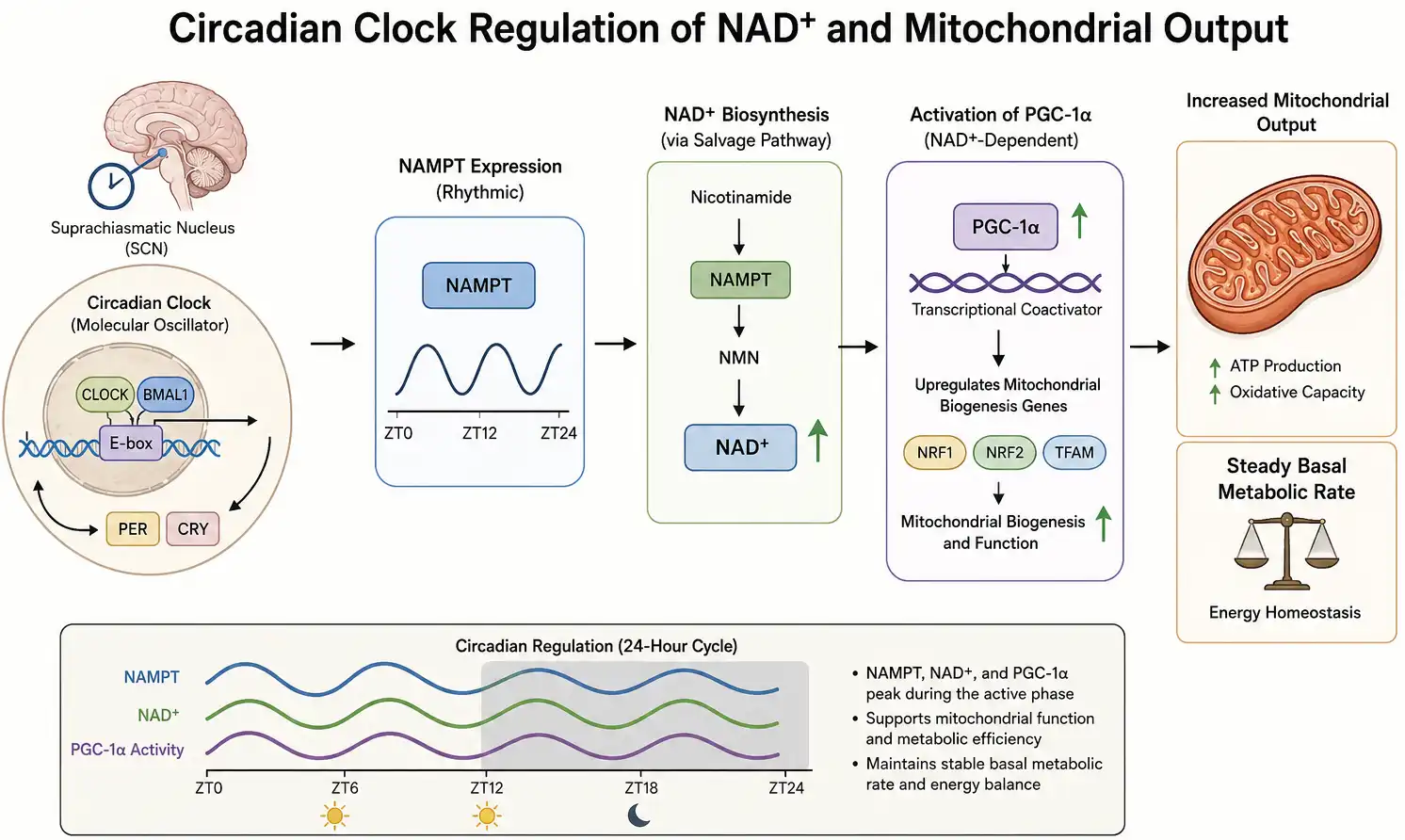
This creates daily oscillations in NAD+ [a molecule your mitochondria need to convert food into usable energy] that regulate mitochondrial output through proteins called SIRT1 and PGC-1α [a master switch that tells your body to create more mitochondria].
If the morning light signal doesn’t arrive on time, this chain reaction doesn’t fire. Your mitochondrial enzyme peak never reaches full height. You spend the whole day underpowered. The contradiction is real. The restful-feeling morning routine is the one shutting down your energy for the day.
Natural light within the first 10 minutes of waking is not optional for people experiencing energy drain after 50. It’s the trigger that opens the production window. A secondary note: chronic rest without movement also signals your body to maintain fewer mitochondria. Movement, even at low intensity, activates AMPK [an enzyme that tells your cells to make more mitochondria when energy runs low] and PGC-1α. Extended rest does not.
How to Close the Leak: The 21-Day Mitochondrial Reset Protocol
Before changing your diet or starting any new exercise routine, check with your doctor first if you’re on medication, managing a heart condition, or dealing with a diagnosed chronic illness.
This protocol works on all three leak points. It uses no supplements and no equipment. It takes less than 20 minutes a day in its smallest form.
CALLOUT BLOCK: The 21-Day Mitochondrial Reset
Step 1 — The Morning Light Anchor (Every Day) Step outside within 10 minutes of waking. No sunglasses for the first five minutes. Even cloudy daylight works. This fires the circadian-mitochondrial cascade that activates your cellular energy system.⁴
Step 2 — The Movement Signal (3 Times Per Week) Walk or move for 12 to 20 minutes at a pace that makes conversation slightly difficult. This activates AMPK and PGC-1α, which trigger new mitochondria to form.⁷
Step 3 — Reduce the Inflammatory Fat Load (Daily) Replace repeatedly heated or highly processed vegetable oils with heat-stable fats: butter, ghee, olive oil, or avocado oil. Oxidized fats are linked to compromised mitochondrial membrane structure via cardiolipin [a fat molecule in the inner mitochondrial membrane that must stay intact for efficient energy production] disruption.⁸
The light step starts the process. The movement step rebuilds the infrastructure. The dietary step removes one source of ongoing membrane disruption. A 2022 review in PMC confirmed that exercise interventions, including moderate-intensity movement, are viable and effective for preserving mitochondrial quality in older adults.⁷
One clear note: 21 days start the process. It does not complete it. Mitochondrial biogenesis [your body growing new cellular power generators] takes weeks to months. You are beginning something, not finishing it.
What Changes When the Leak Closes (And What to Expect in 21 Days)?
The first sign isn’t a burst of energy. It’s a reduction in the heaviness. Most people notice it first in the morning. You sit up, and the familiar weight is slightly less. Your thinking feels clearer before 10 a.m. You reach for your second coffee a little later than usual. These are not dramatic reversals. They’re the first signs that your cellular infrastructure is responding.

Recovery is a dimmer switch, not a light switch. Mitochondrial density builds gradually. The research supports this timeline. HIIT and moderate exercise interventions in older adults produced measurable improvements in mitochondrial health markers, as reported in PMC reviews from 2022.⁷ The biology responds. It just doesn’t do it overnight.
Here’s what this protocol won’t fix: diagnosed hormonal deficiencies, thyroid conditions, anemia, or sleep disorders. If your doctor has identified any of those, this protocol is not a replacement for that care. What it does address is the cellular energy leak that most adults over 50 are experiencing silently, without a diagnosis, without a name, and without a plan.
The 42.6% prevalence of fatigue in older adults is not an inevitable part of aging.¹ The system responds to the right inputs. You just need to give it the right signal at the right time. That energy drain after 50 has a cause. It has a close date.
Conclusion
Start tonight. Set your alarm 20 minutes earlier than usual. Tomorrow morning, step outside within 10 minutes of waking. Remove processed vegetable oils from your next grocery order. Walk for 12 minutes at a pace that makes conversation slightly difficult. Then do it again in 48 hours. Three steps. Twenty-one days. The leak closes faster than you expect. Your cells have been waiting for the right signal. This is it.
⚠️MEDICAL DISCLAIMER
This article is for informational purposes only. It does not replace medical advice, diagnosis, or treatment. The information covers fatigue management, circadian rhythms, morning light exposure, mitochondrial function, chronic inflammation, exercise routines, and dietary fats. Individual results vary based on age, health status, and fitness level.
Before changing your exercise routine, diet, or supplement use, talk to your doctor or a qualified health professional first. If you experience chest pain, dizziness, severe joint pain, or any sudden symptom during or after exercise, stop immediately and seek medical care.
References
[1] Nature / Scientific Reports. Prevalence of fatigue and perceived fatigability in older adults: a systematic review and meta-analysis. Scientific Reports. 2025. https://www.nature.com/articles/s41598-025-88961-x
[2] Yin L et al. The demographic features of fatigue in the general population worldwide: a systematic review and meta-analysis. Frontiers in Public Health. 2023. https://pmc.ncbi.nlm.nih.gov/articles/PMC10416797/
[3] Wawrzyniak NR, Joseph AM, Levin DG, Gundermann DM, Leeuwenburgh C, Sandesara B, Manini TM, Adhihetty PJ. Idiopathic chronic fatigue in older adults is linked to impaired mitochondrial content and biogenesis signaling in skeletal muscle. Oncotarget. 2016. https://www.ncbi.nlm.nih.gov/pmc/articles/PMC5288142/
[4] Wang et al. Circadian coordination: understanding interplay between circadian clock and mitochondria. Animal Cells and Systems. 2024. https://pubmed.ncbi.nlm.nih.gov/38721230/
[5] Neufeld-Cohen A et al. Circadian control of oscillations in mitochondrial rate-limiting enzymes and nutrient utilization by PERIOD proteins. PNAS. 2016. https://pmc.ncbi.nlm.nih.gov/articles/PMC4812734/
[6] Fielding R et al. Nutritional mediators of cellular decline and mitochondrial dysfunction in older adults. Innovation in Aging / Gerontological Society of America. 2020. https://www.ncbi.nlm.nih.gov/pmc/articles/PMC7742510/
[7] Osellame LD et al. (cited in PMC review). Impact of high-intensity interval training on cardio-metabolic health outcomes and mitochondrial function in older adults. PMC. 2022. https://pmc.ncbi.nlm.nih.gov/articles/PMC9176307/
[8] Senoo N et al. Linoleic acid-rich oil alters circulating cardiolipin species and fatty acid composition in adults: a randomized controlled trial. Molecular Nutrition and Food Research. 2022. https://pmc.ncbi.nlm.nih.gov/articles/PMC9540417/