

The first few steps out of bed shouldn’t feel like walking on broken glass. But for millions of people over 50, they do. Your knees grind. Your hips ache. Your lower back feels like it was welded shut overnight. You know it gets better once you move around. But those first 10 minutes? They’re rough.
This is not just age. It’s biology. And once you understand what’s happening inside your joints, the fix makes total sense. Inside every joint, there’s a gel-like liquid called synovial fluid. It’s your body’s natural lubricant. Think of it like motor oil for your car. When you sleep, this fluid slows down and thickens. Your joints sit still all night. Nothing circulates.
So when you wake up, everything feels locked up. After 50, your body also produces less of this fluid. And the fluid it does make gets thinner and less effective. That’s why morning stiffness gets worse as you get older, not better. Movement, even very gentle movement, directly restimulates synovial fluid production.
Why Your Joints Feel Stiff Every Morning (It’s Not Just Age)?
Let’s keep this simple. Two things happen inside your joints as you get older.
First, synovial fluid decreases: This fluid fills the space between your bones and stops them from grinding together. After 50, your body makes less of it. The fluid also becomes more watery and less effective. Less lubrication means more friction. More friction means more pain and stiffness, especially after hours of not moving. AARP / Emory Healthcare, 2026.
Second, cartilage gets thinner: Cartilage is the cushioning on the ends of your bones. With age, a key molecule called hyaluronic acid in your joints breaks down. When that happens, your cartilage loses its springiness. Your joints absorb impact less well. Physio-pedia / IntechOpen, 2024.
Put these two things together, thinner cartilage and less synovial fluid, and you get joint stiffness after 50 that feels worst right after waking up. 32.5 M US adults have osteoarthritis, the most common joint disease. 88%of osteoarthritis patients are aged 45 or older. 5 of 6stretching studies showed real pain reduction with consistent practice.
1. In-Bed Mobility — Joint Lubrication
5 minutes · Still in bed · No equipment. Most stretch guides tell you to get up first. This one doesn’t. And here’s why that matters. When you roll straight out of bed, your joints are cold, dry, and unprepared. That’s the moment people twist their ankle, throw out their back, or feel that sharp pain that ruins the start of their day.
Doing these three moves before you stand up slowly pumps synovial fluid back through your knees, hips, and ankles. By the time your feet hit the floor, your joints are warmer, looser, and ready.
Exercise 1 of 3: Heel Slides
1. Lie flat on your back. You can keep the duvet on.
2. Slowly slide your right heel toward your backside, bending your knee.
3. Slide it back out to straight. That’s one rep.
4. Do 10 reps on each leg. Go slow. No rushing.
Targets: Hips and knees. This move pumps synovial fluid through two of the most commonly stiff joints after 50.
Exercise 2 of 3: Ankle Pumps & Circles
In the video, they demonstrate seated, but you can do this lying flat in bed, which is exactly how we recommend it.
1. Stay on your back. Legs straight.
2. Point your toes away from you, then flex them back toward your face. Repeat 10 times.
3. Now rotate your ankles slowly 10 circles clockwise, then 10 counter-clockwise.
Targets: Ankles and feet. This also pumps blood back up from your legs, which often pool with fluid during sleep.
Exercise 3 of 3: Knee Hugs
1. Still on your back. Bring one knee gently toward your chest.
2. Hold it with both hands, or clasp your hands behind the knee if that’s easier.
3. Hold for 15,30 seconds. Breathe. Then switch legs.
4. Do both sides twice.
Targets: Lower back, glutes, and hip flexors. This is one of the best in-bed stretches for lower back stiffness.
2. Thoracic & Spinal Mobility — Back & Chest
3 minutes · Bed edge or floor · No equipment. Most people over 50 focus on their knees and hips and completely ignore the mid-back. That’s a mistake. Your thoracic spine, the middle part of your back, behind your chest, has 12 vertebrae. When it gets stiff, it doesn’t move the way it should.
So your lower back and neck have to pick up the slack. That’s where a lot of upper-body pain actually comes from, not the neck or lower back themselves, but the stiff middle spine forcing them to overwork.
Exercise 1 of 2: Book Opener (Thoracic Rotation)
The video uses shorter holds with more reps; either way works. We recommend the 20,30 second hold for a deeper, gentler stretch.
1. Lie on your side with knees bent and stacked on top of each other.
2. Stretch both arms straight out in front of you, palms together.
3. Without moving your legs, slowly rotate your top arm back like you’re opening a book. Let your chest open and follow the arm.
4. Hold for 20,30 seconds. Then bring the arm back. Do 3 reps on each side.
Targets: Mid-back rotation and chest opening. Directly reduces the tension that causes upper back pain after 50.
Exercise 2 of 2: Cat-Cow
The video uses short holds; in our version, let your breath lead the movement. Inhale as you arch, exhale as you round. Slow and steady.
1. Get on your hands and knees. Wrists under shoulders, knees under hips.
2. Inhale: let your belly drop, arch your back, look up gently.
3. Exhale: round your spine up toward the ceiling, tuck your chin to your chest.
4. Repeat slowly for 8,10 breaths.
Targets: Full spinal flexibility from neck to tailbone. Also restores circulation in the discs between your vertebrae.
3. Standing Activation — Posture & Hips
3 minutes · Standing · Chair or wall for balance. By now, your joints are warmer. Your spine is looser. Your body has been gently woken up, not shocked into action. Part 3 prepares you for the movement most people do all day without thinking until it starts to hurt. Getting out of a chair. Walking down stairs. Reaching back to buckle a seatbelt.
These three moves also directly reduce your fall risk. That’s not a small thing. A physical therapist at the University of Rochester Medical Center put it plainly: Stiffness and lack of mobility make you prone to losing your balance. Use a chair or wall for balance. Don’t skip that step.
Exercise 1 of 3: Hip Flexor Stretch (Chair-Assisted)
1. Stand next to a chair and hold the back of it for support.
2. Step your right foot back about 18 inches. Keep your back heel on the floor.
3. Gently push your hips forward until you feel a stretch at the front of your right hip and thigh.
4. Hold 20,30 seconds. Switch sides.
Targets: Hip flexors, the muscles at the front of the hip. These get shortened from sitting. Tight hip flexors are a major cause of lower back pain and poor walking gait after 50.
Use a chair against a wall so it doesn’t slide.
Exercise 2 of 3: Standing Calf Stretch
1. Face a wall. Place both hands flat on the wall.
2. Step one foot back about 18 inches. Keep that back heel pressed flat to the floor.
3. Lean gently forward until you feel the stretch in your calf. Hold 20,30 seconds.
4. Switch legs.
Targets: Calves and ankles. This also helps with foot stiffness and plantar fasciitis pain, which is very common in the morning after 50.
Exercise 3 of 3: Chest Opener
1. Stand tall. Roll your shoulders back and down.
2. Clasp your hands together behind your back.
3. Gently lift your arms upward just a few inches. You’ll feel your chest open.
4. Hold for 15,20 seconds. Take 3 slow, deep breaths here.
Targets: Chest, shoulders, and upper spine. Counteracts the forward-hunched sleeping posture that tightens your whole upper body overnight.
5 Rules That Make This Protocol Actually Work
Doing these stretches once will feel nice. Doing them every day will change how your mornings feel. These five rules are the difference between trying something once and building a habit that holds.
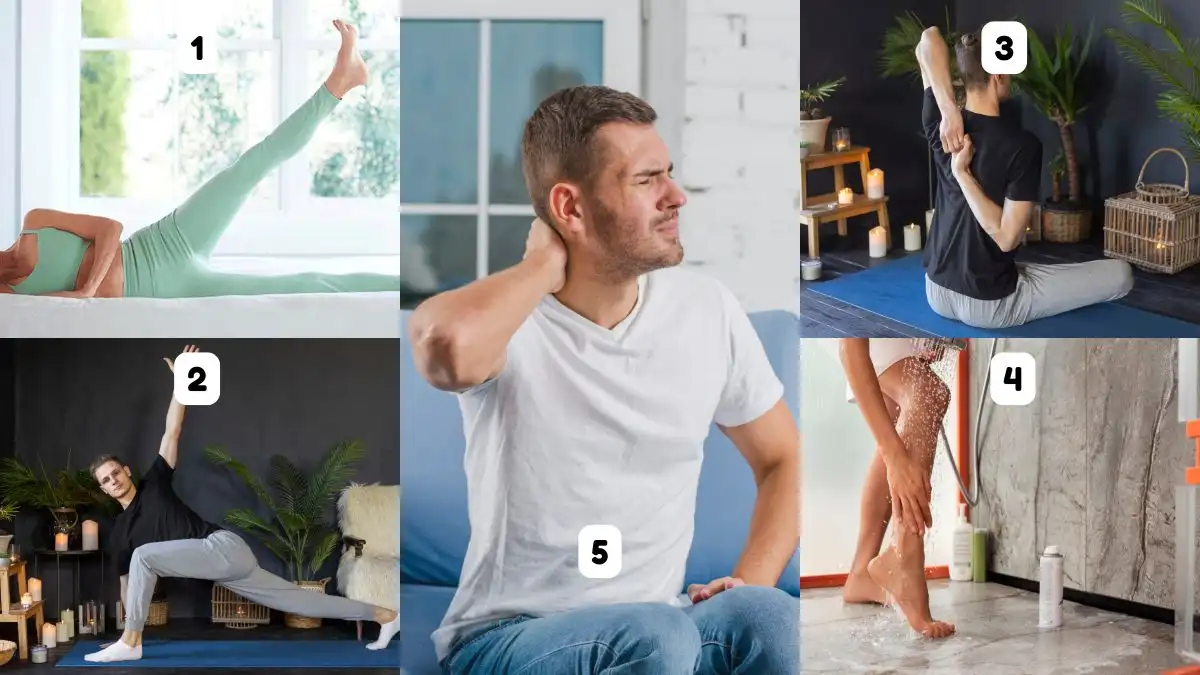
1. Start before you get up: Part 1 works specifically because you do it before standing. Most people leap out of bed and wonder why they’re stiff. You’ll do the opposite. Lie there, do the moves, then stand. This is the single biggest thing that makes this protocol different.
2. Daily beats intense: Ten minutes every morning beats one long stretch session on Sundays. Your joints need regular, gentle movement, not occasional hard workouts. Aim for 5 days a week at a minimum. The other two days, even 5 minutes is fine.
3. Never force a stretch: Mild discomfort is normal. Pain is a stop sign. Harvard Health gives a clear rule: if discomfort lasts more than 2 hours after stretching, ease back. You’re stretching too hard or too long. Pull back, don’t push through.
4. Use heat: A warm shower before or after helps your muscles relax and increases synovial fluid production. If you can’t shower first thing, try a warm cloth on your knees for a few minutes. Even that small amount of heat helps. WebMD, Brown Health.
5. Know when stiffness is a bigger signal: If your morning stiffness gets better within 30 minutes of moving, that’s typical osteoarthritis behavior. But if it regularly lasts longer than 45 minutes and doesn’t improve much with movement, talk to your doctor. It may indicate inflammatory arthritis, which needs a different approach.
Conclusion
Here’s a quick recap of what you just learned:
Part 1: Lubricates joints while you’re still in bed
Part 2: Mobilizes your spine, the most overlooked area
Part 3: Activates your hips and posture before you move
Total time: under 10 minutes. Total equipment: zero. And the science behind it is solid: movement directly stimulates synovial fluid, reduces joint friction, and eases morning stiffness. You don’t have to feel broken every morning. This is biology you can work with.
Try it tomorrow morning. Not someday. Tomorrow. Keep this article open on your phone tonight. Do Part 1 before your feet hit the floor. Give it two weeks. Most people feel a real difference in morning stiffness within 7,10 days of doing this consistently. This morning stretch protocol for stiff joints after 50 costs you nothing but 10 minutes and may change how every day starts.
⚠️MEDICAL DISCLAIMER
This article is for informational purposes only. It does not replace medical advice, diagnosis, or treatment. The information covers morning joint stiffness, synovial fluid production, cartilage thinning, hyaluronic acid breakdown, osteoarthritis, in-bed mobility exercises, spinal mobility, thoracic spine flexibility, hip flexor stretching, calf and ankle stretching, posture, fall risk reduction, plantar fasciitis, heat therapy, and inflammatory arthritis warning signs. Individual results vary based on age, health status, and fitness level.
Before changing your exercise routine, diet, or supplement use, talk to your doctor or a qualified health professional first. If you experience chest pain, dizziness, severe joint pain, or any sudden symptom during or after exercise, stop immediately and seek medical care.