
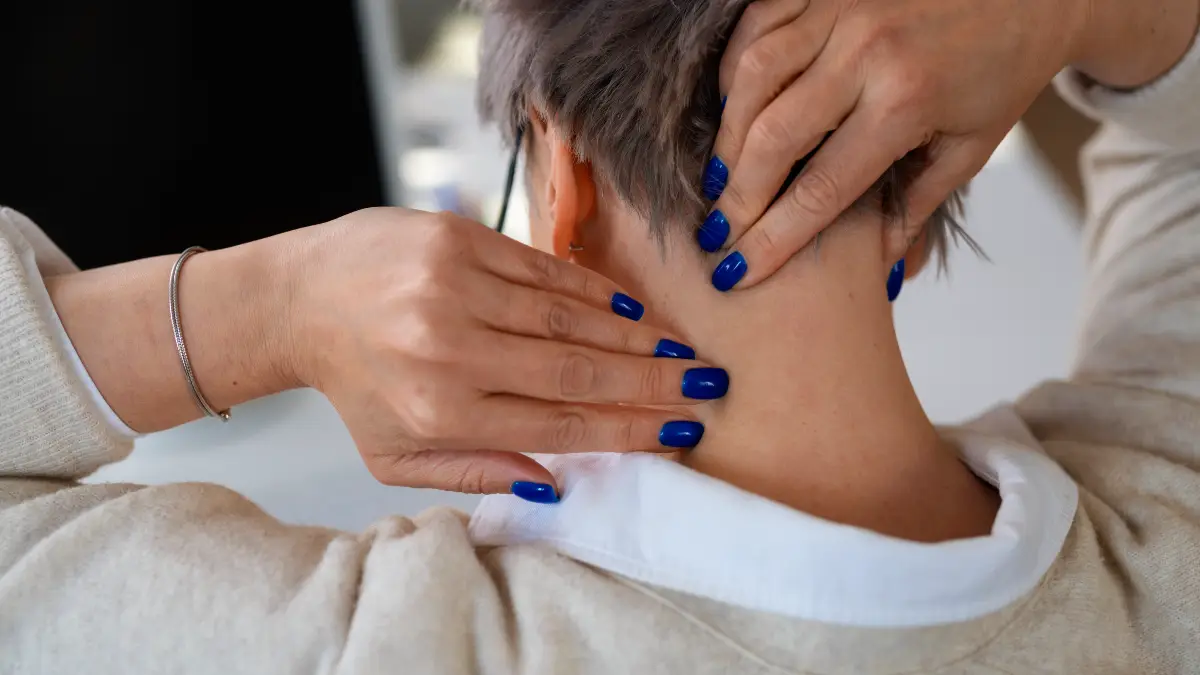
That bump at the base of your neck that appeared sometime after 50? It didn’t arrive overnight; it was built, piece by piece, hour by hour. Maybe someone pointed it out in a photo. Maybe you felt it yourself. Either way, your first thought was probably: Is this just aging? Is there anything I can actually do about it?
Why sitting all day is the single most correctable cause of a neck hump after 50. Exactly what happens to your spine and muscles when your head stays forward all day? A daily exercise plan backed by physical therapists that can actually reverse it. One thing to know upfront: the exercises and changes in this guide work best when the hump comes from posture.
Most of the time, for people who sit at desks or look at phones for hours daily, that’s exactly what’s happening. But if you have osteoporosis or a history of spinal fractures, talk to your doctor before starting any new exercise routine.
What Is That Neck Hump, Really?
The medical name is hyperkyphosis. The old-fashioned name is dowager’s hump. Both describe the same thing: an excessive forward curve in the upper part of your spine that creates a visible rounding at the base of your neck. Your spine naturally has a slight curve in the upper back.
The problem starts when that curve becomes too large, specifically when something called the Cobb angle, a measurement of spinal curve, goes past 40 to 50 degrees. At that point, the upper back starts to visibly hump forward, and the head shifts forward to compensate. The bump you see and feel is usually two things happening at once.
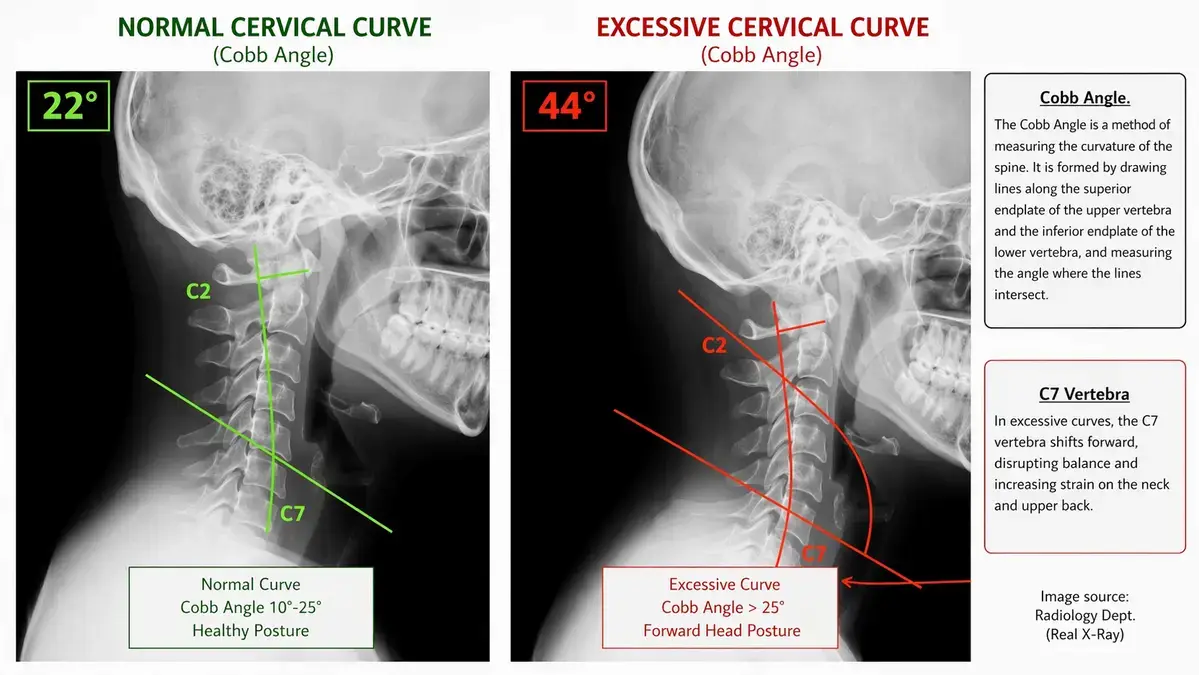
First, the vertebra at the base of your neck, called C7, shifts out of its normal position. Second, the body responds to the chronic stress in that area by depositing soft tissue and fat around C7 as a kind of crude cushion. Over months and years, both of these create the visible hump.
This condition is more common than most people realize. Hyperkyphosis affects an estimated 20 to 40 percent of adults over 60. Even in healthy women aged 20 to 64, a 35 percent incidence of kyphosis was found in a published PubMed study. For women aged 55 to 60, the average kyphosis angle is already 43 degrees, right at the edge of the clinical threshold.
How Sitting All Day Builds the Hump?
Think about your average weekday. You wake up and sit down to breakfast. Commute sitting down. Sit at a desk for most of the workday. Come home and sit on the couch. Research from the American College of Sports Medicine found that U.S. adults average 9.5 hours of sedentary time per day.
And as of 2026, federal data shows the share of the American workday spent standing has actually dropped; workers are sitting more than they have in nearly a decade. All of that sitting does something specific and harmful to your neck.
Your Head Drifts Forward
When you look at a screen, whether it’s a computer, a phone, or a TV, your head tends to shift forward of your spine. This is called forward head posture, sometimes called tech neck. It looks like the head is leading the body rather than sitting directly over it.
Your head weighs about 10 to 12 pounds at rest. But for every inch it moves forward of your spine, it adds approximately 10 pounds of effective pressure on your neck muscles and cervical spine. Research published through the National Library of Medicine confirmed that at a 30 degree forward tilt, the head creates the same load as 40 pounds.
At 60 degrees, a typical phone in lap angle, that number reaches 60 pounds. That’s like carrying a medium sized dog on the back of your neck. All day. Every day. And smartphone users spend 2 to 4 hours per day in that hunched position, up to 1,400 hours every single year.
Your Muscles Give Up
The muscles in your upper back and neck are designed to hold your head upright. But when your head stays forward, those muscles, especially the deep neck flexors, the rhomboids, and the middle and lower trapezius, are constantly being stretched and strained. Over time, they get weak.
At the same time, the muscles in your chest, your pectorals, do the opposite. They get tight and short. Tight chest muscles pull the shoulders forward and down, which tilts the head further forward and puts even more stress on C7.
So you end up with a vicious cycle: weak back muscles can’t pull the head back. Tight chest muscles keep pulling it forward. The spine starts to curve to cope. And the body deposits protective tissue at the site of greatest stress, the back of your lower neck.
After 50, the Process Speeds Up
Two things change after 50 that make this worse. First, muscle mass naturally decreases with age, which is called sarcopenia. The back muscles that are already struggling now have fewer reserves to work with. Second, spinal discs start to compress and thin out. That removes some of the natural spacing and support between vertebrae.
Dr. Rene Cailliet, former director of the Physical Medicine department at the University of Southern California, found that severe forward head posture can reduce lung capacity by up to 30 percent. The hump doesn’t just affect how you look. It affects how you breathe.
How to Tell If Your Hump Is Fixable (The Wall Test)?
Before you start any exercises, do this quick test right now.
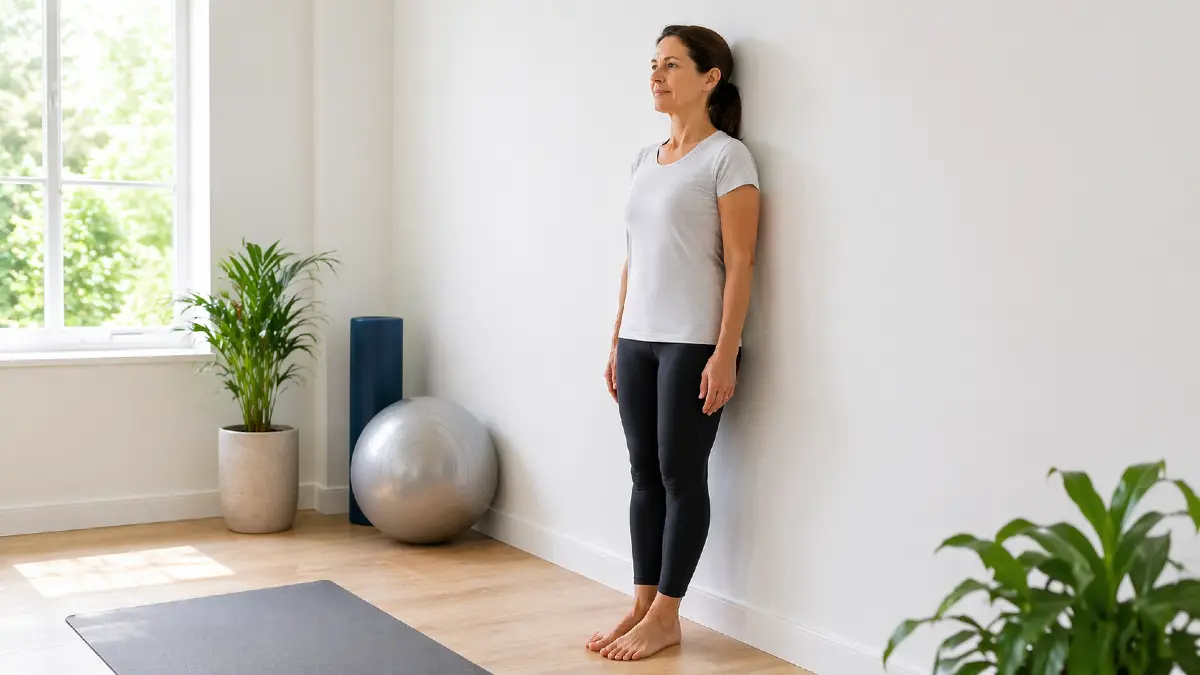
Step 1 — Stand against a wall. Place your heels, backside, and shoulder blades against the wall. Try to press your head back to touch it as well.
Step 2 — Notice what happens. Can your head touch the wall without straining? Does the hump visually reduce or soften when you’re in this position? If it does, even slightly, that’s a strong signal that your kyphosis is primarily postural, meaning the muscles and soft tissue are flexible enough to respond to correction.
If the hump stays completely rigid and nothing shifts, that suggests more structural involvement, and you should see a physical therapist or physician before proceeding.
Step 3 — Measure the gap. While standing against the wall, find C7, the most prominent bone at the base of your neck, when you look down. Use your fingers to measure the distance between that bone and the wall behind it. Here’s a rough guide developed by physical therapists:
- Under 5 cm: Mild, very treatable with regular exercise
- 5 to 7 cm: Moderate, still very treatable, results may take longer
- Over 7 cm: Significant, see a physical therapist first, then use these exercises as part of a supervised plan
Feel the hump, too. A postural hump tends to feel firm; that’s the vertebra and supporting tissue you’re feeling. A soft, squishy hump is more likely to be a fat deposit rather than a spinal curve. Both can improve, but they need different approaches. If yours is soft and squishy, the cause may be hormonal or metabolic rather than postural worth discussing with a doctor.
The Fix: A Daily Exercise Plan That Actually Works
These five exercises are what physical therapists actually prescribe for postural kyphosis and forward head posture. You don’t need a gym. You don’t need equipment. You need about 10 to 15 minutes and a doorframe. Done consistently, research and clinical experience both show that noticeable improvement is possible within 8 to 12 weeks.
The keyword is consistently. One week won’t do it. But two months of daily effort? That changes things. Start with Exercises 1 and 2 in Week 1. Add Exercise 3 in Week 2. Add Exercises 4 and 5 in Week 3. This gives your muscles time to adapt without getting sore and giving up.
Exercise 1: Chin Tucks (Most Important One — Start Here)
Sit or stand tall. Pull your chin straight back, not down, straight back as if you’re trying to make a double chin. Your ears should end up directly over your shoulders. Hold for 5 seconds. Relax. Repeat 10 times. Do this 3 times per day. This directly strengthens the deep cervical flexor muscles, the muscles in the front of your neck that are most weakened by forward head posture.
Every time you do a chin tuck, you’re pulling C7 back toward its correct position. It also gently stretches the suboccipital muscles at the base of your skull that tend to get tight and painful from chronic forward posture. Cleveland Clinic physicians and physical therapists consistently list this as the single most important exercise for addressing a neck hump caused by posture.
You can do this anywhere, at a red light, while waiting for the kettle to boil, or while watching TV. Build it into moments you’re already stationary.
Exercise 2: Scapular Squeezes
Sit or stand. Squeeze your shoulder blades together firmly, as if you’re trying to hold a pencil between them. Hold 5 seconds. Release. Do 10 reps, 3 times daily. This activates the rhomboids and middle trapezius, the muscles that pull the shoulder blades back and hold them in place.
When these muscles are weak, the shoulders roll forward, creating the hunched silhouette that worsens the neck hump. Strengthening them reverses that pull.
Exercise 3: Doorway Pectoral Stretch
Stand in a doorway. Raise both arms to the sides, elbows bent at 90 degrees, in the goalpost position. Place your palms on the door frame. Step one foot forward until you feel a stretch across the front of your chest and shoulders. Hold 20 to 30 seconds. Do this 2 to 3 times daily.
Tight pectoral muscles are one of the main reasons shoulders and necks stay locked in a forward position even after you try to correct your posture. You can do all the strengthening in the world, but if the chest muscles stay short and tight, they’ll keep pulling everything forward. This stretch directly fixes that.
Exercise 4: Thoracic Extension Over a Chair
Sit in a firm chair with a defined backrest. Scoot forward slightly so the top of the chair back sits just below your shoulder blades. Place your hands loosely behind your head. Gently lean back so your upper back extends over the top of the chair back. Hold 10 seconds. Do 5 to 8 reps daily.
The thoracic spine, the middle section of your back, is often the most stuck and rigid in people with a neck hump. Most exercises strengthen muscles around it, but this one actually moves the spine itself back through extension. It is one of the few exercises that directly reverses the forward curled position of the thoracic vertebrae.
You may hear or feel some gentle clicking. That’s usually just stiff joints mobilizing. This should feel like a gentle stretch, not pain. If you feel sharp pain, stop.
Exercise 5: Wall Angels (Y-W Exercise)
Stand with your back flat against a wall, heels, backside, upper back, and head all touching. Raise your arms out to form a Y shape against the wall, then bend your elbows down into a W shape. Keep your arms in contact with the wall throughout the movement. Do 10 reps daily.
This exercise does three things at once: it mobilizes the thoracic spine, retracts the scapulae, and challenges the upper back muscles under load. It also gives you immediate feedback if your arms can’t stay flat against the wall during the movement, which tells you exactly how tight and weak the relevant muscles are.
Your Quick Reference Daily Routine
In Week 1, focus only on chin tucks and scapular squeezes, just 5 minutes a day until they feel natural. In Week 2, add the doorway pectoral stretch, bringing your total to about 8 minutes.
By Week 3, layer in the thoracic extension and wall angles to complete the full 12 to 15 minute routine. Adding one thing at a time keeps it from feeling overwhelming, and you’re far more likely to stick with it.

| Week | Exercises | Time Needed |
|---|---|---|
| Week 1 | Chin Tucks + Scapular Squeezes | ~5 minutes |
| Week 2 | + Add Doorway Pectoral Stretch | ~8 minutes |
| Week 3 onward | + Add Thoracic Extension + Wall Angels | ~12–15 minutes |
Conclusion
The neck hump after 50 is not just aging. It is the result of a pattern of hours of sitting with your head forward, day after day, year after year. That pattern weakens the muscles that hold you upright, tightens the muscles that pull you forward, and triggers your body to deposit protective tissue at C7.
If the cause is postural, which it is for most people, it is reversible. Not overnight. Not without effort. But with 10 to 15 minutes of targeted daily exercises and a few workspace changes, most people see real, measurable improvement within 8 to 12 weeks. You don’t need surgery. You don’t need special equipment. You need consistency.
Start today with one exercise. The chin tuck. Right now, pull your chin straight back, hold for five seconds, and let it go. Do it 10 times. Then set a phone alarm labeled chin tuck and do it twice more before you go to sleep tonight. That’s Day 1. The hump was built one sitting session at a time. It gets undone the same way.
⚠️MEDICAL DISCLAIMER
This article is for informational purposes only. It does not replace medical advice, diagnosis, or treatment. The information covers hyperkyphosis (neck hump), forward head posture, spinal alignment, muscle strengthening (deep neck flexors, rhomboids, trapezius), pectoral stretching, thoracic spine mobility, and the ‘Wall Test’ for postural assessment. Individual results vary based on age, health status, and fitness level.
Before changing your exercise routine, diet, or supplement use, talk to your doctor or a qualified health professional first. If you experience chest pain, dizziness, severe joint pain, or any sudden symptom during or after exercise, stop immediately and seek medical care.