

You have been told it is just aging. That is the explanation you accepted, and it sounded reasonable enough that you never questioned it. But that explanation is often wrong, and believing it can cost you years of comfort in your own hands. If your fingers lock up every morning after 50 and take far longer than they should to loosen, something else may be happening underneath, and most people never think to check.
This article is for anyone over 50 who wakes up with stiff, slow, or swollen fingers and has been blaming it on age without asking why.
By the end, you will know exactly which signs separate ordinary stiffness from hidden inflammation, and what to do with that before your next doctor visit.
| # | Section | What You’ll Find |
|---|---|---|
| 1 | Why Do Fingers Get Stiff Overnight? | What actually changes inside your hands while you sleep, and why it doesn’t always reset by morning |
| 2 | The 5 Hidden Inflammation Signs You Should Not Ignore | Which everyday habits and sensations in your hands might be saying more than you realized |
| 3 | Quick Reference: The 5 Signs at a Glance | What a simple three-day check could reveal before your next doctor visit |
Why Do Fingers Get Stiff Overnight?
Here is what happens inside your joints while you sleep. Your finger joints are cushioned by synovial fluid. Think of it like oil in a car engine. When you are active, that fluid moves around and keeps things smooth. But when you lie still for 7 or 8 hours, the fluid thickens. It pools in the joint. The joint tightens up.
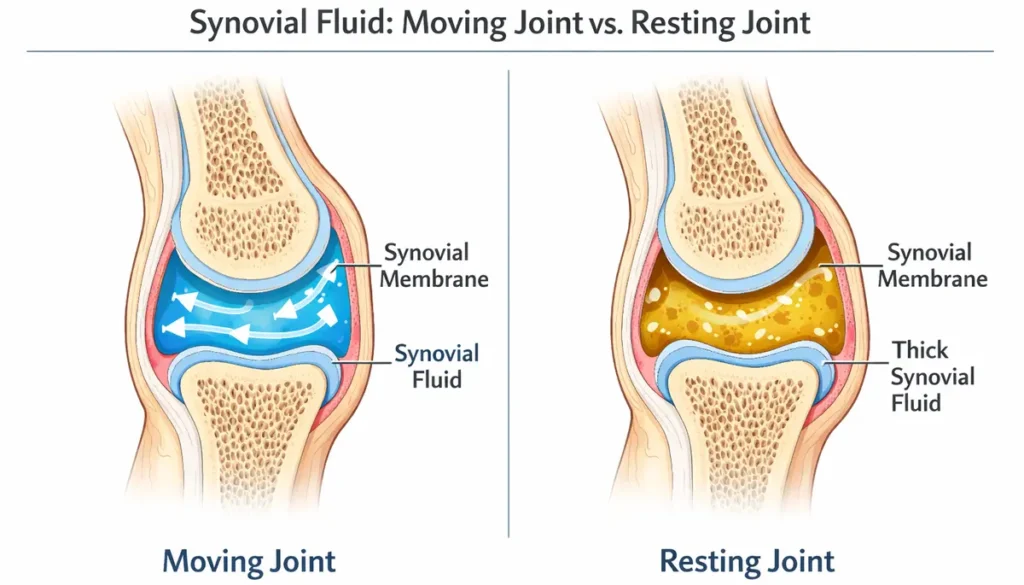
This is completely normal up to a point. In healthy joints, that stiffness should fade within 5 to 15 minutes once you start moving your hands. Your body warms up. The fluid flows again. You are back to normal.
But in inflamed joints, something different is happening. The synovium, the tissue that lines the joint, is itself swollen.
That swelling does not just go away because you started moving your hands. It is structural. It is there whether you are awake or asleep. That is the key difference. Normal stiffness clears up quickly. Inflammatory stiffness hangs around.
Research published in the journal Osteoarthritis and Cartilage found that.
Prolonged morning stiffness is present in roughly 1 in 5 patients with hand osteoarthritis, and those patients had significantly more pain and a worse quality of life than those without it. So how do you know which one you are dealing with? These 5 signs will help you figure that out.
The 5 Hidden Inflammation Signs You Should Not Ignore
Sign 1: Your Stiffness Lasts Longer Than 30 to 60 Minutes
Here is a simple question. How long does it take before your fingers feel normal after you wake up? If the answer is 10 or 15 minutes, that is likely your body warming up. That happens with normal aging.
But if you are still struggling to make a fist 30, 45, or 60 minutes after getting out of bed, that is a red flag.
That is one of the earliest and most consistent signs of inflammatory arthritis. The American College of Rheumatology ACR uses morning stiffness lasting 30 minutes or more as one of the key criteria for diagnosing rheumatoid arthritis RA. The NHS states the same.
If you need a long shower, a heating pad, or an hour of movement just to get your hands working, your body is likely dealing with inflammation, not just age.
Set a timer when you wake up. Stop it when you can make a full fist with no pain or restriction. Write the number down. Do this for 3 days in a row. If it is consistently over 30 minutes, bring those notes to your doctor.
Sign 2: Your Swelling Feels Soft, Warm, or Happens in Both Hands
Not all swelling looks the same. And the difference matters.
If you have hard, bony bumps forming around your finger joints, those are called Heberden’s nodes at the fingertip joints or Bouchard’s nodes at the middle joints. They are firm to the touch. They are common in osteoarthritis. They are caused by bone changes, not active inflammation.
But if the swelling feels soft, spongy, or boggy, especially around your knuckles, that is a different story. That soft puffiness, often with warmth around the joint, is called synovitis. It means the joint lining is actively inflamed.
There is one more clue: symmetry. Inflammatory arthritis, like rheumatoid arthritis, attacks the body systematically.
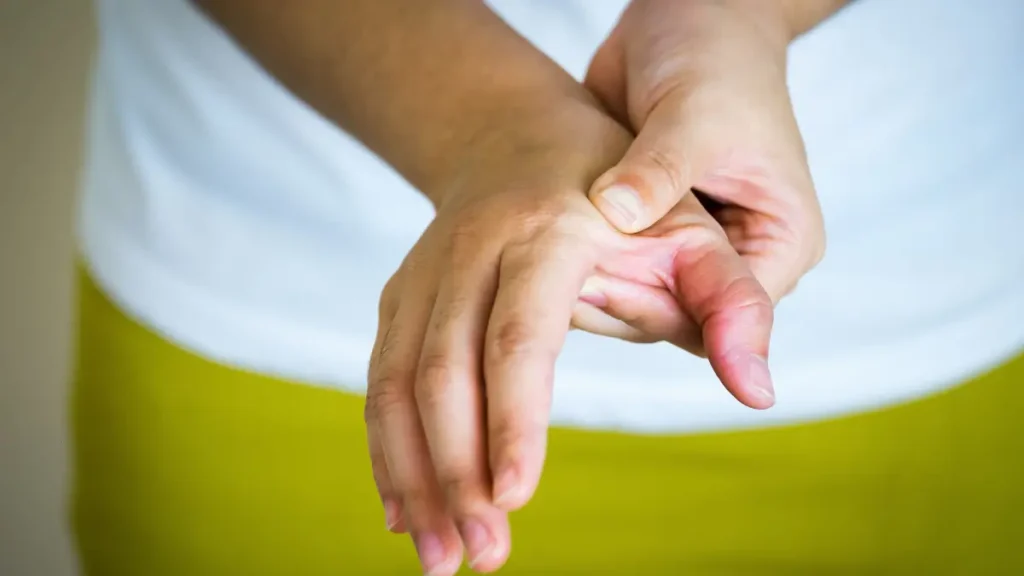
So it tends to hit both hands in a similar pattern. If your left index finger and right index finger are both stiff and swollen, that is not a coincidence. That is a signal of a whole body inflammatory process.
In the morning, gently press your knuckles on the big joints where your fingers meet your hand. If they feel spongy or warm instead of hard, note that.
Sign 3: You cannot open a Jar or make a Full Fist
This one sneaks up on people. You blame it on aging. You buy the rubber jar opener. You ask someone else to unscrew the bottle cap. But losing grip strength is not just a normal part of getting older.

When inflammation sets in around the tendons and joints of your hand, it weakens the muscles and the connective tissue that power your grip. And the damage can happen quietly, long before you feel sharp pain.
Real-life moments that signal a problem:
- Struggling to hold a toothbrush tightly enough to brush properly
- Difficulty gripping a steering wheel on a cold morning
- Dropping things you used to hold easily
- Being unable to fully close your hand into a fist
Research published through the Cochrane Review and the National Institutes of Health found that hand strength in people with rheumatoid arthritis is around 75% lower than in people without the condition. That is not a minor inconvenience. That is a significant loss, and it is not inevitable if caught early.
Sign 4: Your Fingers Snap, Click, or Get Stuck Trigger Finger
This one is unmistakable once it happens to you. You wake up and try to straighten your finger. It will not move. Or it snaps open with a sudden popping sensation like a trigger being released. Your finger was stuck in a bent position, and it took real effort to straighten it out.
This is called trigger finger, or stenosing tenosynovitis. It happens when the sheath around your tendon becomes inflamed and thickened. Instead of gliding smoothly, the tendon gets stuck. When it finally pushes through, it clicks or pops. The symptoms are almost always worse in the morning.
Research shows that trigger finger symptoms are often most noticeable first thing in the morning. After hours of little movement during sleep, stiffness, locking, clicking, and difficulty straightening the finger may be at their worst when a person first wakes up.
A 2025 study published in the Journal of Hand Surgery found something that surprised researchers: trigger finger most commonly affects the middle finger, not the ring finger, as had long been assumed.
And 1 in 3 people with trigger finger have it in more than one finger at a time. If your finger gets stuck in a bent position overnight and requires manual effort to straighten, do not ignore it. That is inflammation affecting the tendon system, not just the joint.
Sign 5: You Feel Numbness, Tingling, or Notice Skin Changes
Sometimes inflammation shows up in ways that do not feel like joint pain at all. You wake up with a pins and needles feeling in your thumb, index, or middle finger. Or your hand feels numb, like it fell asleep, but the sensation does not go away in a few minutes.
This can be a sign of carpal tunnel syndrome, which happens when inflammation in the wrist compresses the median nerve. The nerve runs through a narrow tunnel in your wrist, and when the surrounding tissue swells, the nerve gets squeezed.
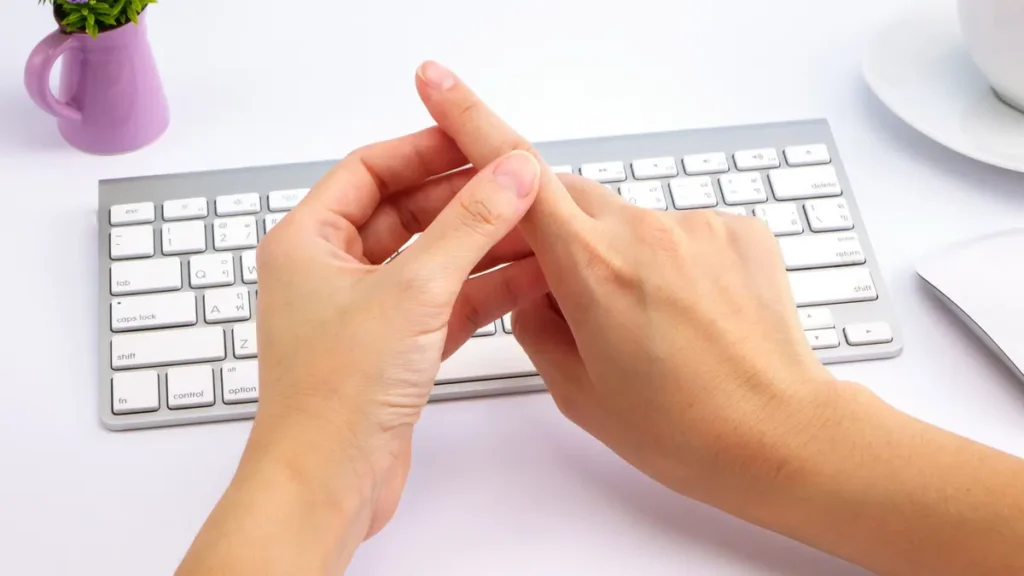
If the numbness wakes you up at night or is present right away in the morning, especially in those first three fingers, carpal tunnel is a likely cause.
There are other skin and sensation changes to watch for, too:
- Skin that feels tight or looks slightly shiny over the fingers can signal connective tissue inflammation.
- Fingers that turn white, then blue, then red in cold temperatures, called Raynaud’s phenomenon, are often linked to autoimmune conditions.
- Persistent numbness or weakness in multiple fingers together can mean nerve compression from inflamed tissue.
Quick Reference: The 5 Signs at a Glance
| Sign | What It Looks Like | What to Do Now |
|---|---|---|
| Stiffness over 30–60 min | Still stiff long after waking | Time it for 3 mornings |
| Soft, warm, or symmetrical swelling | Spongy knuckles, both hands affected | Press knuckles gently, compare both hands |
| Weak grip or can’t make a fist | Dropping things, can’t open jars | Finger stuck, bent, pops straight |
| Fingers snap, click, or lock | Finger stuck bent, pops straight | Note which finger, how often |
| Numbness, tingling, skin changes | Pins and needles, shiny skin | Try a wrist splint at night |
Conclusion
Stiff fingers every morning after 50 are not something you have to simply accept. They are your body’s way of communicating. And now you know the 5 signals that separate normal morning stiffness from hidden inflammation. Start the 3 day tracking test today. Note how long your stiffness lasts each morning.
Note whether both hands are affected. Write down any clicking, locking, or numbness. That simple record becomes a powerful tool when you sit down with your doctor. The sooner you take your morning stiffness seriously, the more options you have. These inflammation signs are manageable, especially when caught before they become a bigger problem.
⚠️DISCLAIMER
This article is for informational purposes only and does not constitute medical advice, diagnosis, or treatment. The content addresses morning finger stiffness as a sign of joint inflammation after 50 and is intended for general educational purposes only. Health conditions vary significantly between individuals, always consult a licensed physician or qualified healthcare provider before making any decisions about your health or medical care.