

Something changed after 55, and you felt it before you could name it. You wake up carrying weight you didn’t bring to bed. Your thinking takes longer to clear. Your body asks for more recovery than it used to need.
Most people over 50 who feel something is wrong but don’t have a name for it yet are not imagining things. Their body’s built-in cellular cleanup system has quietly slowed down, and no one told them what that system is or how to support it.
This article is for adults over 50 who feel that shift. By the end, you’ll know what autophagy after 50 actually looks like, why it loses ground, and one specific change you can make tonight.
| # | Section | What You’ll Find |
|---|---|---|
| 1 | What ran every night | The process your body has always used, and why it needs the dark |
| 2 | When the crew stopped showing up | The mechanical reason the slowdown happens, and it’s not your diet |
| 3 | What the slowdown feels like | The connection between cellular buildup and what you notice every morning |
| 4 | Three ways to open the window | What actually gives the system room to work |
| 5 | What good cleanup looks like | What changes inside when the process runs properly |
| 6 | The shift that matters most | Why no supplement solves what this one habit protects |
Your Body Has Been Running a Nightly Cleanup Since You Were Born
You’ve never had to schedule it. Every night, while you sleep, your cells break down their own damaged parts and recycle the pieces into something usable. The system is called autophagy [the process by which your cells dismantle and recycle damaged internal components], and it won the Nobel Prize in Physiology or Medicine in 2016.¹
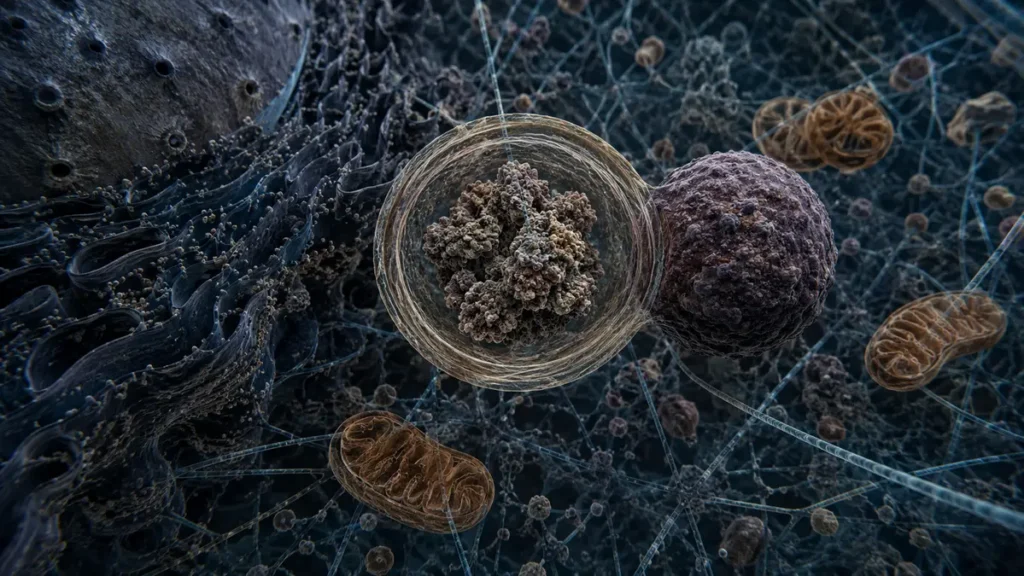
Autophagy after 50 is the same process it always was. What changes is the window it gets to run.
Here is the basic sequence. A cell accumulates damaged proteins, worn-out structures, and other debris during the active hours of the day. The cell wraps that debris in a small membrane pouch called an autophagosome [a bag the cell builds around debris it intends to destroy].¹
That bag fuses with a lysosome [a compartment holding digestive acids strong enough to break the debris into raw parts].¹ The raw parts feed back into the cell as usable material.
Eating activates a cellular switch that tells your cells to build, not clean.¹⁰ Fasting and sleep tell your cells the opposite. The long quiet stretch overnight is when the cleanup crew does its best work.
This isn’t a flaw. It’s the design. The problem isn’t that it stopped. It’s that after 55, it started getting skipped.
After 55, the Cleanup Crew Starts Missing Its Window
You might feel it as stiffness that hangs on past 9 a.m. Or a mental fog that used to lift by 8. These aren’t random. They may reflect a real slowdown in a process that’s been running your entire life.
Your cells didn’t stop cleaning because you ate the wrong things. They slowed down because the window you used to give them got shorter. The long quiet stretch at night when you weren’t eating got crowded as life got busier after 50.
But timing isn’t the only factor. Something mechanical breaks down too.
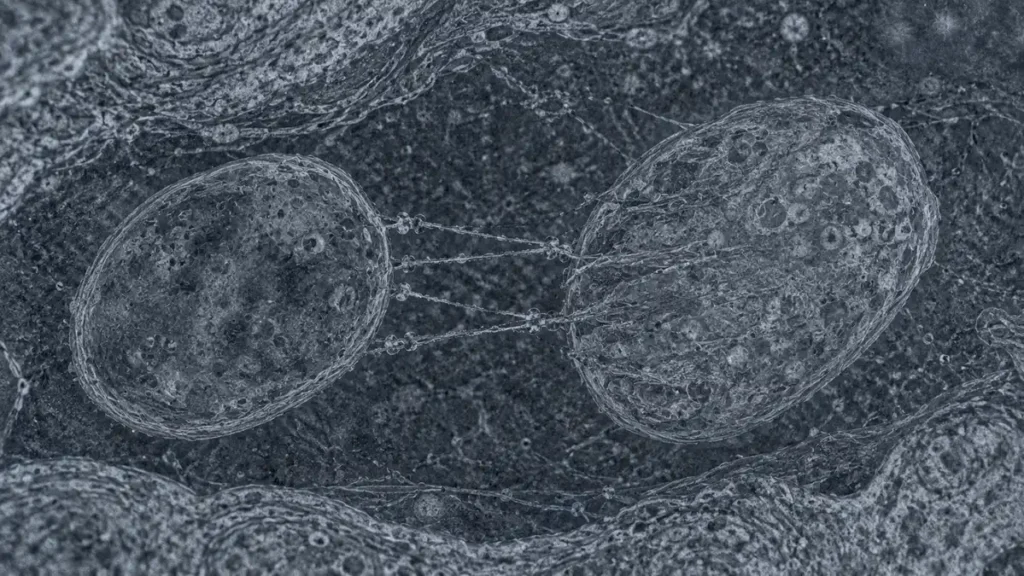
Your cells rely on tiny motor proteins to shuttle the cleanup bags and acid compartments toward each other. An animal study using old and young mouse cells found that these motor proteins weaken with age.²
Autophagosomes and lysosomes in the old cells failed to reposition toward the center of the cell, so they met less often, and the autophagy decline aging cells experienced followed directly from that failure to connect.² Direct confirmation in humans is still being studied, but the same transport protein patterns are thought to operate in aging human cells.
A 2009 PubMed review described what happens as the body ages: both the rate of autophagosome [bag that holds cellular debris for disposal] formation and the efficiency of lysosome [acid chamber that digests the debris] fusion decline together.³ The system doesn’t fail in one place. It loses ground across multiple steps at once.
The lysosomes also change on their own. They become less acidic with age, which reduces how thoroughly they digest even the debris that does arrive.³
The result is a gradual backlog. And that backlog has a physical cost.
What You Feel When the Cleanup Slows Down
You wake up and it takes an hour to feel like yourself. Your joints are thick. Your thinking is slow to load. You’ve written this off as “getting older.” That’s not wrong, but there’s a more specific story underneath it.
When autophagy [the cell’s regular cleanup cycle] slows, the debris that would normally be cleared overnight starts accumulating. One of the most studied results of that buildup is protein aggregation [the process where misfolded proteins clump into sticky masses inside cells and in the bloodstream].
Your blood plasma tells part of this story. A study examining human plasma found that healthy older adults between 60 and 80 had significantly higher levels of degradation-resistant protein aggregates compared to adults under 30.⁴
The primary component of those aggregates was tied to inflammation. The researchers noted that this accumulation may compromise the body’s ability to manage its own protein quality.⁴

The connection to brain function has also been studied directly. A PubMed review found that old proteins can collect inside neurons before any outward signs of disease appear, and this collection is linked to an inflammatory response within those cells.⁵
The authors suggest this buildup may trigger inflammatory responses inside brain cells and could contribute to age-related brain decline.⁵
Mitochondrial fatigue follows the same pattern. Your mitochondria [the structures inside each cell that produce energy] need regular replacement. When damaged mitochondria don’t get cleared through mitophagy [the targeted removal of worn-out mitochondria by the cell’s cleanup system], they pile up.
A PubMed review on aging and mitophagy found that mitophagy declines with age, leading to the accumulation of damaged mitochondria.⁶ These dysfunctional mitochondria are associated with reduced cellular energy balance and impaired stress responses, which may contribute to age-related cellular decline.⁶
None of this announces itself loudly. What you can do tonight is the next part.
Three Things That Give the Cleanup Crew a Real Window
You can’t force your cells to clean faster. But you can stop closing the window before they get a chance to start.
Talk to your doctor before making changes to your eating schedule or exercise routine if you’re on medication, managing a chronic condition, or have a history of disordered eating.
Here are three approaches with the clearest evidence behind them.
1. Protect the overnight fast

Eating activates mTOR [a molecular switch in your cells that signals “food is available, focus on building, not cleaning”].¹⁰ While mTOR is active, autophagy is largely turned off. Fasting turns that switch down.
A human study in healthy male volunteers found that after a 72-hour fast, mTOR activity in skeletal muscle dropped by roughly 50%, and an autophagy activity marker called LC3B-II rose by approximately 30%.⁷ Every hour past your last meal moves the signal further toward cleanup mode.
A 12-to-14-hour gap between dinner and breakfast gives your cells a meaningful overnight fasting autophagy window without requiring any dramatic change.
2. Move at moderate to high intensity

A human study in trained athletes found that high-intensity exercise increased autophagic activity in skeletal muscle, alongside elevated AMPK [a cellular energy sensor that, when active, promotes cleanup and signals the cell away from building mode].⁸ Lower-intensity exercise at 50% of maximum effort did not produce the same response.⁸
The study used well-trained athletes, so the results may not transfer directly to less-active adults.⁸ The underlying pathway is consistent across the exercise physiology literature.
3. Finish eating before the night gets late

Research published in EMBO Journal found that autophagy regulators called TFEB [a protein that activates the genes responsible for cellular cleanup] and TFE3 [a companion protein that works alongside TFEB to coordinate the cleaning cycle] fire during the rest and fasting phase of the body’s daily cycle.⁹ Eating late is associated with a delayed or shortened firing window.⁹
All three of these protect the same stretch of time. What that stretch actually does inside your cells is the part most articles skip.
What Happens Inside When the Process Runs Properly
After a solid overnight fast and full night of sleep, your cells have had several hours in cleanup mode. It doesn’t look like anything from the outside. But inside, three things shift.
One of the first things to improve is energy quality. Through mitophagy [targeted removal of damaged mitochondria], cells clear worn-out energy producers and create conditions for new ones to form.
A PubMed review on aging and mitophagy found that when this process runs well, cells maintain both the removal of old mitochondria and the generation of new ones, a cycle that breaks down when mitophagy declines.⁶
Protein debris gets cleared. The same misfolded proteins linked to chronic low-level inflammation in older adults⁴ are broken down before they reach the concentrations that trigger an inflammatory response. Regular cellular maintenance removes one of the main things that feeds it.
The cell runs leaner. Recycled parts from cleared debris feed back into the cell’s pool of usable materials. The cell spends less energy managing what’s piling up.

You won’t feel it in a single night. But the section ahead names the one change that protects all of it.
What Protects Autophagy After 50 More Than Any Supplement
If you came here looking for a product to take, this section will disappoint you. The research on autophagy and aging points back, every time, to the same behavior. And it costs nothing.
Protect the overnight window. Research published in EMBO Journal confirmed that autophagy is directly tied to the rest and fasting phase of the body’s circadian cycle, and that this cycle is driven by the daily pattern of feeding and not feeding.⁹ When that pattern shifts late, the cleanup cycle shifts late too. Eating late is associated with a delayed or shortened firing window.⁹
This is the change that matters most. Not because of anything exotic. Because the system was always designed around a long, quiet night.

Stop eating two to three hours before bed. Let the window stay open. Your body knows what to do when the kitchen is closed and the lights are off. The job now is to stop getting in the way.
Conclusion
The single most useful thing you can do tonight: stop eating two to three hours before bed and let the overnight window stay open. Try a 12-to-14-hour overnight fast three to four nights per week to give autophagy a reliable window to run. No supplement replaces that window.
Autophagy after 50 doesn’t stop. It slows down, and the window is how you give it room. Your body ran this cleanup reliably for decades. Give it back the quiet, and cellular cleanup after 50 can still run.
⚠️MEDICAL DISCLAIMER
This article is for informational purposes only. It is not a substitute for professional medical advice, diagnosis, or treatment. Always consult a qualified health professional before making changes to your diet, exercise habits, or sleep routine, especially if you have a chronic health condition or take medication.
References
- Nobel Assembly at Karolinska Institutet. The Nobel Prize in Physiology or Medicine 2016 awarded to Yoshinori Ohsumi for discoveries of mechanisms for autophagy. NobelPrize.org. 2016. https://www.nobelprize.org/prizes/medicine/2016/press-release/
- Bejarano E, Murray JW, Wang X, Pampliega O, Yin D, Patel B, Yuste A, Wolkoff AW, Cuervo AM. Defective recruitment of motor proteins to autophagic compartments contributes to autophagic failure in aging. Aging Cell. 2018;17(4):e12777. https://www.ncbi.nlm.nih.gov/pmc/articles/PMC6052466/ [Animal study: old and young mouse hepatocytes and fibroblasts. Human confirmation still being studied.]
- Rajawat YS, Hilioti Z, Bossis I. Aging: central role for autophagy and the lysosomal degradative system. PubMed. 2009. https://pubmed.ncbi.nlm.nih.gov/19427410/ [Mechanism review. Not population-specific.]
- Xia K, Trasatti H, Wymer JP, Colón W. Increased levels of hyper-stable protein aggregates in plasma of older adults. PLoS ONE. 2016.
https://pmc.ncbi.nlm.nih.gov/articles/PMC5005920/ - Currais A, Fischer W, Maher P, Schubert D. Intraneuronal protein aggregation as a trigger for inflammation and neurodegeneration in the aging brain. The FASEB Journal. 2017. https://pubmed.ncbi.nlm.nih.gov/28049155/
[Review; discusses evidence from human and experimental studies; not a direct experiment.] - Palikaras K, Daskalaki I, Markaki M, Tavernarakis N. Mitophagy and age-related pathologies: Development of new therapeutics by targeting mitochondrial turnover. Pharmacology & Therapeutics. 2017. https://pubmed.ncbi.nlm.nih.gov/28461251/
[Review article; discusses mitophagy in aging organisms and links to human disease relevance.] - Vendelbo MH et al. Fasting increases human skeletal muscle net phenylalanine release and this is associated with decreased mTOR signaling. PMC. 2014. https://www.ncbi.nlm.nih.gov/pmc/articles/PMC4096723/ [Human study. Eight healthy male volunteers. 72-hour fast.]
- Schwalm C et al. Activation of autophagy in human skeletal muscle is dependent on exercise intensity and AMPK activation. FASEB Journal. 2015. https://pubmed.ncbi.nlm.nih.gov/25957282/ [Human study. Well-trained athletes. Findings may not transfer directly to less-active adults over 50.]
- Brooks RC, Dang CV. Autophagy: clocking in for the night shift. EMBO Journal / PMC. 2019. https://pmc.ncbi.nlm.nih.gov/articles/PMC6576168/ [Mechanism review. Circadian regulation of autophagy via TFEB/TFE3 pathways. Not population-specific.]
- Rabanal-Ruiz Y, Otten EG, Korolchuk VI. mTORC1 as the main gateway to autophagy. Essays in Biochemistry. PubMed. 2017. https://pubmed.ncbi.nlm.nih.gov/29233869/ [Mechanism review. Under nutrient-rich conditions mTORC1 suppresses autophagy.]