

You open your eyes and it’s already there. Not a thought yet, just a weight, sitting on your chest before you’ve even remembered what day it is.
If you’ve been waking up with anxiety after 50 and assuming it’s just your hormones acting up again, you’re working from the wrong explanation. That’s not your fault.
Almost everything written about this points the same direction.
This is for anyone who wakes up most mornings with a wave of dread they can’t pin to anything specific. It arrives before a single worry has formed.
By the end, you’ll know what’s actually driving it, and a simple way to tell whether what you feel is normal or worth a doctor’s visit.
| # | What’s Comming | Open Question |
|---|---|---|
| 1 | The explanation everyone repeats | Does it actually hold up after 50? |
| 2 | What the research on older adults found | Why does it cut the other way? |
| 3 | The part of you that hasn’t finished waking up | What is your brain still doing? |
| 4 | Why it feels like dread, not just grogginess | What gives it that emotional weight? |
| 5 | The pattern worth tracking | What separates normal from a signal? |
| 6 | When it doesn’t let go | What does that actually mean? |
The Cortisol Story Everyone Repeats (And Where It Breaks Down After 50)
You’ve probably read it a dozen times already. Cortisol spikes when you wake up, and if you’re anxious, that spike feels like a punch instead of a nudge.
It’s a tidy explanation. It’s also the one nearly every article on waking up with anxiety after 50 reaches for first.
Here’s the direct answer: that story is incomplete, and in people over 50 it often doesn’t match what researchers actually find. The cortisol awakening response is real.
It happens to everyone, anxious or not. But treating it as the reason behind your morning dread skips over something specific to your age group that most articles never mention.
That gap matters. If the explanation you’ve been given doesn’t fit your body, every fix built on that explanation is aimed at the wrong target.
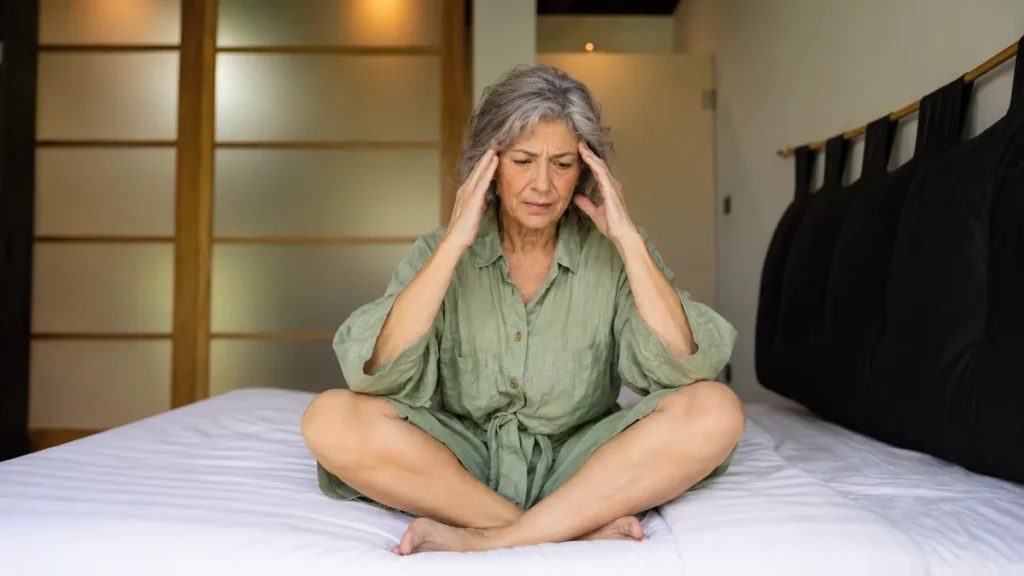
What Actually Happens When You’re Waking Up With Anxiety After 50
You’ve spent years being told to blame the hormone. In older adults, anxiety doesn’t reliably show up alongside a bigger cortisol awakening response. Sometimes it’s the opposite.
Here’s something that should have changed how this gets explained.
A Dutch study of nearly 1,800 adults over 65 found that those with a diagnosed anxiety disorder actually had a lower cortisol response after waking, not a higher one.¹
The exact opposite.
That’s not a small detail buried in a footnote. It’s the finding that should have rewritten every article on this topic, and mostly, it didn’t.
In adults over 50, the research linking high morning cortisol to anxiety doesn’t hold up the way it does in younger people, and in some studies the pattern runs the other way.
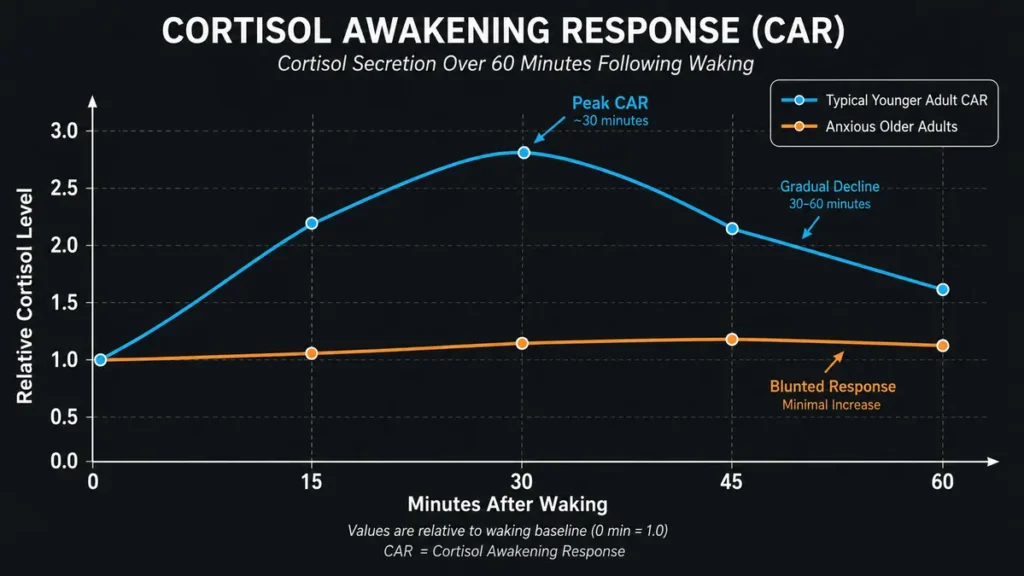
Read that again, because it changes everything that follows. If a bigger cortisol spike were the cause, the most anxious older adults should show the strongest spike.
They don’t. That single mismatch is the reason this entire article exists.
This doesn’t mean cortisol plays no role at all. Your body still produces that morning rise the same way it always has.
It means the simple “spike causes dread” story, the one repeated everywhere, isn’t built for your age group. It was never tested on people your age in the first place.
So if it’s not the hormone, something else is doing this to you every morning.
The Real Driver: The Sleep Stage You’re Still Leaving
Here’s what’s actually happening while you lie there feeling that weight. Your body isn’t reacting to a hormone surge.
It’s still in the process of leaving sleep, and after 50, that process looks different than it used to.
That’s not a flaw.
Sleep architecture [the stages your body cycles through each night] changes with age in specific, measurable ways. Older adults spend less time in deep, restorative sleep.
They spend more time in lighter stages that are easier to be pulled out of.
Sleep also becomes more fragmented, with more frequent shifts between stages and more moments of near-waking through the night.² Your sleep timing tends to shift earlier too.

That means you may be surfacing from a lighter stage exactly when dread has the easiest opening to settle in.
People who’ve lived with this for years sometimes describe the feeling differently than a doctor would. Not racing thoughts. Not a pounding heart.
Just a strange thickness behind the eyes, like the previous night is still playing on a loop somewhere in the back of the skull, refusing to fully end.
That thickness is the tell. It means you’re not in a panic response.
You’re in the tail end of a sleep stage that hasn’t finished letting go.
None of this is something going wrong with you. It’s the ordinary shape of sleep after 50.
It’s the actual mechanism behind that early morning weight, not a hormone overreacting on cue. What it doesn’t explain is the texture the feeling actually has.
Why It Feels Like Dread and Not Just Grogginess
Grogginess and dread aren’t the same thing, and you already know that. Morning grogginess is fog.
Dread has a shape. It feels personal, almost like your thoughts are stuck replaying something, thick and slow to move, even before you can name what they’re replaying.
That texture has an explanation. Sleep inertia [reduced alertness right after waking] lasts about 16 minutes on average, though it varies a lot from person to person.³
For most people that’s grogginess. For people already carrying some anxiety, it’s something heavier.
People with anxiety experience sleep inertia that runs over 14 minutes longer than those without it, the largest single factor researchers found.³ That’s not a small difference.
It’s the difference between a rough five minutes and a dread that follows you into the shower.
Here’s the part worth saying plainly, even though it cuts against the tidy version of this story: anxiety doesn’t just color how sleep inertia feels.
It appears to stretch how long it lasts, which means the dread itself may be doing some of the damage that gets blamed entirely on poor sleep.
It’s also worth saying plainly that the research on why anxiety stretches sleep inertia is still thin, and scientists don’t fully agree on the mechanism. What’s measured is solid.
What’s causing the measurement is still being worked out.
Talk to your doctor before starting a sleep-tracking routine if you’re pregnant, on medication, or managing a chronic condition.
The Pattern Worth Tracking
This is the part most people skip, and it’s the part that actually tells you something. Notice whether the dread fades fast or lingers through the morning.
That distinction matters more than the feeling itself.
If you’re keeping track for your own sake, the National Institute on Aging recommends a sleep diary.⁴ Note bedtime, nighttime waking, and final wake time.
Over a couple of weeks, that record can reveal a pattern worth bringing to a doctor.
Try this for one week:
- Note your wake time and roughly how intense the dread feels on a scale of one to five
- Mark how many minutes pass before it noticeably eases
- Write down whether it returns later in the day or stays gone

Most people who do this notice the same thing. The dread is loud, then it’s gone, usually before they’ve finished their coffee.
That pattern, fast onset, fast fade, is the normal shape.
A short window like that isn’t something to fix. It’s something to recognize, and recognizing it is usually enough to take the edge off.
The dread loses some of its power the moment you know it’s temporary. That’s true for most people, but not everyone, and the difference matters.
When the Dread Doesn’t Let Go
Some mornings are different, and you’ll know it when you feel it. If the dread sits through breakfast and into the afternoon, that’s not a sleep stage finishing its work.
There’s a specific pattern worth knowing about, especially if mornings have started feeling heavier than they used to.
Depression in midlife often shows up as early morning waking, sometimes paired with low mood, sometimes just a flat, joyless start to the day.⁵
In adults past midlife, depression can look even less obvious than that. Less sadness.
More a quiet absence of feeling, which is part of why it gets missed by the person living with it and by the people around them.⁵

That’s the part worth saying directly. If your mornings have stopped fading into ordinary days, the answer isn’t a better sleep routine.
If you’ve been telling yourself this is just what getting older feels like, it’s worth questioning that.
Depression is not a normal part of aging, even though it often gets dismissed that way.⁵ It’s a medical condition that responds to treatment.
It’s a conversation with a doctor who can rule out depression, anxiety, or something physical wearing the same disguise.
That conversation matters more than most people think it does. A doctor has tools a self-check never will, and naming the problem out loud is often the hardest part.
This doesn’t apply to most people reading this. It applies to anyone whose dread has quietly stopped being a 15 minute visitor and started being a permanent guest.
What This Means for You Tomorrow Morning
The single thing worth remembering is this: that weight isn’t a hormone spike singling you out. It’s a sleep stage your body is still leaving.
Notice whether the dread fades within the first 15 to 20 minutes of being awake, or whether it lingers through the morning, since that distinction matters more than the feeling itself.
Waking up with anxiety after 50 doesn’t mean something is broken in you. It means your sleep is doing exactly what aging sleep does, and most mornings, it finishes fast.
⚠️DISCLAIMER:
This article is for informational purposes only and does not constitute medical advice, diagnosis, or treatment. The content addresses waking up with morning anxiety and dread after age 50 and is intended for general educational purposes only. Health conditions vary significantly between individuals, always consult a licensed physician or qualified healthcare provider before making any decisions about your health or medical care.
References
- Hek, K., Direk, N., Newson, R.S., Hofman, A., Hoogendijk, W.J.G., Mulder, C.L., Tiemeier, H. Anxiety disorders and salivary cortisol levels in older adults: a population-based study. Psychoneuroendocrinology. 2013. https://pubmed.ncbi.nlm.nih.gov/22776419/
- Gorgoni, M., De Gennaro, L. Sleep in the Aging Brain. Brain Sciences. 2021. https://pubmed.ncbi.nlm.nih.gov/33673285/
- Morning sleep inertia and its associated factors: Findings from a nationwide study. PubMed. 2026. https://pubmed.ncbi.nlm.nih.gov/41481618/
- Sleep and Older Adults. National Institute on Aging (NIH). 2026. https://www.nia.nih.gov/health/sleep/sleep-and-older-adults
- Depression. National Institute of Mental Health (NIMH). 2024. https://www.nimh.nih.gov/health/publications/depression