
Most people over 50 cook rice the same way they always have. Boil it. Serve it. Eat it hot.
And that’s exactly the problem.
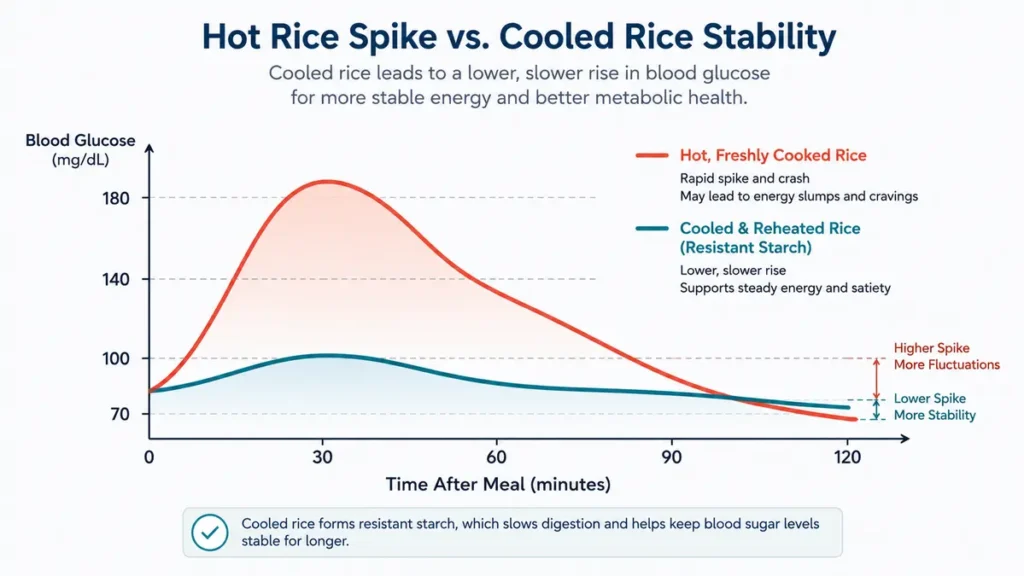
Hot, freshly cooked rice hits your bloodstream fast. Your body breaks it down into glucose quickly. After 50, your body handles that spike less well than it used to. Cells don’t respond to insulin the way they once did. So blood sugar stays elevated longer.
But here’s the thing , you don’t have to give up rice. You just have to change when you eat it.
Cooling cooked rice in the fridge overnight changes its chemistry. A portion of the starch turns into something called resistant starch. Your body can’t digest it fast. It slows the glucose rise. And when you reheat that rice the next day, those benefits stay.
This isn’t a fad. It’s backed by peer-reviewed research. And it costs you nothing extra.
| 3 Things You Will Learn in This Article Why blood sugar becomes harder to manage after 50 and what is happening inside your body. How cooling cooked rice changes its chemistry and slows glucose release. The exact 5-step process you can start using tonight. |
| 2.5x more resistant starch in cooled vs. fresh rice | 25%+ of adults over 65 have diabetes (ADA 2024) | 10% drop in max blood glucose after cooled rice (2022 study) |
You Might Be Eating Rice the Wrong Way
Most people over 50 cook rice the same way they always have. Boil it. Serve it. Eat it hot.
And that’s exactly the problem.
Hot, freshly cooked rice hits your bloodstream fast. It breaks down into glucose quickly. If you’re over 50, your body is less and less able to handle that spike. Your cells don’t respond to insulin the way they used to. So the glucose just sits there longer than it should.
Here’s the good news. You don’t have to stop eating rice. You don’t need a new diet. You just need to change when you eat it.
Cooling cooked rice in the refrigerator overnight changes its chemistry. A portion of the starch converts into something called resistant starch. Your body can’t digest it quickly. It slows the glucose rise. It feeds your gut bacteria. And when you reheat the rice the next day, those benefits stay.
This article explains the science behind it clearly and honestly. Then it gives you the exact steps to try it yourself.
Why Blood Sugar Gets Harder to Control After 50
If your energy crashes after meals more than it used to, you are not imagining it. Something real is happening inside your body.
After age 50, insulin sensitivity may drop by 1 to 2 percent every year. Insulin is the hormone that helps glucose move from your blood into your cells. Think of it like a key, and your cells like a lock. As you get older, the key stops fitting as well. Your cells don’t open up as easily. So glucose builds up in your blood.
Three reasons this happens as you age
- Your muscle mass drops. Muscles are the body’s main glucose users. Less muscle means less glucose gets cleared from the blood after a meal.
- Your hormones shift. For women, estrogen drops during menopause. That directly affects insulin sensitivity. For men, testosterone slowly declines which also affects how the body handles glucose.
- Your pancreas gets tired. After decades of work, it doesn’t produce insulin as efficiently as it once did.

The numbers tell a clear story. According to the American Diabetes Association’s 2024 Standards of Care, more than 25% of adults over age 65 have diabetes. And half of all older adults have prediabetes many without knowing it.
This doesn’t mean you need to stop eating carbs. It means the way you prepare them starts to matter a lot more.
What Cooling Does to Rice (The Simple Science)
When you cook rice, heat and water break open the starch granules. The structure becomes loose. Your digestive enzymes can get in fast and break it all down into glucose. The glucose rushes into your blood.
That’s why freshly cooked white rice can raise blood sugar almost as fast as pure sugar. Darrell Cockburn, PhD, associate professor of food science at Penn State University, put it plainly in a 2024 TODAY interview: “Cooked starches can raise blood glucose levels almost as well as pure sugar because our digestive enzymes are so good at breaking it down.”
But something interesting happens when you let that rice cool down.
| What happens during cooling As rice cools, the starch molecules pull back together. They form tight, crystalline structures. These structures are harder for your digestive enzymes to break apart. This process is called retrogradation. The starch that forms is called resistant starch — because it resists digestion. |
Here is the key fact: A 2015 clinical study published in the Asia Pacific Journal of Clinical Nutrition tested three types of white rice:
- Freshly cooked rice: 0.64 g of resistant starch per 100 g
- Rice cooled for 10 hours at room temperature: 1.30 g
- Rice cooled for 24 hours in the refrigerator, then reheated: 1.65 g
That’s more than 2.5 times more resistant starch from the same rice just by changing how you store it.
And here is the part people miss: reheating the rice did not destroy the resistant starch. The structure is stable enough to survive being warmed up. So you can prep rice in advance, refrigerate it, and reheat it the next day and still get the benefit.
What the Research Shows in Real People
Lab science is one thing. Real human studies are another. Here is what researchers found when they tested this on actual people.

Study 1: 15 healthy adults (2015)
The same study that measured resistant starch also tested the blood sugar response. Participants ate either freshly cooked rice or rice that had been cooled for 24 hours and then reheated. The cooled rice produced a lower glycemic response 125 vs. 152 mmol·min/L (p=0.047). That is a statistically significant difference from a simple kitchen change.
Study 2: 32 people with type 1 diabetes (2022)
Researchers at Poznan University of Medical Sciences in Poland ran a more targeted study. They gave 32 patients with type 1 diabetes either freshly cooked long-grain rice or the same rice that had been refrigerated for 24 hours and then reheated.
They tracked blood glucose every few minutes for three hours using a continuous glucose monitor.
The results were clear:
- Maximum blood glucose was lower after cooled rice: 9.9 mmol/L vs. 11 mmol/L (p=0.0056)
- The area under the glycemic curve a measure of total glucose exposure was significantly reduced.
| ⚠ Important caution for people on insulin This same study found that cooled rice increased the risk of low blood sugar (hypoglycemia) in patients using standard insulin doses. If you use insulin or diabetes medication, talk to your doctor before making this change. Do not adjust your dose on your own. |
These are real, peer-reviewed findings. But it is also worth being honest: most of these studies are small. More research in larger groups is needed. Cooling rice is a supportive habit, not a substitute for medical treatment.
How to Do It: 5 Steps to Start Tonight
The process is simple. You don’t need special equipment. You don’t need to buy anything new. Here’s exactly what to do.
| Step | What to Do | Details |
| 1 | Cook rice fully | Any cooking method works. Long-grain white or basmati is best. |
| 2 | Optional: add oil | Add 1 tsp coconut or sunflower oil per 1/2 cup dry rice before cooking. |
| 3 | Cool it down | Spread in a shallow container. Let it cool at room temp for max 1 hour. |
| 4 | Refrigerate overnight | Store at 4°C (39°F) for at least 12 hours. 24 hours gives the best results. |
| 5 | Reheat and eat | Microwave or stovetop. Don’t overcook. The resistant starch stays intact. |
The coconut oil tip most people don’t know about
A study testing 38 varieties of rice found that adding a small amount of fat before cooking can boost resistant starch formation even further. The method: add about 1 teaspoon of coconut or sunflower oil per 1/2 cup of dry rice to the boiling water before cooking. Then refrigerate as normal.
The fat helps starch molecules bond together during cooling, making them even harder to digest. It’s a small addition with a meaningful effect.
Make it part of your weekly meal prep
The easiest way to do this consistently is to cook a big batch of rice on Sunday. Spread it out to cool. Refrigerate it in portioned containers. Then reheat servings throughout the week as needed.
It takes no extra effort once it becomes a habit. And you get the benefit every single day.
| Which rice works best? Long-grain white rice (like basmati or jasmine) produces more resistant starch when cooled than short-grain varieties. A 2013 study found that long-grain rice cooked in a rice cooker and then refrigerated had the highest resistant starch content. Pressure-cooked rice and congee-style (watery) rice produce less. Brown rice already has more fiber and gets the same benefit from cooling on top of that. |
The Gut Health Bonus You Probably Didn’t Expect
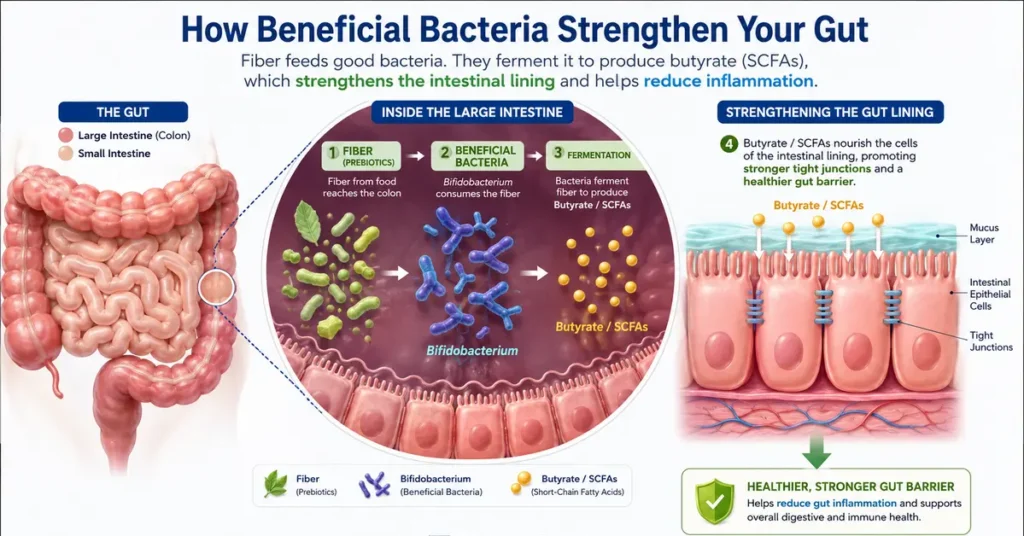
Resistant starch does more than slow glucose. Once it passes your small intestine undigested, it reaches your large intestine. There, it becomes food for your gut bacteria.
This is called a prebiotic effect. Your good bacteria like Bifidobacterium and Lactobacillus ferment the resistant starch and produce something called short-chain fatty acids (SCFAs). The most important one is butyrate.
Why butyrate matters after 50
Butyrate does several things your body needs more of as you age:
- It strengthens the intestinal lining, reducing the chance of gut inflammation
- It reduces systemic inflammation, which is a driver of many age-related diseases
- It may help lower LDL cholesterol, according to the University Hospitals health system (2025)
- It supports the gut-brain connection, which can affect mood and energy
A meta-analysis published in Food Chemistry X (2024) reviewed 24 trials covering 816 people. It found that resistant starch intake consistently stimulated growth of health-promoting bacteria in the gut, including Bifidobacterium.
This matters especially after 50. Gut microbiome diversity naturally declines with age. Resistant starch is one of the simplest and most accessible dietary tools to push back against that decline.
The Bottom Line
Here is what you now know.
After 50, your body handles carbohydrates differently. Insulin resistance increases. Blood sugar spikes hit harder and last longer. Every meal matters more.
Cooling cooked rice in the refrigerator and eating it the next day is a real, science-backed way to reduce that blood sugar spike. It works because the starch physically changes structure during cooling. It becomes harder to digest. It feeds your gut bacteria instead of flooding your bloodstream with glucose.
It takes no extra money. No special ingredients. Just one extra step the night before.
| Try it this week Cook your rice tonight. Spread it out to cool. Refrigerate it. Eat it tomorrow reheated. That is the whole trick. If you use insulin or diabetes medication, speak with your doctor before making changes to your diet. |
And if this works for you the principle applies to other starchy foods too. Potatoes. Pasta. The same cook-cool-reheat method increases resistant starch in all of them. Start with rice. See how you feel.
⚠️MEDICAL/FITNESS DISCLAIMER
This article is for informational purposes only. It does not replace medical advice, diagnosis, or treatment. The information covers blood sugar management, insulin sensitivity, insulin resistance, aging and glucose metabolism, muscle mass and glucose clearance, hormonal changes (estrogen, testosterone) and metabolic effects, resistant starch, glycemic response, rice preparation and cooking methods, dietary fat (coconut oil, sunflower oil) and starch formation, gut health, gut microbiome, prebiotic effect, butyrate and short-chain fatty acids, gut inflammation, LDL cholesterol, hypoglycemia risk for insulin users, portion size, carbohydrate intake, prediabetes, type 1 and type 2 diabetes, and meal preparation habits. Individual results vary based on age, health status, and fitness level.
Before changing your exercise routine, diet, or supplement use, talk to your doctor or a qualified health professional first. If you experience chest pain, dizziness, severe joint pain, or any sudden symptom during or after exercise, stop immediately and seek medical care.