

It happens at the kitchen table. You chose breakfast carefully, added fiber like you were supposed to, and by mid-morning your stomach is tight and round and you can’t explain it.
The problem is not how much fiber you eat. It’s that one category of fiber ferments faster than your slower post-50 gut can handle, and no one told you which one.
After 50, your gut moves more slowly and the bacteria living in it shift. The high-fiber foods that worked in your 40s can now be the direct cause of the bloating you’re trying to fix.
This article is for adults over 50 who eat well but still bloat. It explains the mechanism, names the specific fibers to reconsider, and gives you a 14-day swap to test.
Why the Fiber Advice You’re Following Leaves Out the Most Important Part
The advice you’ve been following tells you how much fiber to eat, but it never tells you which kind. After 50, that missing detail is the whole problem.
Standard guidelines say women over 50 need 22 to 28 grams of fiber per day, and men need 28 to 34 grams.¹ Those numbers say nothing about fiber type. They were built on research done largely in younger adults whose digestive systems move food through faster.
Your gut after 50 is not the same gut. The speed at which fiber moves through your large intestine changes.
The bacteria living there change too. When fiber spends more time sitting in your gut, bacteria have more time to break it down and produce gas.
Whether you feel that gas as bloating depends entirely on what kind of fiber you’re giving those bacteria to work with.
Fiber type is the variable that changes everything. Two people can eat 30 grams of fiber a day and have completely different experiences, based only on which category of fiber they chose.
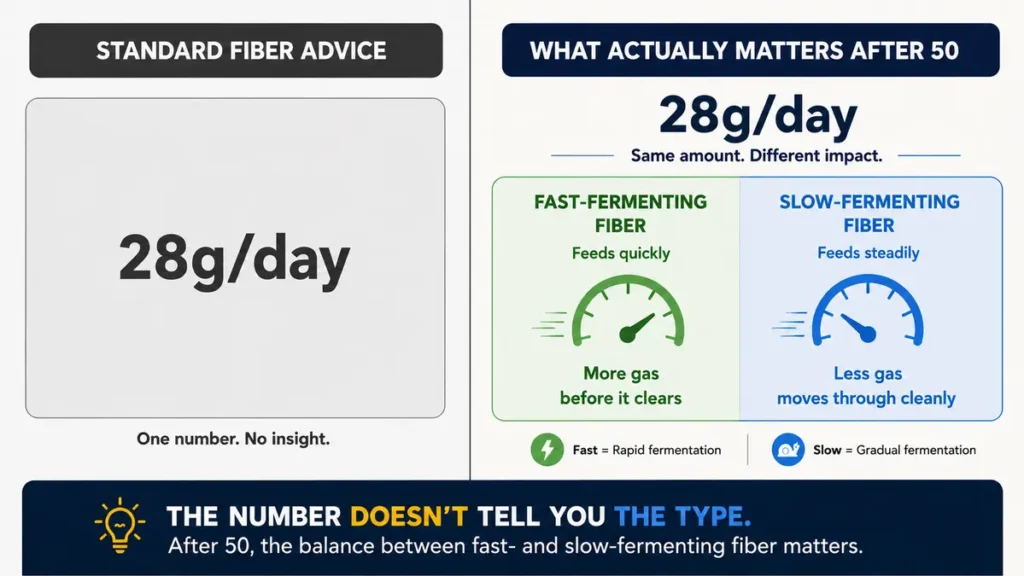
The question your doctor probably didn’t ask when you mentioned bloating isn’t how much fiber you eat. It’s what type.
After 50, Your Gut Handles Fermentable Fiber Differently
After 50, your gut moves more slowly, which means bacteria have more time to work on fiber and push out gas. That’s the short version. Here’s why it matters.
Gut motility [how well your intestines push food forward] slows with age.² When food and fiber move more slowly through your large intestine, bacteria have a longer window to ferment it. More fermentation time means more gas produced before your body can clear it.
Here’s the part that surprises most people. You might be eating the same high-fiber breakfast you’ve eaten for 20 years and suddenly bloating from it, not because your diet changed but because your gut did.
At the same time, gut microbiome [the community of bacteria living in your large intestine] composition shifts noticeably after age 50.³ The balance between bacterial types changes.
Some bacteria that ferment fiber quickly become more dominant. The result is that the same fiber that caused mild, manageable fermentation at 38 causes a larger gas response at 58.
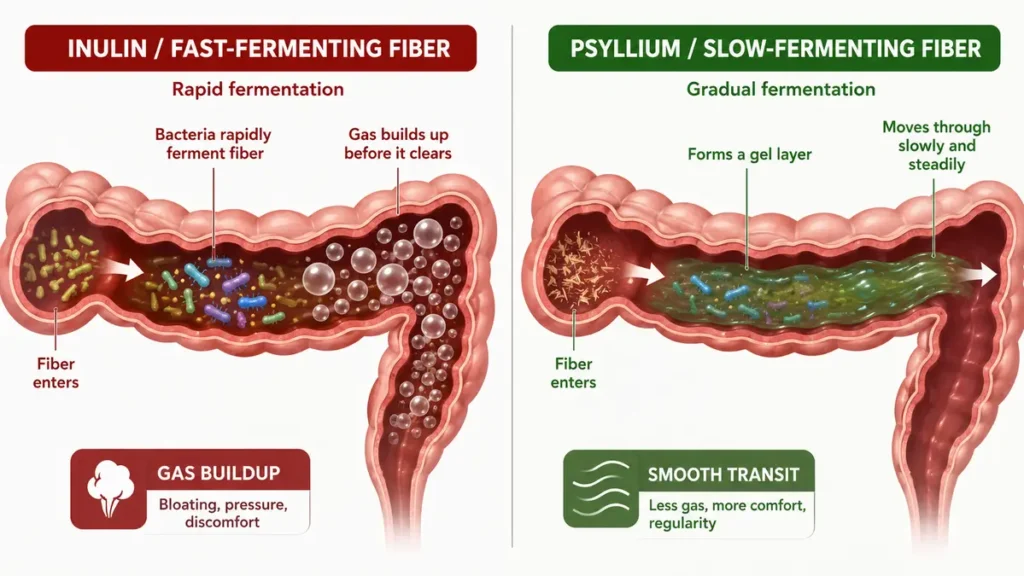
Fermentable fiber and gas production are directly linked, and that link gets stronger as transit time slows.
The two changes together, slower movement and a shifted bacterial community, lower your gut’s tolerance for rapidly fermenting fiber. The fiber isn’t new. The problem is new. And the cause is a specific type of fiber that thrives in exactly this environment.
Two Types of Fiber, Two Very Different Reactions in Your Gut
Not all fiber acts the same way in your body. Some kinds produce almost no gas. Some produce a lot. The ones that produce the most are in foods you probably think of as healthy.
Short-chain fermentable fiber [fiber that gut bacteria break down quickly and produce large amounts of gas from] hits your large intestine and gets consumed by bacteria fast. The gas it produces builds up before your gut can move it along.
In a younger digestive system with faster transit, that gas clears quickly. After 50, it doesn’t.⁴
Long-chain, slowly fermentable fiber [fiber that resists quick breakdown and moves through the gut producing little gas] works differently. It forms a gel in your intestine, moves slowly, and gives bacteria almost nothing to rapidly ferment.
Here’s the fact that most fiber articles skip entirely. The fiber ingredient added to prebiotic yogurt, fiber-fortified protein bars, and “gut health” supplements is inulin [a fast-fermenting fiber from chicory root that gut bacteria break down rapidly into gas]. Inulin is one of the fastest-fermenting fibers in the human gut.⁴
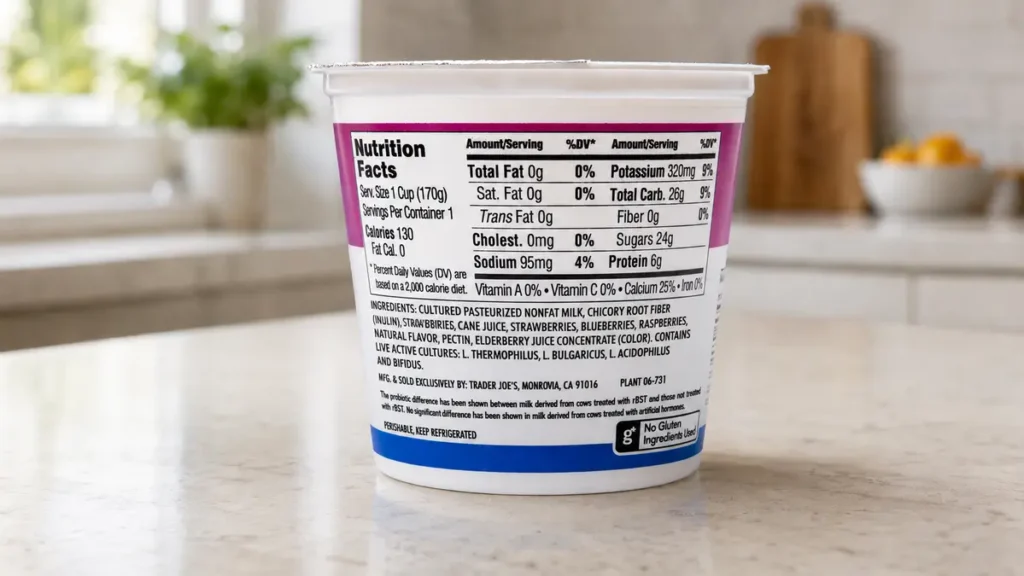
It is actively marketed as a health food. For a 35-year-old with fast gut transit, it may be fine.
For an adult over 50 with slower motility and a shifted microbiome, it can be the direct cause of the morning bloat that no one can explain.
This is the psyllium husk vs. inulin bloating distinction that almost no general fiber advice makes. They are both called “fiber.” They behave like opposites.
The High-Fermentation Fibers Most Healthy Eaters Over 50 Consume Daily
The fiber causing your bloating probably has a name you’ve seen on ingredient labels but never thought twice about.
Chicory root fiber is inulin. If you eat prebiotic yogurt, fiber-enriched protein bars, or supplements labeled “prebiotic boost,” check the ingredients. Chicory root fiber or inulin in the first five ingredients means fast-fermenting fiber, added without warning on the front of the package.
Fructooligosaccharides (FOS) [short sugar chains that gut bacteria ferment quickly into gas] are found naturally in garlic, onions, leeks, and Jerusalem artichokes. These are genuinely nutritious foods. That’s what makes this harder.
Eating garlic isn’t wrong. But if you bloat one to three hours after a meal heavy in garlic or onions, that timing is not a coincidence. It’s fermentation gas.

Raw legumes and undercooked beans carry a high fermentable fiber load. Cooking them longer reduces but does not eliminate the fermentation.⁵
The bloating from these foods that causes problems for adults after 50 is not random. It follows a pattern tied to fiber type, not meal size.
SAVE THIS: Quick Label Check Flip any packaged “high-fiber” food and scan the ingredients. These names mean fast-fermenting fiber:
- Chicory root fiber
- Inulin
- Fructooligosaccharides or FOS
- Oligofructose If any of these appear in the first five ingredients, that product is a likely bloat trigger for adults over 50 with slower gut transit. The fiber to replace these with is in the next section.

Recognizing the source is step one. Knowing what to replace it with is what actually stops the bloating.
The Fiber Types That Work Better in a Slower Gut
Some fibers move through your gut gently, produce very little gas, and work better in a slower digestive system. These are not new discoveries. They’re just rarely named specifically in general fiber advice.
Psyllium [a gel-forming fiber from plant husks that ferments slowly and produces little gas] is the most well-studied option. In a randomized controlled trial using MRI imaging, psyllium increased colonic volume without increasing colonic gas or breath hydrogen at all.⁶
That’s a direct measurement, not an estimate. It moves things along without the gas burst.
Psyllium is also the most effective fiber studied for improving bowel regularity, outperforming other fiber types in a meta-analysis across multiple trials.⁷
Beta-glucan [a slowly fermenting fiber found in oats and barley] produces far less rapid gas than inulin or FOS. Cooked oatmeal is a reliable, practical source.

These aren’t compromises. They’re the fibers that actually match how your gut works after 50
Cooked and cooled legumes carry resistant starch [a type of starch that passes to the large intestine mostly undigested] that ferments more slowly than raw or freshly cooked beans. The cooling step changes the starch structure.
These fibers don’t eliminate fermentation. They slow it down to a pace a post-50 gut can clear.
Talk to your doctor before changing your fiber routine if you’re on medication, managing a chronic digestive condition, or have been told to follow a specific diet.
he switch is straightforward. But adding new fiber on top of existing fiber instead of replacing it can make symptoms worse before they improve.
The 14-Day Fiber Swap: How to Test Whether Type Is Your Problem
This protocol doesn’t ask you to eat less fiber. It asks you to swap one type for another and watch what changes.
This is a fiber type audit, not a diet change. After 50, this kind of audit is the adjustment most healthy eaters never knew they needed.
Total fiber grams stay roughly the same. Only the fermentation speed of one source changes.

The 5-Step Protocol
- Identify one fast-fermenting source in your current daily diet. Check your breakfast yogurt, any fiber supplement, protein bars, and your most frequent garlic or onion servings. Pick the one you eat most consistently.
- Choose your swap. Replace that one source with psyllium husk (start with one teaspoon stirred into at least eight ounces of water), cooked oatmeal (not raw oat bars), or cooked and cooled lentils.
- Swap, don’t add. Remove the fast-fermenting source first. Then introduce the replacement. Adding both at once inflates your total fermentation load.
- Track one symptom each morning. Rate your abdominal tightness on a scale of one to five. Same time each day. Takes ten seconds. Do this for 14 days.
- Read the result. If your score drops by day seven, continue and consider a second swap. If it stays the same or rises, go back to baseline and consult a registered dietitian who can rule out other causes.
Conclusion
For the next 14 days, swap one high-fermentation fiber source in your current diet for psyllium husk or cooked oats, note your symptoms each morning, and return to the fiber type guide above to adjust from there. You don’t need to eat less fiber. You need to change which kind.
For adults over 50 looking at the right types of fiber for bloating, the answer isn’t on the nutrition facts panel. It’s in the ingredient list. Your gut didn’t fail you. The advice just left out the most important part.
⚠️MEDICAL DISCLAIMER:
This article is for informational purposes only. It does not replace medical advice, diagnosis, or treatment. The information covers fiber type, bloating, gut motility, gut microbiome, fermentable fiber, gas production, colonic transit time, inulin, fructooligosaccharides, chicory root fiber, psyllium, beta-glucan, resistant starch, dietary fiber intake, fiber swap protocol, symptom tracking, digestive health after 50.
Individual results vary based on age, health status, and fitness level. Before changing your exercise routine, diet, or supplement use, talk to your doctor or a qualified health professional first. If you experience chest pain, dizziness, severe joint pain, or any sudden symptom during or after exercise, stop immediately and seek medical care.
References
- Cleveland Clinic. (n.d.). How much fiber per day should you eat? Cleveland Clinic Health Essentials. https://health.clevelandclinic.org/how-much-fiber-per-day
- Tottey W, et al. Colonic transit time is a driven force of the gut microbiota composition and metabolism: increased transit time with aging linked to gut microbiota modification. Journal of Neurogastroenterology and Motility. 2017. https://pubmed.ncbi.nlm.nih.gov/27530163/
- Gyriki D, et al. The gut microbiota and aging: interactions, implications, and interventions. Aging is associated with notable shifts in gut microbiota composition and decreased diversity. Frontiers in Aging. 2025. https://pmc.ncbi.nlm.nih.gov/articles/PMC12116569/
- Moayyedi P, et al. Dietary fiber in irritable bowel syndrome: short-chain fermentable fibers produce rapid gas causing bloating; psyllium produces low gas production. International Journal of Molecular Medicine. 2017. https://pmc.ncbi.nlm.nih.gov/articles/PMC5548066/
- Ganz AS, et al. Open label study of a novel fiber product for bloating, gas, and bowel regularity: imbalance in fiber types leads to adverse bloating and gas. Frontiers in Medicine. 2025. https://doi.org/10.3389/fmed.2025.1572261
- Casellas Jordà F, et al. Psyllium reduces inulin-induced colonic gas production in IBS: MRI and in vitro fermentation studies. Psyllium increased colonic volumes without increasing colonic gas or breath hydrogen. Gut. 2022. https://pubmed.ncbi.nlm.nih.gov/34353864/
- Bellini M, et al. The effect of fiber supplementation on chronic constipation in adults: psyllium is the most efficacious investigated fiber at providing constipation relief. American Journal of Clinical Nutrition. 2022. https://ajcn.nutrition.org/article/S0002-9165(23)03614-6/fulltext