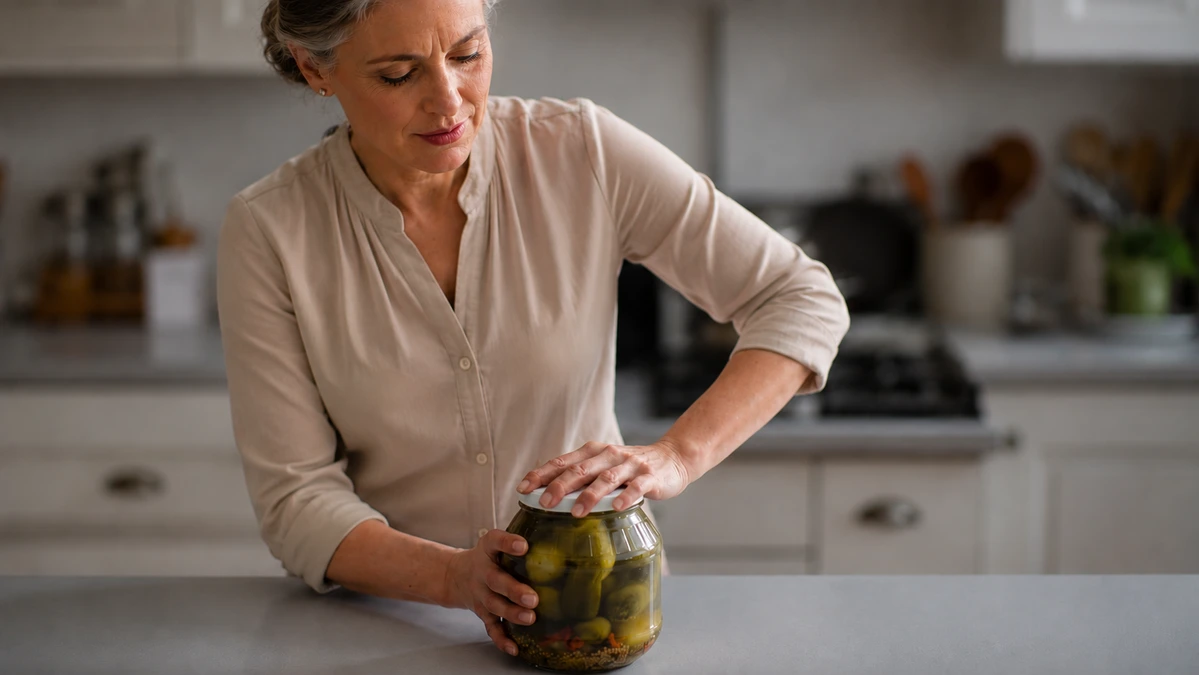
You reach for the jar lid, twist, and nothing happens. You try again, angle your wrist, still nothing. Ten years ago this took one motion and no thought at all. That small failure is not about the jar.
For adults past 55 who want to stay capable and independent as they age, this moment is often the first hint of a change in grip strength, quietly one of the most useful measurements of how your whole body is aging.¹ Most people track aging by how their body looks in the mirror.
The measurement that actually predicts how long you stay capable rarely gets checked at all.
Why This Article Is Worth Your Time
- Learn which single measurement doctors increasingly trust more than blood pressure for predicting your future health.
- Find out what almost nobody checks about their own strength, though it may matter more than the number itself.
- Get the exact weekly protocol that rebuilds strength most efficiently at this age.
- See a two-minute test you can do at home today with something already in your kitchen.
- Understand what this measurement cannot yet tell you, and why that gap is worth knowing about.
The Grip That’s Quietly Reporting on Your Whole Body
You notice it in small moments. The grocery bag that used to hang easily from two fingers now needs your whole hand. The car door feels heavier. You assume it is the bag, the door, a bad night’s sleep.

What you are feeling is grip strength, and it is not really about your hands. Grip strength is produced by the muscles in your hand and forearm, and researchers use it as a stand-in for your overall muscle strength because it correlates closely with strength throughout your body.²
After about age 50, muscle mass declines at a rate of one to two percent per year, and the decline in strength moves even faster.³
That grocery bag moment is often the first place this shows up, because your hands work harder, more often, than almost any other muscle group you own.
The moment a jar lid, a car door, or a grocery bag suddenly feels heavier than it used to, most people blame the object. It is usually the first data point of a trend that started years earlier.
Why This One Measurement Beats Blood Pressure at Predicting Your Future
You already know your blood pressure number. Almost no one knows their grip strength number, even though it may say more about your future health than blood pressure does.
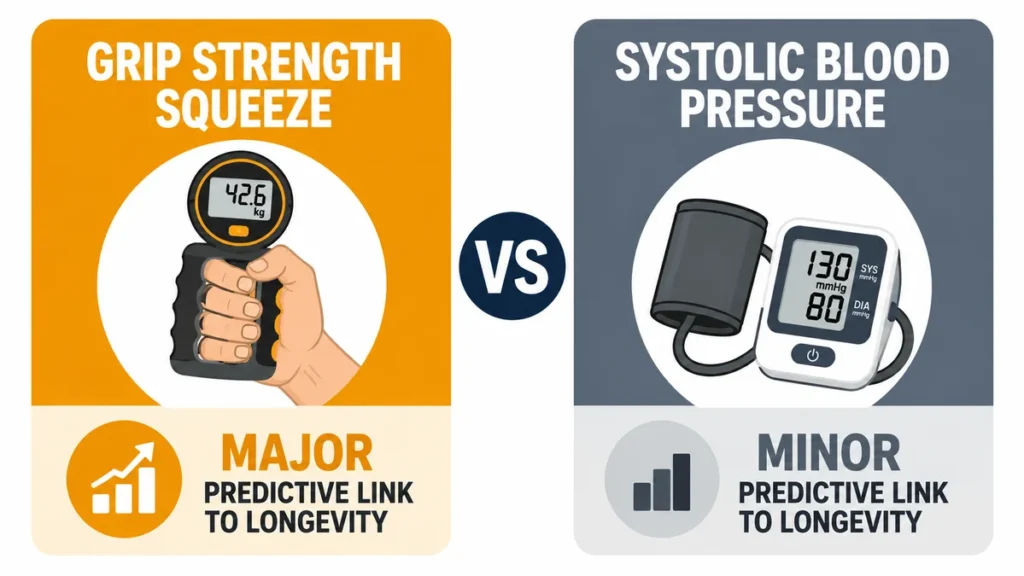
A study following nearly 140,000 adults across 17 countries measured grip strength at the start and then tracked who died over the next several years.⁴
Every five-kilogram drop in grip strength was linked to a sixteen percent higher risk of death from any cause, and grip strength turned out to be a stronger predictor of death from any cause and from cardiovascular causes than systolic blood pressure was.⁴
A cheap five-second squeeze test has been outperforming the blood pressure cuff this whole time, and almost nobody noticed.⁴
Your grip does not just measure your hands, it reports on the trajectory your whole body is on, and that trajectory matters more than the number you start with.
That finding held up across countries at every income level, in men and women alike, which is what makes it more than a fluke in one population.⁴
It is inexpensive to measure and takes less than a minute, so this is not a case where the better measurement is also the harder one to get.
Doctors have not caught up to this yet. Most primary care visits still measure blood pressure as a matter of routine and skip grip strength entirely, even though a hand dynamometer costs less than a blood pressure cuff. You are likely more informed on this than your last checkup was.
The Direction You’re Heading Matters More Than Where You Start
You may assume that if your grip is still reasonably strong, you have nothing to worry about. That assumption misses the part worth paying attention to.
A study of adults in their late eighties and nineties measured grip strength twice, five years apart, then tracked mortality for almost a decade afterward.⁵
People whose grip strength was falling had a meaningfully higher risk of death than people with the same starting strength whose grip stayed level or improved.⁵
Men losing grip strength saw their risk climb sixteen percent for every kilogram lost per year, and women saw an even steeper rise of thirty-three percent.⁵
The population in that study was adults aged 85 and older, so the exact numbers do not transfer directly to someone in their fifties or sixties.⁵ The underlying pattern, that trajectory carries its own risk apart from your starting point, is the part worth taking seriously at any age.
Here is the uncomfortable part. A person with below-average grip strength who is holding steady may be in a better position than someone with above-average strength who is losing it quickly.
The number on the day you test it is not the whole story. Which matters more to you: where you stand today, or where you are headed?
What Actually Rebuilds Grip Strength After 55
You do not need a gym membership or hours of free time to change this. The evidence points to something far simpler than most people expect.
Resistance training is the most effective tool for rebuilding strength training after 55, and the evidence behind it keeps getting stronger.⁶
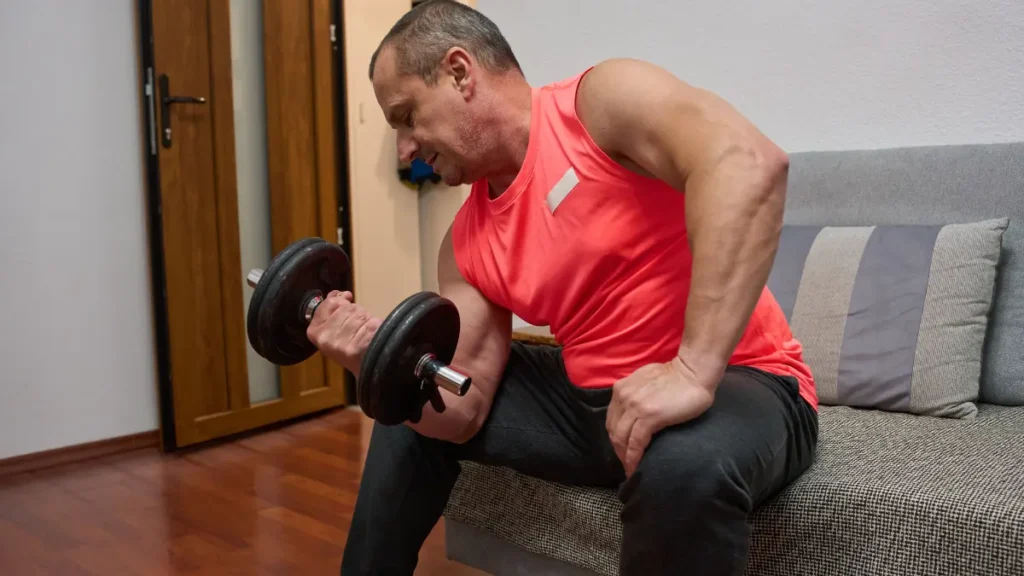
A recent review of forty-two clinical trials found that resistance training is associated with an average gain of nearly three kilograms of handgrip strength compared to no training at all.⁶
New guidance released this year confirms the minimum effective dose: train each major muscle group at least twice a week, with two to three sets per exercise.⁷
Stuart Phillips, a kinesiology professor at McMaster University involved in that guidance, put it plainly: consistency in showing up matters more than the complexity of the program.⁷
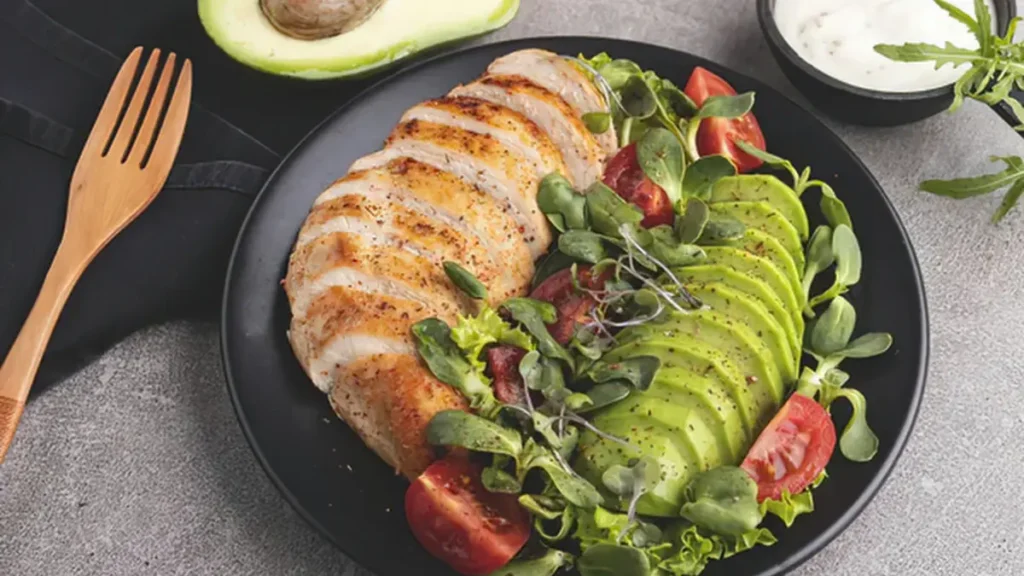
Protein intake plays a supporting role alongside training. Research on community-dwelling older adults has found that those eating between one and one point two grams of protein per kilogram of body weight each day tend to retain more lean muscle than those eating the standard recommended amount.⁸
For someone weighing 70 kilograms, that works out to roughly 70 to 84 grams of protein spread across the day.
Talk to your doctor before starting a new strength training program if you have joint problems, heart disease, or another condition that affects how you exercise.
A simple starting protocol:
- Two sessions per week, on non-consecutive days, focused on major muscle groups.⁶
- Two to three sets per exercise, using a resistance you can manage for eight to twelve repetitions.
- One protein-rich food at each meal, aiming for the range above across the day.
- A grip strength check every two to four weeks to track direction, not just level.
Most people who start this kind of program feel a difference in daily tasks, jar lids, grocery bags, car doors, within the first several weeks, well before the number on a dynamometer moves much at all.
What the Research Can’t Tell You Yet
You deserve the full picture, not just the encouraging parts. Here is what this article has not resolved.
No single study has followed adults from age 55 onward, tracked their grip strength trajectory for decades, and confirmed that catching a decline early changes how long they live.
The evidence supporting that idea is built from separate pieces: one large study on baseline grip strength and mortality risk across midlife and older adults, and a smaller study on grip strength trajectory in adults over 85.⁴,⁵
A separate body of trials shows that training raises grip strength in the short term.⁶
No one has yet run the study that connects all three steps in a single group of people followed from their fifties into old age.
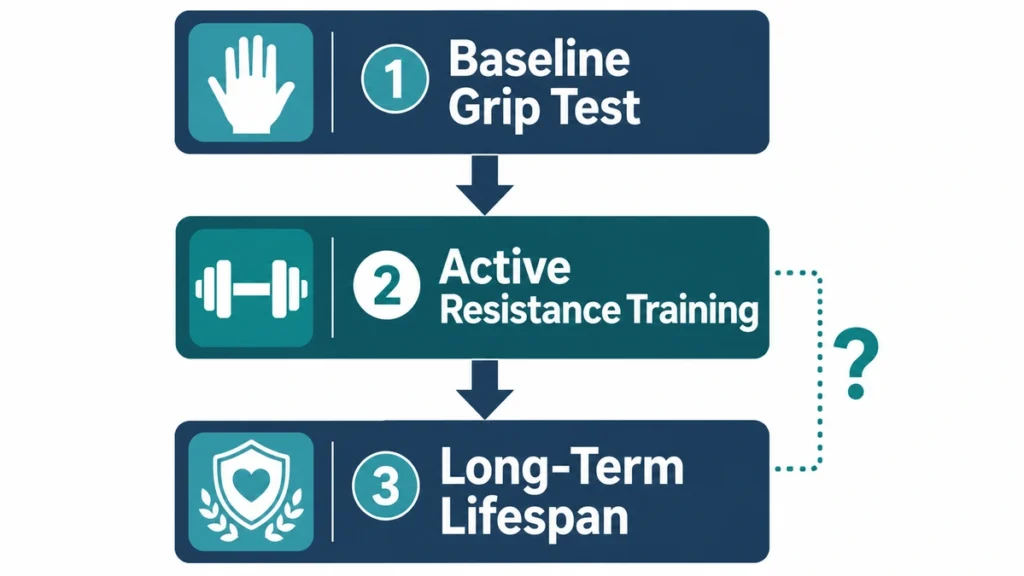
This matters because it is possible, though not yet shown, that improving your grip strength number does not fully translate into the mortality benefit associated with naturally higher grip strength.
The training studies measure strength gains over months. The mortality studies measure outcomes over years. Nobody has bridged that gap directly yet.
None of this weakens the case for training. It means the exact size of the benefit from starting today is not yet pinned down by direct evidence, even though every individual piece points the same direction.
The Two-Minute Check You Can Do Right Now
You do not need a lab or a clinic to start tracking this. A friend of mine, a physical therapist in her sixties, tests her own grip strength the same week every month. She says the number matters less to her than whether it moved since last time.
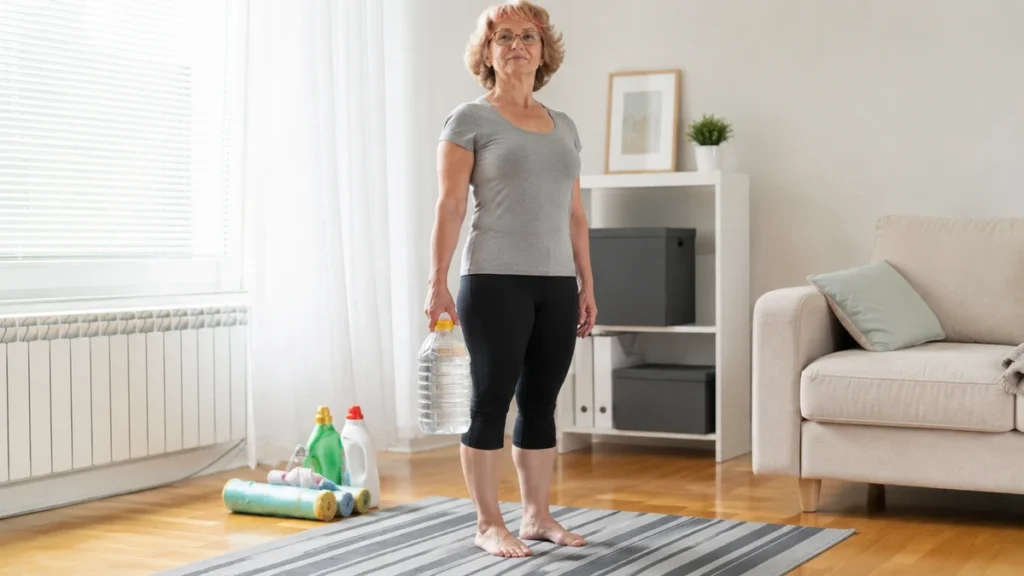
Fill a plastic jug halfway with water, hold it by the handle with your arm straight down at your side, and see how long you can hold it there before your grip gives out.
Do this once a month, same jug, same arm position, and write down the time. You are not measuring your maximum strength this way.
You are measuring your trend, which is the number that this article has argued matters most.
For a more structured starting point, the National Institute on Aging publishes a free exercise guide built specifically for adults building strength later in life, with no membership or cost required.⁹ It includes routines that target the same muscle groups this article has covered.
Start the habit before you need the proof it worked.
The Number Worth Tracking From Here
The single most important thing to remember is that your grip strength trend matters more than its current level, and almost nobody is watching their trend.
Test your grip strength this week, then start two short strength sessions to build it back.
Grip strength will not tell you everything about how you are aging. It tells you more than most people think to ask, and it costs almost nothing to find out.
What it cannot yet tell you is exactly how much difference starting today will make, only that the direction is worth choosing.
⚠️DISCLAIMER
This article is for informational purposes only and does not constitute medical or professional fitness advice. The content addresses grip strength as a strength-training and aging indicator and is intended for general educational purposes only. Exercise carries inherent risk, consult a qualified healthcare or fitness professional before beginning or modifying any training program, particularly if you have an existing injury or medical condition.
References
[1]. von Haehling S, Morley JE, Anker SD. An overview of sarcopenia: facts and numbers on prevalence and clinical impact. Journal of Cachexia, Sarcopenia and Muscle. 2011. https://pmc.ncbi.nlm.nih.gov/articles/PMC3060646/
[2]. Bohannon RW. Grip Strength: An Indispensable Biomarker For Older Adults. Clinical Interventions in Aging. 2019. https://pmc.ncbi.nlm.nih.gov/articles/PMC6778477/
[3]. von Haehling S, Morley JE, Anker SD. From muscle wasting to sarcopenia and myopenia: update 2012. Current Opinion in Clinical Nutrition and Metabolic Care. 2012. https://pmc.ncbi.nlm.nih.gov/articles/PMC3505577/
[4]. Leong DP, Teo KK, Rangarajan S, et al. Prognostic value of grip strength: findings from the Prospective Urban Rural Epidemiology (PURE) study. The Lancet. 2015. https://www.thelancet.com/journals/lancet/article/PIIS0140-6736(14)62000-6/abstract
[5]. Granic A, Davies K, Adamson A, et al. Initial level and rate of change in grip strength predict all-cause mortality in very old adults. Age and Ageing. 2017. https://pmc.ncbi.nlm.nih.gov/articles/PMC5860048/
[6]. Li HR, Huang SL, Yv ZZ, Jiang N, Li PH, Zhai YF, Peng FL. Optimal dose of resistance training to improve handgrip strength in older adults with sarcopenia: a systematic review and Bayesian model-based network meta-analysis. Frontiers in Physiology. 2025. https://www.frontiersin.org/journals/physiology/articles/10.3389/fphys.2025.1564988/full
[7]. American College of Sports Medicine. Resistance Training Prescription for Muscle Function, Hypertrophy, and Physical Performance in Healthy Adults: An Overview of Reviews. ACSM Position Stand. Medicine & Science in Sports & Exercise 2026. https://acsm.org/resistance-training-guidelines-update-2026/
[8]. Deer RR, Volpi E. Protein Intake and Muscle Function in Older Adults. Current Opinion in Clinical Nutrition and Metabolic Care. 2015. https://pmc.ncbi.nlm.nih.gov/articles/PMC4394186/
[9]. National Institute on Aging. Exercise and Older Adults Toolkit. https://www.nia.nih.gov/toolkits/exercise