

You have felt it: the morning your knees announced themselves before you were out of bed, or the afternoon you lost a footrace to someone a decade older.
If you are among the adults who feel younger or older than your birth year suggests, you already know what science is only recently catching up to confirm.
Your birth year tells doctors how old you are, but your biological age tells a different story. It measures how fast your body is actually wearing down.
Two numbers sit on that fact: the one on your driver’s license and the one your cells are quietly running on their own, and they are not always close.
Why keep reading
- Why the number your doctor uses to assess your age risk may be the least accurate measure available
- What a standard blood test most people already have can reveal about how fast your body is aging
- The lifestyle changes shown in a controlled trial to move the biological clock backward, not just slow it
- What scientists mean when they say two people the same age can be biologically a decade apart
- Why the pace of aging matters more than any single snapshot score
Why your birth year is the least useful number in your medical file
Your birthday does not know you. It does not know that you ran a half-marathon at 54, slept six hours a night for a decade, or spent years under chronic stress that never fully lifted.
Your chronological age [the number of years that have passed since your birth] advances at exactly the same rate for every person on the planet. It is the least personalized number in medicine.
Biological age [how well your cells, organs, and body systems are actually functioning compared to what is typical for people your age] is something else entirely. It can run ahead of your calendar age or behind it.¹
Researchers now prefer it over chronological age because it captures what your genes, your environment, and your choices have actually done to your body, not just how many times you have circled the sun.¹
You may have already sensed this without having a name for it. The colleague who is 62 and looks 45. The neighbor who is 50 and moves like someone older.

The gap between those two people is not luck or genetics alone. It is the difference their lives have written into their cells.
It is not a score you passively receive. It is a rate you are already influencing, right now, whether or not you know it.
How scientists actually read the pace of aging in your blood and DNA
Most people imagine aging as something you can see in the mirror. Scientists measure it differently.
The most powerful tools researchers use are called epigenetic clocks [laboratory tests that read chemical tags on your DNA to estimate how old your cells are behaving, regardless of the date on your birth certificate].²
These clocks track changes in DNA methylation [a process where tiny chemical markers attach to specific spots on your DNA and switch genes on or off], which shifts in predictable patterns as you age.²
The first generation of these clocks, developed by geneticist Steve Horvath in 2013, were trained simply to predict chronological age. The second generation changed the question entirely.
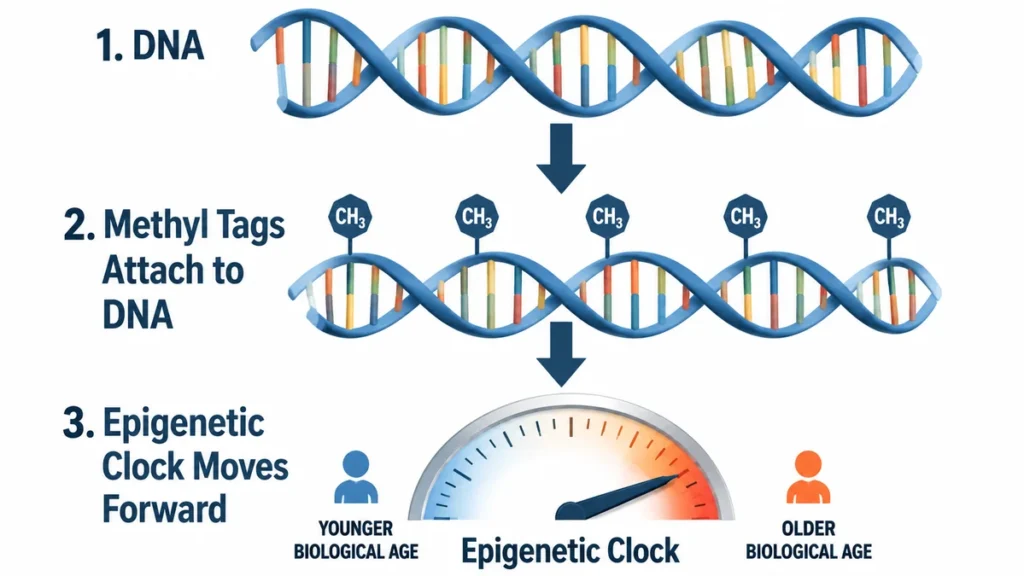
Instead of asking “how old is this person,” researchers asked “how close is this person to death or disease?”
That shift produced PhenoAge, developed by Morgan Levine and colleagues, which estimates biological age using DNA methylation patterns. It is linked to all-cause mortality, cancer risk, physical decline, and Alzheimer’s disease in multiple large cohorts.²
This is the direct challenge to how most health articles frame this topic: it is not a curiosity or a wellness score to post on social media. It is a mortality signal.
Here is the part many articles skip: the same PhenoAge calculation is available for free, using lab work your own doctor may have already ordered. The clock is not locked inside an expensive kit. It is already in your blood.
The gap no one talks about: two people, same birthday, ten years apart biologically
Pick any random group of 50-year-olds and measure their ages. You will not find a tidy cluster. You will find a spread.
Research examining epigenetic age acceleration [the gap between a person’s biological age and their chronological age] has shown that this gap varies substantially among people the same calendar age.³ People whose biological age runs older than their chronological age show higher rates of cognitive decline and mortality.³
Two people born the same year can sit in the same waiting room, share the same birthday, and be biologically a decade apart: not because of luck, but because of choices that changed what their DNA actually does.

This is what most coverage of aging misses: the central claim that lifestyle changes measurably reverse this process is not supported by one large study that tested all lifestyle factors together.
It is assembled from multiple studies, each testing a different piece: sleep in one, exercise in another, diet in a third.
The evidence is consistent and converging, but no single trial has proven the whole picture at once.
Still, that convergence is meaningful. DNA methylation-based clocks show that deviations between epigenetic and chronological age vary among individuals, and those deviations predict disease risk and cognitive function in ways that your birth year simply does not.³
The gap is real. What drives it wider, and what closes it, is what this article turns to next.
What is genuinely driving your biological clock faster
You already know that stress is bad for you. What the science now shows is exactly how deeply it reaches.
Four factors consistently emerge across studies as the strongest drivers of biological age acceleration [the process by which your cells age faster than your calendar years would predict].
Poor sleep. Sleep is when your cells repair DNA damage and clear the waste products that accumulate between neurons during the day.
A 2025 Mendelian randomization study, a method that uses genetic data to test causality rather than just correlation, found that sleep traits have a likely causal relationship with epigenetic clock acceleration.⁴
People with insomnia symptoms showed measurably accelerated biological aging on the GrimAge clock, a second-generation epigenetic measure linked to mortality risk.⁴
Chronic stress. Elevated cortisol [a hormone released during stress that, at high levels, promotes inflammation and speeds up cellular damage] has been linked to faster cellular aging.
A study of adults aged 54 to 76 found that larger cortisol responses to mental stress were linked to shorter telomeres [the protective caps on the ends of chromosomes that shorten each time a cell divides] measured three years later.⁵
Diet quality. A Mediterranean-style diet rich in vegetables, fish, nuts, and olive oil has been associated with methylation changes in inflammation-related genes, which may play a role in slowing biological aging.⁶
Physical inactivity. Low cardiovascular fitness is linked to accelerated biological aging, appearing in blood markers, epigenetic clock scores, and functional measures alike.⁷
Talk to your doctor before changing your diet or exercise routine significantly if you are pregnant, on medication, or managing a chronic condition.
Eight weeks that moved the clock backward
If you have ever wondered whether these habits actually change anything measurable, a trial has an answer.
In a randomized controlled trial of 43 healthy men between the ages of 50 and 72, researchers put one group through an eight-week program covering diet, sleep quality, exercise, and stress management.⁸ The control group received no intervention.⁸

At the end of eight weeks, the treatment group showed a 3.23-year reduction in biological age compared to controls, measured by the Horvath DNA methylation clock.⁸
That number, a three-year reversal through diet, sleep, and movement alone, is among the most notable findings in the published lifestyle-aging literature.
No drug.
This was a small study of 43 men, and the finding awaits replication in larger, more varied populations. A 2023 case series in the same research program found an average reversal of 4.60 years in six women following the same protocol.⁹
Case series cannot establish causation. The evidence is promising, not settled.
A separate line of research on exercise alone adds texture. In a 2026 pilot study, sedentary adults who completed six months of endurance training showed a 7.44-month reduction in GrimAge, a second-generation epigenetic clock, relative to the expected trajectory.⁷
Improvements in VO₂ max, the standard measure of cardiovascular fitness, correlated with this deceleration in epigenetic aging.⁷
Eight weeks is the interval used in this trial, but it may not be a magic threshold; future research may detect reversal over shorter or longer periods.⁸
One blood test you probably already have: and what it can tell you
You do not need a $400 saliva kit to get a first look at your biological age. You may already have the numbers.

The PhenoAge algorithm, developed by Morgan Levine and colleagues at UCLA and validated in nearly 2,000 adults from the Framingham Heart Study Offspring Cohort, uses nine standard blood biomarkers to estimate biological age.¹⁰
Higher diet quality was associated with lower age acceleration in that same cohort, meaning the same blood draw can reveal both an age estimate and a signal about how daily choices show up at the cellular level.¹⁰
The nine markers come from two tests most doctors order at routine physicals: a complete blood count (CBC) and a comprehensive metabolic panel (CMP), plus a high-sensitivity C-reactive protein (hs-CRP) test.
What the markers measure:
- Albumin: nutritional status and liver function
- Creatinine: kidney function and muscle metabolism
- Fasting glucose: metabolic health
- High-sensitivity C-reactive protein: systemic inflammation
- Alkaline phosphatase: liver and bone health
- White blood cell count: immune function and inflammatory state
- Red cell distribution width: cell size variation, a marker of cellular stress
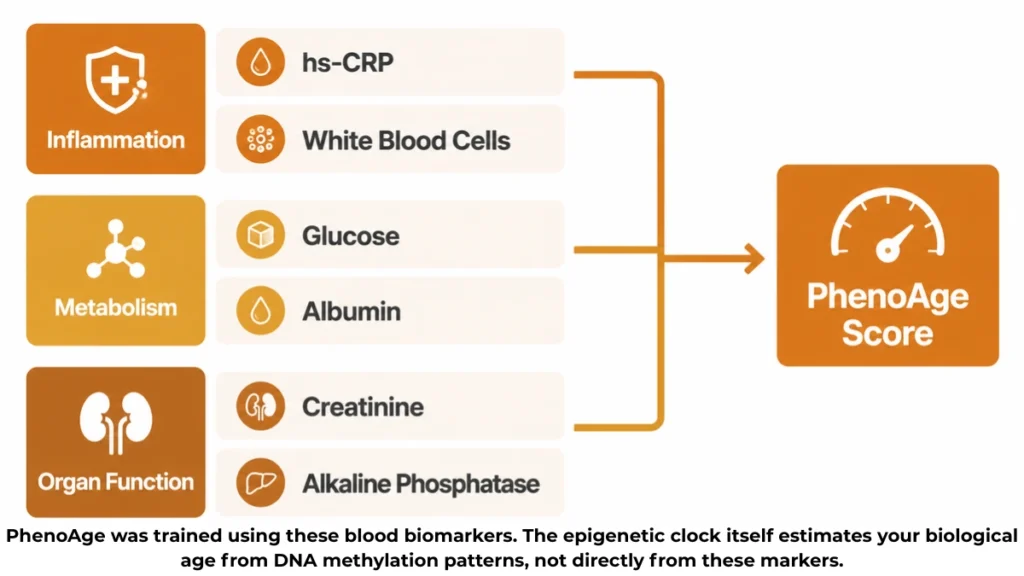
A free calculator using the exact Levine PhenoAge formula is available at longevity-tools.com/levine-pheno-age. No sign-up required. Input your most recent lab values and it returns your result in seconds. Track it each time you get a routine blood draw. The trend matters more than any single number.
Your cells are keeping score whether you check or not
Your biological age is already moving. Every night of poor sleep, every skipped workout, every year of chronic stress shifts it. So does the opposite.
Ask your doctor for a CBC and CMP at your next routine visit, then use the free PhenoAge calculator at longevity-tools.com/levine-pheno-age to see where your biological age stands today.
The science on reversing biological age is converging fast. What it cannot yet tell you is how much of that reversal lasts.
⚠️DISCLAIMER:
This article is for informational purposes only and does not constitute medical advice or an endorsement of any longevity intervention. The content addresses measuring and reducing biological age through lifestyle changes and is intended for general educational purposes only. Individual health, genetics, and medical history significantly affect outcomes, consult a qualified physician before adopting any protocol discussed in this article.
References
- Li Z, Zhang W, Duan Y, et al. Progress in biological age research. Front Public Health. 2023 https://www.frontiersin.org/journals/public-health/articles/10.3389/fpubh.2023.1074274/full
- Levine ME, Lu AT, Quach A, et al. An epigenetic biomarker of aging for lifespan and healthspan. Aging (Albany NY). 2018;10(4):573-591. https://www.aging-us.com/article/101414
- Zavala DV, Dzikowski N, Gopalan S, et al. Epigenetic age acceleration and chronological age: associations with cognitive performance in daily life. J Gerontol A Biol Sci Med Sci. 2024 https://pmc.ncbi.nlm.nih.gov/articles/PMC10733172/
- Zhao W, Yu S, Xu Y, et al. Sleep traits causally affect epigenetic age acceleration: a Mendelian randomization study. Sci Rep. 2025. https://www.nature.com/articles/s41598-024-84957-1
- Steptoe A, Hamer M, Lin J, Blackburn EH, Erusalimsky JD. The longitudinal relationship between cortisol responses to mental stress and leukocyte telomere attrition. J Clin Endocrinol Metab. 2017 https://pmc.ncbi.nlm.nih.gov/articles/PMC5460695/
- Arpón A, Riezu-Boj JI, Milagro FI, et al. Adherence to Mediterranean diet is associated with methylation changes in inflammation-related genes in peripheral blood cells. J Physiol Biochem. 2017. https://pubmed.ncbi.nlm.nih.gov/28181167/
- Van Damme M, Stegen S, Steenwinckel B, et al. Epigenetic age deceleration reflects exercise-induced cardiorespiratory fitness improvements. GeroScience. 2026. https://link.springer.com/article/10.1007/s11357-025-02076-9
- Fitzgerald KN, et al. Potential reversal of epigenetic age using a diet and lifestyle intervention: a pilot randomized clinical trial. Aging (Albany NY). 2021;13(7):9419-9432. https://pmc.ncbi.nlm.nih.gov/articles/PMC8064200/
- Fitzgerald KN, et al. Potential reversal of biological age in women following an 8-week methylation-supportive diet and lifestyle program: a case series. Aging (Albany NY). 2023. https://pmc.ncbi.nlm.nih.gov/articles/PMC10085584/
- Kim Y, Huan T, Joehanes R, et al. Higher diet quality relates to decelerated epigenetic aging. Am J Clin Nutr. 2022. https://pmc.ncbi.nlm.nih.gov/articles/PMC8755029/