
You finished the prescription two weeks ago, you feel mostly better, and you’ve gone back to eating normally, but something is still off.
What most adults over 50 who have recently finished a course of antibiotics don’t know is that finishing the prescription is not the same as finishing the damage.
Gut recovery after antibiotics over 50 takes longer than most people expect, and it quietly affects your energy, your immunity, and your digestion for months. After 50, your gut already carries fewer types of bacteria than it did at 30. Antibiotics knock that number down further, and rebuilding takes longer than your doctor’s discharge notes suggested.
This article maps the real timeline. Find your week. Start there.
The First 72 Hours After Your Last Dose Carry Real Risk
Gut recovery after antibiotics over 50 starts at its lowest point right now, not when symptoms began. Not when symptoms started. Not during the course. Right now, on the day you took the last pill.
Your gut’s bacterial community [the trillions of living organisms that protect your digestion and immune system] has just been through the equivalent of a wildfire. The landscape is open. That is not just a recovery opportunity. It is a vulnerability window.
Here is the specific danger. People are up to 10 times more likely to develop a C. difficile [a harmful bacteria that can take over the gut when protective bacteria are gone] infection while taking antibiotics and during the month after finishing a course.¹
The risk is highest exactly when most people think it’s over.
Three things to do today:
- Start fermented foods now. Plain yogurt, kefir, or unpasteurized sauerkraut. Not tomorrow.
- Skip alcohol completely. It slows the return of beneficial bacteria.
- Drink water with electrolytes. The gut lining needs fluid to start repairs.
One thing not to do. Don’t push high-fiber foods yet. The bacteria that break fiber down are depleted. In a disrupted gut, fiber can feed the wrong organisms instead of the right ones.
Talk to your doctor before changing your supplement routine if you’re on medication, managing a chronic condition, or if your original infection was serious.
By Day 4, you may feel close to normal. That feeling is real, and it’s also misleading.
Days 4–7 — You Feel Better, but Your Gut Doesn’t Know That Yet
You feel better. That’s the problem.
Symptom recovery [feeling well again] and gut microbiome recovery [the actual return of your bacterial community] are two completely different events. They don’t happen at the same time. Feeling normal on Day 5 does not mean your gut’s bacterial community is anywhere close to normal.
Here is the part almost no post-antibiotic article will tell you. A major clinical trial at Stanford found that a high-fiber diet did not increase gut bacterial variety in people who already had low bacterial variety. Fermented foods did.²
The gut needs live bacteria introduced from the outside, not just fuel for bacteria that may not be there yet.
This is the week most people make every mistake at once.
The relatable part. You feel fine, so you have a glass of wine with dinner. You take ibuprofen for a headache. You eat whatever you want because the infection is gone. Each of those choices quietly delays the return of the bacteria your gut is trying to rebuild. None of them feel like a big deal. Together, they extend your recovery by weeks.
What to eat this week for post-antibiotic gut rebuilding:
- Plain kefir (one cup daily)
- Plain yogurt with live cultures (look for “live and active cultures” on the label)
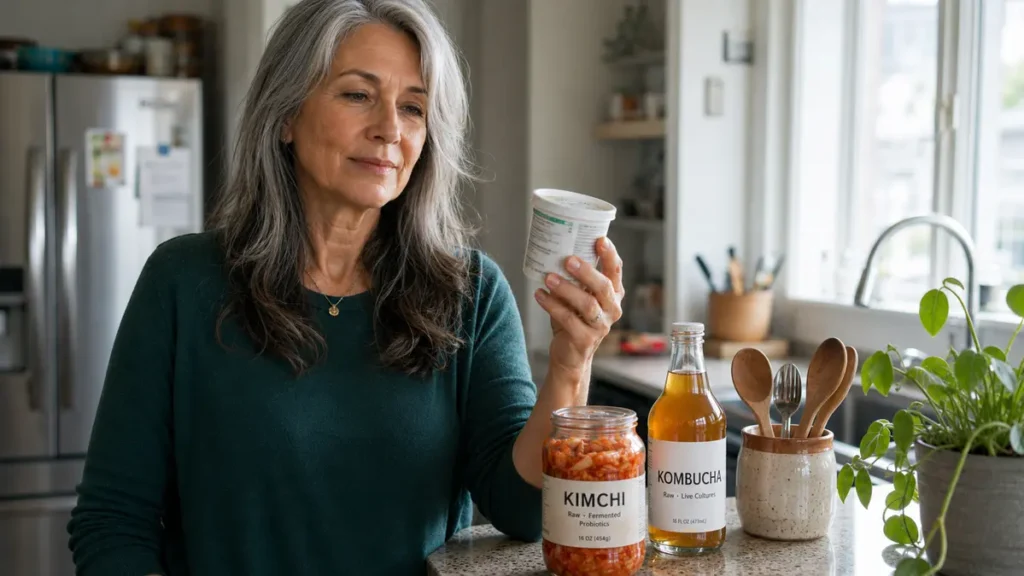
- Kimchi or sauerkraut (unpasteurized, from the refrigerated section)
- Kombucha (low sugar)
Gut bacterial variety [the number of different species living in your gut] doesn’t come back just because your symptoms did. It’s still being rebuilt, and this week is writing the first chapter.
Days 7–30 — The Window That Decides the Next Three Months
Right now, the bacteria that survived are trying to grow back. But the gut is unstable, and one wrong move can reset the clock.
This is the fragile recolonization phase. Recolonization [when bacteria grow back and start filling the space left behind] is not automatic. It’s competitive.
Harmful bacteria can move in just as fast as helpful ones. What you eat, drink, and take during these 30 days determines which kind wins.
Age changes everything about this phase. Research comparing gut recovery across age groups found that older subjects showed a significantly different bacterial rebuilding pattern than younger ones, with more species failing to return after antibiotic exposure.³ Your gut doesn’t have the same backup depth it had at 35.
A second disruption during this window can restart the entire process. Another antibiotic course, a week of high-sugar eating, or chronic stress can all derail recolonization before it stabilizes.
Three signs your gut may be stalling in this phase:
- Bloating after small meals that wasn’t there before the antibiotics
- Afternoon energy crashes that sleep doesn’t fix
- New food sensitivities that appeared after you finished the course
These aren’t random. They’re your gut signaling that the rebuilding process has hit a wall.
Whether the bacteria your immune system runs on come back during this window shapes how well you fight off illness for months afterward. The next section tells you what the research found when scientists looked at who came back and who didn’t.
Month 2 — Some Bacteria Come Back. Some Don’t.
Some of the bacteria that were in your gut before antibiotics will be gone six months from now. Not weakened. Gone.
A six-month study tracking gut bacteria after a broad-spectrum antibiotic course found that nine species present in every participant before treatment were still undetectable in most of them 180 days later, even as the rest of the gut microbiome [the full community of bacteria living in your gut] appeared to recover.⁴
The gut looked recovered. It wasn’t, not completely.
This is where microbiome repair after antibiotics gets harder after 50. The species most likely to disappear permanently are the same ones that aging had already reduced. You’re losing from a smaller starting number.
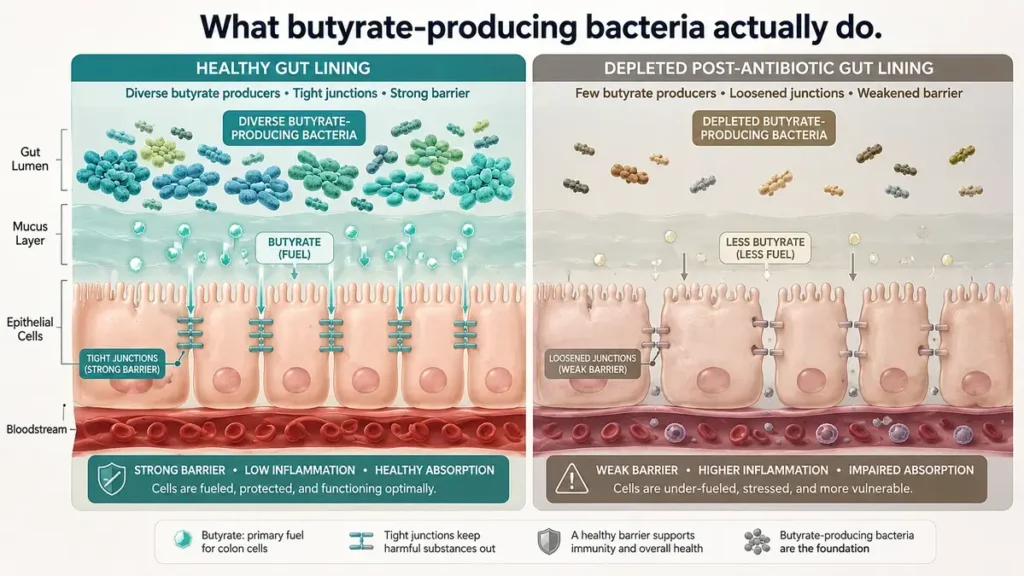
What do those missing species actually do? They make butyrate [a fuel your gut lining uses to stay healthy and keep inflammation low]. When butyrate-producing bacteria go missing, your gut lining gets less of the substance it needs to stay tight and intact.
That matters for digestion, for immune function, and for how often you get sick.

SAVE THIS: Month 2 Recovery Check
Run this check every two weeks in Month 2.
- Energy: Am I less tired than I was two weeks ago? (Yes/No)
- Digestion: Has bloating improved since Week 4? (Yes/No)
- Infections: Have I had a new cold, UTI, or respiratory illness? (Yes/No)
- Diet: Am I eating at least one fermented food daily? (Yes/No)
If you answered No to the first three and Yes to the fourth, you’re on track. Two or more No answers on the first three after Week 6 is a signal to speak with your doctor.
No consumer test reliably tells you which of your species returned. But your body sends signals. The check above uses four you can measure without a lab.
Month 3 and Beyond — Why You May Still Feel Off (and What That Actually Means)
If you’re still not yourself at Month 3, your gut hasn’t failed. It’s settled at a new baseline, and that baseline can still be raised.
Plateau [when recovery stops improving and levels off] is not the same as permanent damage. It means your gut has reached the top of what the current strategy can do. The strategy needs to change, not the person.
Here’s the part that matters if you’ve taken antibiotics more than once. Research tracking gut bacteria across repeated antibiotic courses found that each course left behind more species that never returned, and the baseline itself shifted downward over time.⁵
If this wasn’t your first course, your starting point was already lower. That’s not a reason to give up. It’s a reason to be more deliberate.
What deliberate pressure looks like at Month 3:
- Rotate your fermented foods. If you’ve been eating only yogurt, add kimchi this week. Different foods carry different bacterial strains.
- Add prebiotic fiber now. The bacteria are stable enough to use it. Garlic, onions, oats, and bananas all feed beneficial species.
- Track symptoms in two-week windows. Not day to day. Two weeks gives you a real signal.
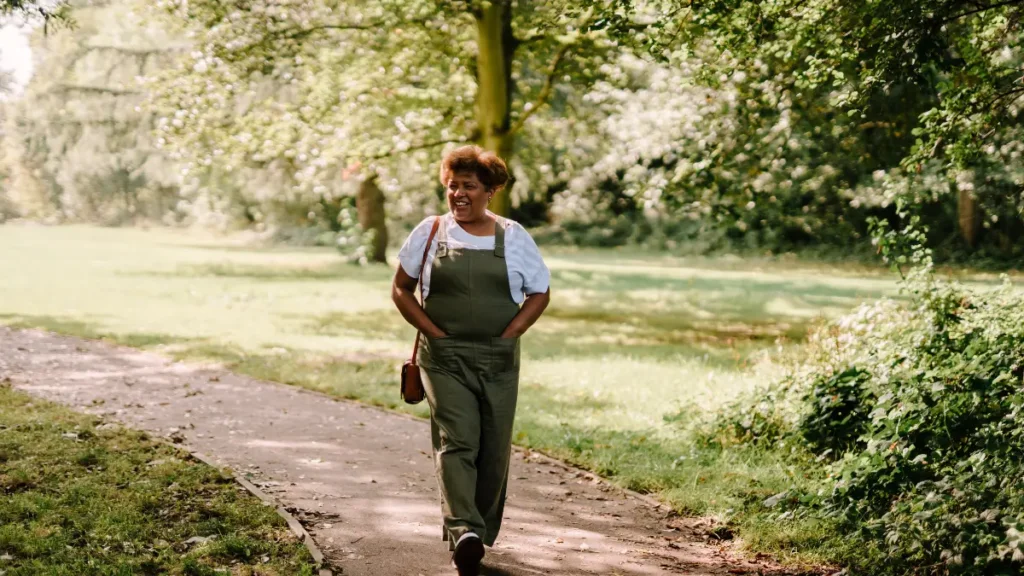
- Move your body consistently. Regular exercise in older adults was linked to changes in specific gut bacteria, particularly after five weeks or more of consistent activity. ⁶
When to see a gastroenterologist: if symptoms haven’t improved at all between Month 2 and Month 3, or if new digestive symptoms appeared after Week 6, it’s time to ask for more than general advice.
The next section lists the specific signs that mean recovery has stopped, and something else has started.
Warning Signs Your Gut Isn’t Rebuilding — It’s Going Backward
Some discomfort after antibiotics is recovery. Some is regression. The difference is specific, and it’s worth knowing before you reach for another supplement.
Normal recovery looks like slow, uneven improvement. Most days get a little better. Some days don’t. Regression looks like symptoms getting worse over time, or new symptoms appearing weeks after you finished the course.

Call your doctor today — don’t wait — if you have any of these gut dysbiosis symptoms in adults over 50:
- Watery diarrhea more than three times per day, beyond Day 14
- Fever appearing after the original infection cleared
- Severe stomach cramping that stops you from eating
- Blood in your stool
- Extreme fatigue that gets worse after Week 3, not better
- Three or more upper respiratory infections, UTIs, or other illnesses within 60 days of finishing antibiotics
These are not normal antibiotic aftermath. Each one is a signal that something specific has gone wrong.
The most serious risk in this window is C. difficile. CDC surveillance data shows the rate of C. difficile infection increases with age, with the median patient being 65 years old.⁷ Its symptoms, cramping, watery diarrhea and fever, are routinely dismissed as leftover antibiotic effects. They’re not always that.
Go to the emergency room, not the doctor’s office, if you have a fever above 103°F combined with severe cramping and diarrhea. That combination needs same-day evaluation.
Regression is not a personal failure. It’s information. Your gut is telling you it needs more than diet can provide right now.
Conclusion
Start with today’s phase, not from the beginning. Within 72 hours of your last dose, begin the timeline in this article, starting with the phase you’re actually in right now, not from Week 1 if you’re already in Month 2. Gut recovery after antibiotics over 50 is not a single event. The timeline is real. Now you know where you stand in it.
⚠️MEDICAL DISCLAIMER
This article is for informational purposes only and does not constitute medical advice, diagnosis, or treatment. The content addresses rebuilding gut health after antibiotic use in adults over 50 and is intended for general educational purposes only. Health conditions vary significantly between individuals, always consult a licensed physician or qualified healthcare provider before making any decisions about your health or medical care.
References
- CDC. About C. diff: risk during and after antibiotic use. Centers for Disease Control and Prevention. 2024. https://www.cdc.gov/c-diff/about/index.html
- Wastyk HC, Fragiadakis GK, Perelman D, et al. Gut-microbiota-targeted diets modulate human immune status. Cell. 2021;184(16):4137–4153. https://doi.org/10.1016/j.cell.2021.06.019
- Laubitz D, Typpo K, Midura-Kiela M, et al. Dynamics of gut microbiota recovery after antibiotic exposure in young and old mice (a pilot study). Microorganisms. 2021;9(3):647. https://www.ncbi.nlm.nih.gov/pmc/articles/PMC8003781/ [Editor note: mouse study — disclosed in article as animal research.]
- Zeller G, et al. Recovery of gut microbiota of healthy adults following antibiotic exposure. Nature Microbiology. 2018. https://www.nature.com/articles/s41564-018-0257-9
- Dethlefsen L, Relman DA. Incomplete recovery and individualized responses of the human distal gut microbiota to repeated antibiotic perturbation. PNAS. 2011;108(Suppl 1):4554–4561. https://www.pnas.org/doi/10.1073/pnas.1000087107
- Aya V, Jimenez P, Munoz E, Ramirez JD. Effects of exercise and physical activity on gut microbiota composition and function in older adults: a systematic review. BMC Geriatrics. 2023;23(1):364. https://link.springer.com/article/10.1186/s12877-023-04066-y
- CDC. Clostridioides difficile infection (CDI) surveillance. Healthcare-Associated Infections. 2024. https://www.cdc.gov/healthcare-associated-infections/php/haic-eip/cdiff.html