

You did the same workout you’ve done for years, and now you can barely walk down stairs three days later. It’s not your imagination, and it’s not weakness.
Adults over 50 keep training on the same schedule that worked at 35, and their muscles stay sore because the biology of recovery has genuinely changed. Four specific biological systems that drive muscle repair have each shifted with age, and each one has a different fix.
This article explains what those shifts are and what actually addresses each one.
Why Read This
- The reason your muscles stay sore longer after 50 has nothing to do with how hard you trained. The real cause changes everything about how you recover.
- One biological shift makes complete rest actively harmful for aging muscle. Most people do exactly the wrong thing when they feel sore.
- Your body runs a low-grade inflammatory process around the clock that slows repair before you even start your workout. Two daily habits directly reduce it.
- The protein amount that works at 30 falls below a critical threshold after 50. When you eat it matters as much as how much.
- Your deepest repair window shrinks with age regardless of how long you sleep. Four specific changes protect what remains.
This article is for informational purposes only and does not constitute medical advice. The information provided is based on published research and is intended for general educational use. Individual health conditions vary. Always consult your doctor or a qualified healthcare professional before making changes to your exercise routine, diet, or sleep habits.
Why Your Recovery Schedule Stopped Working
You feel it before you even swing your legs out of bed. The soreness from Tuesday’s workout is still there on Friday. Muscle recovery after 50 feels like a completely different problem than it used to be, and that’s because it genuinely is.

Here’s the direct answer: aging muscle displays delayed, prolonged, and inefficient recovery compared to younger muscle, according to a 2024 narrative review in the journal Cells.¹
The reason is not simply fitness decline. Four biological systems that handle repair have each shifted in a measurable way.¹ Each one slows the process through a different mechanism. And because the causes are different, the fixes have to be different too.
This is why adding one extra rest day doesn’t always solve it. If three of the four problems are still untreated, the soreness comes back the next week just the same.
The real surprise is this: the soreness you feel is not proof that your muscles took more damage. It’s proof that the repair cycle is running behind.¹ That difference changes how you respond to it.
The four sections that follow name each biological shift and pair it with the one action most likely to address it.
Biological Shift 1: Your Repair Crew Has Gotten Smaller
You might assume that older muscles hurt more because they take more damage during exercise. The research says otherwise.
Here’s the surprising part. A 2025 meta-analysis published in the Journal of Aging and Physical Activity pooled data from 36 studies comparing older and younger adults after exercise.²
Muscle soreness in older adults was actually lower, not higher, at all measured timepoints post-workout compared to younger adults.² In other words, aging does not appear to cause greater exercise-induced muscle damage. However, a 2024 review suggests that the recovery and remodeling processes that follow muscle damage may proceed more slowly in older muscle.¹
Soreness that used to vanish overnight now lingers for three days not because your muscles are weaker, but because four specific biological systems that drive repair have each shifted in a way that needs a different fix.¹,²
The first shift involves satellite cells [specialized stem cells that sit alongside muscle fibers and rebuild them after exercise damage]. These are the primary repair crew. In young muscle, they activate quickly after a workout, multiply, and patch the damaged fibers. In aged muscle, satellite cells that spend long periods without being activated may enter a state called cellular senescence [an irreversible shutdown where the cell permanently stops dividing and can no longer contribute to repair].³ Once a satellite cell goes senescent, it is no longer available for repair work.³
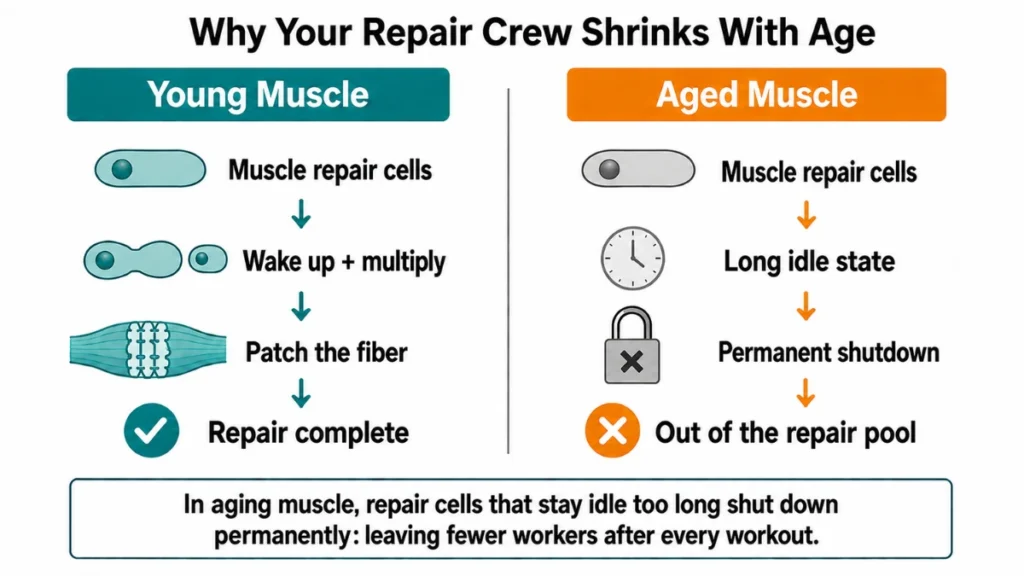
The fix is counterintuitive. Complete rest does not protect satellite cells in aging muscle. Prolonged rest actually deepens their dormancy, which accelerates the shift toward senescence. Regular resistance training keeps satellite cells cycling and prevents that irreversible shutdown.³
Consistent training is not just about building fitness. It is directly protecting the repair crew that makes muscle recovery after 50 possible, but a second biological shift is already working against that repair crew before you even start.
Biological Shift 2: Your Body Is Already Fighting a Low-Grade Fire
You can’t feel it, but your immune system is running a background process it was never meant to run indefinitely.
It has a name, and it has been documented in aging adults across multiple published studies.⁴ Inflammaging [a chronic, low-level state of inflammation that develops with age even without infection or injury] is now recognized as a core feature of biological aging.⁴,⁵
It develops gradually as the body accumulates cellular waste and inflammatory signals that do not fully clear with age.

Here’s why this matters for recovery. When you exercise, healthy acute inflammation is the signal your body uses to call the repair crew in. It is the alarm that says: damage is here, start fixing it.
In adults with high levels of background inflammaging, that acute repair signal has to compete with the chronic noise already present in the system. The repair response arrives more slowly as a result.
Your own blood numbers may reflect this. A study published in Oxidative Medicine and Cellular Longevity found that older adults with elevated C-reactive protein [a blood marker of chronic low-level inflammation] showed reduced numbers of available satellite cells and impaired anabolic signaling compared to age-matched peers with lower inflammation markers.⁶
The inflammation was not caused by the workout. It was already there before the person ever set foot in the gym.
The fix has two parts. First, resistance training performed consistently tends to reduce chronic inflammation over time.¹² Second, high intake of processed food and added sugar is associated with elevated systemic inflammation markers in adults.¹⁰,¹¹ Reducing them lowers the background fire and lets the acute repair signal come through more clearly.

The next shift explains what happens when the repair signal gets through but the building materials aren’t ready.
Biological Shift 3: You Are Not Getting Enough Raw Material to Rebuild
Your muscles send the signal to repair. The signal gets through. But the protein you ate today may not have been enough to actually fund the rebuild.
There’s a name for why that happens. This is anabolic resistance [a reduced ability of aging muscle to use dietary protein to build and repair muscle tissue]. It is one of the most documented changes in exercise physiology for aging adults,⁷ and it is why the protein advice for a 30-year-old does not apply to someone over 50.⁷
In younger adults, a smaller amount of high-quality protein per meal is generally enough to trigger a strong muscle protein synthesis response. In older adults, research indicates the per-meal threshold is higher, often requiring 25 to 35 grams of protein per meal,⁷ with leucine content being a key factor in activating the repair signal.⁸

Leucine [an essential amino acid that directly activates the muscle protein synthesis pathway in aging muscle] acts as the key that starts the engine. Aging muscle needs more of it per meal to get the same response that younger muscle gets from less.⁷
Many adults tend to concentrate their largest protein serving at dinner rather than spreading it evenly across meals. That pattern often means breakfast and lunch fall below the threshold needed to trigger any meaningful repair response. When intake falls below the threshold, aging muscle cannot fund the repair process.
The practical fix:
Talk to your doctor before changing your protein intake or training schedule if you are on medication, managing a chronic condition, or recovering from injury.
- Aim for 25 to 35 grams of high-quality protein at each meal, not just dinner
- Choose protein sources that are leucine-rich: eggs, chicken, fish, Greek yogurt, cottage cheese, or edamame
- After a strength workout, prioritize a protein-containing meal or snack soon after
- Do not rely on a single large protein meal at the end of the day to cover the whole day’s rebuilding

Spreading protein evenly across meals gives aging muscle multiple chances per day to hit the threshold that actually funds repair, but there is a fourth shift that limits how much rebuilding can happen regardless of what you eat.
Biological Shift 4: Your Rebuild Window Shrinks Every Night
Most of the structural repair work your muscles do happens not in the gym and not at the kitchen table. It happens while you sleep, during one specific stage.
Slow-wave sleep [the deepest stage of non-REM sleep, also called stage 3 or N3, when the body carries out most of its physical repair] is when growth hormone [a hormone that signals the body to rebuild damaged tissue and synthesize new muscle protein] is released in its largest daily pulses.⁹ Much of the body’s hormonal repair signaling occurs during this overnight window.⁹
A landmark study published in JAMA tracked 149 healthy men from age 16 to 83 and found that deep slow-wave sleep made up approximately 19% of sleep time in early adulthood, dropping to around 3% by midlife in men aged 36 to 50.⁹ That is not a gradual erosion.
That is most of the repair window disappearing across a single adult lifespan. Growth hormone secretion declined sharply alongside it.⁹
This is a study of healthy men, so these numbers reflect that population specifically. Aging reduces the proportion of deep sleep, and that reduction cuts into nightly recovery.
The fix targets what remains of the deep sleep window:
- Set a consistent sleep and wake time every day, including weekends
- Keep the bedroom cool, as a drop in body temperature helps trigger deep sleep
- Avoid alcohol within three hours of bedtime
- Limit screens and bright light in the hour before bed
You cannot recover the slow-wave sleep you have lost to aging. But you can protect what is left, and the next section shows exactly how to put all four fixes together into one practical plan.
The Four-Fix Plan for Muscle Recovery After 50
Now that each of the four shifts has a name, the fix for each one becomes specific rather than generic.
Here is the complete plan:
Fix 1: Protect your satellite cells (repair crew)
Perform regular resistance training. Do not take extended breaks from strength training, even when you feel run down. Complete rest accelerates the dormancy that leads satellite cells toward senescence. Active recovery between sessions is better than full rest weeks.
Fix 2: Lower the background inflammation (inflammaging)
On non-strength days, do 20 to 30 minutes of light movement such as walking, swimming, or easy cycling at a pace where you can hold a conversation. Regular light movement supports lower inflammation levels over time. High intake of processed food and refined sugar is associated with elevated inflammatory markers in adults,¹⁰,¹¹ so keeping those low reduces the background fire.

Fix 3: Hit the protein threshold at every meal (anabolic resistance)
Allow adequate recovery time between sessions targeting the same muscle group, and eat at least 25 to 35 grams of protein per meal ⁷ to give aging muscle the time and raw material it needs to rebuild. Do not let breakfast or lunch fall below 20 grams.⁷ Those meals are not just fuel. In aging muscle, they are repair funding.

Fix 4: Protect your deep sleep (slow-wave sleep window)
Consistent sleep timing, a cool room, and no alcohol near bedtime are the three highest-leverage changes for preserving the deep sleep that remains.

Apply all four, not just one. If any single shift is unaddressed, it limits the gains from the other three. The soreness you feel after 50 is not the problem. It is the signal that one or more of these systems needs attention.
Start With These Two Changes Today
Start with the two changes that affect every workout, regardless of age: allow adequate recovery time between sessions targeting the same muscle group, and restructure your meals so each one contains at least 25 to 35 grams of protein.⁷
These two adjustments address the anabolic resistance shift directly. Then layer in consistent sleep protection and regular light movement on recovery days. Muscle recovery after 50 is not broken. It is just running on a biology that needs a different input set.
References
- Li, D.C.W., Rudloff, S., Langer, H.T., Norman, K., Herpich, C. Age-Associated Differences in Recovery from Exercise-Induced Muscle Damage. Cells. 2024;13(3):255. https://www.mdpi.com/2073-4409/13/3/255
- Fernandes, J.F.T., Wilson, L.J., Dingley, A.F., Hearn, A.N., Johnson, K.O., Hicks, K.M., Twist, C., Hayes, L.D. Advancing Age Is Not Associated With Greater Exercise-Induced Muscle Damage: A Systematic Review, Meta-Analysis, and Meta-Regression. Journal of Aging and Physical Activity. 2025;33(6):606-624. https://pubmed.ncbi.nlm.nih.gov/40174882/
- Chen, W., Datzkiw, D., Rudnicki, M.A. Satellite cells in ageing: use it or lose it. Open Biology. 2020;10(5):200048. https://royalsocietypublishing.org/doi/10.1098/rsob.200048
- Ferrucci, L., Fabbri, E. Inflammageing: chronic inflammation in ageing, cardiovascular disease, and frailty. Nature Reviews Cardiology. 2018;15(9):505-522. https://www.nature.com/articles/s41569-018-0064-2
- Kunz, H.E., Lanza, I.R. Age-associated inflammation and implications for skeletal muscle responses to exercise. Experimental Gerontology. 2023;177:112177. https://pubmed.ncbi.nlm.nih.gov/37085128/
- Draganidis, D., Jamurtas, A.Z., Chondrogianni, N., Mastorakos, G., Jung, T., Grune, T., Papadopoulos, C., Papanikolaou, K., Papassotiriou, I., Papaevgeniou, N., Poulios, A., Batrakoulis, A., Deli, C.K., Georgakouli, K., Chatzinikolaou, A., Karagounis, L.G., Fatouros, I.G. Low-Grade Systemic Inflammation Interferes with Anabolic and Catabolic Characteristics of the Aged Human Skeletal Muscle. Oxidative Medicine and Cellular Longevity. 2021. https://www.ncbi.nlm.nih.gov/pmc/articles/PMC8670932/
- Landi, F., Calvani, R., Tosato, M., Martone, A.M., Ortolani, E., Savera, G., D’Angelo, E., Sisto, A., Marzetti, E. Protein Intake and Muscle Health in Old Age: From Biological Plausibility to Clinical Evidence. Nutrients. 2016;8(5):295. https://www.ncbi.nlm.nih.gov/pmc/articles/PMC4882708/
- Lixandrão, M.E., Longobardi, I., Leitão, A.E., Morais, J.V.M., Swinton, P.A., Aihara, A.Y., Goes, P.C.K., Ugrinowitsch, C., Candow, D.G., Gualano, B., Roschel, H. Daily Leucine Intake Is Positively Associated with Lower Limb Skeletal Muscle Mass and Strength in the Elderly. Nutrients. 2021;13(10):3536. https://www.ncbi.nlm.nih.gov/pmc/articles/PMC8539207/
- Van Cauter, E., Leproult, R., Plat, L. Age-Related Changes in Slow Wave Sleep and REM Sleep and Relationship With Growth Hormone and Cortisol Levels in Healthy Men. JAMA. 2000;284(7):861-868. https://pubmed.ncbi.nlm.nih.gov/10938176/
- Tian, T., Hong, T., Tian, T., He, Y., Wang, X., Qian, L., Deng, S., Jin, H., Jiang, M., Fan, J., Li, Y. Association between ultra-processed foods consumption and systemic immune-inflammation biomarkers in US Adults: Cross-Sectional results from NHANES 2003-2023. Human Nutrition & Metabolism. 2025;42:200339. https://doi.org/10.1016/j.hnm.2025.200339
- Ma, X., Nan, F., Liang, H., Shu, P., Fan, X., Song, X., Hou, Y., Zhang, D. Excessive intake of sugar: An accomplice of inflammation. Frontiers in Immunology. 2022;13:988481. https://doi.org/10.3389/fimmu.2022.988481
- Kim, S.-D., Yeun, Y.-R. Effects of Resistance Training on C-Reactive Protein and Inflammatory Cytokines in Elderly Adults: A Systematic Review and Meta-Analysis of Randomized Controlled Trials. International Journal of Environmental Research and Public Health. 2022;19(6):3434. https://doi.org/10.3390/ijerph19063434