

You are over 50. You show up every week. You push harder than people half your age.
The training protocol your trainer is using was designed for a 28-year-old body. After 50, that same program is more likely to injure you than build you. It does not matter whether you train at a gym or at home. The protocol problem is the same either way.
For active adults over 50 who already show up, effort is not the problem. What drives muscle building after 50 is not the weight on the bar. By the time you finish reading, you will know more about building muscle after 50 than most certified trainers do.
| # | Section | What You’ll Find |
|---|---|---|
| 1 | Progressive Overload: Who It Was For | The origin of the rule your trainer swears by |
| 2 | The Real Growth Signal After 50 | What 30,000 research participants showed that most gyms haven’t caught up to |
| 3 | The Volume Blind Spot | Why the number on the bar may be the least important number |
| 4 | Tempo and What It Changes | What slowing down does that heavier weight cannot |
| 5 | The Trainer Conversation | What to say and what their response will tell you |
| 6 | The First Shift You Can Make This Week | One change, this week, that changes the direction |
Progressive Overload Was Not Built for You
You add weight to the bar because that’s what your trainer told you to do. And your trainer told you that because it’s the most repeated rule in fitness: push harder, lift heavier, progress or plateau. The rule has a name: progressive overload [gradually increasing the stress placed on your muscles over time so they keep adapting].
It works. The problem is who it was built for.

Where the rule came from matters here. The concept of progressive overload as a formal training method was developed by Dr. Thomas DeLorme while he was rehabilitating young soldiers after World War II.² These were men in their 20s with high natural hormone levels and fast recovery speeds.
The protocol spread from there into gyms, textbooks, and trainer certifications. Almost none of it was adjusted for age.
After 50, your body is working with different tools. Testosterone, the hormone that helps build and repair muscle, declines roughly one to two percent per year starting around age 30, with strength losses accelerating to between 1.5 and three percent per year after 50.¹
Your joints carry more wear. Your recovery window is longer. A program that worked at 28 creates a different result at 53.
Sarcopenia [age-related muscle loss that speeds up after 50] makes the situation more urgent.³ You’re already losing muscle. A protocol that increases injury risk without increasing growth makes that loss worse.
The principle isn’t wrong. It’s being applied to the wrong body.
What Actually Signals Muscle Growth After 50
If the weight on the bar isn’t the main driver, what is?
The answer is mechanical tension [the pulling force a muscle generates when it works against resistance]. When your muscle creates that tension consistently, across enough sets each week, it gets the signal to grow.⁴ The load matters less than most trainers believe.⁴ How many times per week you create that tension matters more.

Your trainer is not wrong about progressive overload. They are wrong about which body they are applying it to.
The research behind this is not a fringe opinion. The American College of Sports Medicine released its 2026 Position Stand after reviewing 137 systematic studies covering more than 30,000 participants.
The finding was direct: hypertrophy [the process of muscle cells growing larger] is not consistently affected by how heavy the weight is when total training volume is equated across groups.⁴ Moderate loads, roughly 30 to 70 percent of your one-rep max, are associated with muscle growth in older adults comparable to what heavier loads produce.⁴
For resistance training over 50, this changes everything about how you should be measuring progress.
You don’t measure success by whether you added five pounds to the bar. You measure it by whether you hit enough total sets this week to keep sending your muscles the signal.
That leads directly to the variable most trainers skip entirely.
The Volume Truth Your Trainer Is Skipping
Your trainer is tracking weight. The research says they should be tracking sets.
Volume-load [the total amount of work your muscles do in a week, counted as sets multiplied by reps multiplied by weight] is the variable that most reliably predicts muscle building after 50. Not the number on the bar.
A 2021 review published in Frontiers in Physiology highlighted research showing that older adults training with higher-volume, moderate-load workouts gained more muscle than those training at near-maximum intensity. Both approaches improved strength, but measurable muscle growth occurred only in the higher-volume group.⁵
Think about what that means for you. If your trainer is running you through heavy compound sets at low reps, you may be getting stronger in certain movements while getting almost no signal for new muscle tissue.
The evidence-based threshold for hypertrophy [the process of muscle cells growing larger] is approximately 10 sets per muscle group per week, with more sets producing more growth up to a point.⁴
If you aren’t counting sets, you likely aren’t reaching that threshold.
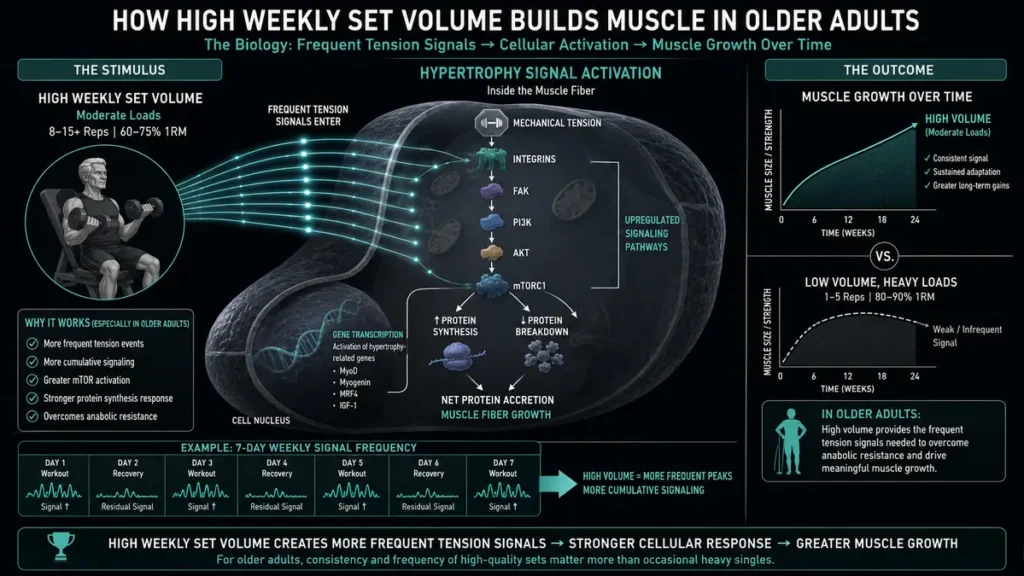
What to count is the shift. Total weekly sets per muscle group. Not the weight. Not your one-rep max. Sets.
The research says more sets at moderate weight outperforms fewer sets at maximum weight. Most trainers have it exactly backwards.
Why Controlled Reps Build More Than Heavy Ones
Picture this. You lower a weight slowly, taking three full seconds to bring it down. You feel the muscle working the whole way. That burn before the weight is even heavy is the signal.
This video features a trainer demonstration, but the technique shown, controlled tempo and slow lowering, applies directly to everyday dumbbell and bodyweight exercises. No heavy weights required. The same method used in physical therapy rehab is what makes it safe and effective for adults over 50.
That feeling has a name. It’s called the eccentric phase [the lowering part of a lift, when your muscle lengthens while still working against the weight]. And it’s one of the most underused tools in resistance training for progressive overload in older adults.
Time under tension [how long your muscle stays under load during a set] is what makes a slower lowering phase valuable.
When you lower a weight in one second, your muscle generates the tension signal for one second. When you lower it in three, you triple that window without adding a single pound.
Research confirms this works. A meta-analysis found that repetition durations between 0.5 and eight seconds produce similar muscle growth.⁶ That means a controlled three-second lowering phase is just as effective as a fast drop, and far less stressful on joints that have been working for five decades.
There is one limit: training at very slow speeds over 10 seconds per rep was actually shown to be inferior for muscle growth, likely because extremely slow movement can’t recruit the full range of muscle fibers.⁶

The practical target: three seconds down, a brief pause, one second up. Same muscle signal. Lower joint cost.
After 50, that trade is worth making every single time.
How to Talk to Your Trainer About This (Without Firing Them)
Your trainer is probably not trying to hurt you. They are applying a protocol that was not built for your body.
Most trainers were taught a general adult program. They weren’t taught to adjust it by decade. That’s not an excuse. It’s context. And knowing the difference changes how you walk into that conversation.
Start with one specific ask. Tell your trainer you want to add higher-rep, moderate-load sets to at least two sessions per week. Keep the weight at 60 to 70 percent of your max. Aim for 10 to 15 reps per set. Ask them to help you count your total sets per muscle group each week.

The National Strength and Conditioning Association’s position statement on resistance training for older adults states directly that muscle changes “may also be achieved at low to moderate intensities, approximately 50 to 70 percent of 1RM.³
That sentence is your evidence. You don’t need to argue. You just need to hand them the standard their own field wrote.
Then watch what they do. A good trainer gets curious. They ask questions. They look up the source. A trainer who dismisses peer-reviewed guidance from their own credentialing organization is telling you something important about how they’ll handle the next problem too.
You don’t need to win this conversation. You need to know whether your trainer will adapt.
What you say in that conversation will determine whether your program changes or stays the same.
Before changing your training load or volume, talk to your doctor if you’re managing a joint condition, recovering from an injury, or have been told to avoid strenuous exercise.
The Week-One Shift You Can Make Right Now
One change. Not a new program. Not a new trainer. One set, per movement, different.
This week, pick one compound movement you do in every session, whether that’s a squat, a press, or a row. Replace one heavy set with this instead:
Your Week-One Protocol
- Load: 60 to 70 percent of the heaviest weight you can lift one time
- Reps: 10 to 15 per set
- Tempo: Three seconds to lower the weight, a brief pause, one second to lift it
- Rest: 90 seconds between sets
- Progress rule: For the first six to eight weeks, add sets, not weight

The goal is to hit at least 10 total sets per muscle group per week.⁴ That is the research threshold where muscle building after 50 becomes measurable. Count your sets. Not your weight.
After 48 hours, check in with your joints. If they feel better than they do after your current heavy sessions, that’s your first data point.
Add one set per week until you reach 10 sets per major muscle group. Then track from there.
The goal was never the heaviest weight in the room. It was always the strongest body at 65.
Conclusion
Start this week by tracking one number: your total sets per muscle group. This week, stop chasing a heavier bar and start tracking your total weekly volume. Add one slow-tempo, moderate-load set to each major movement and notice what your body actually responds to.
Learning how to build muscle in your 50s doesn’t require a new gym or a new trainer. It requires a better question than “how much did I lift?”
⚠️DISCLAIMER:
This article is for informational purposes only and does not constitute medical or professional fitness advice. The content addresses resistance training protocols and muscle building strategies for adults over 50 and is intended for general educational purposes only. Exercise carries inherent risk, consult a qualified healthcare or fitness professional before beginning or modifying any training program, particularly if you have an existing injury or medical condition.
References
- Lattice Training. Testosterone decline and muscle strength loss after age 50, citing peer-reviewed literature. Lattice Training Blog. 2024. https://latticetraining.com/blog/testosterone-the-effects-of-ageing-and-exercise/
- Todd JS, Shurley JP, Todd TC. Thomas L. DeLorme and the science of progressive resistance exercise. Journal of Strength and Conditioning Research. 2012;26(11):2913-2923. https://pubmed.ncbi.nlm.nih.gov/22592167/
- National Strength and Conditioning Association. Resistance Training for Older Adults Position Statement. Muscle changes in older adults achievable at 50-70% of 1RM. Journal of Strength and Conditioning Research. 2019. https://www.nsca.com/contentassets/2a4112fb355a4a48853bbafbe070fb8e/resistance_training_for_older_adults__position.1.pdf
- American College of Sports Medicine. 2026 Position Stand. Hypertrophy not consistently affected by load when volume equated; approximately 10 sets per muscle group per week is evidence threshold; moderate loads 30-70% 1RM produce equivalent hypertrophy. Medicine and Science in Sports and Exercise. 2026. https://acsm.org/resistance-training-guidelines-update-2026/
- Santana DA, Castro A, Cavaglieri CR. Strength Training Volume to Increase Muscle Mass Responsiveness in Older Individuals. Only higher-volume group showed hypertrophy versus maximum-intensity group in older adult sample. Frontiers in Physiology. 2021. https://www.ncbi.nlm.nih.gov/pmc/articles/PMC8514686/
- Schoenfeld BJ et al. Effect of repetition duration during resistance training on muscle hypertrophy: a systematic review and meta-analysis. Repetition durations 0.5 to 8 seconds produce similar hypertrophy; durations over 10 seconds inferior. PubMed. 2015. https://pubmed.ncbi.nlm.nih.gov/25601394/