
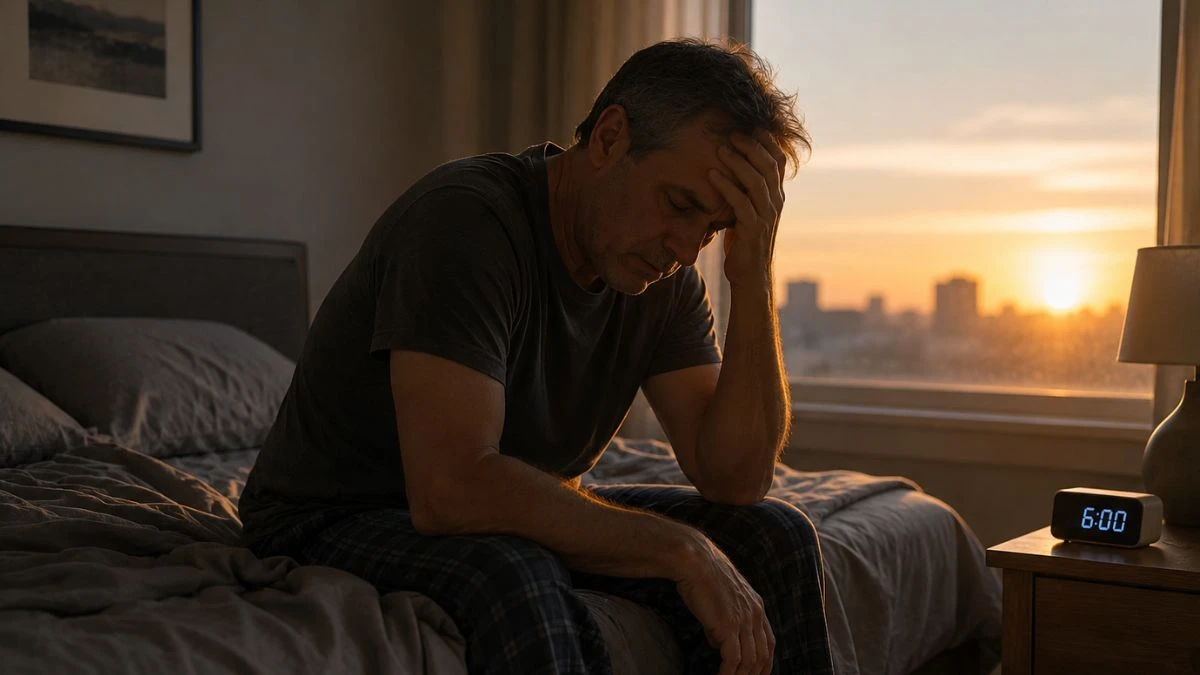
You went to bed on time. You gave yourself a full eight hours. You woke up feeling like you hadn’t slept at all. You are not lazy, broken, or just getting old. You are also not alone. Millions of adults over 50 sleep the recommended hours and still wake up exhausted. The problem is not the number of hours.
The problem is what happens inside those hours and how that changes after 50. Why does sleep quality after 50 drop even when sleep time looks fine? You will learn what is really stealing your energy, which common habits make it worse, and what you can do starting tonight to finally wake up refreshed.
Why 8 Hours Stops Working After 50 (It’s Not What You Think)?

The problem is not that you are sleeping long enough. It is that the sleep you are getting has quietly changed. Sleep is not one flat, steady state. Every night, your body cycles through light sleep, deep sleep, and REM sleep.
Each stage does a different repair job. Deep sleep rebuilds your body. REM sleep restores your mind. Light sleep connects the two.
After 50, something shifts. Your brain spends far less time in deep sleep. Research from the University of Chicago found that deep sleep drops from about 20% of a night’s sleep in your 20s to less than 5% by your mid-30s and continues to decline after that.
REM sleep also shrinks to about half of what it was in your younger years.
Think of it like charging a phone with a frayed cable. Eight hours pass. But the power never really transferred. The real number that matters is not how long you slept. It is how much of that time was deep, restorative sleep.
Your Sleep Loses Its Most Powerful Stage — And This Is Why You Feel It
Here is what most people do not know: deep sleep is when your body releases growth hormone. Growth hormone repairs muscle, burns fat, and restores energy. By the time most men reach 45, they have nearly lost the ability to generate significant amounts of deep sleep.
And when deep sleep drops, growth hormone secretion drops with it by roughly 75%, according to University of Chicago Medicine research published in JAMA. This is not a small change. It explains why you feel slower to recover.
It explains the brain fog. It explains why your body feels like it needs more sleep even when the clock says eight hours.
After 50, total sleep also declines by about 27 minutes per decade. And nighttime wake-ups become more frequent and longer. You may not even remember waking up. But your sleep tracker will.
The goal after 50 is not more hours. It is more time in the deep stages that actually do the work.
How Your Hormones Are Making Sleep Worse Every Year?
Most articles tell you to cut screens and go to bed earlier. What they skip is the hormonal reason those fixes stop working after 50.
For men:
As testosterone drops, so does the ability to stay in deep sleep. Men in their early 50s average just 5.7 hours of sleep per night, and sleeping under 6 hours is directly linked to lower testosterone levels.
Less testosterone means worse sleep. Worse sleep means less testosterone. It is a cycle that keeps tightening.

For women:
The drop in estrogen and progesterone is the main driver of sleep problems during perimenopause and menopause. Hot flashes wake you up repeatedly through the night.
Nearly 50% of women experience insomnia during midlife, according to clinical research. Each interruption pulls you out of deep sleep before your body has finished its repair work.

There is another hormone working against you, too. Evening cortisol, your stress hormone, rises with age, right when it should be falling. Higher evening cortisol directly suppresses deep sleep and increases the chance of waking up in the night.
Poor sleep lowers hormones. Low hormones worsen sleep. The sooner you break the cycle, the better you will feel.
The Hidden Condition That Steals Sleep Without You Knowing
One of the most common reasons adults over 50 wake up exhausted is never found because they never get tested for it. Sleep apnea is a condition where your airway partially closes during sleep. Your breathing stops. Your brain wakes you up just enough to restart it.
You never remember any of this. But it can happen dozens of times per hour, all night long.
About 40% of men aged 50,70 have obstructive sleep apnea, according to 2025 research. For women, the numbers are striking too. Johns Hopkins Medicine (updated November 2025) reports that postmenopausal women are 2,3 times more likely to develop sleep apnea than premenopausal women.
And because women do not always snore loudly, it is frequently missed.
Check yourself for these warning signs:
- You wake up unrefreshed even after a long sleep
- You get morning headaches
- You wake up to urinate at night
- You feel moody or foggy during the day
- A partner has noticed you stop breathing, gasp, or snore
If three or more of these apply to you, talk to your doctor before trying anything else. A home sleep test is simple, affordable, and can be arranged through your GP. Fixing sleep apnea alone can change everything.
5 Daily Habits That Are Canceling Your Sleep (And the Fixes)
Before adding anything new to your routine, check whether these five habits are quietly destroying the sleep you already have.
1. No fixed wake time

Your body’s internal clock needs a consistent anchor. A 2020 review of 41 studies confirmed that irregular sleep patterns directly hurt sleep quality. Fix: Pick one wake time and hold it every day, including weekends. This single habit does more than almost anything else.
2. Screens before bed

Blue light from phones and TVs suppresses melatonin, the hormone that signals your brain to sleep. And a 2025 study in Frontiers in Psychiatry found that smartphone dependence was linked to poorer sleep quality even when people tried to rest. Fix: Stop screens 60,90 minutes before bed.
3. Afternoon caffeine

Caffeine has a half-life of 5,7 hours. That 3 pm coffee is still partly active in your body at 10 pm, keeping sleep lighter and more broken. Fix: Cut caffeine before noon or 1 pm at the latest.
4. Alcohol to wind down

Alcohol makes you feel sleepy at first. But it breaks up deep sleep and REM in the second half of the night. You may sleep 8 hours and still miss the restorative stages completely. Fix: If you drink, finish at least 3 hours before bed.
5. No morning sunlight

Getting outside within 30 minutes of waking, even for 10,15 minutes, resets your circadian clock. It suppresses leftover melatonin, triggers healthy cortisol release, and directly improves sleep quality the following night. Andrew Huberman’s 2025 sleep protocols and Mount Sinai Medical Center both name this as one of the highest-return habits you can build.
Start with one fix. The consistent wake time and morning light combo is the most powerful place to begin.
The Sleep Quality Protocol That Actually Works After 50
Fixing sleep after 50 is not about doing everything at once. It is about a few well-placed changes that work with your biology, not against it.
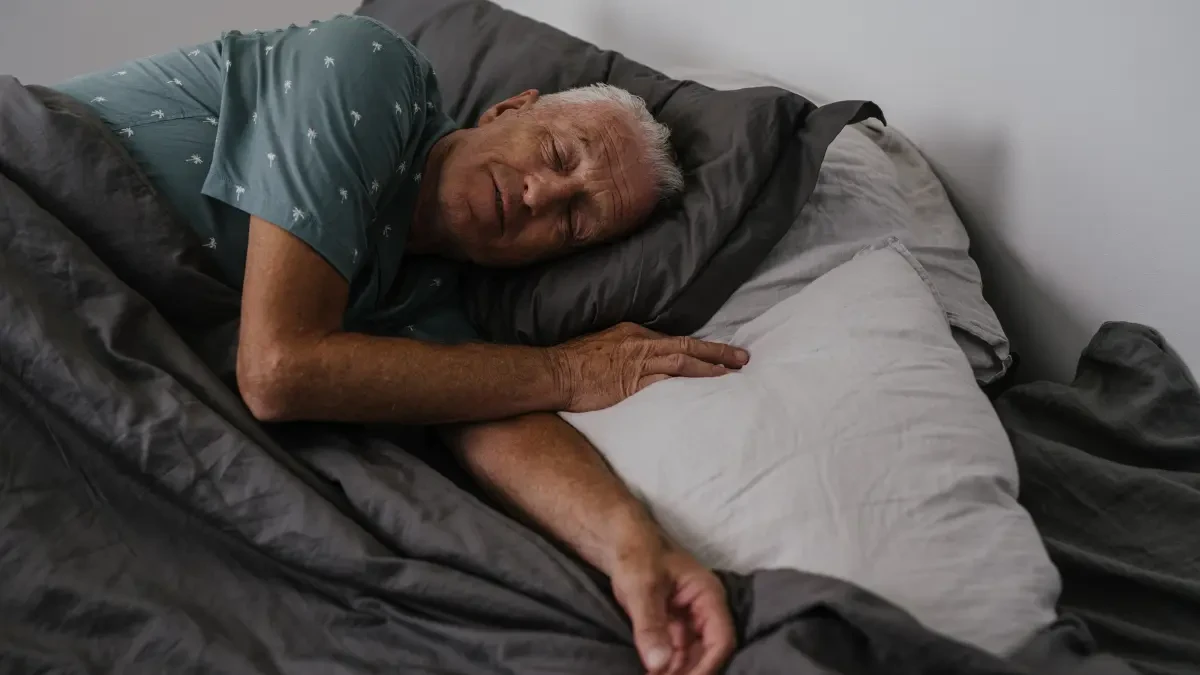
Cool your bedroom.
Your core body temperature must drop 2,3°F to enter and stay in deep sleep. The Cleveland Clinic and sleep researchers consistently point to 60–67°F (15–19°C) as the sweet spot. This matters more after 50, when the body regulates temperature less efficiently.
Let your chronotype shift.
After 50, most adults naturally want to sleep and wake earlier. Fighting this by staying up late creates what chronobiologists call social jetlag. It reduces sleep quality even when total hours look fine. Work with your natural shift, not against it.
Use the Pittsburgh Sleep Quality Index (PSQI).
This is a free, clinically validated questionnaire that breaks your sleep into 7 components, including sleep efficiency, disturbances, and daytime function.
It helps you identify exactly which part of your sleep is broken, so you fix the right thing instead of guessing. You can find it through your doctor or search for it online.
Track patterns, not stages.
Wearables like the Oura Ring, Apple Watch, and Garmin are useful for spotting trends, but they overestimate deep sleep compared to lab tests, according to sleep specialists.
Use them to track consistency and heart rate variability (HRV), which is a better measure of overnight recovery.
If nothing improves after 4–6 weeks, ask for a sleep study. Not as a last resort, but as a smart, logical next step. The Cleveland Clinic’s January 2026 review confirms that sleep disorders, hormonal imbalances, and vitamin deficiencies are medical causes that require professional evaluation, not more self-help protocols.
Most people who apply these changes consistently for 2,4 weeks report better mornings, not because they slept more hours, but because those hours finally counted.
Conclusion
Eight hours is a number. It is not a guarantee. After 50, what matters is sleep quality, specifically, how much deep and REM sleep you are actually getting. Start with your wake time. Get outside in the morning. Cut the afternoon caffeine. And if you suspect sleep apnea, get tested. Small changes, done consistently, make a real difference.
⚠️MEDICAL DISCLAIMER
This article is for informational purposes only. It does not replace medical advice, diagnosis, or treatment. The information covers sleep cycles, hormone levels, sleep apnea, circadian rhythms, screen time, melatonin, caffeine intake, alcohol consumption, sunlight exposure, core body temperature, and heart rate variability.
Individual results vary based on age, health status, and fitness level. Before changing your exercise routine, diet, or supplement use, talk to your doctor or a qualified health professional first. If you experience chest pain, dizziness, severe joint pain, or any sudden symptom during or after exercise, stop immediately and seek medical care.