

You’ve been doing the right thing. You added chicken to your lunch, you switched to Greek yogurt, you started reading labels. And your muscles are still getting smaller.
Adults over 50 who eat a reasonable diet and still wonder why their strength and energy are fading are not doing it wrong. They’re following advice that doesn’t account for how the aging body processes protein differently. Managing protein intake after 50 is not just about eating more of it.
By the end of this article, you’ll know exactly what the guidelines miss, and what to change at each meal starting tomorrow.
| # | Section | What You’ll Find |
|---|---|---|
| 1 | Why Your Body Stops Listening | The reason more protein isn’t working yet |
| 2 | The Gram Count Trap | What hitting your daily target still misses |
| 3 | The Breakfast Problem | Why dinner protein can’t undo the morning |
| 4 | What Your Muscles Actually Receive | Not all 30 grams are built the same |
| 5 | The Timing Window | When protein does more work than usual |
| 6 | A Three-Meal Framework | The fix that doesn’t require eating more |
Why Your Body Stops Listening to Protein After 50
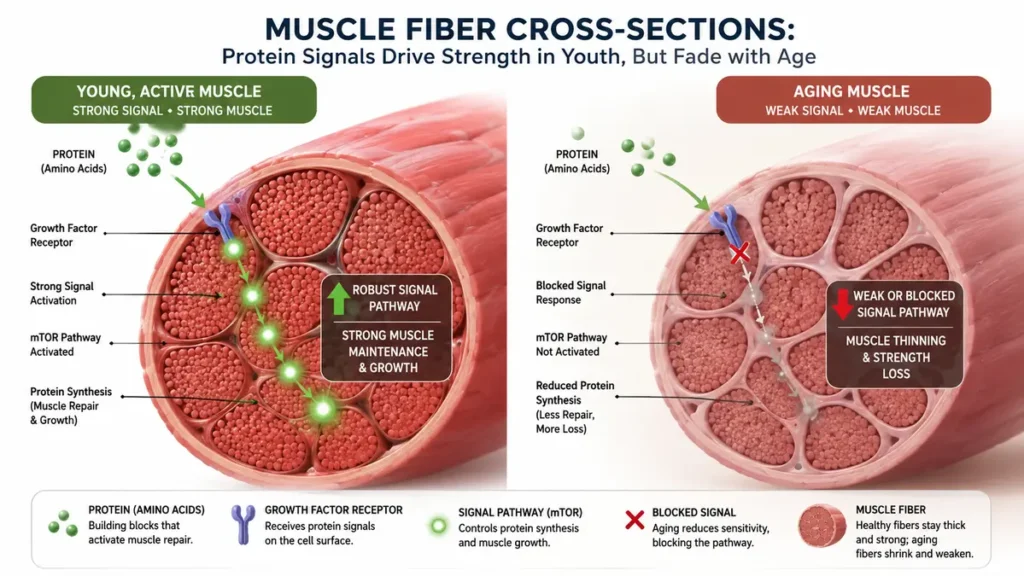
You eat the protein, but your muscles don’t get the message. That’s the frustrating part. The food is there, but something between the plate and the muscle is breaking down.

After 50, your body starts responding less to the protein you eat. Anabolic resistance [the muscle’s reduced ability to respond to protein from food] sets in after midlife, and it changes how much protein it takes to trigger muscle repair. A younger body can build muscle from a modest meal.
After 50, the same meal may not produce any meaningful repair signal at all.
The hard numbers After age 50, muscle mass declines at roughly one to two percent per year, with strength dropping about three percent per year.¹ That’s not inevitable collapse. It’s a slow slide that the right protein strategy can slow down significantly. The body still has the capacity to respond and rebuild. But it now requires a stronger signal to do it.
Sarcopenia [the gradual loss of muscle mass and strength that comes with age] is the clinical term for what happens when that signal stays too weak, too often.² It contributes to falls, loss of independence, and a lower quality of life in older adults.
The standard protein advice was never built for this reality. What you’re following was designed for a younger body. The next section explains why the number you’ve been tracking may be the wrong number entirely.
The Gram Count Trap: Why Hitting Your Daily Target Is Not Enough
Most people eating carefully after 50 are working from the same number: 0.8 grams of protein per kilogram of body weight per day. That’s the standard Recommended Dietary Allowance. It was designed to prevent deficiency, not to preserve muscle in an aging body.²
The gap is real. Most research now points to 1.2 to 1.6 grams per kilogram per day for adults over 50.³ For a 165-pound adult, that’s roughly 90 to 120 grams, not the 60 grams the standard RDA produces. But even hitting the higher target fails if all the protein is stacked at dinner.
Here’s why. Muscle protein synthesis [the process by which the body repairs and builds muscle tissue] operates on a per-meal signal, not a daily average.⁴ Your muscles do not carry over a credit from yesterday’s chicken. They either respond or they don’t, based on what arrives at each individual meal.
The per-meal threshold Clinical studies show that adults over 60 need approximately 30 grams of protein per meal, providing at least 2.8 grams of leucine [the amino acid that acts as the trigger signal for muscle repair], to fire that synthesis signal.⁴ After 60, a meal under that threshold may produce no meaningful repair response at all.
Your muscles do not care how much protein you ate yesterday. They need a strong enough signal at every single meal, and after 50 that threshold goes up while most people’s breakfast protein stays near zero.⁴
Approximately 46 percent of adults aged 51 and older don’t meet even the basic daily protein recommendation.⁵ Most who do are still loading it all at dinner.
The next section explains why that pattern matters more than most people realize.
The Breakfast Problem That Erases Hours of Good Eating
Think about what you ate for breakfast this morning. If it was toast, cereal, fruit, or coffee with nothing substantial, you started the day with very little protein. Your dinner may have been excellent. It may not have been enough.
Here’s what happens overnight. While you sleep, your body enters a slow breakdown phase where it uses muscle tissue to meet basic energy needs. By morning, that process has been running for seven to nine hours.
A protein-light breakfast extends it further. By the time you get to your protein-heavy dinner, you’ve spent most of the day in a state of net muscle loss.
Morning timing matters A placebo-controlled randomized trial in adults aged 65 and older found that supplementing protein at breakfast rather than in the evening produced significantly greater gains in muscle mass and handgrip strength over 12 weeks.⁶
And the researchers found a direct relationship: the higher the share of total daily protein consumed at breakfast, the better the muscle mass outcomes.⁶

The problem is habit, not appetite: most people eat their lowest-protein meal first and their highest-protein meal last.
WHAT A MORNING PROTEIN RESET LOOKS LIKE
- Greek yogurt (plain, full-fat, one cup): approximately 17 grams
- Two large eggs: approximately 12 grams
- One ounce of almonds: approximately 6 grams
- Total: approximately 35 grams, which is enough to cross the synthesis threshold
The what matters as much as the when. The next section explains why 30 grams from one source is not the same as 30 grams from another.
How Protein Quality Changes What Your Muscles Actually Receive
One of the trickier parts of protein intake after 50 is that you can hit 30 grams and still miss the threshold. The amino acid makeup of what you eat determines how much of that protein can actually signal muscle repair.
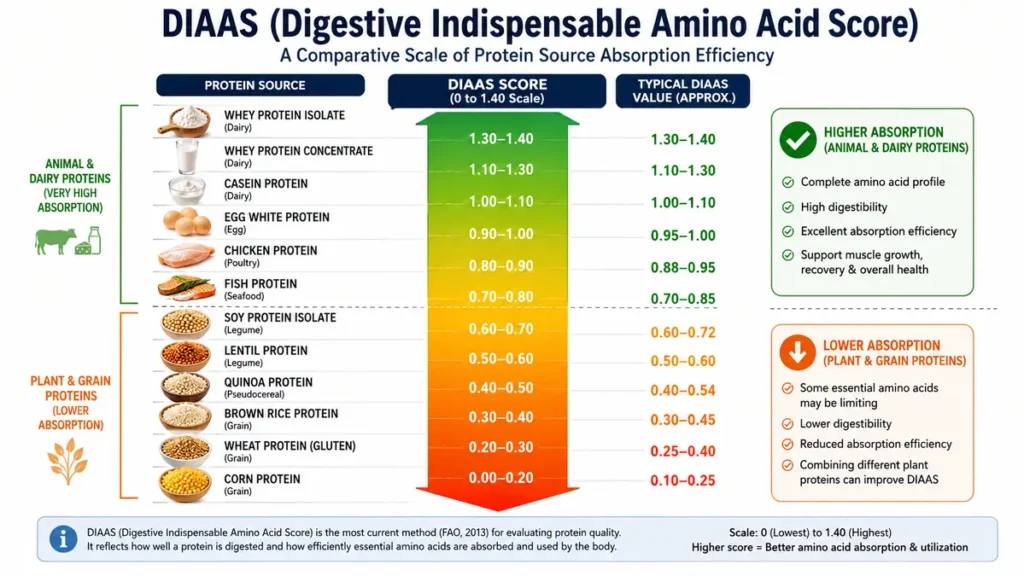
Protein quality after 50 Researchers use a scoring system called DIAAS [a scoring system that rates how well a food’s amino acids are actually absorbed by the body] to measure how effectively a protein source delivers usable amino acids to the body.⁷
Dairy proteins such as whey, casein, and milk score among the highest. Most grain proteins fall below the threshold where researchers can even make a quality claim.⁷
The specific concern for adults over 50 is leucine. A systematic review found that a typical 20-gram protein dose, the amount used in many studies on older adults, contains roughly two grams of leucine.⁸ That falls below the three-gram leucine threshold associated with maximum muscle protein synthesis stimulation in older adults.⁸
Smaller portions of lower-quality protein may produce no anabolic signal at all, even if the gram count looks acceptable on a label.
Animal proteins score highest Eggs, fish, dairy, and lean meat carry a complete amino acid profile and are efficiently absorbed. Plant proteins are not inferior, but they require a different approach.
If you eat mostly plant-based protein, two practical adjustments close the gap:
- Increase the serving size to 40 to 45 grams per meal to compensate for lower leucine density⁸
- Combine sources at the same meal (legumes with whole grains, for example) to build a more complete amino acid profile

The source matters Counting grams without considering source is like counting calories without looking at what you’re eating. The number matters less than what the body can actually use. The next section adds one more factor that changes how much work a meal’s protein can do.
The Timing Window: When Protein Does More Work After Exercise
Exercise changes the equation. When you use your muscles, including with light effort, they become more sensitive to protein for a period afterward. This matters especially after 50, when anabolic resistance makes the baseline response weaker.
Activity overrides resistance Research shows that activity before protein intake can allow more of the protein you eat to be directed toward muscle repair rather than used for energy.⁹
You don’t need a full gym session. The effect occurs with resistance training, but light activity like a 10-minute walk before a meal still moves the needle in the right direction.
The timing evidence is direct. In a 12-week study with men averaging 74 years of age, those who received protein immediately after resistance training showed significantly greater muscle hypertrophy [the increase in muscle size that comes from consistent training and enough protein] compared to those who waited two hours.¹⁰ Same protein, same amount. The window made the difference.
Two key points First, post-exercise protein works because exercise primes the muscle to receive it.⁹ Exercise itself does not build anything without the protein arriving afterward.
Second, timing is a multiplier, not a replacement. You still need 30 grams at each of your three daily meals regardless of whether you exercised. The post-exercise window amplifies a good meal; it cannot compensate for a missing one.
For adults who do resistance training two or three times per week, eating a protein-rich meal within one to two hours after the session is one of the most effective changes they can make. The muscle is primed. The protein has somewhere to go.
The next section puts all of this together into a daily structure that most people can follow without eating more total food.
A Three-Meal Framework That Puts Everything Together
Talk to your doctor before changing your eating pattern if you’re managing kidney disease, diabetes, or a condition that affects how your body processes protein, or if you’re on medication that interacts with dietary changes.
Most adults who are managing their protein intake after 50 don’t need to eat more of it. They need to redistribute what they’re already eating.
The framework is direct:
- Eat approximately 30 grams of high-quality protein at breakfast. This is the most missed window and the one with the strongest evidence for muscle benefit.
- Eat approximately 30 grams at lunch. This keeps the synthesis signal active through the middle of the day.
- Eat approximately 30 grams at dinner. Most people are already doing this. The goal is to reduce dinner’s share and raise breakfast’s.
- If you do resistance training, time one of these meals within one to two hours after your session.
- If you eat mostly plant-based protein, increase each meal’s serving to 40 to 45 grams and combine protein sources at the same meal.

This redistribution works because muscle protein synthesis responds to each meal independently. In healthy adults, distributing protein evenly across three meals was associated with greater 24-hour muscle protein synthesis rates compared to eating most of it at one meal.¹¹
Older adults with protein intakes at or above 1.2 grams per kilogram per day had 43 percent less lean mass loss over three years than those eating near the standard 0.8-gram RDA.¹² The gram target matters. But it only delivers if the distribution is right.
Conclusion
The most important change you can make today is to move protein to breakfast. Spread protein intake across three meals each day, aiming for 30 grams per meal, rather than loading most of it into dinner.
Your muscles respond to what arrives at each meal, not to what you ate across the whole day. That single shift is where the research says the gap actually is for most people managing their protein intake after 50. No new supplement required.
⚠️DISCLAIMER:
This article is for informational purposes only and does not constitute dietary or medical advice. The content addresses protein intake timing and distribution for adults over 50 and is meant for general educational purposes only. Nutritional needs differ based on age, health status, and individual circumstances, consult a registered dietitian or your healthcare provider before making significant changes to your diet.
References
- Age-related muscle mass and strength decline rates in older adults. Clinical trial background document citing multiple studies. ClinicalTrials.gov. 2019. https://cdn.clinicaltrials.gov/large-docs/16/NCT04048616/Prot_000.pdf
- Protein intake and muscle function in older adults: evidence that RDA is inadequate for optimal health; anabolic resistance as key mechanism in sarcopenia. Volpi E, Nazemi R, Fujita S. PMC/NIH. 2015. https://pmc.ncbi.nlm.nih.gov/articles/PMC4394186/
- Protein needs for adults over 50: recommendation of 1.2 to 1.6 grams per kilogram per day. Stanford Lifestyle Medicine. 2024. https://lifestylemedicine.stanford.edu/protein-needs-for-adults-50/
- Clinical studies showing adults over 60 require approximately 30 grams of protein per meal (providing at least 2.8 grams of leucine) to stimulate muscle protein synthesis; leucine as the key anabolic trigger. Layman DK. Frontiers in Nutrition. 2024. https://www.ncbi.nlm.nih.gov/pmc/articles/PMC11099237/
- Approximately 46 percent of adults aged 51 and older do not meet daily protein recommendations. Cited in Harvard Health, sourcing Journal of Nutrition, Health and Aging. 2024. https://www.health.harvard.edu/staying-healthy/muscle-loss-and-protein-needs-in-older-adults
- Placebo-controlled randomized trial in adults aged 65 and older: protein supplementation at breakfast rather than evening produced significantly greater muscle mass and handgrip strength gains over 12 weeks; higher morning protein ratio correlated with better muscle mass outcomes. Aoyama S et al. Frontiers in Nutrition / PubMed. 2021. https://pubmed.ncbi.nlm.nih.gov/34993224/
- DIAAS scoring showing dairy proteins (whey, casein, milk) among highest-scoring; most grain proteins falling below the 75-point quality threshold. Herreman L et al. Food Science and Nutrition / PMC. 2020. https://www.ncbi.nlm.nih.gov/pmc/articles/PMC7590266/
- Systematic review finding that typical 20-gram protein dose in older adult studies provides approximately 2 grams of leucine, below the 3-gram threshold for maximum muscle protein synthesis stimulation in older adults. Frontiers in Nutrition. 2021.
https://www.frontiersin.org/journals/nutrition/articles/10.3389/fnut.2021.685165/full - Physical activity prior to protein ingestion compensates for anabolic resistance in older adults, directing more protein toward muscle repair. Gatorade Sports Science Institute, citing Burd et al. and Pennings et al. https://www.gssiweb.org/sports-science-exchange/article/sse-160-dietary-protein-to-support-active-aging
- 12-week resistance training study in men averaging 74 years: immediate post-exercise protein produced significantly greater muscle hypertrophy than protein delayed by two hours. Esmarck B et al. Journal of Physiology / PMC. 2008. https://pmc.ncbi.nlm.nih.gov/articles/PMC2278776/
- Even protein distribution across three daily meals associated with greater 24-hour muscle protein synthesis rates than skewed distribution toward one meal, in healthy adults. Mamerow MM et al. Journal of Nutrition. 2014. https://pubmed.ncbi.nlm.nih.gov/24477298/
- Older adults with protein intake at or above 1.2 grams per kilogram per day had 43 percent less lean mass loss over three years compared to those near the 0.8-gram RDA. Clinical trial background document. ClinicalTrials.gov / NIH. 2019. https://cdn.clinicaltrials.gov/large-docs/16/NCT04048616/Prot_000.pdf