

You did everything right today. You ate a decent lunch. You didn’t touch the candy dish. And now it’s 2:45 p.m. and you can’t remember what you were doing three minutes ago.
Adults over 50 who hit a wall every afternoon and think it is their fault are not failing, and their bodies are processing food differently than they did at 35.The crash is a metabolic signal, not a character flaw.
This article explains the blood sugar and willpower after 50 pattern and shows you the three habits that break it. No overhaul. No new diet. Just a clear picture of what’s happening and what to do about it today.
| # | Section | What You’ll Find |
|---|---|---|
| 1 | Why lunch hits differently now | The biology behind the afternoon wall |
| 2 | The three-hour breakdown window | When exactly the pattern turns against you |
| 3 | Why eating less makes it worse | The counterintuitive rebound most people trigger |
| 4 | The first lever: how to build your lunch | What the meal needs to do before you sit down |
| 5 | The second lever: the 10-minute move | The step most people skip that changes everything |
| 6 | The same-day protocol | Three habits, no overhaul, starting today |
Blood Sugar and Willpower After 50: Why Lunch Hits Differently Now
You’re not imagining it. The same chicken-and-rice lunch that carried you through the afternoon at 38 now drops you at 2 p.m. Your biology has changed in a specific and addressable way. The blood sugar and willpower after 50 connection starts here, and it begins with what happens inside your muscles every time you eat.
Here’s what’s happening inside you after every meal. Skeletal muscle [the large muscles in your legs, back, and arms] is the body’s main site for clearing glucose from the blood after eating. After a mixed meal, skeletal muscle handles the majority of glucose disposal.¹ When this system works well, blood sugar rises after eating, peaks, and comes back down.
GLUT4 transporter activity [the mechanism that moves glucose from your blood into muscle cells] is the key driver of how quickly your muscles pull glucose out of the bloodstream after eating.
Research in humans aged 18 to 80 found that GLUT4 protein concentration in the vastus lateralis muscle was negatively associated with age in both men and women, though this association was not observed in all muscle groups.²
After 50, your body can turn a normal, reasonable lunch into a blood sugar spike because the muscle tissue that once absorbed glucose quietly is now less responsive, and no amount of “eating clean” fixes that without addressing the muscle.
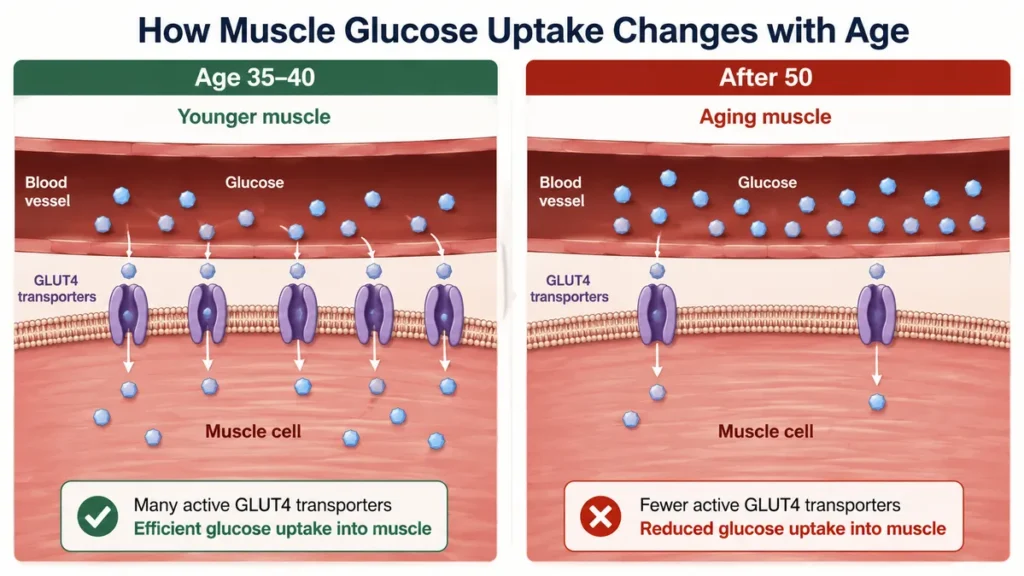
This is not a sign that you ate badly. It’s a structural change in how aging muscle handles fuel. The rest of this article shows you what to do about it, but the first step is understanding exactly when the breakdown happens.
The Three-Hour Window Where Blood Sugar Control Breaks Down
You know the feeling: sharp focus at noon, then a fog rolls in somewhere between two and four. That afternoon blood sugar crash is not random. It maps almost exactly to the peak and descent of your postprandial glucose response [the rise in blood sugar that follows a meal].
Your body’s ability to handle glucose is not the same at noon as it was at breakfast.
Research reviewed in Diabetologia found that in healthy individuals, postprandial glucose appears approximately 17% higher in the circadian evening compared to the morning, independent of behavior.³ Insulin’s early response to glucose is also about 27% lower as the day progresses.³ This pattern is driven by the body’s internal clock, not by what you ate.
Inside you, a 24-hour clock governs when metabolism is strongest and weakest. Circadian rhythm [the 24-hour internal cycle that governs body functions including metabolism] creates a predictable window where your glucose handling is weakest. That window starts roughly at lunchtime and extends into the mid-afternoon.
For adults over 50 who already have reduced muscle glucose uptake, this layering of reduced afternoon insulin response on top of reduced muscle responsiveness creates the conditions for a harder spike and a longer drop.
The result is a three-hour stretch where focus fades, cravings rise, and the sugar shelf starts calling.
The next section reveals the single most common response to this crash and why it makes the three-hour window longer, not shorter.
Why Eating Less in the Afternoon Often Makes the Crash Worse
Most people’s instinct when the 3 p.m. slump hits is to push through it: skip the snack, stay disciplined, and feel proud of not reaching for a cookie. That instinct is understandable. It is also, for many people over 50, the thing that extends the crash.
When blood sugar falls, the body does not quietly wait for the next meal. It releases cortisol and glucagon to pull glucose back up.
Research in humans confirmed that cortisol plays a direct counterregulatory role during low blood sugar by stimulating the liver to produce more glucose and by reducing insulin-dependent glucose uptake in peripheral tissue.⁴ This is the body trying to help.
The problem is what happens next. Gluconeogenesis [the process where the liver makes new glucose from non-carbohydrate sources like amino acids] produces a secondary glucose rise, and when that glucose hits a system that is already less responsive to insulin in the afternoon, it creates another spike-and-drop cycle.
Research indicates that glucocorticoids, of which cortisol is one, are associated with increased glucose production in the liver and reduced glucose uptake in muscle and adipose tissue.⁵
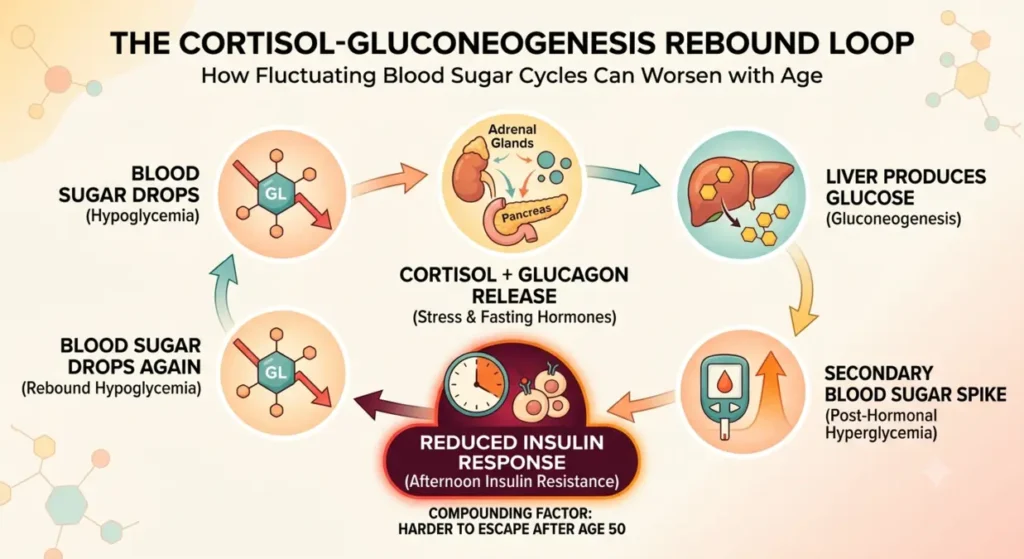
So the sequence looks like this. You skip a snack or eat very little after the crash. Blood sugar drops lower. Cortisol releases. The liver makes glucose. Blood sugar rebounds. The brain interprets that rebound as a craving. You reach for something sweet. And the cycle runs again.
This is not a willpower failure. It is a hormonal rebound running on a schedule your body set, not you. The next section covers the first lever that interrupts this loop before it starts.
Talk to your doctor before changing your diet or exercise habits if you’re on medication for blood sugar, blood pressure, or any chronic condition.
The First Lever: What Your Lunch Needs to Do
You feel the 3 p.m. crash before you can prevent it, so prevention starts at the meal, not after it. The structure of your lunch determines whether blood sugar rises fast and hard or slow and steady, and that difference is exactly what controls how you feel two hours later.
The speed at which your stomach empties after a meal is one of the main controls on how fast blood sugar rises. Gastric emptying rate [how quickly food moves from your stomach into the small intestine, where glucose enters the blood] is the mechanism protein and fiber both target.
Research in healthy humans found that adding protein to a meal lowers postprandial blood glucose concentrations by slowing gastric emptying and stimulating incretin hormones.⁶

Dietary fiber works through a related but distinct pathway, increasing the viscosity of digestive contents and slowing gastric emptying and intestinal glucose absorption.⁷
In a study of adults with type 2 diabetes and those with normal glucose tolerance, a premeal combination of protein and fiber was associated with a significantly lower postprandial glucose area under the curve compared to consuming the same meal without the preload.⁸
The key insight is that it’s not about removing carbs. It’s about the order and composition. Protein and fiber first, even a small amount, changes the rate at which the rest of the meal reaches the bloodstream.
Here’s what that looks like in practice:
- Start with a palm-sized portion of protein: eggs, chicken, fish, cottage cheese, or legumes.
- Add at least one high-fiber component: leafy greens, beans, or a piece of whole fruit eaten before the starchy portion.
- Eat your carbohydrates last. Bread, rice, and pasta at the end of the meal, not the beginning.
The second lever picks up exactly where this one ends.

The Second Lever: The 10-Minute Move After Lunch
You’ve eaten. Now comes the part that determines whether the protein and fiber you just ate actually hold the line, or whether the afternoon pattern wins anyway. One 10-minute walk right after lunch is the difference.
When your muscles move, they pull glucose in on their own, no insulin required. Contraction-mediated glucose uptake [the process by which muscle contractions pull glucose into muscle cells without needing insulin] is the reason walking after eating works so differently from walking at other times.
Walking activates a separate pathway that does not depend on insulin sensitivity. For adults over 50 whose insulin signaling in muscle has declined, this pathway is not impaired. It bypasses the bottleneck.
A randomized trial in inactive older adults aged 60 and older at risk for glucose intolerance found that short bouts of postmeal walking significantly improved 24-hour glycemic control and were more effective than 45 minutes of sustained morning walking at lowering post-dinner glucose.⁹
The timing matters. Walking before a meal or at a random time later in the afternoon does not produce the same effect. The glucose-lowering benefit is linked to the window right after eating, when glucose from the meal is entering the blood.⁹

Your after-lunch action:
- Finish your meal.
- Within 10 to 15 minutes, stand up and walk.
- Pace does not need to be vigorous. A comfortable, easy pace works.
- Aim for at least 10 minutes. Fifteen is better. Twenty costs very little more time.
This move costs nothing and requires no equipment, but the third lever, the one that reduces cortisol before lunch, determines whether the full pattern breaks.
The Same-Day Protocol: Three Habits, No Overhaul
Your afternoon follows a pattern, and three daily habits determine whether it works for you or against you. What follows is the same-day fix. You do not need a new diet. You do not need a gym. You need a different sequence.
1. The stress window before lunch.
Cortisol doesn’t just respond to low blood sugar. It also rises with mental and physical stress before you eat. Elevated cortisol before a meal reduces insulin sensitivity in muscle during and after that meal, which means the spike from an ordinary lunch goes higher.⁵
Spending five minutes away from screens, a brief walk, or even sitting quietly before lunch is not optional comfort. It is a blood sugar lever.

2. The meal structure.
As covered in the previous section: protein and fiber before carbs. This slows the rate of glucose entry into the blood.
In a randomized crossover trial of adults with type 2 diabetes, those who walked 10 minutes after each main meal had significantly lower postprandial glucose than those walking 30 minutes once daily, even though both groups met the same total activity guidelines.¹⁰
3. The post-meal walk.
Within 15 minutes of finishing lunch, stand and walk for at least 10 minutes. Not after a phone call. Not after finishing the email. Right after the meal, when the insulin-independent glucose uptake pathway is most active.
Here is the full sequence:
- Five minutes of quiet or slow movement before lunch.
- Eat protein and fiber first, carbohydrates last.
- Walk for 10 to 15 minutes immediately after eating.

Today, eat a protein-and-fiber lunch before 1 p.m. and take a 10-minute walk after eating. That sequence, done once, changes how you feel at 3 p.m. today. Done daily, it changes the underlying pattern.
Conclusion
The single most important action you can take today is to walk for 10 minutes right after your next meal. Eat a protein-and-fiber lunch before 1 p.m. and take a 10-minute walk after eating. The blood sugar and willpower after 50 pattern is real, it is measurable, and it responds to specific actions, not more discipline.
⚠️DISCLAIMER:
This article is for informational purposes only and does not constitute medical advice, diagnosis, or treatment. The content addresses managing afternoon blood sugar shifts after age fifty and is intended for general educational purposes only. Health conditions vary significantly between individuals, always consult a licensed physician or qualified healthcare provider before making any decisions about your health or medical care.
References
- Skeletal muscle’s central role in glucose disposal after a mixed meal; mechanism of insulin resistance during skeletal muscle aging. Diabetology & Metabolic Syndrome. 2020. https://dmsjournal.biomedcentral.com/articles/10.1186/s13098-020-0523-x
- GLUT4 protein concentration in vastus lateralis muscle negatively associated with age in men and women aged 18 to 80. American Journal of Physiology. 1995. https://pubmed.ncbi.nlm.nih.gov/7729615/
- Postprandial glucose approximately 17% higher in the circadian evening versus morning in healthy individuals; early-phase insulin response 27% lower as the day progresses. Diabetologia. 2020. https://link.springer.com/article/10.1007/s00125-019-05059-6
- Cortisol plays a counterregulatory role during low blood sugar by augmenting hepatic glucose production and decreasing peripheral glucose utilization in normal humans. American Journal of Physiology — Endocrinology and Metabolism. 1989. https://pubmed.ncbi.nlm.nih.gov/2665516/
- Glucocorticoids are associated with increased glucose production in the liver and reduced glucose uptake in skeletal muscle and adipose tissue. Frontiers in Endocrinology (review). 2015. https://pubmed.ncbi.nlm.nih.gov/26215992/
- In healthy humans, adding protein to a meal lowers postprandial blood glucose predominantly by slowing gastric emptying and stimulating incretin hormones. American Journal of Physiology — Gastrointestinal and Liver Physiology. 2007. https://pubmed.ncbi.nlm.nih.gov/17991647/
- Dietary fiber appears to delay gastric emptying by increasing the viscosity of gastric contents and may form a physical barrier that slows intestinal glucose absorption. Foods (MDPI). 2020. https://www.mdpi.com/2304-8158/9/10/1500
- Premeal protein-and-fiber combination associated with significantly lower postprandial glucose area under the curve in adults with type 2 diabetes and those with normal glucose tolerance. Journal of Diabetes Investigation. 2018. https://pubmed.ncbi.nlm.nih.gov/29502350/
- Three short bouts of postmeal walking significantly improved 24-hour glycemic control in inactive older adults aged 60 and older at risk for impaired glucose tolerance; postmeal walking was significantly more effective than 45 minutes of sustained morning or afternoon walking at lowering 3-hour post-dinner glucose. Diabetes Care. 2013. https://pubmed.ncbi.nlm.nih.gov/23761134/
- In adults with type 2 diabetes (mean age 60 years), walking 10 minutes after each main meal produced significantly lower postprandial glycemia than walking 30 minutes once daily, with the same total activity time. Diabetologia. 2016. https://pubmed.ncbi.nlm.nih.gov/27747394/