
You used to drink coffee at 4 p.m. and sleep just fine. Now one cup before noon is enough to keep you up until midnight. Nothing in your routine changed. So what happened? Your body changed. After 50, the way your body processes caffeine slows down a lot.
The same cup of coffee that cleared your system in 5 hours now takes up to 10. That means the caffeine you drank at noon might still be active in your brain at 10 p.m.
This isn’t in your head. It’s biology. And once you understand exactly why it happens, you’ll know what to do about it.
Why Your Body Can’t Clear Caffeine Like It Used To?
Your liver does most of the work when it comes to breaking down caffeine. It uses a specific enzyme called CYP1A2, and this enzyme handles over 90% of all caffeine clearance in your body.
As you age, CYP1A2 activity slows down. Your liver doesn’t break caffeine down as fast as it once did.
Research confirms that age-related changes in liver function prolong caffeine’s half-life, meaning caffeine stays in your system longer before your body clears it out.
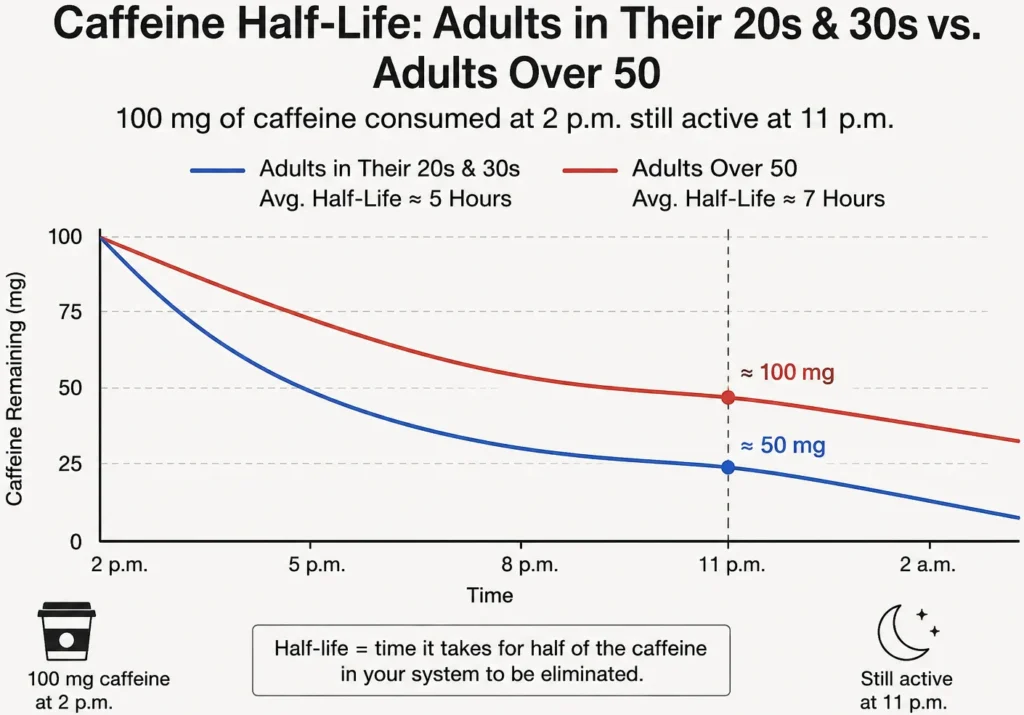
In your 20s and 30s, caffeine’s half-life was around 4 to 6 hours. After 50, that same half-life can stretch to 7 to 10 hours. It sounds like a small shift. It isn’t.
Think about it this way: you drink a 200 mg cup of coffee at 2 p.m. With a 9-hour half-life, your body still has 100 mg of caffeine active at 11 p.m. That’s the equivalent of a full espresso shot right before bed. No wonder you can’t sleep.
The Half-Life Math That Changes Everything
Most people have never heard of caffeine’s half-life. It sounds like science class. But it matters more than you think.
A half-life is simply the time your body needs to eliminate half the caffeine you drank. If you drank 200 mg and your half-life is 10 hours, after 10 hours, you still have 100 mg in your system.
After 20 hours, you have 50 mg left. Stanford researchers confirmed in 2025 that caffeine’s half-life varies widely, anywhere from 2 to 10 hours across healthy adults. Younger adults tend to sit on the lower end. Older adults drift toward the higher end.
After age 59, the genetic advantage some people have as fast metabolizers of caffeine largely disappears. That fast-metabolizer edge, the reason some 30-year-olds could drink espresso at 9 p.m.
And sleep at 10 stops working as reliably after 50. This is not about tolerance. It’s not about willpower. It’s a change in how fast your body can physically remove caffeine from your bloodstream.
What Hormones Do to Your Caffeine Tolerance (Especially for Women)?
For women, there’s another layer that most caffeine articles skip entirely: hormones. Estrogen plays a direct role in regulating CYP1A2 activity, the same enzyme that clears caffeine. During premenopausal years, estrogen influences how quickly caffeine is processed.
When estrogen drops during and after menopause, that regulation shifts. A 2025 study published in PMC on caffeine and cardiovascular aging confirmed these sex-specific differences.
For postmenopausal women, the relationship between caffeine and the body becomes less predictable.
Even if clearance speed doesn’t slow dramatically, the nervous system becomes more reactive to caffeine’s stimulating effects. The same amount feels stronger. It hits harder. For men over 50, the hormonal picture is simpler, but the trend is similar.

Slower clearance as general liver function gradually declines with age. Testosterone doesn’t interact much with CYP1A2, so the slowdown in men is more gradual and more consistent.
If your caffeine tolerance changed dramatically around menopause, this is almost certainly a major reason why.
You Think You’re Sleeping Fine — But You’re Not
Here’s a common mistake people make: they measure caffeine’s impact by whether they can fall asleep. That’s the wrong measure.
Caffeine works by blocking adenosine, the brain chemical that builds up all day, telling your body it’s tired. When caffeine fills those receptor sites, your brain gets a false signal that you’re still alert.
Once you fall asleep, the caffeine doesn’t stop. It keeps blocking those receptors, and that directly interrupts your deepest sleep.
A 2025 meta-analysis of 22 controlled trials covering 956 participants found that caffeine significantly reduced total sleep time by about 35 minutes.
Lowered sleep efficiency by nearly 5% and reduced slow-wave deep sleep. Deep sleep is the stage where your body repairs itself and consolidates memory. Sleep physician Dr. Dustin Cotliar put it plainly.
Even if you can fall asleep after recently consuming caffeine, you may not be sleeping as deeply or getting as much high-quality sleep as you would otherwise. You might be getting 7 hours in bed. The quality of those 7 hours is the real problem.
The “I Stop at 6 p.m.” Rule Is Not Enough After 50
Many people follow the no caffeine after 6 p.m. For a 30-year-old with a 5-hour half-life, that leaves room to clear caffeine before a 10 p.m. bedtime. For a 55-year-old with a 9-hour half-life, 6 p.m. is still too late.
A May 2026 review published in AJMC confirmed that caffeine consumed even 6 hours before bed reduces sleep quality.
And that research was not focused on older adults; it was a general adult finding. For people over 50 with slower metabolism, the risk window is even wider.
A separate 2023 study found that caffeine taken 6 hours before bed cut total sleep by about 41 minutes on average.

The math is simple: work backward from your bedtime using your likely half-life. If you go to bed at 10 p.m. and your half-life is 9 hours, your last coffee should be before 1 p.m. Not 6 p.m. Not 3 p.m. Before 1 p.m.
4 Changes That Actually Help After 50
1. Move your cut-off time earlier than you think.
If your bedtime is 10 p.m. and your half-life is 8,10 hours, stop caffeine by 12 p.m. or 1 p.m.
A 2025 Oxford SLEEP journal trial confirmed that even 100 mg of caffeine is safe up to 4 hours before bed, but 400 mg within 12 hours of bed hurts sleep quality. For older adults with longer half-lives, the safe window shrinks further.
2. Lower your total daily dose.
UCLA Health recommends 50,100 mg as a well-tolerated daily amount for older adults. That’s about one small cup of coffee. If you’re drinking three cups a day, consider switching your second and third to half-caff or herbal tea. You’re not giving up coffee. You’re right-sizing it.

3. Check your medications.
This is the most overlooked factor. Certain antibiotics, especially ciprofloxacin and antidepressants, some blood pressure drugs, and asthma medications, can further inhibit CYP1A2. That slows caffeine clearance on top of the age-related slowdown.
MedlinePlus and the NIH explicitly advise people taking heart medicines or certain antibiotics to discuss caffeine interactions with their doctor. Bring a list of your medications to your next appointment and ask directly.
4. Do a caffeine reset every 3 to 4 months.
Regular caffeine use builds adenosine receptor tolerance. You need more caffeine to feel the same effect.
The fix is a gradual reset; reduce your intake by about 25% every 10 days. After 4 to 8 weeks, most people return to their baseline sensitivity. Smaller amounts work better again, and your natural sleep system functions without interference.

Signs Your Caffeine Metabolism Has Already Slowed
Your body has probably already been signaling this. You just might not have connected the dots.
Watch for these signs:
- You feel wired but tired, alert but not rested after afternoon caffeine
- You wake between 2 a.m. and 4 a.m. with no clear reason
- You need more coffee than you used to for the same effect
- You feel heart palpitations or a racing heartbeat from amounts that never bothered you before
- You feel more anxious or restless after caffeine than you did in your 30s
If you recognize three or more of these, your caffeine metabolism has very likely slowed. This is not a disease. It’s not permanent damage. It’s your body’s signal that the old rules no longer apply. And the fix is simpler than most people expect, mostly a shift in timing and dose.
Conclusion
After 50, caffeine stays in your body up to twice as long as it used to. One enzyme slows down, your hormones shift, and what used to work stops working. Move your last cup to before noon. Lower your dose. Check your medications. Give your body a reset every few months. Sleep improves faster than you’d expect.
⚠️MEDICAL DISCLAIMER
This article is for informational purposes only. It does not replace medical advice, diagnosis, or treatment. The information covers caffeine clearance, liver enzyme activity, caffeine half-life math, estrogen and hormonal shifts, nervous system reactivity, adenosine receptor blocking, deep sleep quality, sleep efficiency, caffeine cutoff timing, daily caffeine dosing, medication interactions with caffeine, caffeine resets, and signs of slowed caffeine metabolism.
Individual results vary based on age, health status, and fitness level. Before changing your exercise routine, diet, or supplement use, talk to your doctor or a qualified health professional first. If you experience chest pain, dizziness, severe joint pain, or any sudden symptom during or after exercise, stop immediately and seek medical care