
You did everything right today. Salad for lunch, a green smoothie, Greek yogurt for a snack. And by 7 PM your stomach looked like a balloon. Feeling bloated after healthy meals after 50 is more common than you think, and it’s almost never about effort.
After 50, your digestive system processes food differently, and several foods labeled as healthy are now quietly working against you. This article names three of them and tells you exactly what to eat instead.
| # | Section | What You’ll Find |
|---|---|---|
| 1 | Why Your Gut Processes Food Differently After 50 | The biological shift that changes how your body handles food |
| 2 | Food 1: Raw Cruciferous Vegetables | Why broccoli and kale ferment before they even finish digesting |
| 3 | Food 2: The Hidden Ingredient Making “Healthy” Snacks a Problem | How a hidden ingredient in healthy snacks stacks up to cause gas |
| 4 | Food 3: The Gut Health Hero With a Hidden Cost | The irony inside the most-recommended gut health food |
| 5 | The Swap Protocol: What to Eat and When | One direct replacement for each food, with timing guidance |
| 6 | Your 7-Day Reset: What to Track and When to Call Your Doctor | What to track, what to expect, and when to call your doctor |
Why Your Gut Processes Food Differently After 50
You’re not imagining it. Feeling bloated after healthy meals after 50 is real, it’s common, and it has a biological explanation.
After 50, your body makes fewer digestive enzymes[proteins that split food into smaller pieces your body can use].² The mix of bacteria in your gut shifts, with beneficial strains becoming less dominant.³ Your colon also moves food through more slowly than it did when you were younger.¹
That last part matters more than most people realize. Slower gut motility [the speed at which food moves through your digestive system] means food spends more time sitting in your colon.
The bacteria living there break it down instead. That process produces gas. It doesn’t matter how clean the food is. If it sits long enough, it ferments.
Here is the part no dietary advice ever says out loud: most clean-eating guidelines were written for a 35-year-old digestive system. They were not updated when your biology changed. The foods on this list are not bad foods. They are the right foods for the wrong stage of your gut’s life.
The clean-eating advice you’ve been following was written for a younger version of your body, not the one you have now.
Food 1: Raw Cruciferous Vegetables
Your body can’t break down raw broccoli, cauliflower, and kale the same way it used to. These vegetables contain raffinose [a complex sugar found in many vegetables that the human body cannot digest on its own], and processing it requires specific gut bacteria.⁴
After 50, the mix of bacteria in your gut shifts. The types needed to handle raffinose become less active. So the raffinose moves to your colon undigested, where other bacteria begin fermentation [a process where bacteria break down food and release gas as a byproduct].⁴ That gas has to go somewhere.
Raw preparation makes this significantly worse. Heat breaks down the cell walls in these vegetables and reduces the amount of fermentable material before it ever reaches your gut. Cooking doesn’t remove the nutrition. It removes the part your body can’t handle.⁵

The food did not change. You did.
The fix is not to stop eating these vegetables. It’s to cook them and keep your portion to one cup or less at any single meal. A light steam or medium-heat roast is enough to make a real difference.
One reliable swap: Trade your raw kale salad for lightly steamed broccoli or roasted cauliflower. Same family of vegetables, far less fermentable load.
The second food is harder to spot than broccoli, because it hides inside products marketed as healthy foods that cause gas and bloating.
Food 2: The Hidden Ingredient Making “Healthy” Snacks a Problem
Most women don’t know they’re eating this one. Inulin [a type of fiber added to many packaged foods that feeds gut bacteria but also produces gas when eaten in large amounts] is a prebiotic [a type of fiber that feeds the good bacteria in your gut].
It is added to protein bars, fiber supplements, yogurt, and dozens of other products aimed at women over 50.

In small doses, inulin is genuinely useful. Above a certain threshold in a single meal, it becomes one of the most reliable gas producers in the FODMAP [Fermentable Oligosaccharides, Disaccharides, Monosaccharides And Polyols, a group of carbohydrates that ferment easily in the gut] category.⁶
After 50, inulin sits longer and ferments harder.
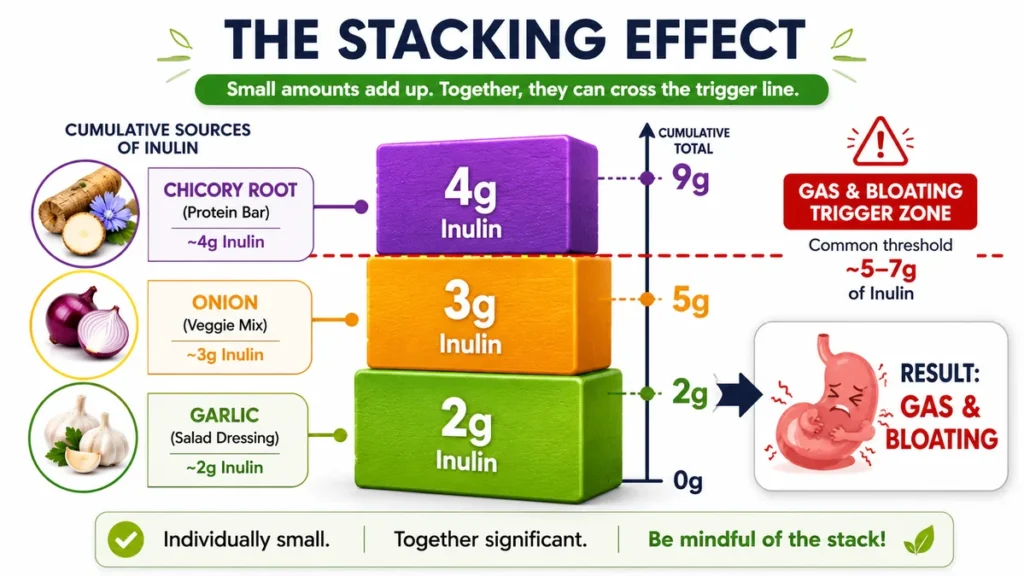
Here’s where healthy foods that cause gas and bloating catch most people off guard: the stacking. You might eat garlic in your salad dressing, onion in your vegetable mix, and a chicory-root protein bar as a snack.
Each one contains inulin. None of them alone would cause a problem. Together, you’ve easily crossed a problematic dose before dinner.
Check your bar’s label. If chicory root or inulin appears in the first five ingredients, that bar is a likely trigger. Switch to a rice-protein or egg-white protein bar with no added fiber.
Reliable swaps for inulin-heavy foods:
- Replace garlic with garlic-infused olive oil (the fructans stay in the solid, not the oil)
- Replace white and yellow onion with the green tops of scallions
- Replace chicory-based protein bars with rice or egg-white protein options
The third food on this list will surprise you more than these two, because every gut health expert you follow has told you to eat more of it.
Food 3: The Gut Health Hero With a Hidden Cost
Greek yogurt deserves its reputation. It’s high in protein, genuinely rich in live cultures, and one of the most nutrient-dense foods available to women over 50. This is not a reason to stop eating it forever. It’s a reason to understand what changed.

Lactase [the enzyme your body makes to digest lactose, the sugar found in dairy] production often decreases after childhood. This process, called adult-onset lactase decline, is a normal biological trait in most of the world’s population and can reduce the ability to digest lactose-containing foods.⁷
You don’t need to be diagnosed with anything for this to affect you. A mild drop in lactase output is enough to produce bloating and gas, especially when lactose [the natural sugar in milk and most dairy products] hits a gut that’s already moving slowly.
This is one of the most common foods that cause bloating in women over 50, and it’s the last one most people consider, because it’s the food their doctor told them to eat more of.
The live cultures in Greek yogurt can produce extra gas in a gut with altered bacterial balance. The very thing meant to help your gut can add to the fermentation problem when conditions aren’t right.

Reliable swaps:
- Lactose-free Greek yogurt: same protein, same probiotics, without the lactose load
- Coconut-based kefir: lower lactose, still delivers live cultures
These three swaps remove the most common triggers. The next section tells you exactly what to eat instead and when to eat it.
The Swap Protocol: What to Eat and When
Talk to your doctor before making significant dietary changes if you’re on medication, managing a chronic condition, or pregnant.

Here is the direct swap for each food. Timing matters as much as the food itself.
| Instead of | Eat this | Timing note |
|---|---|---|
| Raw broccoli or kale salad | Lightly steamed broccoli or roasted cauliflower | Best at lunch. Colonic transit is faster in the first half of the day.¹ Cooked vegetables are harder to digest at dinner when the gut slows down. |
| Garlic, onion, chicory-root bars | Garlic-infused oil, scallion tops, rice protein bar | These can be eaten at any meal. The key is not stacking more than one inulin source per meal. |
| Regular Greek yogurt or kefir | Lactose-free Greek yogurt or coconut kefir | Have this as a standalone snack, not immediately after a large meal with other fermentable foods. |
One additional factor most articles skip: psychological stress has been shown to change how quickly food moves through your digestive system.⁸ Two minutes of slow breathing before a meal is not a cliché. It is worth trying.
You have the swaps. What you do with them in the next seven days will tell you which one matters most for your specific gut.
Your 7-Day Reset: What to Track and When to Call Your Doctor
Eating rushed, eating while anxious, or skipping meals and eating large portions later disrupts normal gut rhythm and makes all three of these foods ferment more. Fix the environment first.
Now, the 7-day protocol.

Days 1 to 3:
- Remove all three flagged foods from your meals
- Rate your bloating on a scale of one to 10, once in the morning and once in the evening
- Note what you ate and when
Days 4 to 7:
- Reintroduce one food at a time in a small portion
- Wait 24 hours before reintroducing the next
- Log any change in bloating score
- The food that raises your score is your personal primary trigger
Most women notice a measurable change by day three. Some notice it within 48 hours.
See your doctor before continuing this protocol if you have any of these:
- Bloating that is painful, not just uncomfortable
- Blood in your stool
- Unexplained weight loss
- Bloating that has come on suddenly and recently
These are not signs that your diet needs adjusting. They are signs that something else needs a diagnosis.
The goal here is not to restrict more. It’s to eat the same volume with better-targeted choices. You now have everything you need to do that.
Conclusion
Start today by removing just one of these three foods. You don’t need to overhaul your diet all at once. Swap out the three foods in this article for the gentler alternatives listed below each one, and track your bloating for seven days. Most readers notice a difference by day three.
Digestive changes after 50 are real, but they don’t have to mean eating less or enjoying food less. You’re not broken. You just needed updated information.
DISCLAIMER:
This article is for informational purposes only and does not constitute dietary or medical advice. The content addresses common foods that cause bloating in women over 50 and is meant for general educational purposes only. Nutritional needs differ based on age, health status, and individual circumstances, consult a registered dietitian or your healthcare provider before making significant changes to your diet.
References
- Madsen JL, Graff J. Effects of ageing on gastrointestinal motor function. Age and Ageing. 2004;33(2):154-159. https://academic.oup.com/ageing/article/33/2/154/40152
- Laugier R, Bernard JP, Berthezene P, Dupuy P. Changes in pancreatic exocrine secretion with age: pancreatic exocrine secretion does decrease in the elderly. Digestion. 1991;50(3-4):202-211. PubMed PMID 1812045. https://pubmed.ncbi.nlm.nih.gov/1812045/“
- Biagi E, Nylund L, Candela M, et al. Through ageing, and beyond: gut microbiota and inflammatory status in seniors and centenarians. PLoS ONE. 2010. PMC5390822 also relevant: Voreades N, Kozil A, Weir TL. Nutrition and the gut microbiome in the elderly. Genes and Nutrition. 2017. https://pmc.ncbi.nlm.nih.gov/articles/PMC5390822/“
- Niness KR, Brownwell LA. Raffinose Family Oligosaccharides: Friend or Foe for Human and Plant Health? Frontiers in Plant Science. 2022. https://pmc.ncbi.nlm.nih.gov/articles/PMC8891438/
- Kowalski S et al. Impact of Cooking Techniques on the Dietary Fiber Profile in Selected Cruciferous Vegetables. Nutrients. 2025. https://pmc.ncbi.nlm.nih.gov/articles/PMC11821131/
- Bonnema AL, Kolberg LW, Thomas W, Slavin JL. Gastrointestinal tolerance of chicory inulin products. Journal of the American Dietetic Association. 2010;110(6):865-868. PubMed PMID 20497775. https://pubmed.ncbi.nlm.nih.gov/20497775/
- Suchy FJ, Brannon PM, Carpenter TO, et al. NIH Consensus Development Conference Statement: Lactose Intolerance and Health. NIH Consensus and State-of-the-Science Statements. 2010;27(2):1-27. PubMed PMID: 20186234. https://pubmed.ncbi.nlm.nih.gov/20186234/
- Cann PA, Read NW, Cammack J, Childs H, Holden S, Kashman R, Longmore J, Nix S, Simms N, Swallow K, Weller J. Psychological stress and the passage of a standard meal through the stomach and small intestine in man. Gut. 1983;24(3):236-240. PubMed PMID: 6826109. https://pubmed.ncbi.nlm.nih.gov/6826109/