You fall asleep fine. It’s 2 AM, that’s the problem. You wake up. You’re hot, or the room is too bright, or both. You stare at the ceiling for an hour.
Middle-of-the-night waking is the most common sleep complaint for people over 50. And most advice misses the two biggest causes: a bedroom that’s too warm and a bedroom that isn’t dark enough.
This article covers why aging bodies react differently to heat and light, what the research says about the right bedroom temperature after 50, how blackout curtains protect your sleep hormones, and which fix to try first. These aren’t complicated solutions. They’re free or close to it, and they work.
Why Sleep Changes So Much After 50?
Broken sleep after 50 isn’t a personal failing. It’s biology. Insomnia symptoms affect up to 75% of adults aged 65 and older. Nearly half of older adults report some difficulty with sleep, making it one of the most common health complaints in this age group.
The National Sleep Foundation found that about 60% of adults overall don’t get enough sleep.
Two specific things change in your body as you age.
First: Your thermoregulation weakens. Your body becomes less efficient at managing its internal temperature, so a warm room hits much harder than it did at 35.
Second: Your circadian light sensitivity increases.
Your brain becomes more reactive to light at the wrong times, making it easier for ambient light to knock your sleep off track. These changes aren’t random. They’re well-documented shifts that happen to most people.
And the consequences are real. Poor sleep in this age group is linked to higher risks of cardiovascular disease, diabetes, and cognitive decline. Fixing your sleep environment isn’t just about comfort. It’s about long-term health.
The Cool Room Advantage — What the Science Actually Says?
Here’s the basic biology: your core body temperature needs to drop to trigger deep sleep. A cool room helps that process happen faster. This isn’t a preference; it’s how your body is wired.
The research on this is specific. A peer-reviewed study tracked 10,903 person-nights of sleep data from older adults.
It found sleep was most efficient when nighttime room temperature stayed between 20,25°C (68–77°F). When the temperature climbed from 25°C to 30°C, sleep efficiency dropped by a clinically meaningful 5–10%.
Over 50: your ideal range is slightly different from that of younger adults.
The National Sleep Foundation says 75°F is too warm for most people. But a Harvard Medical School study found that adults 65 and older didn’t see sleep efficiency drop until temperatures went above 77°F. That’s a meaningful distinction.
Don’t overcool your room based on advice meant for younger people. A 2025 study monitoring 47 adults aged 65 and older across a full summer found that hot nights significantly impaired sleep and stressed the cardiovascular system.
Blackout Curtains — Why Light Hits Harder After 50
Most people assume they become less sensitive to things as they age. With light and sleep, the opposite is true. As the lens of your eye ages, it scatters more light onto the retina. That means older adults are actually more sensitive to ambient light during sleep, not less.
Even a small amount of light in the room can interfere with sleep continuity.
How small? Melatonin suppression, the hormone that keeps you asleep, begins at just 5 to 10 lux. That’s roughly the brightness of a dimly lit hallway. Standard blackout curtains that are poorly installed still allow 10 to 50 lux of edge leakage. That’s enough.
A 2024 NIH-backed study published in Sleep examined 47,765 women and found that indoor light at night was tied to worse sleep across multiple measures, including trouble falling and staying asleep.
Light in the two hours before your normal sleep time has the biggest suppressive effect on melatonin.
Exposure to bright light (100+ lux) in that window can delay melatonin onset by 2 to 3 hours, the equivalent of severe jet lag. One more benefit: quality blackout curtains also insulate your room from outside heat.
That makes them a two-for-one fix. Installation matters. Curtains hung inside the window frame leave light gaps at the edges. To actually block light, your curtains must extend 4 to 6 inches beyond the window frame on all sides.
Head-to-Head — Which One Should You Fix First?
You don’t have to fix everything at once. Use this simple framework to figure out where to start.
| Your Symptom | Likely Cause | Fix First |
|---|---|---|
| Wake up sweating or overheated | Light triggers the circadian system | Temperature control |
| Wake before 5 AM, can’t go back to sleep | Light triggering circadian system | Blackout curtains |
| Wake multiple times, no clear pattern | Both factors | Start with temperature |
| Live near streetlights or busy roads | Ambient light | Blackout curtains |
Temperature is the more fundamental driver. It determines whether you enter deep sleep at all. Without deep sleep, nothing else matters much.
Light is the more common cause of early-morning or middle-of-night awakenings once you’re already asleep. If you’re waking at 5 AM when the sky starts to brighten, light is likely pulling you out of sleep before your body is ready.
Neither fix is a complete solution on its own. But you don’t have to guess, your symptoms tell you where to start.
On cost: a quality set of blackout curtains runs $30 to $80. Adjusting your thermostat costs nothing. Both are worth trying before anything more complicated.
The Combined Sleep Sanctuary — What to Do Tonight
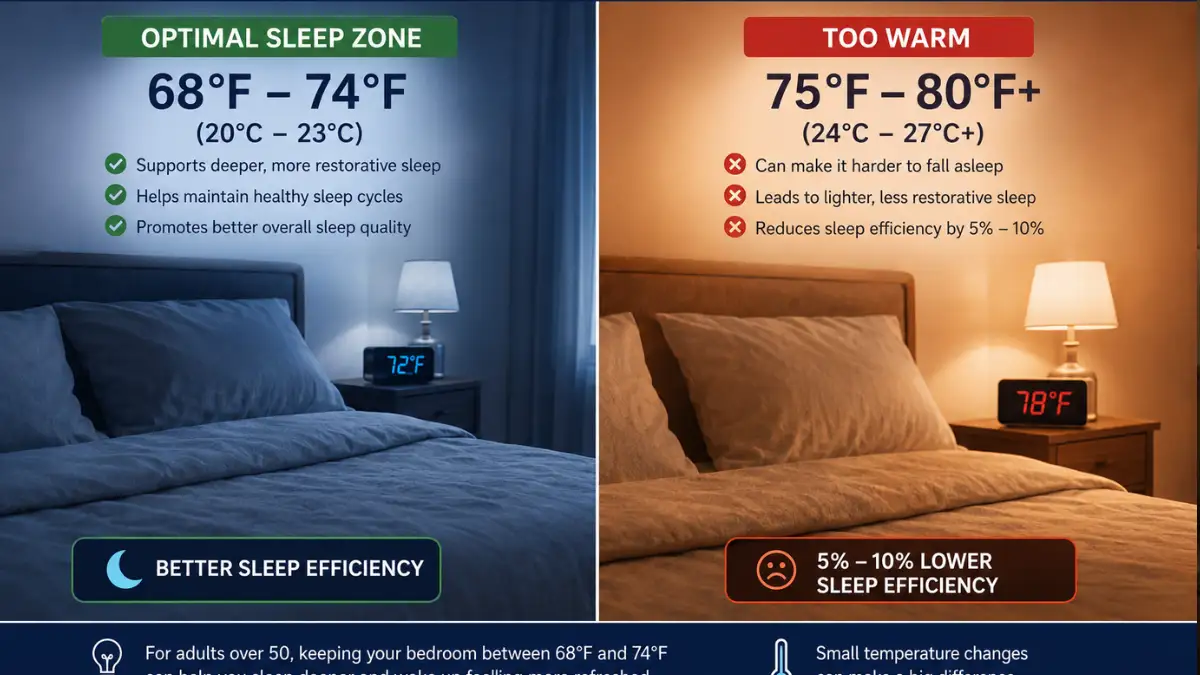
Start with temperature. Set your thermostat to 68–74°F (20–23°C). If you don’t have a programmable thermostat, use a fan pointed at your body and swap heavy bedding for breathable cotton or bamboo.
Don’t go below 65°F. Rooms that get too cold can disrupt sleep for older adults just as much as rooms that are too warm.
Next, handle the light. Install blackout curtains that extend 4 to 6 inches past the window frame on every side. Use blackout tape or curtain clips to close any edge gaps. Even small gaps matter.
In the morning, do the opposite: get bright natural light within 30 minutes of waking. This anchors your circadian rhythm and actually makes the darkness more effective at night.
Light in the morning and darkness at night work together; you need both. Give it one week. That’s enough time to notice a meaningful difference in how often you wake up and how rested you feel.
For product recommendations, the Sleep Foundation (sleepfoundation.org) has blackout curtain buying guides. Wirecutter has vetted picks across price ranges.
Conclusion
Broken sleep after 50 is largely environmental and largely fixable. A cool room (68–74°F) is where to start. Blackout curtains protect your melatonin and stop early light from cutting your sleep short. Together, they address the two most common and most fixable causes of middle-of-the-night waking.
Start tonight: check your thermostat, then look at how much light enters your bedroom at 5 AM. Fix the one that’s clearly off first. Sleep after 50 doesn’t have to mean broken sleep; it usually means your bedroom environment needs adjusting, not your medication.
⚠️MEDICAL DISCLAIMER
This article is for informational purposes only. It does not replace medical advice, diagnosis, or treatment. The information covers bedroom temperature and sleep, thermoregulation in aging adults, circadian rhythm and light sensitivity, melatonin suppression, sleep efficiency, blackout curtains and light exposure, deep sleep and sleep continuity, cardiovascular health and sleep, middle-of-the-night waking, sleep environment setup, and morning light exposure.
Individual results vary based on age, health status, and fitness level. Before changing your sleep environment, routine, or any health-related habit based on this content, talk to your doctor or a qualified health professional first. If you experience chest pain, dizziness, severe discomfort, or any sudden symptoms during the night, stop and seek medical care immediately.