You know the feeling. It’s the same hour, the same wide-awake jolt, the same ceiling staring back at you. For adults over 50 who wake at 3 AM feeling alert or wired, this is not a quirk or a bad stretch of luck.
For adults over 50, waking at 3 AM is often the body’s rising cortisol breaking through sleep that has already grown too shallow to hold it back. Both of those things are at work here: a hormone that rises earlier with age and a sleep structure that no longer holds it back.
By the end, you’ll know why that hour keeps coming up, what’s happening in your body from the moment your head hits the pillow, and what you can change.
| # | Section | What You’ll Find |
|---|---|---|
| 1 | What’s happening before 3 AM | The sleep shift no one warned you about |
| 2 | Why that exact hour | The hormone timing most people never hear |
| 3 | What food adds to the problem | The evening habit that turns up the signal |
| 4 | What your next day is showing you | Your body’s report from the night before |
| 5 | What to change before bed | The evening moves that shift the pattern |
| 6 | When to call a doctor | The line between biology and something more |
What Is Happening in Your Body When You Wake Up at 3 AM After 50
You fall asleep and feel fine. Then you’re wide awake at 3 AM. What happens in between is worth knowing, because the 3 AM wake-up after 50 is not random. It is written into the structure of how your sleep has changed.
Your nights are divided into stages, and where you land by 3 AM depends on how those stages have shifted with age. Sleep runs in cycles of roughly 90 minutes each.¹ Early in the night, those cycles are loaded with the deepest, hardest-to-interrupt sleep stage, called slow-wave sleep [deep, restorative sleep where the brain produces slow delta waves and the body recovers]. It acts as a buffer.
Noise, light, and small shifts in your body’s internal chemistry can’t get through it.
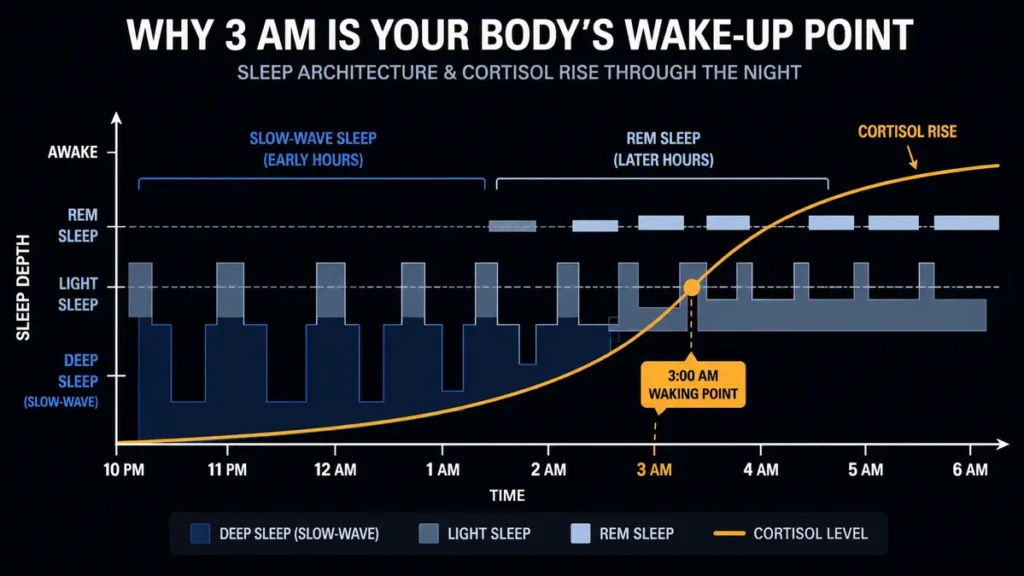
By your 50s, slow-wave sleep has declined significantly. Research following healthy men aged 16 to 83 found that increasing age was associated with elevated evening cortisol levels that became significant after age 50, when sleep became more fragmented and the restorative stages declined.²
Less slow-wave sleep means shallower sleep overall. By 3 AM, you are spending most of your time in REM sleep [rapid eye movement sleep, the lightest stage, during which the brain is active and the body is easy to rouse].² This stage is thin cover. Almost anything can wake you through it.
The shift is gradual and common. It is also invisible until it isn’t. You don’t notice shallower sleep. You notice 3 AM.
What this means for you: the problem didn’t start at 3 AM. It started earlier. The next section explains why that hour in particular is when the hormone signal finally breaks through.
Why 3 AM Is the Exact Hour the Aging Stress System Fires
You’d expect your stress hormone to be quiet at midnight. For younger adults, it mostly is. For adults past 50, it isn’t, and that difference is a big part of why the clock reads 3 AM when your eyes open.
Cortisol [a hormone produced by the adrenal glands that regulates energy, stress response, and the sleep-wake cycle] follows a 24-hour rhythm. It drops to its lowest point in the early hours, a point called the nocturnal nadir [the overnight floor, the point in the night when cortisol is supposed to be at its quietest], then begins rising before dawn to wake you. That rise is normal. What changes with age is where the floor sits.
Research on healthy elderly adults found significantly elevated cortisol and ACTH [adrenocorticotropic hormone, the signal from the brain that tells the adrenal glands to release cortisol] concentrations during early nocturnal sleep, at levels measurably higher than those in young controls (p < 0.001).³
A broader review of aging and the HPA axis [the hypothalamic-pituitary-adrenal axis, the body’s central stress-response system linking the brain to the adrenal glands] confirmed this pattern: normal aging is associated with HPA axis hyperactivity, a decrease in the variation of the cortisol rhythm across the day, and an elevation of the nocturnal floor.⁴
After 50, the body’s overnight cortisol floor rises, which means the stress hormone that should be nearly silent at midnight is already loud enough to pull you out of the lighter sleep that aging has left you with.
The pre-dawn cortisol rise doesn’t start from silence. It starts from elevated ground. By 3 AM, it has crossed enough of a threshold to trigger waking in sleep that no longer has the deep buffer of slow-wave stages to absorb it.
You didn’t make this happen. But you can change some of what feeds it.
What Blood Sugar and Evening Eating Add to the Problem After 50
What you eat, and when you eat it, matters more at night than most people realize. If cortisol’s overnight rise is the main switch, blood sugar instability is a second hand pushing the same switch.
Glucose [blood sugar, the brain’s main fuel source] needs to stay stable through the night. When it drops, the body treats it as a low-fuel alert. The response is immediate: it releases cortisol and adrenaline to bring blood sugar back up.
Research in healthy non-diabetic adults found that the cortisol response to a blood sugar drop is stronger at nighttime than it is in the morning.⁵
A dinner eaten at 6 PM leaves the body nine hours without food by 3 AM. That’s a long window for blood sugar to drift down, especially if the evening meal was light or heavy on simple carbohydrates.
Alcohol adds a separate layer. It may help you fall asleep, but research shows it is associated with disrupted sleep architecture during the second half of the night, shifting the body toward lighter sleep stages right around the time cortisol is already beginning its pre-dawn climb.⁶
This doesn’t mean eating a large meal late at night. It means a small, mixed snack before bed with protein and a source of fat may help stabilize blood sugar through the night.

Talk to your doctor before changing your evening eating habits if you manage diabetes, take insulin, or are on medications that affect blood sugar.
Quick check — evening habits that raise 3 AM risk:
- Last meal before 6 PM with no snack before bed
- Alcohol within three hours of sleep
- Evening meals high in refined carbohydrates and low in protein
- Long gaps between dinner and bedtime
The next section shows what those evening habits look like the morning after.
What the Day After a 3 AM Wake-Up Is Telling You
The next morning is its own kind of evidence. If you wake at 3 AM and then drag through the day feeling anxious, foggy, or flat, that pattern isn’t separate from what happened at night. It’s confirmation of it.
A rough night doesn’t leave you at the same baseline the next morning. It is associated with elevated daytime cortisol levels in older adults.⁷
Research suggests that excessive HPA axis activation is associated with sleep fragmentation, and sleep fragmentation in turn is linked to higher cortisol levels, a self-reinforcing loop.⁸
Brain fog [difficulty concentrating, slower mental processing, or a sense of mental cloudiness] after a poor night is one of the most common daytime signs.

Research in older adults has found that elevated basal cortisol levels are associated with dysfunction in the hippocampus [the brain region most involved in forming new memories] and prefrontal cortex [the region responsible for attention, planning, and decision-making].⁹
A longitudinal study following aging adults found that persistent cortisol elevations were associated with reduced hippocampal volume and deficits in memory tasks compared to normal-cortisol controls.¹⁰
Midday anxiety, irritability with no clear cause, and reaching for caffeine or sugar by 10 AM are common the day after a 3 AM wake-up.
The next section turns what you’ve learned into actions you can take before tonight.
What You Can Do in the Evening to Change What Happens at 3 AM
Most approaches to sleep focus on the bedroom. The bigger window is actually the hours before you get there.
Move during the day. A systematic review and meta-analysis found that physical activity interventions are associated with reduced cortisol levels and improved sleep quality.¹¹ Morning or midday exercise is the better timing choice.

Manage accumulated stress before evening. A study of adults aged 45 and older assigned to telephone-based stress management or exercise interventions found improvements in cortisol dynamics over four months compared to baseline.¹² The mechanism is the same in both cases: lowering the day’s cortisol load reduces how high the overnight floor sits.
Eat something before bed. A small snack with protein and fat, a few nuts, a piece of cheese, or a hard-boiled egg, can help stabilize blood sugar through the night without overloading digestion.
Set a consistent wake time. Going to bed at the same time matters less than getting up at the same time. A fixed rise time is associated with stronger circadian rhythm signaling, which may help reduce variability in the body’s pre-dawn cortisol timing.¹³

Cut alcohol three hours before sleep. For anyone waking up at 3 AM after 50, this is one of the most direct changes to make.
Reduce evening light exposure. Bright screens within an hour of bed suppress melatonin [a hormone that signals the brain it is time to sleep], which is associated with delayed sleep onset and compressed deep sleep stages that would otherwise absorb the pre-dawn cortisol rise.¹⁴

What you still need to know is when these steps aren’t enough and a doctor needs to be part of the picture.
When 3 AM Waking Signals Something a Doctor Needs to Evaluate
Most 3 AM wake-ups are the cortisol-sleep architecture story described above. Some are a signal that something else is happening, and that something responds to treatment.
The threshold doctors use for chronic insomnia is waking at least three nights per week for three months or longer.¹⁵ Below that, the disruption is more likely situational.
Above it, the pattern has crossed into a clinical range worth investigating. If you’ve been waking most nights for months and feel it affecting your daily function, that’s the conversation to take to your doctor.
Sleep apnea [a condition in which breathing repeatedly stops and starts during sleep, disrupting the sleep cycle and fragmenting rest] is underdiagnosed and common.
Research suggests that sleep apnea prevalence increases significantly with age and may affect a substantial portion of older adults at a threshold of five or more breathing interruptions per hour, with estimates varying widely across studies.¹⁶
Most people who have it don’t know. Warning signs include snoring, waking up gasping, waking with a headache, or extreme daytime fatigue even after what feels like a full night’s sleep.

Advanced sleep-wake phase disorder [a circadian condition in which the body’s internal clock is set several hours earlier than a normal schedule] is particularly common in older adults. People with this condition feel sleepy in the early evening and wake spontaneously between 3 AM and 5 AM, not because of cortisol dysregulation but because their biological clock has shifted its timing.¹⁷
It looks like a cortisol problem from the outside. A sleep specialist can distinguish between the two.
Night sweats, acid reflux that wakes you, needing to urinate two or more times per night, and a pounding heart at waking each warrant their own evaluation.¹⁸
A two-week sleep log that tracks your wake times, symptoms, and how you feel the next day is useful to bring to that appointment.
Conclusion
The most important action you can take today is to start tracking. Keep a two-week log of your 3 AM wake-ups, what you ate the evening before, and how you felt the next day, then bring it to your doctor if it is happening three or more nights per week.
Waking up at 3am after 50 is not simply aging. It is the body’s stress system and sleep structure interacting in a way that has specific causes and real responses. The log gives you and your doctor something concrete to act on.
References
- Sleep Foundation. How sleep works. https://www.sleepfoundation.org/how-sleep-works
- Age-related changes in slow wave sleep and REM sleep and relationship with growth hormone and cortisol levels in healthy men. JAMA. 2000;284(7):861-868. https://pubmed.ncbi.nlm.nih.gov/10938176/
- Basal secretory activity of the hypothalamo-pituitary-adrenocortical axis is enhanced in healthy elderly. An assessment during undisturbed night-time sleep. PubMed. 1994. https://pubmed.ncbi.nlm.nih.gov/7952154/
- Aging and the role of the HPA axis and rhythm in sleep and memory-consolidation. Sleep Medicine Clinics. 2013. https://www.sciencedirect.com/science/article/abs/pii/S1064748112614201
- Differences between nighttime and daytime hypoglycemia counter regulation in healthy humans. PubMed. 2004. https://pubmed.ncbi.nlm.nih.gov/15254883/
- Alcohol and sleep I: effects on normal sleep. Alcoholism: Clinical and Experimental Research. 2012. https://pubmed.ncbi.nlm.nih.gov/23347102/
- Physiology and Diseases of the Hypothalamic-Pituitary Axis in the Elderly. NIH/NCBI Bookshelf (Endotext). 2025. https://www.ncbi.nlm.nih.gov/books/NBK620038/
- Interactions between sleep, stress, and metabolism: From physiological to pathological conditions. PMC. 2015. https://pmc.ncbi.nlm.nih.gov/articles/PMC4688585/
- The association of basal cortisol levels with episodic memory in older adults is mediated by executive function. PubMed. 2022. https://pubmed.ncbi.nlm.nih.gov/35182737/
- Cortisol levels during human aging predict hippocampal atrophy and memory deficits. Nature Neuroscience. 1998;1(1):69-73. https://radiology.weill.cornell.edu/research/publications/cortisol-levels-during-human-aging-predict-hippocampal-atrophy-and-memory
- The effects of physical activity on cortisol and sleep: A systematic review and meta-analysis. Psychoneuroendocrinology. 2022. https://www.sciencedirect.com/science/article/pii/S0306453022001846
- Effects of health behavior interventions on psychosocial outcomes and cortisol regulation among chronically stressed midlife and older adults. PubMed. 2021. https://pubmed.ncbi.nlm.nih.gov/33495978/
- HPA axis and sleep. NIH/NCBI Bookshelf (Endotext). 2020. https://www.ncbi.nlm.nih.gov/books/NBK279071/
- Sleep in normal aging. Sleep Medicine Clinics. PMC. 2018. https://pmc.ncbi.nlm.nih.gov/articles/PMC5841578/
- Chronic Insomnia. NIH/NCBI Bookshelf (StatPearls). 2025. https://www.ncbi.nlm.nih.gov/books/NBK526136/
- Prevalence of obstructive sleep apnea in the general population: A systematic review. Sleep Medicine Reviews. 2016. https://www.sciencedirect.com/science/article/abs/pii/S1087079216300648
- Sleep Foundation. Insomnia and older adults. https://www.sleepfoundation.org/insomnia/older-adults
- Cleveland Clinic. Why you keep waking up at 3 a.m. https://health.clevelandclinic.org/why-do-you-always-wake-up-at-3-a-m