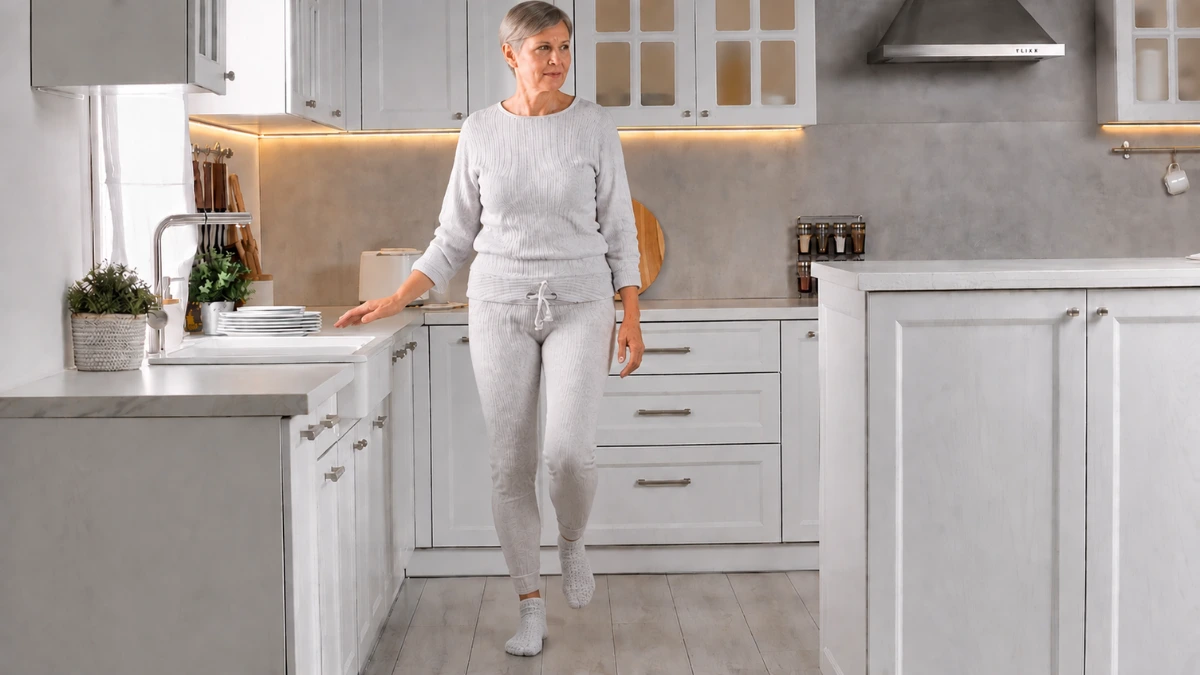
Stand on one leg right now. No hands. Time yourself. If you couldn’t hold 10 seconds, you’re not alone, and you’re not out of options.
A 2022 study published in the British Journal of Sports Medicine tracked 1,702 adults aged 51–75 and found that failing the 10-second single-leg balance test was independently linked to a higher risk of all-cause mortality.¹
Balance isn’t something that disappears overnight. It fades slowly, starting in your 50s, long before most people notice. And by the time a fall happens, the warning signs are already there.
This guide gives you a 3-phase single-leg training protocol for fall prevention after 50. No gym. No equipment. Just a counter, some floor space, and 20 minutes, three days a week.
Why Read This
- The balance test you can do right now tells you more about your future health than most people realize
- Why closing your eyes during exercise is the step that actually trains the system that catches you when you fall
- The one muscle group most people never train that decides whether a stumble becomes a fall
- What the research from the Baltimore Longitudinal Study found about who falls next and when
The information in this article is for educational purposes only and is not a substitute for professional medical advice, diagnosis, or treatment. Always consult your doctor or a qualified healthcare provider before starting any new exercise program, especially if you have a medical condition, have experienced recent falls, or are taking medications that may affect your balance. The exercises described are intended as general guidance only. Individual results may vary.
Why Falls Are a Silent Health Crisis After 50?
Falls are the leading cause of injury-related death among adults 65 and older. In 2023, the fall death rate reached 69.9 per 100,000 older adults.²
The age-adjusted death rate has risen 21% since 2018, and that number is still climbing.³ The financial cost is just as serious.
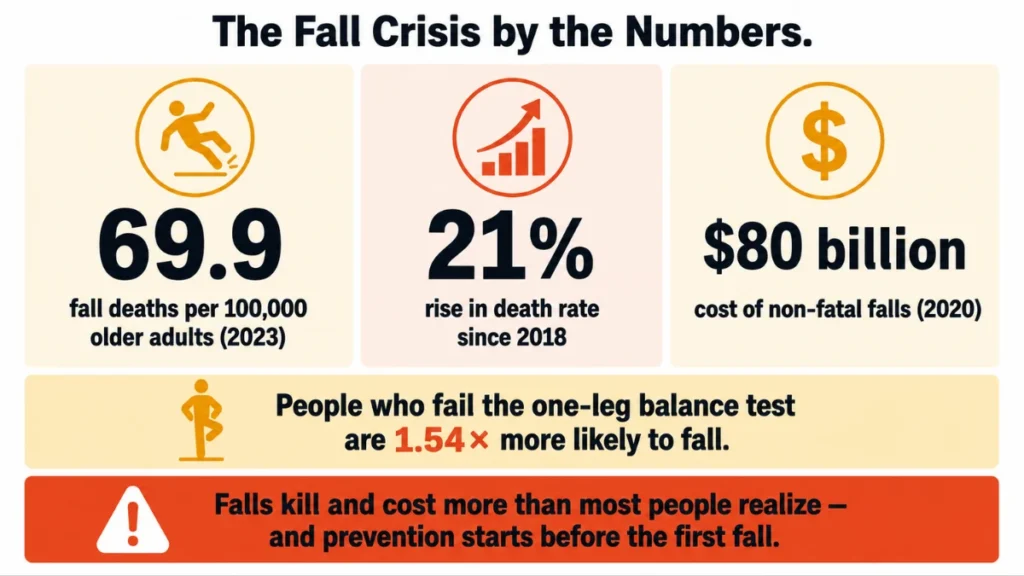
Non-fatal falls cost the U.S. healthcare system $80 billion in 2020.⁴ Most prevention only kicks in after someone has already fallen.
But research from the Baltimore Longitudinal Study of Aging (952 adults aged 60–97) found that people who failed the single-leg stance test had 1.54 times greater odds of falling in the future.⁵
The warning signs show up long before the fall. And it’s not just a problem for people in their 70s. Balance decline begins in your 50s, not your 70s.
Women in their 50s already show measurable difficulty with the eyes-closed single-leg stance. Balance is a trainable skill. It is not a fixed trait. That’s the point of this guide.
What’s Actually Happening Inside Your Body After 50
Every time you stumble, your brain fires electrical signals down your spine and into your legs in a fraction of a second. After 50, that chain gets slower. Proprioception is your body’s internal GPS.
It tells you where your feet are, how your weight is shifted, and when to correct your balance.
Picture a signal running between your feet and your brain. After 50, that signal weakens. Balance training strengthens it.
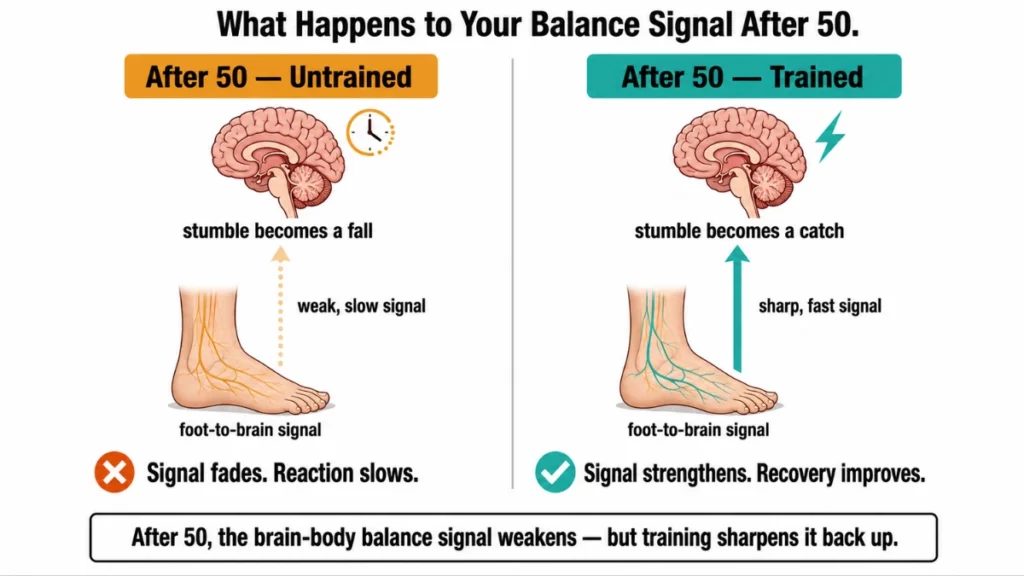
After 50, muscle mass gradually decreases with age. By the time most people reach their 70s, that loss becomes noticeable. But it’s not just size; muscles also contain tiny sensors called spindles that send feedback to the brain.⁶
When spindle sensitivity drops, the brain gets slower, fuzzier signals.⁶ Your reaction time to a stumble slows down.
Research published in Biology (Basel) (2025) suggests that age-related changes may include reduced spindle sensitivity, altered afferent feedback, and diminished central processing efficiency.⁶
All of which affect how fast you respond when something goes wrong. These systems respond to training.
Your brain and muscles can rebuild that communication at any age. Every single-leg stand you practice sends a signal to your nervous system: stay sharp.
The 3-Phase Single-Leg Training Protocol
This protocol builds from the ground up. Each phase adds a new layer of challenge. Don’t skip ahead; every phase prepares your body for the next one.
Phase 1: Static Single-Leg Stands. Build the Foundation
Phase 1 installs the foundation. This is where your body learns to shift and hold weight on one leg without panicking.
Talk to your doctor before starting this protocol if you are on medication, managing a chronic condition, or have had a recent fall.
The Movement:
- Stand near a sturdy counter, wall, or heavy chair.
- Place feet hip-width apart.
- Slowly lift one foot off the floor.
- Hold. Return. Switch legs.
The Goal: Hold 10–30 seconds on each leg.
The Progression Ladder:
- Weeks 1–2: Hold the counter lightly. Eyes open.
- Weeks 3–4: Release your grip. Eyes open.
- Week 5+: Let go fully. Close your eyes. This forces your vestibular system (inner ear) and proprioception to do all the work.
Why does the eyes-closed step matter so much? Because in real life, you don’t always see the curb you just stepped off. Closing your eyes removes your visual crutch and trains the systems that actually catch you when things go wrong.
Quick Self-Test: Set a timer. Stand on your non-dominant leg, hands on hips.
- Under 10 seconds: start here.
- 10–30 seconds: you’re ready for Phase 2.
- Over 30 seconds with eyes closed: skip to Phase 3.
Johns Hopkins Medicine includes single-leg stands in its recommended balance exercise progression for fall prevention.⁷
Phase 2: Dynamic Weight-Shifting and Directional Reaches – Make Balance Functional
Phase 2 makes your foundation functional. Static balance keeps you standing. Dynamic balance keeps you from falling while you’re moving, which is when falls actually happen.
The Movement:
- Balance on one leg, holding a stable surface if needed.
- Slowly reach your free leg forward, then return to center.
- Reach it backward, then return.
- Reach it to the side, then return.
- Tap the floor gently each time before coming back.
The trainer in the video includes a couple of extra diagonal taps at the end of her circle (0:07 and 0:10). Don’t worry about those for now; just focus on mastering the main three directions: forward, side, and straight back.
The Goal: 5–10 taps in each direction, per leg.
The Progression: Once you can complete all directions with support, let go. Without something to hold, your hips and core engage much harder. That’s the training.
Think about the moments when falls actually happen. Stepping out of a shower. Reaching into a high cabinet while standing on one foot. Stepping sideways off a bus. All of those involve a shift in your center of gravity, exactly what this phase trains.
Common mistake to avoid: Don’t let your standing hip drop outward. That’s a sign of a weak glute medius, one of the key muscles that stabilizes your mid-step. Keep your hip level and your gaze fixed on a wall, not the floor.
Multi-directional reach training is a core component of balance work for older adults.
Phase 3: Single-Leg Step-Ups and Romanian Deadlifts – Bulletproof the Legs
Phase 3 makes you bulletproof. This is where you add load to the single-leg system. It trains the glutes, hamstrings, and ankles, the muscles that catch you mid-stumble when nothing else can.
Movement A: Single-Leg Step-Up
- Stand sideways next to a low step (4–8 inches high).
- Place your inside foot on the step.
- Press through your heel to lift your body.
- Balance briefly on that one leg at the top.
- Step back down slowly. That’s one rep.
The Goal: 3 sets of 8–10 reps per leg.
Use a low step, not a full step. A sturdy step platform or even a thick hardcover book works. The shorter height is safer and loads the hip just as well.
Your Weekly Training Schedule
This fits into your week without rearranging your life. Train 3 days per week. Take at least one rest day between sessions.
| Week | Monday | Wednesday | Friday/Saturday |
|---|---|---|---|
| 1–2 | Phase 1 only | Phase 1 only | Phase 1 only |
| 3–4 | Phase 1 + 2 | Phase 1 + 2 | Phase 1 + 2 |
| 5+ | All 3 Phases | Phase 1 + 2 | All 3 Phases |
Each session takes 15–25 minutes. That’s less time than a sitcom episode.
Before every session, run through this safety checklist:
- Clear rugs, cords, and loose items from your training area
- Wear close-toed shoes with grip soles: no socks on wood floors, no sandals
- Keep a counter, wall, or heavy chair within arm’s reach
- Don’t train when you’re very tired or after alcohol

Research consistently shows that exercise programs combining balance and strength training can meaningfully reduce fall risk compared to doing nothing. Training at least three times per week for more than 12 weeks appears to produce the strongest results. That is roughly the same commitment as finishing a short TV series.
How to Know the Protocol Is Actually Working
Remember that opening test? The 10-second single-leg stand? That’s your measuring stick. Retest yourself every 4 weeks. If you started at 6 seconds and you’re now hitting 15, that’s real, measurable progress. Write it down.
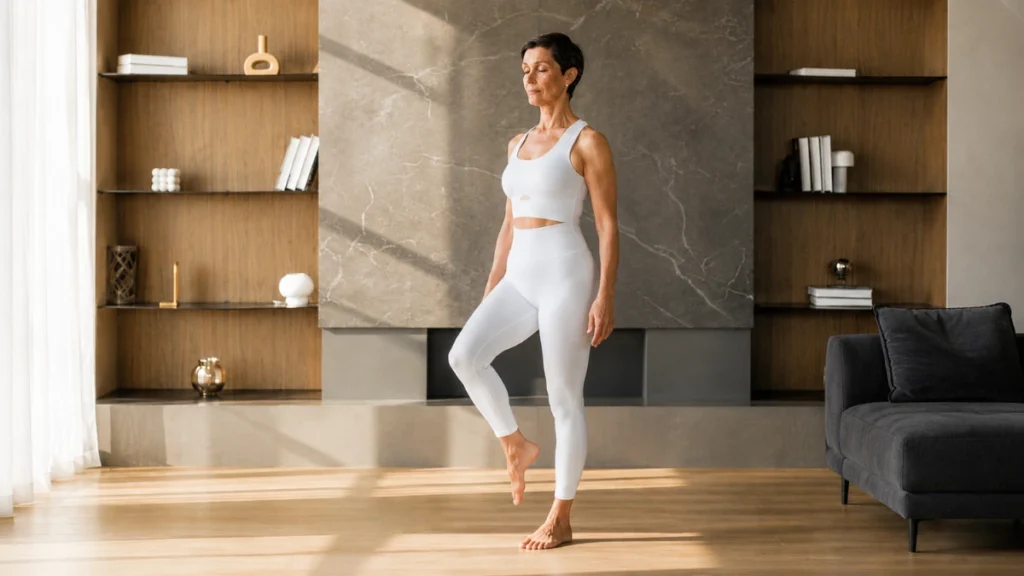
Note: This image is for demonstration purposes. Always practice with close-toed shoes with grip soles, especially on hard floors.
Other signs the protocol is working:
- Less wobbling when you stand on one leg
- More confidence on stairs and uneven surfaces
- You’re reaching for handrails less often
- When you stumble, you catch yourself instead of going all the way down
That last one matters most. The goal isn’t to stumble, it’s to have the reflexes to recover when you do.
When to see a professional first: If you experience sudden dizziness, numbness in your feet or legs, unexplained worsening of balance, or you’re on medications that affect balance, see a physical therapist before starting Phase 3.
The CDC’s STEADI toolkit (cdc.gov/STEADI) is a free clinical resource that helps providers assess fall risk and build a plan.
Red flags: stop and get guidance:
- Sharp joint pain during any movement
- Sudden, new dizziness or vertigo
- Any fall during training
Progress won’t announce itself loudly. It shows up quietly when you step off a curb without thinking twice, or catch the edge of a rug without going down. That’s the protocol working.
Start Tonight. One Foot. One Rep.
Falls aren’t inevitable. They’re largely preventable if you act before one forces your hand. The 3-phase single-leg training protocol for fall prevention after 50 takes 20 minutes, three days a week. Start Phase 1 tonight. Stand near your counter. Lift one foot. Start the clock. That’s Rep 1.
References
- Araujo CG, de Souza E Silva CG, Laukkanen JA, Fiatarone Singh M, Kunutsor SK, Myers J, Franca JF, Castro CL. Successful 10-second one-legged stance performance predicts survival in middle-aged and older individuals. Br J Sports Med. 2022. https://pubmed.ncbi.nlm.nih.gov/35728834/
- Garnett MF, Weeks JD, Zehner AM. Unintentional Fall Deaths in Adults Age 65 and Older: United States, 2023. NCHS Data Brief No. 532. 2025. https://www.cdc.gov/nchs/products/databriefs/db532.htm
- Centers for Disease Control and Prevention, National Center for Health Statistics. Older Adult Falls Data. 2026. https://www.cdc.gov/falls/data-research/index.html
- Haddad YK, Miller GF, Kakara R, Florence C, Bergen G, Burns ER, Atherly A. Healthcare spending for non-fatal falls among older adults, USA. Inj Prev. 2024. https://pmc.ncbi.nlm.nih.gov/articles/PMC11445707/
- Brown C, Oktapodas Feiler M, Anson ER, Simonsick EM. Narrow Walk, Condition II, Semi-Tandem, Tandem, and Single Leg Stance Test Failure Could Predict Falls in Older Adults. Inquiry. 2025. https://pmc.ncbi.nlm.nih.gov/articles/PMC12234881/
- Oleksy L, Mika A, Sopa M, Stolarczyk A, Adamska O, Zyznawska J, Buryta R, Ciepiela P, Witkowski J, Kielnar R. Proprioceptive Control of Muscle Activation in Aging: Implications for Balance and Fall Risk. Biology (Basel). 2025. https://pmc.ncbi.nlm.nih.gov/articles/PMC12189530/
- Johns Hopkins Medicine. Fall Prevention: Balance and Strength Exercises for Older Adults. Johns Hopkins Medicine. 2026. https://www.hopkinsmedicine.org/health/wellness-and-prevention/fall-prevention-exercises