
You’re lying in a dark, quiet room at 2 a.m. with every condition technically right. You dimmed the lights. You had the tea. You skipped the screens. You even took a bath.
Your body is exhausted and your brain won’t stop. That combination has a name: tired but wired, and after 50 it has a specific biological cause. The routines most sleep experts recommend were built for younger nervous systems, and after 50 they can quietly work against you.
If you’re one of the health-conscious adults over 50 who already have a bedtime routine and still wake up exhausted, this is not a discipline problem and it is not simply aging. The routine itself is misfiring. Here’s exactly where, and what to swap tonight.
Your Bedtime Routine After 50 Was Built for Someone Younger
Your bedtime routine isn’t the problem, it was built for someone younger.
The standard sleep checklist has been around for decades. Dim the lights. No screens. Warm bath. Herbal tea. Calm reading. Good advice. Tested advice. Advice built almost entirely on studies of people in their 20s and 30s.
The biology shifts. By your mid-fifties, you may be spending less than four percent of the night in slow-wave sleep [the deepest stage of sleep, when your body repairs tissue and your brain consolidates memory]. In your twenties, that number was close to 19 percent.¹
That is not a small difference. It changes what kind of sleep is even physically possible.
The habits on the standard checklist were designed to calm a nervous system that was too stimulated. After 50, that is often not the problem. The problem has flipped. A routine aimed at the wrong target doesn’t just fail. It can actively get in the way.
Four specific habits inside most routines are misfiring right now. The first one starts with a chemical your brain can no longer hear clearly.
Why You Feel Exhausted All Day but Still Can’t Get Deep Sleep
Your brain still makes the chemical that pushes you toward deep sleep, but after 50 it can’t hear the signal as well.
That chemical is adenosine [a chemical your brain builds up while you’re awake that creates pressure to sleep deeply].
Every hour you stay awake, adenosine accumulates. When it reaches a high enough level, it signals your brain to drop into slow-wave sleep [the deepest stage of sleep, when your body repairs tissue and your brain consolidates memory].
This is your homeostatic sleep pressure [your brain’s built-in drive to sleep deeply, which builds with every hour you stay awake] doing its job.
Here is where sleep problems after 50 get complicated. After midlife, your brain’s adenosine A1 receptors [the brain’s receiving stations that pick up the sleep-pressure signal from adenosine] begin to decline. The signal is still being sent. Your brain just can’t receive it as clearly.²
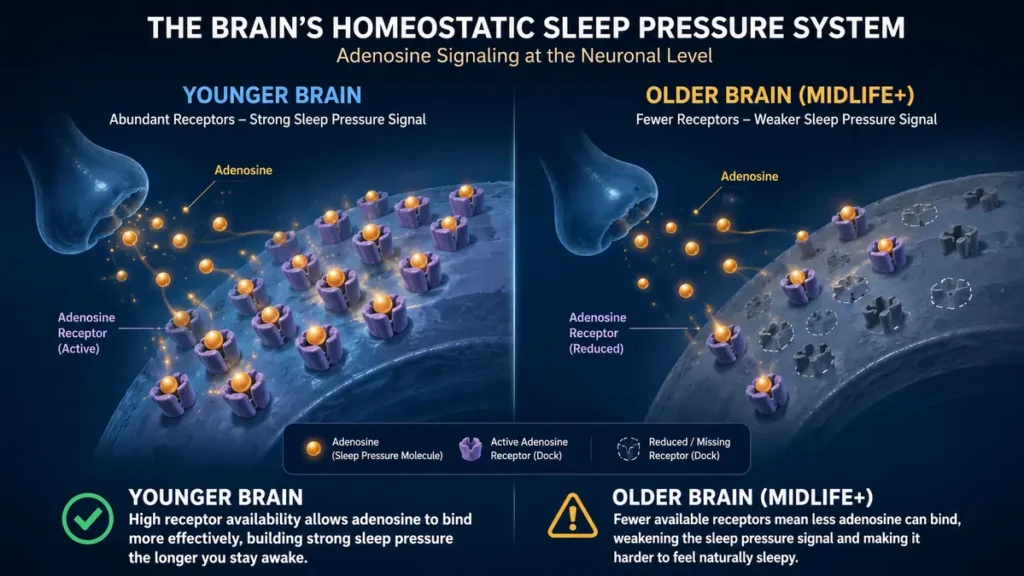
Tired is not the same as sleep-ready. You can feel worn out all day and still not have enough biological sleep pressure to pull you into deep, restorative sleep at night.
This is the part almost no sleep article mentions. Winding down before bed works best when sleep pressure is already high. When the receivers are weakened, winding down alone can’t carry the load.
So if relaxing isn’t the full answer, what creates the right signal?
Your Body Clock Has Moved Two Hours Earlier, and Nobody Told Your Routine
After 50, your body clock genuinely moves earlier, and most bedtime routines never move with it.
This shift has a name: circadian phase advance [a biological shift that moves your body clock earlier than it ran when you were younger]. It is not a preference. It is not simply becoming a morning person.
Research confirms it is a measurable biological change that begins in your forties and becomes more pronounced through your fifties.³
The window closes early. Your body’s internal sleep window may have shifted up to two hours earlier than it was when you were 35.³
Here is why that matters. If your body’s optimal sleep window now opens at 9:30 p.m. but your routine still starts at 10:30 p.m., you are beginning your wind-down after the biological window has already started closing. You are not falling asleep in a rising tide. You are paddling against one.
This is the moment many readers send to a partner or a friend. The problem isn’t that you can’t sleep. The problem is that you’re going to bed at the right time for the person you were 20 years ago.
One of the most common habits inside the routine has a specific timing problem tied directly to this shift.
The Warm Bath Works, But Almost Everyone Takes It at the Wrong Time
A warm bath before bed really can help you sleep, but most people take it at the wrong time.
The bath doesn’t work because it feels relaxing. It works because of vasodilation [the widening of blood vessels near the skin that lets body heat escape]. Warm water draws blood to the surface of your skin.
That pulls heat away from your body’s core. Your core temperature drops. That drop is one of the clearest signals your brain uses to begin the sleep process.
If you’ve ever asked yourself why can’t I sleep through the night despite doing everything right, this timing gap may be the answer.
A large study of more than 1,000 older adults found that a hot bath shortened the time it took to fall asleep, but only when taken 61 to 120 minutes before bed.⁴ Outside that window, the benefit disappeared entirely.
Most people take their bath 10 to 20 minutes before getting in bed. The cooling response hasn’t had time to complete. The signal never fully lands.

The 90-Minute Bath Rule Use this tonight. Move your bath to exactly 90 minutes before your target bedtime.
- Water temperature: 104 to 109 degrees Fahrenheit
- Duration: 10 to 20 minutes
- After the bath: stay in a cool, dim room and do not reheat
- If you currently bathe right before bed, move it back by one full hour this week
- Track how quickly you fall asleep over seven nights
The bath timing is a one-night fix. But there is a second habit creating a harder problem, and it involves light you are probably not thinking about.
It Isn’t Just Your Phone, Your Living Room Lamp Is Keeping You Awake
It isn’t just your phone keeping you awake, your living room lamp is doing it too.
Most people already know screens are a problem before bed. What fewer people know is that ordinary room lighting suppresses melatonin [the hormone your brain releases in the evening to signal that sleep time is coming] in older adults just as powerfully.
The phase-advanced clock makes this worse. Because your body clock has already shifted earlier, your brain is trying to release melatonin at an earlier hour than before.
A study of adults aged 56 to 74 found that typical indoor lighting of around 90 lux, which is standard living room brightness, delayed the observed time of melatonin onset on evenings when participants were in lit rooms.⁵ That is not a screen issue. That is your floor lamp.

Reading on a backlit e-reader before bed delays your body’s circadian clock by more than one hour, cuts melatonin secretion, and reduces REM sleep [the lighter, dreaming stage of sleep tied to emotional recovery and memory] compared to reading a printed book.⁶
The reading itself is not the problem. The light source is.
The fix is more precise than “no screens.” It involves your light habits during the day as much as before bed, and the full protocol is next.
5 Swaps That Fix the Bedtime Routine After 50 Tonight
Here are five specific swaps you can make tonight, each one fixing a different part of the routine that’s misfiring.
Before you start: talk to your doctor before changing your supplement routine if you are on medication, managing a chronic condition, or pregnant.
This is how to improve sleep quality over 50 by fixing the biological mismatches one at a time, not by adding more habits on top of ones that are already broken.

The 5-Swap Protocol
Swap 1: Move your bath to 90 minutes before bed. Fixes the vasodilation timing gap. Lets your core temperature drop fully before you lie down.
Swap 2: Dim all room lighting 90 minutes before bed. Fixes melatonin suppression from ordinary lamps, not just screens. Use bulbs at 30 lux or lower, or switch to warm amber lighting after 8 p.m.
Swap 3: Move your target bedtime 30 minutes earlier. Fixes the circadian phase advance mismatch. Test for seven nights. If you wake earlier but feel more rested, the shift is working.
Swap 4: Drink chamomile 60 minutes before bed, not right before. Fixes the absorption timing problem. Apigenin [the active compound in chamomile that binds to calming receptors in the brain] needs time after you drink it to reach the brain. A review of 10 trials covering 772 participants found chamomile improved sleep quality scores, but most people drink it too late for the active compound to work.⁷
Swap 5: Switch to a printed book or audio-only content. Fixes the blue-light delay caused by backlit e-readers and tablets.
Swap 3, the timing shift, produces the fastest result for most people. It is also the one most people skip because it feels too simple.
The danger isn’t that these swaps are hard. The danger is stopping after just one.
Conclusion
Start tonight with Swap 3: move your bedtime 30 minutes earlier and time your bath 90 minutes before that new time.
Tonight, take the last 60 minutes before bed and swap just one habit using the age-calibrated protocol above, one change, one night, and your nervous system will begin to feel the difference. The standard bedtime routine after 50 was never designed for your biology, and now you know exactly where it breaks down and how to improve sleep quality over 50 starting tonight.
You’ve been doing the right things. You were just working from the wrong instructions.
⚠️MEDICAL DISCLAIMER
This article is for informational purposes only. It does not replace medical advice, diagnosis, or treatment. The information covers bedtime routine, sleep quality, slow-wave sleep, adenosine, homeostatic sleep pressure, circadian phase advance, melatonin, body temperature regulation, chamomile supplementation, evening light exposure, sleep timing, age-related sleep changes.
Individual results vary based on age, health status, and fitness level. Before changing your exercise routine, diet, or supplement use, talk to your doctor or a qualified health professional first. If you experience chest pain, dizziness, severe joint pain, or any sudden symptom during or after exercise, stop immediately and seek medical care.
References
- Van Cauter E, Leproult R, Plat L. Age-related changes in slow wave sleep and REM sleep and relationship with growth hormone and cortisol levels in healthy men. JAMA. 2000;284(7):861-868. https://pubmed.ncbi.nlm.nih.gov/10938176/
- Mander BA, Winer JR, Walker MP. Sleep and human aging. Neuron. 2017;94(1):19-36. https://pubmed.ncbi.nlm.nih.gov/28384471/
- Duffy JF, Dijk DJ, Hall EF, Czeisler CA. Phase advance of sleep and temperature circadian rhythms in the middle years of life in humans. Journal of Biological Rhythms. 2002;17(1):58-67. https://pubmed.ncbi.nlm.nih.gov/11849749/
- Obayashi K et al. Hot-water bathing before bedtime and shorter sleep onset latency are accompanied by a higher distal-proximal skin temperature gradient in older adults. Journal of Clinical Sleep Medicine. 2021. https://pubmed.ncbi.nlm.nih.gov/33645499/
- Arrona-Palacios A, Lee J-H, Czeisler CA, Duffy JF. The timing of the melatonin onset and phase angle to sleep onset in older adults after uncontrolled vs. controlled lighting conditions. Clocks and Sleep. 2023;5(3). https://pubmed.ncbi.nlm.nih.gov/37489435/
- Chang A-M, Aeschbach D, Duffy JF, Czeisler CA. Evening use of light-emitting eReaders negatively affects sleep, circadian timing, and next-morning alertness. Proceedings of the National Academy of Sciences. 2015;112(4):1232-1237. https://www.pnas.org/doi/10.1073/pnas.1418490112
- Akhgarjand C et al. Effects of chamomile on sleep: A systematic review and meta-analysis of clinical trials. Phytotherapy Research. 2024. https://www.sciencedirect.com/science/article/pii/S0965229924000591