

You’ve had your cholesterol checked. You watch your blood pressure. You probably know your resting heart rate. But there’s a good chance your doctor has never once asked how often you feel lonely, and that gap matters more than most people realize.
Adults over 50 who manage their heart health carefully rarely hear loneliness come up at a cardiac appointment, even though research now connects loneliness and heart health after 50 in ways that matter.
This article explains what that risk actually is, how it works inside the body, and what you can say to your doctor at your next visit to start that conversation.
| # | What’s Coming | Open Question |
|---|---|---|
| 1 | The gap your doctor misses | Why isn’t this on any risk checklist? |
| 2 | What loneliness does inside | How does feeling lonely stress the heart? |
| 3 | Duration changes everything | Does it matter how long you’ve felt this way? |
| 4 | The direct biological chain | Does behavior explain the whole risk? |
| 5 | What you can track at home | Can you catch this without a lab test? |
| 6 | What to say at your appointment | How do you actually raise this with a doctor? |
The Heart Risk Your Doctor Has Never Measured
If you’ve had a cardiac workup, you know the list: cholesterol, blood pressure, blood sugar, smoking history, age, family history. Loneliness and heart health after 50 are not on that list. They have never been on any standard cardiac risk calculator.
That omission may be a problem. A prospective study of 5,397 men and women over 50, tracked across England for more than five years, found that loneliness was associated with a 27% higher risk of developing heart disease or stroke, independently of every traditional cardiovascular risk factor on the checklist above.¹
Researchers controlled for blood pressure, cholesterol, smoking, diabetes, and more. The association held.

What the finding revealed was not what most people would expect. The study tested both loneliness and objective social isolation (that is, the actual count of social contacts) in the same group. Social isolation was not associated with increased cardiac risk. Loneliness was.¹
This is the distinction that almost every consumer article on this topic collapses into a single “being alone is bad” message. The research says something more specific: it’s the feeling of disconnection that registers as a risk factor, not the number of people in your life.
You can be surrounded by family and still be lonely. You can live alone and not be lonely at all.
No standard cardiac risk tool asks you how you feel inside your relationships. That’s the gap.
What Loneliness Actually Does Inside the Heart
Most people picture stress as something that shows up in behavior: eating badly, sleeping less, skipping exercise. The biology of loneliness runs deeper than that.
Loneliness does not appear on any standard cardiac risk calculator, but the evidence now suggests it belongs there.
When you feel chronically disconnected, your body reads that as a threat.² It activates the HPA axis [the hypothalamic-pituitary-adrenal axis, the brain-to-adrenal-gland chain that controls your stress hormone output] and the sympathetic nervous system [the part of the nervous system that triggers the “fight or flight” response].²
Cortisol rises. Heart rate goes up. Blood vessels tighten.²
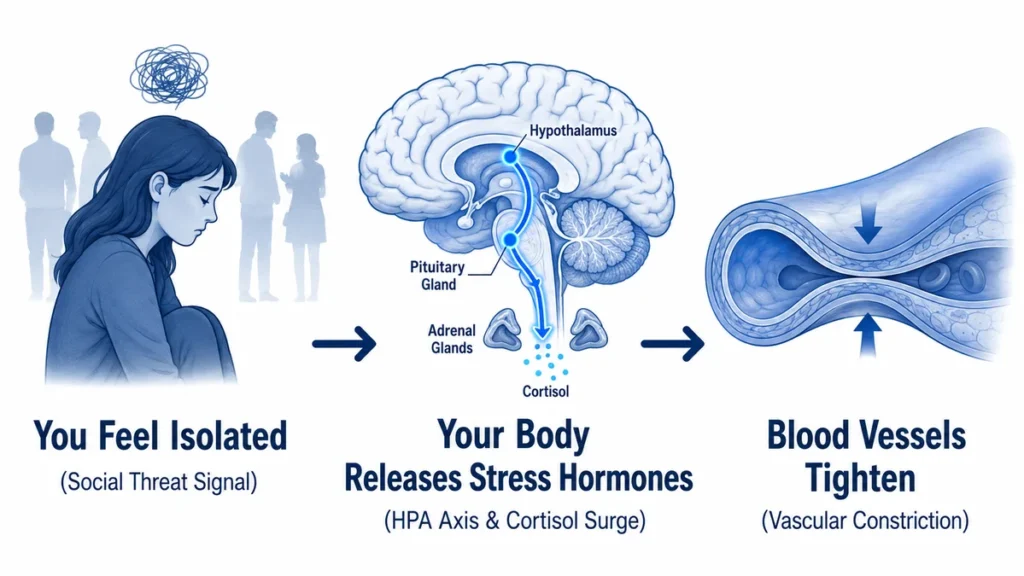
Blood pressure climbs.³ A study of 229 adults aged 50 to 68 found that loneliness was a unique predictor of higher systolic blood pressure, even after accounting for depression, perceived stress, and social support.³
The association held independently of health behaviors and other psychosocial factors measured in the study.³
Over time, chronic loneliness is associated with the development of glucocorticoid resistance [a state where the body becomes less responsive to cortisol’s natural anti-inflammatory signal, leaving inflammation running longer than it should].²
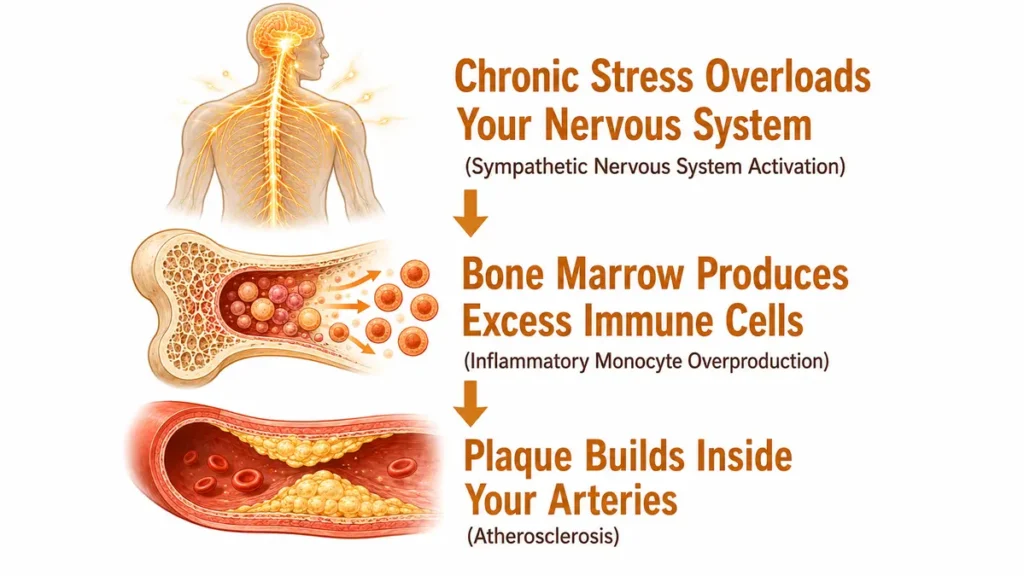
When that anti-inflammatory brake weakens, the body is associated with higher output of proinflammatory monocytes [immature immune cells that circulate in the blood and contribute to the buildup of plaque inside artery walls].²
This is a direct biological pathway to atherosclerosis [a condition where plaque builds up inside arteries and narrows them, reducing blood flow to the heart], and it operates separately from whether a person smokes or exercises.
Researchers note that while these associations are well established, the exact causal chain in humans is still being studied.² The direction of the relationship (loneliness driving cardiac damage rather than the reverse) is supported by longitudinal data but has not yet been confirmed through a controlled trial in people.
No single study has tested this entire sequence from start to finish; what the research shows is a set of well-documented links, each confirmed separately, that together point in the same direction.
The next question is one most articles never ask: does how long you’ve felt this way change how serious the risk is?
Chronic vs. Occasional Loneliness: Why Duration Is the Actual Risk
Most people feel lonely sometimes. A holiday that goes flat. A move to a new place. A friendship that quietly fades. That kind of loneliness is real, but it is not what the research on cardiac risk is measuring.
You’ve probably felt lonely at some point in the last year and not thought of it as a cardiac event in slow motion. That’s actually the right instinct, because the data suggest occasional loneliness does not carry the same risk as chronic, persistent loneliness.
Duration is the variable.
A prospective study using UK Biobank data, with 18,258 participants at a mean age of 57, tracked people across more than eight years and categorized their loneliness as never, transient, or persistent. Persistent loneliness was associated with a 52% higher risk of dying from cardiovascular disease, compared to people who never reported loneliness. Transient loneliness showed far smaller associations.⁴
A separate longitudinal study of adults aged 45 and older in China found a clear dose-response pattern: reporting loneliness at one point in time was associated with a 21% higher CVD risk. Reporting it at two points raised that to 23%. Reporting it at three consecutive measurement points was linked to a 50% higher risk.⁵
The implication is not subtle. Loneliness is not a switch. It behaves more like a chronic exposure, something closer to how researchers think about long-term high blood pressure than to a single stressful event.
What the duration data doesn’t explain is why the biological effect keeps building, and that requires looking at what chronic loneliness does to the heart’s structural environment over time.
The Biological Chain: From Feeling Isolated to Harder Arteries
Here is the assumption most people carry: if I exercise, eat well, and don’t smoke, my heart risk is managed. It isn’t.
Loneliness inflammation and heart damage share a direct biological pathway that operates even when a person’s lifestyle is otherwise healthy. The mechanism runs through the immune system, not through behavior.
When the sympathetic nervous system is activated chronically, as it is under persistent loneliness, it appears to stimulate the bone marrow to generate more immature, proinflammatory immune cells.² These cells enter the bloodstream and contribute to the process of atherosclerosis, the plaque buildup already defined above.⁶
They don’t wait for dietary fat or cigarette smoke to start that process.² They are generated by the stress response itself.²
Oxidative stress [a state where unstable molecules called free radicals accumulate faster than the body can neutralize them, damaging cells and tissues] is now thought to be a key molecular link between chronic social stress and cardiovascular disease.²
In animal models of social isolation, oxidative stress in blood vessel walls was associated with increased vascular tone (how constricted the blood vessels stayed) and appeared to accelerate plaque formation.²
Human studies show a consistent pattern. Lonely individuals tend to have higher peripheral vascular resistance [the force the heart must work against to push blood through narrowed or stiffened blood vessels], independent of their lifestyle choices.²
The honest note here: in humans, researchers have confirmed the associations at each step in this chain. What has not yet been confirmed through a controlled clinical trial is whether resolving loneliness directly reduces the progression of cardiovascular disease.²
The pieces connect, but the full chain remains under active study.
What this chain tells you, practically, is that managing lifestyle risk factors is still worth doing. It just doesn’t close the gap that loneliness creates.
What You Can Track at Home Without a Lab Test
You don’t need a blood panel to start paying attention to this. Three things are worth noting before your next cardiac appointment, not as a diagnosis, but as information to bring to your doctor.
Track your sleep quality. Loneliness is associated with more disrupted sleep: more time awake during the night, shorter overall sleep duration, and more fragmented rest, leaving people feeling as though they’ve had a much shorter overall sleep duration.⁷
Disrupted sleep is itself a known cardiovascular risk factor.⁸ If you’re waking frequently at night and feeling disconnected from the people around you, those two things may not be coincidental.
Note how many nights in the past two weeks you woke and couldn’t get back to sleep easily.

Watch your blood pressure trend.
A five-year longitudinal study of adults aged 50 to 68 found that loneliness predicted increasing systolic blood pressure over time: not just a one-time reading, but a cumulative rise tracked year over year.⁹
If you take blood pressure readings at home, look at the trend over the past few months rather than a single number. A slow upward drift without changes in diet or medication is worth flagging.
Rate your relationship satisfaction honestly.
Researchers use validated scales to measure loneliness.
You don’t need one. A simple, honest question asked consistently over time works: “How often in the past month did my relationships give me what I needed?”
Rate it one to five, the same way, on the same day of each week. What you’re looking for is a pattern, not a single number.
Before your next appointment, write down:
- How many nights per week you woke during sleep in the past two weeks
- Whether your at-home blood pressure readings have been trending upward
- Your honest one-to-five rating of relationship satisfaction for the past month
- Approximately when this pattern started; the duration matters to the doctor as much as the current state

These aren’t diagnostic tools. They’re observations. A doctor who knows to ask about loneliness and heart health after 50 will know what to do with them.
How to Bring This Up at Your Next Cardiac Appointment
Most doctors won’t ask. That’s not negligence. It’s a gap in current clinical practice.
The American Heart Association published a scientific statement in 2022 noting that social isolation and loneliness are under-recognized determinants of cardiovascular health.¹⁰
The statement recommends that clinicians ask patients about the frequency of their social activity and whether they’re satisfied with those relationships. They be prepared to refer people who are isolated or lonely to community resources.¹⁰
Despite this, as of the AHA’s own reporting, including loneliness data in electronic health records is still not widely adopted.¹⁰
This is the evidence-limitation piece that any honest article on this topic has to name: there are currently no published clinical trials that have tested whether reducing loneliness directly reduces cardiac events.¹⁰ The research establishes a clear association.
It does not yet establish that treating loneliness is a proven cardiac intervention.
That does not make the conversation with your doctor less worth having. It means you can ask about this risk by name, not just wait to see if it comes up.
What to ask: “Is social isolation something you track as a heart risk factor for me?” That question does three things. It tells the doctor you’ve done some reading. It opens the door to a conversation about psychosocial risk that most appointments never reach. And it gives the doctor a chance to note your pattern, which is the first step toward it being tracked.

If your doctor says this isn’t something they monitor, that is a useful answer too. It confirms the gap exists for you specifically.
You then have the option to ask for a referral, mention the AHA statement, or bring it up at a future visit when the evidence has moved further.
The research on loneliness and heart health is not finished. But it is far enough along that not raising it is no longer the obviously safe choice.
One Question Worth Asking Your Doctor Today
The most important thing to take from this article: loneliness and heart health after 50 are connected through a documented cardiac risk that no standard checkup currently measures, and how long you’ve felt it matters as much as whether you feel it at all. Book an appointment with your doctor and ask specifically: “Is social isolation something you track as a heart risk factor for me?”
That single question can open a conversation most patients and doctors never reach. Heart health after 50 has more variables than the standard checklist captures.
⚠️DISCLAIMER:
This article is for informational purposes only and does not constitute medical advice, diagnosis, or treatment. The content addresses the connection between loneliness and cardiovascular risk in adults over 50 and is intended for general educational purposes only. Health conditions vary significantly between individuals, always consult a licensed physician or qualified healthcare provider before making any decisions about your health or medical care.
References
- Steptoe A et al. Loneliness, social isolation and risk of cardiovascular disease in the English Longitudinal Study of Ageing. European Journal of Preventive Cardiology. 2018. https://pubmed.ncbi.nlm.nih.gov/30068233/
- Ye R, Bhatt DL. The role of oxidative stress in cardiovascular disease caused by social isolation and loneliness. Antioxidants and Redox Signaling. 2021. https://pmc.ncbi.nlm.nih.gov/articles/PMC7767744/
- Hawkley LC, Masi CM, Berry JD, Cacioppo JT. Loneliness is a unique predictor of age-related differences in systolic blood pressure. Psychology and Aging. 2006. https://pubmed.ncbi.nlm.nih.gov/16594800/
- Li H et al. Evaluation of changes in social isolation and loneliness with incident cardiovascular events and mortality. PMC. 2024. https://pubmed.ncbi.nlm.nih.gov/38801491/
- Author names required; see editor flag. Association between cumulative loneliness and risk of cardiovascular diseases in middle-aged and older adults: A longitudinal study. Public Health. 2025. https://www.sciencedirect.com/science/article/abs/pii/S0033350625000137
- Okubatsion T et al. Loneliness and Risk for Cardiovascular Disease: Mechanisms and Future Directions. PMC. 2021. https://pmc.ncbi.nlm.nih.gov/articles/PMC8105233/
- Kurina LM et al. Associations of loneliness and social isolation with actigraph and self-reported sleep quality in a national sample of older adults. Sleep. 2021. https://pubmed.ncbi.nlm.nih.gov/32691067/
- St-Onge MP et al. Multidimensional Sleep Health: Definitions and Implications for Cardiometabolic Health: A Scientific Statement From the American Heart Association. Circulation: Cardiovascular Quality and Outcomes. 2025;18:e000139. https://www.ahajournals.org/doi/10.1161/HCQ.0000000000000139
- Hawkley LC, Thisted RA, Cacioppo JT. Loneliness predicts increased blood pressure: 5-year cross-lagged analyses in middle-aged and older adults. Psychology and Aging. 2010. https://pubmed.ncbi.nlm.nih.gov/20230134/
- Cené CW et al. Effects of objective and perceived social isolation on cardiovascular and brain health: a scientific statement from the American Heart Association. Journal of the American Heart Association. 2022. https://www.ahajournals.org/doi/10.1161/JAHA.122.026493