

You’ve done the stretches. You’ve iced it, heated it, rested it, and still that deep ache in your buttock keeps coming back.
If you’ve been treating your back for months and that ache never lifts, the real source might not be your spine at all.
This article is for adults over 50 with stubborn buttock or leg pain who have already tried typical back treatments without relief.
By the time you finish reading, you will know the seven piriformis syndrome symptoms that point to a single overlooked hip muscle.
You will also know exactly how to check yourself at home before your next appointment.
| # | What’s Coming | Open Question |
|---|---|---|
| 1 | The pattern doctors miss first | Why does treatment for your back keep falling short? |
| 2 | The test that lies to you | Could a “negative” result still mean you have this? |
| 3 | Seven signs, one muscle | Which of these have you already felt without naming them? |
| 4 | Two checks you can do tonight | What does your own body already know? |
| 5 | What calms it down | Why does rest sometimes make this worse, not better? |
| 6 | The line you shouldn’t cross | When does checking yourself stop being enough? |
The Pain Pattern Adults Over 50 Keep Misreading
You feel it the moment you sit down for too long: a dull, deep ache that sits right in the buttock, sometimes sliding down the back of the thigh.
Most people in this situation get told the same thing.
“It’s sciatica, it’s your back, go do some stretches and give it time,” is the answer most people hear. That answer is sometimes right and sometimes incomplete.
Piriformis syndrome is estimated to account for roughly 0.3 to six percent of all low back pain and sciatica cases.¹
Doctors and patients both default to the more familiar diagnosis, since the symptoms overlap so closely with spinal sciatica.
Here’s the part that catches people off guard.
Piriformis syndrome [pain caused by a small hip muscle pressing on the nerve that runs down your leg] does not always show up the way people expect.
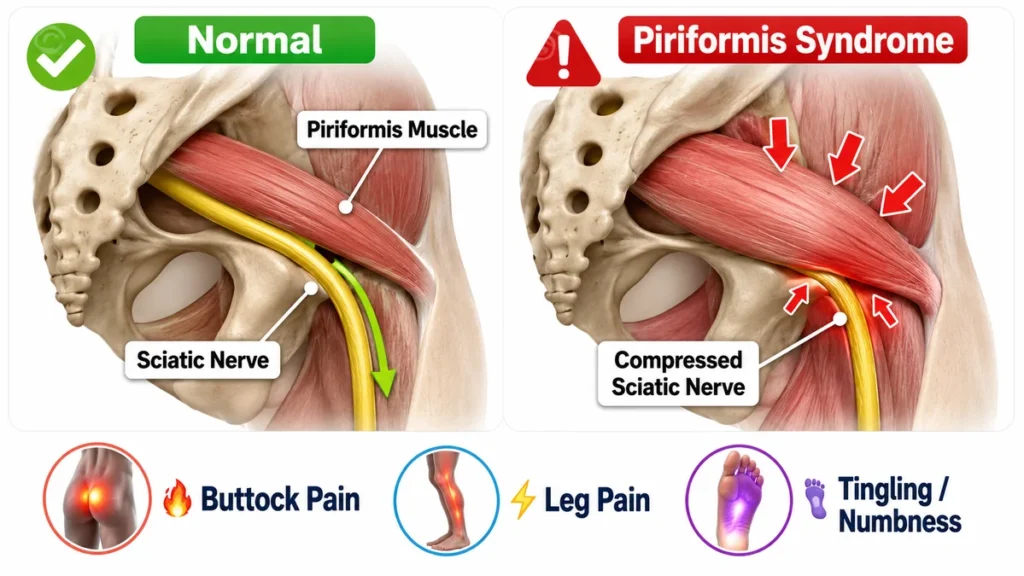
It can mimic a back problem so well that months pass before anyone looks at the muscle instead of the spine.
If you have been doing back exercises for weeks with no real change, that stall is worth paying attention to.
It might mean you have been treating the wrong target the entire time. The next section explains why the usual home tests for sciatica often miss these piriformis syndrome symptoms.
Why “It’s Just Sciatica” Is Often the Wrong Answer
Spinal sciatica and piriformis syndrome can feel almost identical from the inside. Both send pain shooting from the buttock down the leg, and both get worse with certain positions.
Most of the self-checks people find online were never built with this muscle in mind. No single definitive test for piriformis syndrome exists.
Clinicians often rely on a mix of history, movement, and sometimes imaging to sort it out.² That means a quick online quiz cannot settle the question either way.

The pain tests you find online were built to find a damaged disc, not a tight muscle, so passing them tells you almost nothing about your piriformis.
That’s the piece almost nobody says out loud.
You can fail it and still have a piriformis problem underneath the whole time.
Some researchers argue piriformis syndrome is overdiagnosed in certain clinics, while others say it remains underrecognized as a real, distinct cause of sciatica-like pain.²
Experts don’t fully agree on how often this is the true cause, and that honest gap is worth knowing.
That disagreement is exactly why paying attention to your own pattern matters. Knowing the test you took was answering the wrong question is useful.
Knowing what the right signs actually look like is what comes next.
Seven Piriformis Syndrome Symptoms Pointing to This One Muscle
Talk to your doctor before starting any new stretch or exercise routine if you are pregnant, on blood thinners, or managing a condition that affects your bones, nerves, or balance.
Pain coming from the piriformis tends to follow its own pattern, separate from a typical spinal issue. Here are the seven signs worth checking against your own experience.
- Pain sits squarely in the buttock rather than starting in your lower back
- Sitting, especially with legs crossed, consistently makes it worse
- The ache rarely travels past your knee
- Lying flat on your back tends to ease it rather than worsen it
- A deep stretch across the hip reproduces the familiar pain
- You have no real history of back pain or disc problems
- The pain shows up on one side only, not both
Pain that does not extend below the knee is one of the more reliable clues here.
Clinical comparisons note that piriformis pain usually stays closer to the buttock and upper thigh.³
Spinal sciatica more often radiates further, sometimes into the foot.³
People who have lived with this for a while often notice something that rarely makes it into general symptom lists.
Piriformis pain frequently eases the moment you lie flat on your back with your knees bent.
A straight-leg raise in that same position is more likely to bring on true spinal sciatica pain.⁴
If three or more of these sound familiar, the next section gives you two simple ways to check yourself tonight, without needing an appointment first.
The Two Home Checks That Tell You More Than a Doctor’s First Guess
These checks won’t replace a diagnosis, but they can tell you something useful about which direction to look first.
Check one: the Figure-4 position. Lie on your back, cross the painful side’s ankle over the opposite knee, and gently pull the bent knee toward your chest.
This position is a version of the FAIR test, a maneuver clinicians use to help reproduce piriformis-specific symptoms during an exam.⁵
If it recreates that familiar deep ache, the piriformis is a real suspect.
Check two: the lying-flat comparison. Notice what happens to your pain when you lie flat with your legs straight versus when you sit.
If lying flat consistently calms things down, that lines up more with a muscle issue than a spinal one. Neither check is a diagnosis.
Think of them as a flashlight, not a verdict.
What they do is give you language for your next doctor’s visit, instead of walking in only able to say “it hurts.”
A result that points toward the piriformis still deserves a real conversation with a professional, especially if the pain has lasted more than a few weeks.
Once you have a clearer sense of what you’re dealing with, the next question is what actually helps it settle down.
What Actually Calms This Muscle Down
It feels logical to rest a muscle that hurts, but with this one, rest is often the wrong instinct.
Prolonged sitting is one of the most consistently named triggers for piriformis symptoms, since it appears to compress the muscle and the nerve beneath it at the same time.
Gentle, consistent movement tends to help more than staying still.
A short list of habits makes a real difference here.
- Take a standing or walking break every hour if your day involves a lot of sitting
- Stretch the hip gently before getting up after long periods seated
- Adjust your chair so you’re not sinking into a deep, soft seat
- Walk regularly, even short distances, rather than going fully sedentary
- Avoid sitting directly on a thick wallet or anything that tilts your hips

These small adjustments target the actual mechanism: less sustained pressure on the muscle, more regular movement through the hip.
Most of what’s known about these stretches and habits comes from physical therapist guidance and clinical observation rather than large, long-term controlled trials.
Think of them as a sensible starting point rather than a guaranteed fix.
Calming the muscle down is one part of this. Knowing when calming it down isn’t enough anymore is the other.
When Seven Signs Mean It’s Time to Stop Guessing
Self-checks are useful right up until they’re not. There’s a point where this stops being something to monitor on your own.
If your symptoms have lasted more than a few weeks, are getting worse instead of better, or are interfering with your sleep, that’s the signal to bring in a professional.

A clinician can take your specific symptom pattern, including how long it’s lasted and what makes it better or worse, and use that alongside an exam to guide next steps.
Waiting it out at that stage usually costs you more time than it saves.
Diagnosis typically relies on a clinical exam, and sometimes imaging, since no blood test or single scan settles this on its own.⁶
Weakness in your leg or foot, numbness that’s spreading, or pain that’s intensifying despite rest are not signs to push through alone.
These point to nerve involvement that deserves a closer look sooner rather than later.
A physical therapist or doctor can confirm what your home checks only suggested. They can build a plan around what’s actually happening rather than what seems likely.
That confirmation step matters. The two home checks earlier in this article are a starting point, not a finish line.
What you do with that information next is what actually changes how this ends.
The Real Fix
The real fix here isn’t a single stretch. It’s recognizing that ongoing buttock and leg pain after 50 deserves more than one explanation.
Piriformis syndrome symptoms are worth ruling in or out specifically, not assumed away by a generic sciatica label.
Try the at-home Figure-4 stretch test described in this article today, and track whether the symptom pattern matches piriformis syndrome rather than spinal sciatica, then bring those notes to a doctor or physical therapist.
Pain that doesn’t respond to treatment is information, not failure. Listen to it.
⚠️DISCLAIMER:
This article is for informational purposes only and does not constitute medical advice, diagnosis, or treatment. The content addresses recognizing piriformis syndrome symptoms versus spinal sciatica and is intended for general educational purposes only. Health conditions vary significantly between individuals, always consult a licensed physician or qualified healthcare provider before making any decisions about your health or medical care.
References
- Piriformis Syndrome. NCBI Bookshelf, StatPearls, NIH. 2023. https://www.ncbi.nlm.nih.gov/books/NBK448172/
- Looking beyond Piriformis Syndrome: Is It Really the Piriformis? PMC (PubMed Central). 2023. https://pmc.ncbi.nlm.nih.gov/articles/PMC10020728/
- Piriformis Syndrome vs. Sciatica. Goodman Campbell. 2025. https://www.goodmancampbell.com/2025/12/piriformis-syndrome-vs-sciatica/
- Is Piriformis Syndrome the Same Thing as Sciatica? Spine-Health, citing StatPearls. 2020. https://www.spine-health.com/blog/piriformis-syndrome-same-thing-sciatica
- Piriformis Syndrome or True Sciatica: Are They the Same or Different? MedCrave Online (MOJOR). 2017. https://medcraveonline.com/MOJOR/piriformis-syndrome-or-true-sciatica-are-they-the-same-or-different.html
- Health Library. 2024. https://www.cedars-sinai.org/health-library/diseases-and-conditions/p/piriformis-syndrome.html